
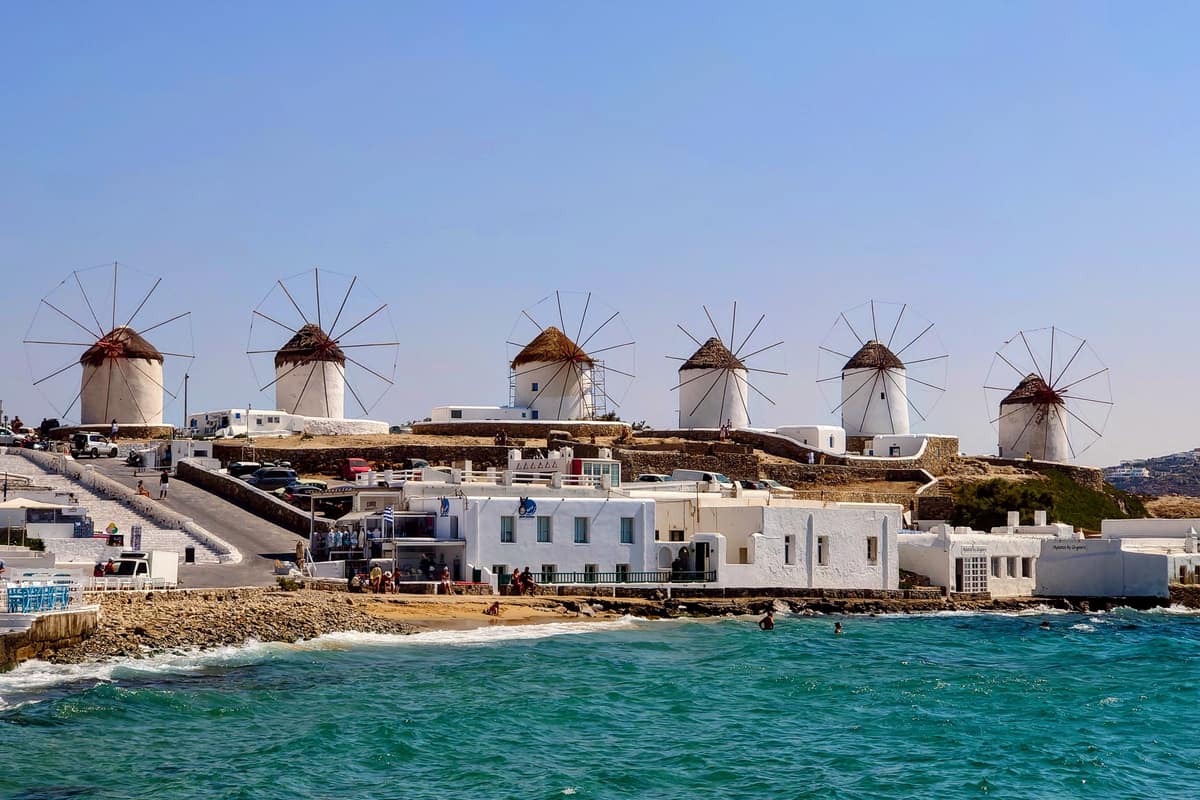
Mykonos Town hotels stand inside and around the white main town of the island, known as Chora. Boat days and island tours from Mykonos are collected on our tours in Greece home page.
The sections below cover the lanes, the quarters, the harbour, the windmills, the walk times, the old index and questions. Each section answers one plain question about the town, so a visitor can read only the part needed.
Where do the Mykonos Town hotels stand on the island?
The Mykonos Town hotels stand in the main town of the island, on its west coast. Wikipedia names the town Mykonos, like the island, and says the greater part of the inhabitants live there. Greeks also call it Chora. The island itself is part of the Cyclades chain in Greece.
Wikipedia places Mykonos among the Cyclades, with Tinos, Syros, Paros and Naxos as four of its island neighbours. The same article puts Athens 150 kilometres away, with the island to the east, in the Aegean Sea. One travel wiki lists bearings: south of Tinos, east of Syros, north of Paros and Naxos. The Mykonos Town hotels share that setting.
The land area comes to 85.5 square kilometres, according to Wikipedia. One travel wiki adds a length of twelve to fifteen kilometres and a width of ten. It calls the island one of the smallest of the Cyclades. For the whole island, see Mykonos tours on this site. Read it first, as a frame for the Mykonos Town hotels.
That travel wiki calls Chora the port town and the capital of the island. It names only one other main community, Ano Mera. So the Mykonos Town hotels stand in the chief settlement and not in a village. Wikipedia gives that settlement a second name, Chora, next to Mykonos, the name it shares with the island.
Wikipedia says the largest town lies along the west shore of the island, where the bulk of the islanders live. The municipality, says Wikipedia, is wider than the island itself. It covers 105.183 square kilometres, because it also holds Delos, Rhenia and further uninhabited islets. The Mykonos Town hotels therefore lie in the one municipality of the island.
A census counts the members of a given population. The United Nations recommends a new census at least every ten years. Wikipedia reports 10,704 inhabitants for the island, a figure dated two thousand and twenty-one. The count belongs to one date only. The Mykonos Town hotels stand in the town that holds the larger share of those people.
Another line of the same article gives the island a population of nearly 12,500. That is about eighteen hundred more than the census figure. The article does not say why the two lines differ. Read both figures as dated claims. For a current count, check a recent source before you picture the town around the Mykonos Town hotels.
What is the name behind the Mykonos Town hotels?
Two theories explain the name Mykonos, and Wikipedia states neither as fact. One links it to an old Greek term glossed as a heap of stones, or stony ground. The other ties it to a hero named Mykonos, son of Anius. The Mykonos Town hotels carry the name of the island.
Wikipedia speaks of two prevailing theories about the origin of the name Mykonos. Each theory rests on a different early writer. A theory only offers an explanation that nobody has proved, so this page gives both and chooses neither. The town and the island answer to one name, and the Mykonos Town hotels follow that same name.
The first theory comes from Hesychius of Alexandria. Wikipedia describes him as a Greek grammarian who lived around the fifth or sixth century AD. His lexicon of rare and obscure Greek words survives. In the island article, he links the name to an ancient Greek word, Mykon. It translates roughly as a rocky place, or a heap of stones.
Stephanus of Byzantium, a Byzantine grammarian of the sixth century AD, is the source of the second theory. His Ethnica is an alphabetical dictionary of places and peoples. Wikipedia says he ties the name to a mythological hero called Mykonos, son of Anius. Under that reading, the Mykonos Town hotels stand on an island named after a person.
Wikipedia describes Anius as a king of Delos, a priest of Apollo and a son of that god. The island article calls the hero Mykonos a grandson of Apollo. A further article adds that two sons of Anius, Andros and Mykonos, gave their names to islands. Lodgings of each area are gathered in the Mykonos hotel index.
The town has a second name, Chora, the Greek word for Town. Wikipedia notes the common Greek habit of giving an island and its main town one name. Wikipedia adds that under Ottoman rule, between fifteen thirty-seven and eighteen thirty, the island bore the Turkish name Mukene. The Mykonos Town hotels stand in a town of two names.
One place name in the town honours a person. In the Greek Revolution of eighteen twenty-one, Wikipedia says, Mykonos played an important role. The heroine Manto Mavrogenous led it. Her statue stands in the middle of Manto Mavrogenous square, in the main town. The Mykonos Town hotels lie in a town that keeps her name in a public square.
What does the layout of the streets mean for the Mykonos Town hotels?
The Mykonos Town hotels stand inside a tangle of tiny whitewashed lanes around one harbour in a wide bay. Wikivoyage calls this pattern a maze, with houses and churches along the lanes. The layout decides how a guest arrives, how far luggage travels on foot, and how the correct door is found.
A wide bay gives the town one fixed point, and the harbour sits in the middle of it. Wikivoyage places the lanes, the houses and the churches around that water. A guest who studies a map of the Mykonos Town hotels can use the sea as a first reference. Ask the lodging for the final turns of the route.
The Mykonos Town hotels share their lanes with churches, and the sources give the reason for it. Wikipedia reports a long-standing requirement: each islander raised a church on the plot first, and the house followed. The rule gave the island an abundance of churches. A walk through the maze therefore passes churches among the doorways of ordinary homes.
Trade is a central part of the town’s past. According to Wikipedia, trade made the island prosperous up to the close of the eighteenth century. It drew settlers from nearby islands. Wikivoyage adds that decades of uncontrolled property development have frequently meant ancient sites were razed. The town’s earlier periods are covered by a separate page, Mykonos history.
Parking areas lie on the outskirts of the town, says Wikivoyage. A large public car park stands next to the old port. The same page puts car and motorbike hire around the southern bus station. For the Mykonos Town hotels the last stretch of an arrival is on foot. Ask the lodging which car park lies closest.
The white of the walls has a plain explanation. Wikipedia describes whitewash in general as a coating built on slaked lime or chalk. Carbon dioxide in the open air makes the coating cure, and masonry absorbs it easily. Earth pigments can tint it toward cream, yellow or brown. Wikipedia notes that a little can rub off onto clothing.
Wikivoyage lists little shops, galleries, cafes, bars and restaurants along the streets. It adds that the town kept its Cycladic character and calls it crowded. Before choosing among the Mykonos Town hotels, ask each lodging three plain questions. Which lane holds the entrance? How far does the nearest road lie? Does the room face the lane or the sea?
Which harbour front and which figures surround the Mykonos Town hotels?
Rows of fishing houses, with balconies that hang over the sea, line the harbour front of the Mykonos Town hotels. Wikipedia adds three more figures of the town beyond the houses. They are Petros the pelican, a library in an eighteenth-century mansion, and a statue in the square of Manto Mavrogenous.
On the waterfront, says Wikipedia, rows of fishing houses carry balconies that hang over the sea. A balcony is a raised platform on the outside of a building, enclosed by a balustrade. Balconies also give a building outside space and ventilation. For the Mykonos Town hotels this sets the picture of houses whose balconies face the water.
The harbour front has a date of war. Wikipedia dates the Battle of Mykonos to June seventeen ninety-four, when British and French ships clashed in the main harbour. The same article lists regular pirate raids in that period. The article stops there, and this page does the same. Ask the lodging how far it lies from the water.
Wikipedia calls Petros the pelican an old celebrity of the town’s waterfront. For more than sixty years he has been the island’s official mascot. He settled for good after a storm in nineteen fifty-four. When he died, the islanders chose a successor to keep his legacy alive. The article names no spot or hour for a sighting.
Wikipedia says a library holds books and other materials for its members to use. The word comes from the Latin liber, which means book. Wikipedia says the Municipal Library of Chora occupies a mansion from the eighteenth century, on Ayia Kyriaki square. Whoever stays at the Mykonos Town hotels finds it inside Chora, the island’s capital and main town.
Wikipedia counts more than eight thousand volumes in the library. It lists photographs, documents, Cycladic coins and old seals from the eighteenth and nineteenth centuries. It also names sketches and books from the private library of an American artist. The article gives no opening hours, so ask your lodging among the Mykonos Town hotels or check on the spot.
The statue of Manto Mavrogenous sits in the middle of the square that carries her name. Wikivoyage places the square on the harbour front. Wikipedia describes her as an aristocrat shaped by the ideas of the Enlightenment. She spent her family’s wealth on the Greek cause. For the Mykonos Town hotels, the statue is a clear point for directions.
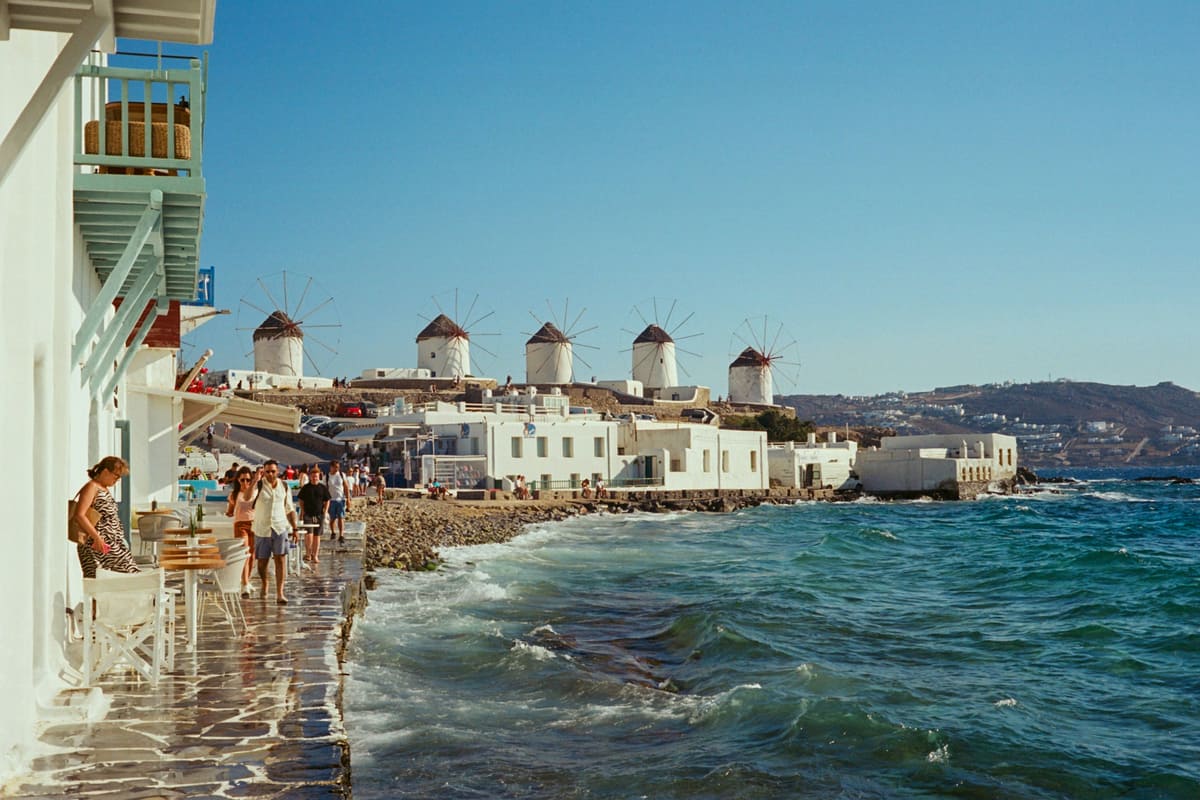
Which windmills stand above the Mykonos Town hotels?
One encyclopedia article counts 16 windmills on the island of Mykonos. Seven of them occupy the hill in Chora that the article calls a landmark. That group forms the skyline of the town and the Mykonos Town hotels. The Venetians built the greater part of the mills in the sixteenth century.
A traveller coming into the harbour of Alefkandra sees the windmills before anything else, says the article. The hill that carries them looks down over that area. The hill works as a fixed point when the Mykonos Town hotels are compared on a town map. The sources state no walking time from any single lodging to the hill.
Building did not stop with the Venetians: it went on into the early twentieth century. The mills mainly milled wheat, and the article ranks them as a major income source for the islanders. Their use gradually declined until production stopped at the mid-point of the twentieth century. One mill has since become a museum, says the same article.
The greater part of the mills face north, where the island’s strongest winds blow. The Mykonos article names the lower mills by their Greek name, Kato Mili. It says they form a line along a hill above the sea to catch the north winds. Both facts explain why the mills crown the ridge above the Mykonos Town hotels.
The article gives every mill the same look: round, white, topped by a pointed roof, with very small windows. Such mills stand on almost all Cyclades islands. The general windmill article defines a tower mill as a masonry tower whose cap alone turns into the wind. A separate page tells about Delos, the island next to Mykonos: Delos island.
The general windmill article explains how mills work, as background for readers of the Mykonos Town hotels page. Sails carry a frame with cloth spread over it, and the miller adjusts the cloth to the wind. The mill must stop for that task. A jib sail, a triangle of cloth round a spar, is common in Mediterranean countries.
Windmills have also been preserved for their historic value, the general article adds, as static exhibits or as working mills. Camel Rock, close to the Kato Mili mills and just offshore, is a formation shaped like a seated camel. The walk to the hill differs among the Mykonos Town hotels, so put it to the lodging.
Is Little Venice a place near the Mykonos Town hotels?
Little Venice is a district of Mykonos Town at the sea. A travel wiki counts it among the romantic places of the whole island of Mykonos. The windmill hill looks over it, so it belongs to the setting of the Mykonos Town hotels. Alefkandra is a second name of the district.
The reputation comes from two sources that differ slightly in words. A travel wiki calls Little Venice a romantic place and says it offers a fine sunset. The encyclopedia entry for Mykonos calls it a romantic spot. This page repeats both descriptions and judges nothing. A guest weighing the Mykonos Town hotels can read them as a reputation only.
Little Venice is not the only seaside spot near the Mykonos Town hotels. The bay of Tourlos, where the new port stands, is listed under Mykonos Tourlos beach hotels. It lies north of the town, while the district described here sits inside it. A travel wiki lists it among the attractions of Mykonos Town, right after the windmills.
The travel wiki calls the medieval houses of Little Venice two and three storeys high. Together they form a wall above the water and carry wooden, colourful balconies. The encyclopedia adds that the area attracts artists, who come to paint the coastline. The sources give no street plan, so ask the lodging for the route to the district.
The travel wiki names a drink at a bar or cafe on the seashore as a favourite sunset activity. The encyclopedia says people assemble in Little Venice at sunset. The same wiki calls the windmill area the favourite sunset spot of the island. Sunset watchers near the Mykonos Town hotels have two named spots: the shore and the hill.
In the general sunset article, sunset means the instant the Sun’s top rim sinks beneath the horizon. Twilight, the stage after sunset, has three phases: civil, nautical and astronomical. Near the horizon sunlight crosses a longer stretch of air, which strips out blue and green. These notes are general: no fetched source gives a sunset hour for Mykonos.
The travel wiki gives a five-minute walk from a bus station to Little Venice. It adds that a sign for the district can be found across the square. Walking times from the lodgings of the Mykonos Town hotels are in no source read. Ask the lodging and check the lanes on the spot before an evening walk.
Which church of the Kastro quarter is near the Mykonos Town hotels?
Panagia Paraportiani is a church in Kastro, a quarter of Chora, the island’s main town. One encyclopedia describes a whitewashed building made of five joined churches, finished in the seventeenth century. It therefore lies inside the town itself, the same town that holds the Mykonos Town hotels of this page.
Kastro is the quarter that holds the church, and one travel wiki names it the oldest district of the town. Anyone staying at the Mykonos Town hotels therefore looks for it in the old core of Chora. The sources do not time the walk from any lodging, so ask the lodging for the minutes on foot.
Translated, the Greek name is Our Lady of the Side Gate. Its door stood in a side gate that led into the Kastro area, as one encyclopedia explains. A second passage of the same source puts the church beside the door of the old castle. Readers who want the island’s practical notes can open Mykonos island information.
The whitewashed building joins five separate churches. Four of them stand at ground level. Saint Sozon and Saint Eustathios hold two dedications. Anastasia and the Anargyroi hold the others. Together they support a fifth church, built on top of them. No source gives its height or width, so see the stack yourself from the Mykonos Town hotels.
Work on the church began in fourteen twenty-five, according to one encyclopedia. Builders finished it only in the seventeenth century. The same source’s article on the island puts the building time at around two hundred years. The sources do not name the builders or the order of the five churches, so the page leaves both out.
Kastro once held a medieval castle. One encyclopedia says the Ghisi family, who controlled the island, built it in twelve hundred and seven. The sixteenth century brought its destruction, and new houses covered its remains in the eighteenth century. A stay at the Mykonos Town hotels is a stay in a town whose growth covered those remains.
One travel wiki says a single ground-level chapel welcomes visitors, and only from early morning until sunset. That listing is undated, so the hours can change at any time. Ask the lodging of the Mykonos Town hotels for the current hours. The wiki counts four hundred churches on the island, and none is photographed more than this one.
Which museums of the town are near the Mykonos Town hotels?
The town holds an archaeological museum near the old port and a maritime museum in Tria Pigadia. One encyclopedia lists both, and a travel wiki adds the opening months. Together they show finds from Rhenia and the ship history of the Aegean to anyone at the Mykonos Town hotels.
The Greek Archaeological Service established the archaeological museum in nineteen hundred and two. It stands near the old port, so it sits inside the area of the Mykonos Town hotels. It was built first for finds from a burial site on Rhenia, an uninhabited islet west of Delos. The finds date back to 425 or 426 BC.
The neoclassical building dates from nineteen hundred and five. Refurbishments followed in two later decades, the nineteen thirties and the nineteen sixties. A large eastern room was added in nineteen seventy-two. One encyclopedia article on the island places it among the oldest museums in Greece. The same article adds that the land was a gift of the island’s municipality.
Funerary urns, pottery and sculpture of three eras fill the collection: Cycladic, Geometric and Classical. The Rhenia finds include Cycladic pottery of the ninth and eighth centuries BC. The large Mykonos vase carries pictures of the fall of Troy. A travel wiki says finds from Mykonos itself are rare, so visitors from the Mykonos Town hotels meet Rhenia here.
The maritime museum fills a nineteenth-century building in Tria Pigadia, in the town centre. Founded in nineteen eighty-three, this non-profit museum welcomed its first visitors in nineteen eighty-five. Its subject is the history of merchant ships in the Aegean. The garden holds a restored lighthouse built in eighteen ninety and ancient marble gravestones of sailors from Mykonos and Delos.
According to the encyclopedia, a folklore museum fills the island’s oldest house, with nineteenth-century furniture, jewellery, ceramics and embroidery. It also shows ship models and cannons used in the War of Independence. A house museum of a shipping family keeps its original furniture. Both show visitors from the Mykonos Town hotels the daily life of the island.
One travel wiki says all museums open from April to October, except the archaeological museum, open all year. The listings also give opening hours, which are undated. In winter, visitors from the Mykonos Town hotels can plan on the archaeological museum alone. Ask the lodging which museum is open on the day of arrival, and check the current timetable.
Which quarters of the old index do the Mykonos Town hotels cover?
The town group of the old index carries twelve place labels, from Tagoo to Megali Ammos. Seven of those names have no neutral placement. The labels show how the old page sorted the Mykonos Town hotels. Not one of them has a border in the sources read.
Twelve labels return down the group. They read Tagoo, Aggelika, Kato Mili, Drafaki, Drosopezoula and the School of Fine Arts. Then come Rohari, Despotika, Vrissi, Megali Ammos, the town centre and a spot above the old port. The old page gives no street, distance or direction for any label. These twelve names sort the Mykonos Town hotels.
Eight labels end with the word area, as in Tagoo area. Four labels stand alone. They are the School of Fine Arts, Megali Ammos beach, the town centre and above the old port. No neutral page places Tagoo, Aggelika, Drosopezoula, Rohari, Despotika, Vrissi or the School of Fine Arts. This page therefore gives those seven names no direction.
Drafaki lies on the hill above the old port. Two more lines of the old group use the plain words above the old port. No page says whether both phrases name one slope. How steep is the last lane to the door, for the Mykonos Town hotels on that hill? Only the lodging itself can say.
Megali Ammos is the beach just south of the old port. Wikivoyage calls it the nearest beach to the town, about one kilometre away. The walk along the coast takes ten minutes and heads towards Ornos. That bay is listed under Mykonos Ornos beach hotels. This label puts the Mykonos Town hotels of the old index by a beach.
Wikipedia calls a neighbourhood a localised community within a larger town. Where no official status exists, it says, questions can arise about where one neighbourhood ends. Wikivoyage still files town lodgings under Tagoo, Vrissi, Megali Ammos and the School of Fine Arts district. Among the Mykonos Town hotels, the old labels are live names, not dead ones.
Wikipedia defines a quarter as a section of an urban settlement. It can have official borders, or it can be a distinct neighbourhood with its own character. No page read gives an official border for any label of the Mykonos Town hotels. Kato Mili takes its name from the windmill ridge at the harbour, not from a border.
How far is the walk between the bus stations for the Mykonos Town hotels?
Two bus stations serve the town, and no bus links them. One travel wiki puts the walk between them at twenty minutes. One travel page says fifteen. Anyone who changes stations walks that gap, so the stop nearest the lodging matters. That holds across the Mykonos Town hotels.
The southern station is called Fabrika, or Fabrica on Wikivoyage. Wikivoyage calls it the main southern station. One travel page places it at the southern edge, and times the way to the centre at five minutes. The same page calls it the station that the greater part of visitors use. The other station lies on the opposite side.
Four pages place the northern site, and all four name the old port area. Wikivoyage puts the station near the landing of the old port ferries. One travel page puts it beside the waterfront. Another places it in front of the archaeological museum. Wikipedia sets the north depot above the old port. None of the four gives a street.
Wikivoyage says no bus runs between the two stations. It puts the walk at twenty minutes on foot. One travel page puts the same walk at fifteen minutes. The gap of five minutes stays unexplained, because neither page states a pace or a route. Time the walk once on the spot before you plan around the Mykonos Town hotels.
The walk to the Mykonos Town hotels does not end when the bus stops. One travel page says a walk of five to fifteen minutes can follow, over uneven lanes and steps. Suitcases ride in the luggage hold below the bus. Wikivoyage describes the buses as almost always full in the busy parts of the day.
Wikipedia counts three main bus depots in Mykonos, while Wikivoyage counts two bus stations in the town. The words differ, and no page says whether a depot and a station are one place. This page keeps the two counts apart and merges nothing. Among the Mykonos Town hotels of the old index, no line names a stop either.
Wikivoyage says departure times are marked at both stations and at route ends. It adds that a new timetable comes about every second week. One travel page says summer schedules shift through the season. It names two routes with no posted times. Ask any lodging among the Mykonos Town hotels for the nearest stop, then check the current timetable.
How does the old index of this site file the Mykonos Town hotels?
This site’s old index gives the Mykonos Town hotels a page of their own and files them as one group. Every line pairs a lodging name with a place label. The group runs from the top class down to the apartments. Dated text cannot tell the class of a lodging today.
The page carries the title Mykonos Town hotels in capital letters. A trail of links above it leads from the home page through the Cyclades to the island. A banner line of the page also reads accommodation and lodgings information. A bar at the top of the page links to destinations, Greek hotels, car hire, cruises and tours.
Each line of the group joins a lodging name to a place label with a plain dash. A label can name a quarter, a position such as the town centre, or a beach. A lodging stands only once in the whole group. Every one of the Mykonos Town hotels therefore carries a place on its own line.
The short list below collects the pages of the lodgings that this group files. A reader opens a page to see what that lodging says about itself. The list shows how the old index sorted its lines. It makes no claim about class, size or position today. It does not rank the lodgings, and it gives no count.
- The town group of the old index of this site opens with Leto Hotel Mykonos and Hermes Hotel Mykonos.
- Two more entries of that group are Semeli Hotel Mykonos and Belvedere Hotel Mykonos.
- The group also files Ostraco Suites Hotel Mykonos and Les Moulins Hotel Mykonos.
The group of the Mykonos Town hotels reads, in general, from the top class downwards. Its opening entries return in the deluxe list below, and its last entries carry the word apartments. A menu on the page prints stars in brackets: five for deluxe, down to two for class C. These labels belong to the old index alone.
Beneath the group on the same page, the class lists cover the whole island and hold bare names. Not every entry of the group returns in the class lists. Lodging of other kinds across the island is gathered under Mykonos accommodation. The Mykonos Town hotels stand first in the row of area pages near the foot of the page.
A span closes the old page: the first year is two thousand and three, the last two thousand and ten. Wikipedia dates the arrival of the European star scheme in Greece to two thousand and thirteen. Read the labels as the index’s record. Every lodging in the Mykonos Town hotels holds its own current name, class and room list.
How do ships reach the port that serves the Mykonos Town hotels?
Ships call at one of two ports that serve the Mykonos Town hotels. The old port lies in the town. Tourlos holds the new port, about two kilometres north. Wikivoyage sorts the traffic by vessel: ferries call mainly at Tourlos, fast catamarans in the town. Check which port your boat uses.
The old port sits within the town where the Mykonos Town hotels stand. Wikivoyage describes the way from this quay into town as a brief, easy walk beside the sea. For cruise passengers who land here, the same wiki gives a ten-minute walk to the heart of the town. The high-speed catamarans land their passengers at this quay.
The new port at Tourlos handles the ferries, says Wikivoyage, and lies about two kilometres north of town. Almost all cruise ships dock there, though the old port takes a cruise ship now and then. A shuttle bus for cruise passengers reaches town in under ten minutes. Ferries and cruise ships therefore share the new port.
Wikivoyage lists four ways from the new port. A sea bus sails every half hour and needs twelve minutes. Its route stops twice at the port and twice in town. Public buses run rarely in high season, and a taxi is the better choice. On foot, the trip takes about forty-five minutes along a busy road with no sidewalk.
From June to September, says Wikivoyage, infrequent boats leave the town harbour for Super Paradise, Agrari and Elia. Converted fishing boats also sail from Platys Gialos about once an hour. Strong wind can cancel a run, so check the current timetable. The bus road to the south coast ends at a long beach, listed under Mykonos Platis Gialos hotels.
Wikivoyage names two mainland harbours for daily sailings by ferry and fast catamaran: Piraeus and Rafina. Fast services take about half the time of slow ones. Regular ferries pause from late October to about April. Winter sailings are irregular, and rough seas can cancel them. A visitor to the Mykonos Town hotels checks the current timetable before the day.
The Mykonos Town hotels sit on an island with boat links to the other Cyclades. Syros, Andros, Tinos and Paros each send boats more than once a day, says Wikivoyage. Naxos, Ios, Santorini and Crete have a daily boat. An overnight ferry runs daily from Samos and Ikaria. Syros and Paros serve as hubs to other Greek islands.
Which harbour traffic is on the water near the Mykonos Town hotels?
One travel wiki lists excursion boats at the harbour of the town. It places fishing boats and private yachts at the marina in Tourlos. Wikipedia adds general facts on harbours, fishing villages and yachts. This page sorts that traffic for the Mykonos Town hotels and says where no source gives a figure.
Wikipedia sorts harbours as natural or artificial. A natural harbour is a landform that shelters the water and is deep enough for anchorage. An artificial one has breakwaters, sea walls or jetties, or comes from dredging. The oldest artificial harbour, at Wadi al-Jarf, is at least forty-five centuries old. No source says which kind serves the Mykonos Town hotels.
Wikivoyage says boats for Delos leave from a pier on the western side of the harbour. The crossing takes about thirty minutes. In the off-season, it adds, boats leave once a day. It advises a kiosk check, since online times can mislead. From June to September it lists infrequent boats from there to Super Paradise, Agrari and Elia.
Wikipedia defines a fishing village as a village with an economy based on catching fish and harvesting seafood. It places coastal ones around a small natural harbour, a safe haven for the fleet. For the Mykonos Town hotels, one travel wiki names fishing boats at the marina in Tourlos. No source calls the town itself a fishing village.
Fishing villages also support boat building and maintenance, and fish processing and marketing, says Wikipedia. It adds that in more developed countries traditional villages are changing, through industrial fishing and urbanisation. Tourist enterprises increasingly target them. Pictures of the island sit together in the Mykonos photo gallery. No source gives the number of working fishing boats in the town.
The English word yacht derives from the Dutch jacht, meaning hunt. Wikipedia says it first named light, fast sailing vessels of the Dutch navy. Sailing yachts began in Europe in the early sixteen hundreds, with a vessel for the son of King James I. Private yachts, says the travel wiki, use the marina north of the Mykonos Town hotels.
Wikipedia says no standard definition of a yacht exists. It classes a yacht of twenty-four metres or more as large, and such a yacht needs a hired crew. A superyacht is longer than forty metres. A commercial large yacht carries no more than twelve passengers. No source counts the yachts that lie near the Mykonos Town hotels.
What is the rhythm of a day around the Mykonos Town hotels?
Wikivoyage reports seven-day opening for the greater part of the shops. They close from two to five in the afternoon. A number of tourist shops stay open late into the evening. This page follows a day around the Mykonos Town hotels, from the shop break to the late bars.
The same wiki lists the shops for daily needs: mini-markets, green grocers, butchers, kiosks, bakeries and a number of pharmacies. It adds that ATMs stand throughout the town. It also notes that the town has no department store. No source gives the number of shops near the Mykonos Town hotels, so a walk shows what stands close.
Wikipedia describes the midday nap as a short sleep in the early afternoon. It calls the habit a widespread tradition in warm-weather zones such as the Mediterranean. The Greek name means afternoon sleep. For Greece, it puts the lunch break at one to five or six in the afternoon. Afternoon work then runs to nine at night.
The word siesta comes from the Latin hora sexta, the sixth hour counted from dawn, which puts it around noon. Wikipedia says Roman nobles on the Mediterranean coast found the noon heat hard to handle. No fetched source links the afternoon shop break around the Mykonos Town hotels to heat or to a nap. None states its cause.
The same wiki calls Mykonos extremely crowded in July and August, with overcrowding from the middle of July through August. In March and April, the wiki adds, restaurants and shops offer a limited choice. A large share are closed for renovation until late spring. Dates for a visit to the Mykonos Town hotels are worth confirming with the lodging.
Wikipedia treats nightlife as evening and night pastimes, from pubs and bars to nightclubs, live music and shows. It calls such entertainment more adult-oriented than daytime entertainment. Wikipedia lists nightlife among the island’s well-known features. The travel wiki counts a vast number of bars and nightclubs on the island. It warns visitors to expect loud dance clubs.
Wikivoyage puts loud music on the beaches of Paradise and Super Paradise at about four in the afternoon. It lists town bars that open at ten at night, one until half past three. One travel page names noise and late-night partying as a drawback of a stay among the Mykonos Town hotels. Guests ask the lodging about night noise.
What supplies the water and the wind of the Mykonos Town hotels?
Wikipedia says reverse osmosis supplies the island: a plant turns sea water into drinking water, 4,500 cubic metres daily. The wind that reaches the Mykonos Town hotels is the Aegean meltemi, which Wikivoyage places in July and August. No source gives the share of the town, so ask the lodging.
Wikipedia defines reverse osmosis as a process that purifies water. It presses water through a semi-permeable membrane that keeps back salt and other substances. The article names drinking water from sea water as a common use. The island’s daily output is 4,500 cubic metres this way. No page read here states the share that reaches the Mykonos Town hotels.
The town also has an older source of water. Wikipedia describes three identical wells that stand side by side at the centre of Chora. They were built in seventeen twenty-two to supply the town. Each is shallow, at five to six metres, because the ground was sand. The article contrasts them with modern wells deeper than thirty metres.
Rivers are absent from the island, according to Wikipedia. It holds seasonal streams, and two are reservoirs. Rainfall is low, with a rainy season from October to March. Wikivoyage extends the showers to April and says it hardly ever rains in summer. Agios Ioannis, a bay in the island’s south-west, has its own page, Mykonos Agios Ioannis hotels.
Wikipedia reports that the strong winds across Mykonos gave the island its second name: The Island of the Winds. The article adds that the island rock is largely granite, with areas worn away by the winds. For a guest of the Mykonos Town hotels, the nickname is a plain statement about the weather, not a slogan.
Wikivoyage describes the constant meltemi of July and August as a wind that softens the heat. Wikipedia lists the meltemi among the etesian winds, dry north winds of the Aegean. They keep blowing from late spring to roughly the middle of September. The sources differ on the months, so a guest of the Mykonos Town hotels checks the forecast.
According to the etesian article, the afternoon brings the strongest wind, and nights are quieter. The Beaufort scale puts the peak at force seven or eight. Certain yachts cannot sail in such wind, and neither can the bulk of the ferries linking islands. Wikivoyage notes that Megali Ammos beach has no sunbeds because of the strong north winds.
How far is the airport from the Mykonos Town hotels?
Wikipedia gives 4 kilometres from the town to the airport in its lead and 3.5 in its ground transport section. Wikivoyage says about 4 kilometres, and its distance table says 4.2 kilometres. For the Mykonos Town hotels, only the lodging itself can state the drive to its door.
Wikipedia calls it the island’s international airport, with domestic and European routes. The routes follow from the island being a leisure destination. The lead of the article sets the distance to the town of Mykonos at 4 kilometres. The old entry gives no airport distance at all, so the Mykonos Town hotels have no dated figure to compare.
The ground transport section reads differently. It puts the airport 3.5 kilometres from Chora, on the Mykonos provincial road. The drive takes about ten minutes, it adds. So one article carries two numbers for one pair of places. A reader of the Mykonos Town hotels keeps both and treats the half kilometre as a difference of sources.
Wikivoyage is a second source for this distance. In its text, the airport sits roughly 4 kilometres out from the main town. Its distance table lists 4.2 kilometres from Mykonos Town. Three figures exist: 3.5, 4 and 4.2 kilometres. They lie within seven hundred metres. No source says why they differ, and none gives a figure for a lodging.
Wikivoyage lists a fourth figure, for a walk. On foot, the page gives about 2.5 kilometres between the airport and the town. A pavement runs along the greater part of it, the text adds. The way toward the airport runs mainly uphill. A guest of the Mykonos Town hotels checks the route on a map before setting out.
For the Mykonos Town hotels, Wikipedia’s entry on Mykonos itself puts the airport southeast of the town, 4 kilometres off. International flights serve it in summer. Flying from Athens takes 25 minutes in that entry, against 35 minutes in Wikivoyage, which lists daily flights. Charter flights from European airports run between late spring and October, says Wikivoyage.
Wikipedia gives nineteen seventy-one as the year when the airport began operating. Outside the peak tourist season, it adds, the flight links and the working hours are limited. Buses to Chora run in summer only; Wikivoyage says none run off-season. A taxi rank stands across from the terminal. For the Mykonos Town hotels, check the current timetable.
Which other questions do guests ask about the Mykonos Town hotels?
What is the number of lodgings in the Mykonos Town hotels?
No page read for this work states the number of lodgings that the town holds. This site’s old entry lists its town lodgings under area names, not as a total. Its text was written in the first decade of the century. Even its list describes an earlier time.
Wikipedia sorts hotels into types such as full-service, boutique, economy and extended-stay. Each type differs in size and in the services it offers. A total that mixes all of them tells a reader little about rooms or beds. For that reason a bare number of lodgings says less than it seems to.
The Mykonos Town hotels page therefore gives no total. A visitor who needs the number of rooms of one house asks that house. A current listing, read shortly before travel, shows which lodgings are trading in the weeks of the stay. The old entry cannot show that.
How do the lanes of the Mykonos Town hotels work for a walk?
The travel wiki says that once a visitor stands in the centre, everything is within walking distance. Walking is therefore the way to move. The same wiki names Matoyianni Street as the main street of the town. The lanes are tiny, yet no fetched source gives a width for any single lane.
Timed walks are rare in the sources. A traveller on foot needs about twenty minutes to get from one bus station to its counterpart, says the wiki. That figure measures the town on foot. It is not the distance from any lodging to its door, and no other walking time is given.
Steps, gradients and surfaces are not counted either. A visitor with luggage asks the lodging how to reach its door on foot. The lodging can also name the easiest lane for the last stretch, and say whether that stretch has steps. Every other distance is checked on the spot.
Are the windmills above the Mykonos Town hotels open to a visit?
The answer for the windmills above the Mykonos Town hotels depends on the source. Wikipedia’s windmill article names a single museum among the mills of the island. A travel wiki names two sights instead. One is a windmill of the sixteenth century that overlooks the town. The other is a collection of traditional farm tools.
The two sources do not describe the museum in the same words, and neither is bent to fit the other. The encyclopedia speaks of a mill turned into a museum. The wiki lists a mill and a tool collection as separate entries. Which door is open on a given day is not stated anywhere.
No fetched source gives opening hours for any of these sights. A visitor checks the current timetable at the hill. The lodging can say whether the climb suits the plan for the day. It can add how long the way up takes from its own door.
Which town is meant by the Mykonos Town hotels?
This page means the main town of the island, which Greeks call Chora. Wikipedia counts ten villages on the island, so the name Mykonos can point to more than one place. The Mykonos Town hotels are the lodgings of the town itself, and of no village or bay.
The old entry restored here carries the same header words. It files its lodgings under area names inside the town, such as Drafaki, Kato Mili and Megali Ammos. Those names are the old index’s own. A neutral source places only a part of them. The lodging tells a visitor where its area begins and ends.
Other places of the island are treated elsewhere on this site. The bay of Tourlos, the beaches and the village of Ano Mera are not part of this page. A reader who wants one of them looks for its own page. Each of those pages carries its own list of lodgings.
Are the museums near the Mykonos Town hotels open in winter?
A travel wiki states that all museums are open from April to October. The archaeological museum is the exception and is open all year. For a winter visit near the Mykonos Town hotels, that museum is the one the wiki names as open. The wiki names no other museum as open in winter.
The wiki lists the museums one by one, and each entry carries its own daily window of hours. The windows differ from one museum to the next. No fetched source states the months of the other museums beyond the April to October rule. The hours are undated, so they are checked again before a visit.
Winter itself is mild, says Wikipedia. The average daily high is near fifteen degrees Celsius, and the nights stay near eleven. The article calls the winters mild and wet, and adds that sunny days come even in mid-winter. A visitor checks the current timetable before a museum walk in those months.
Do the bus stations of the Mykonos Town hotels connect with each other?
No. According to the travel wiki, the town has one bus station on each of two sides. No bus connection exists between the two. A traveller who changes from one station to the other walks, as the answer on the lanes notes. No fetched source gives a timetable for that leg.
Wikipedia counts three bus depots on the whole island. Buses for Kalafatis, Elia and Ano Mera leave from the depot above the old port. A depot a short distance below, at the old port, runs to Agios Stefanos and Tourlos. Ornos, Agios Ioannis, Platis Gialos, Psarou, Paraga and Paradise are reached from the depot at the town entrance.
Each depot has its own set of destinations, so the choice of station follows the destination. Wikipedia gives no frequency and no hours for any depot. A visitor reads the current timetable at the station. The lodging can also say which depot suits the trip planned for the day.
Do taxis in the Mykonos Town hotels area use a meter?
No. A travel wiki reports that no taxi on the island carries a meter. Instead a board gives a posted charge for every destination. This page prints none of those figures, since no fetched source reproduces the board. A rider reads the board at the rank, then asks the driver to confirm the destination.
The same wiki puts the number of taxis on the entire island at about thirty. It says riders queue at the rank in the town, and the wait can last for hours. No source gives a waiting time for a particular hour of the day, so a rider keeps the plan loose.
Wikipedia says the word taxicab blends taximeter and cabriolet. The meter in the first word comes from the Greek metron, meaning measure. On Mykonos a board does the measuring, not a device in the car, as the travel wiki reports. A rider reads the board each time.