
Mykonos history is the story of a small Cycladic island that passed from the Bronze Age through Roman, Venetian and Ottoman rule into the present. Other islands of the Aegean are collected on the tours in Greece home page.
Below you find the first peoples, the Venetian lords, the Ottoman years, the revolution, the shipping decline, the windmills and the churches, the museums and the questions readers ask.
How did the Cycladic culture of the Bronze Age begin Mykonos history?
Mykonos history opens inside the Cycladic culture. Wikipedia calls it a Bronze Age culture that ran from about thirty-one hundred BC to about one thousand BC. The culture spread over an Aegean group of islands, the Cyclades. Mykonos belongs to that group, so the earliest long chapter of its past is a shared one.
Wikipedia calls the Cycladic dating a relative system. It runs roughly parallel to the Helladic chronology of the mainland and the Minoan chronology of Crete. Scholars divide it into an Early, a Middle and a Late sequence. The early one begins about thirty-one hundred BC. Readers who want the island of today can open the Mykonos tours page.
The culture is known above all for its marble figurines. The islands’ pure white marble supplied the stone for these schematic, flat figures, which are female and, rarely, male. Wikipedia ties them to the Late Neolithic and the Early Bronze Age, and calls their purpose uncertain. Mykonos history shares that puzzle with all the other islands of the Cyclades.
The term is modern, and it labels a period of Mykonos history that is far older. The label Cycladic civilization comes from Christos Tsountas, according to Wikipedia. From eighteen ninety-eight to eighteen ninety-nine he studied the burial grounds of a number of islands. Interest in the culture then lagged, and it picked up again by the mid-twentieth century.
Crete changed the balance. Wikipedia says the other islands became relatively less significant once the highly organised palace culture of Crete arose. Cycladic culture was submerged in the rising influence of Minoan Crete. By the end of the Late sequence, about one thousand BC, the two civilisations had essentially converged. That closes the Bronze Age chapter of Mykonos history.
Not every island lost its standing. Wikipedia names Kea and Naxos as exceptions, and Delos as a third. Kea held the Bronze Age settlement of Ayia Irini, at its height from sixteen hundred to fourteen hundred BC. Naxos has been inhabited continuously since the fourth millennium BC. Naxos lies close to Mykonos, so its record frames Mykonos history.
Which Carians and Ionians were the first peoples of Mykonos history?
Herodotus names the Carians as the original inhabitants of the island, according to Wikipedia’s article on Mykonos. Wikipedia places the Carians in Caria, in southwest Anatolia, where they spoke the Carian language, of the Anatolian family. Mykonos history therefore starts with a maritime people from the Anatolian coast, before the Ionians from Athens arrive.
Herodotus recorded that the Carians believed themselves natives of Caria. Ancient sources agree, Wikipedia adds, that they were a maritime people before being pushed inland. Herodotus also wrote that the Carians were known as Leleges while they were said to live amid the Cyclades. Mykonos history owes the Carian name to ancient writers such as Herodotus and Thucydides.
Thucydides credits the Carians with the first settlement of the Cyclades, ahead of the Minoans of Crete. Wikipedia adds that the Minoan advance of the Middle Bronze Age seems to have come at their expense. Strabo adds that the Carians roamed Greece as hired soldiers. A reader who wants the whole group can open the Cyclades islands page.
Wikipedia says Minos of Knossos built a navy to secure revenue in the Cyclades. With it he took control of the Hellenic sea and ruled the islands. In doing so he expelled the Carians. A number of them then turned to piracy as a way of life. The tale shows how sea power decided who held the islands.
In the early eleventh century BC the Carians were followed, it seems, by Ionians from Athens, Wikipedia’s Mykonos article says. The Ionians were one of the four major tribes of the Greeks, with the Dorians, the Aeolians and the Achaeans. Mykonos history thus passes from a people of Anatolia to a Greek tribe from Athens, on the mainland.
The Ionians settled the northern Cyclades in the middle of the eleventh century BC. That date, from the article on the Iron Age Greek migrations, is later than that of the Mykonos article. The Ionians had moved on through Euboea after losing land to the Dorians. In Mykonos history, the word Ionian names both a people and a dialect.
What does the Ftelia site show about the Neolithic start of Mykonos history?
Ftelia is an archaeological site on Mykonos. Wikipedia ranks it first among the known Late Neolithic settlements of the Cyclades, ahead of Saliagos. That ranking makes Ftelia the main door into the Neolithic start of Mykonos history. The paragraphs below read the site through its date, its position, its buildings and its finds.
Radiocarbon dating places the settlement between five thousand and four thousand five hundred BC, according to Wikipedia. Wikipedia files Ftelia under the Saliagos culture, which belongs to the early Final Neolithic. The site was discovered in nineteen ninety-two, and excavation began in nineteen ninety-five. So the Neolithic chapter of Mykonos history came to light only in recent decades.
Wikipedia links the position of the island to the role of the site. Mykonos had a cultural affinity with regions that lay relatively far away. For that reason, the article suggests, Ftelia was an important hub for the exchange of techniques and materials. It names rocks, and obsidian in particular. Mykonos history thus opens with a place of exchange.
The building foundations at Ftelia show repeated phases, says Wikipedia’s article. That points to settled life over a longer period of time. The part of the village found so far suggests around one hundred fifty to two hundred residents. The walls were built largely of rubble from the local granite, and flat stones were used for the foundations.
Wikipedia counts nineteen stone figurines among the finds. Thirteen show people, and six show animals. A gold object from the earliest phase belongs to the fifth millennium BC, in its first half. Wikipedia names it the earliest gold object of the Aegean with a secure date. That gives Mykonos history an early place in the story of metalwork.
The Ministry of Culture names Ftelia, Diakoftis and Angelika as prehistoric sites of the island. Its page on the Archaeological Museum of Mykonos says the finds from the island went into warehouses. Only a small number of finds from those sites, with the Pithos of Mykonos, stayed out of storage. Mykonos history keeps its prehistoric chapter in that museum.
How did the Romans and the Byzantines shape Mykonos history?
Wikipedia says Mykonos came under Roman control and then lay inside the Byzantine Empire up to the twelfth century. These two periods frame the centuries of Mykonos history that lead up to the Latin lords. This part follows the dates and the provinces that Wikipedia names for Greece and for the Aegean islands.
The League of the Islanders counted Mykonos among its members before the Romans, says Wikipedia. The article dates that membership to the Hellenistic period that followed Alexander the Great’s death. Wikipedia says the Roman Republic steadily gained control of mainland Greece by defeating Macedon in the Macedonian Wars. Mykonos history then turned on that slow shift of Roman power.
Wikipedia dates the Roman conquest of Greece in two steps. Rome made the Greek peninsula a protectorate first, in one hundred forty-six BC. The Aegean islands were then added to that territory in one hundred thirty-three BC, thirteen years later. Readers who follow the sacred neighbour of Mykonos can also open the Delos island page of this site.
Wikipedia also gives the later map of the Roman world. In the days of Constantine I, the Greek mainland belonged to two dioceses, Macedonia and Thrace. A separate province, Insulae, took in the eastern and southern Aegean islands, within the Diocese of Asia. Mykonos history of the fourth century sits inside this wider Roman map of provinces and dioceses.
Greek waters had no strong fleet, says Wikipedia, so the islands and the coasts suffered from pirates. Pompey’s campaign against the pirates succeeded. Later came the Pax Romana, a stretch of peace that Wikipedia calls the longest in Greek history. Wikipedia adds that Greece became a major crossroads of sea trade between Rome and its Greek-speaking eastern half.
Constantine the Great adopted Byzantium as Nova Roma, and in three hundred thirty AD the city was renamed Constantinople. After Theodosius I died in three hundred ninety-five AD, the empire split into a Western and an Eastern Empire. Wikipedia says modern histories call the Eastern one the Byzantine Empire. Mykonos history stayed under that rule until the twelfth century.
How did the Ghisi brothers and the Duchy of the Archipelago rule Mykonos history?
In twelve hundred seven, Marco Sanudo, who took part in the Fourth Crusade, founded the Duchy of the Archipelago. According to Wikipedia, he ruled it from Naxos, while the Ghisi brothers held Mykonos in their own right. That split gives the Latin chapter of Mykonos history its political outline of two lordships.
Wikipedia says Genoa, Pisa and Venice had eyed the Aegean islands long before the Fourth Crusade. Italian trading colonies already stood in Constantinople. Italian pirates raided island settlements in the twelfth century. After the Byzantine Empire broke up in twelve hundred four, Venice found it easier to pursue its Aegean aims. That is the backdrop of Mykonos history here.
Sanudo did not sail alone. The Duchy article lists Marino Dandolo and the brothers Andrea and Geremia Ghisi among his companions. He had eight galleys on loan from the Venetian Arsenal and landed at Potamides, now Pyrgaki. The Naxiotes resisted from an inland base. Sanudo’s siege of that base, the fortress of Apalyros, lasted five or six weeks.
Other crusaders in his party carved out lordships, and the Ghisi lordship was one of them. Wikipedia lists Tinos, Mykonos and the Northern Sporades as the lands of the Ghisi brothers. The article names Skiathos, Skyros and Skopelos as the Sporades in question. One family held two island groups. Mykonos history therefore links the island with the Northern Sporades.
In Mykonos history, Sanudo and the Ghisi brothers were not lord and vassal. Wikipedia notes that writers commonly count them as his vassals, yet they never recognised his suzerainty. Like Sanudo, they were direct vassals of the Latin emperors who sat at Constantinople. Venice was not his overlord either, because Sanudo himself answered to the Latin Empire alone.
By twelve ten all of Naxos was his. He took the title Duke of Naxia, also called Duke of the Archipelago. He split Naxos into fifty-six provinces and shared them as fiefs with the leaders of his men. The Duchy covered the whole Cyclades group except Mykonos and Tinos. So Mykonos history then belongs to the Ghisi lordship instead.
Which Catalan raids and Venetian claims mark Mykonos history in the late Middle Ages?
According to Wikipedia’s account of the island, the Catalans ravaged Mykonos at the end of the thirteenth century. In that account the raid is followed by the final handover of the island to direct Venetian rule. These two events, a raid and a handover, frame the late Middle Ages in Mykonos history.
The Catalan Company belongs to the early fourteenth century. Wikipedia calls it a band of hired soldiers under Roger de Flor. The Byzantine emperor Andronikos the Second hired the band to face the rising Anatolian beyliks. It reached Constantinople in January of thirteen oh three, after sailing from Messina with thirty-six ships. Eighteen of those ships were galleys.
The Duchy of the Archipelago felt a Catalan raid in thirteen seventeen. The Duchy article says the Catalan Company raided its remnants that year. The article on the Frankish occupation adds that the Company had taken the Duchy of Athens in thirteen eleven. That duchy, which had begun in twelve oh five, was added to the Crown of Aragon.
In thirteen eighty-three an armed revolt under the Crispo family toppled the heirs of Sanudo. Wikipedia adds that the Crispo period saw order and agriculture decay while piracy took over. The Duchy article says the state was centred on Naxos and Paros. Mykonos belongs to the same group, so this turmoil happened close by. Mykonos history shares that setting.
The Mykonos article tells us that the island finally passed to direct Venetian rule. The article on Venice calls the city a financial and sea power of the Middle Ages. It names the city capital of the republic from eight hundred ten to seventeen ninety-seven. Direct rule is the Venetian claim that Mykonos history records for the island itself.
Venice became the formal overlord of the Duchy in fourteen eighteen, says the Duchy article. It gives the reason as the rise of the Ottoman Empire. Its dukes had earlier served the Latin emperors, then the Villehardouin princes of Achaea, then the Angevins of Naples. That chain of overlords is the political frame of Mykonos history in this period.
What did the Ottoman admiral Barbarossa bring to Mykonos history in fifteen thirty-seven?
Wikipedia says that Hayreddin Barbarossa attacked Mykonos in fifteen thirty-seven. He was the admiral of Suleiman the Magnificent. The attack opens the Ottoman chapter of Mykonos history. It is the first event of that chapter in the article. The fleet, the new rulers and the later system of local government all come after it.
Wikipedia places the attack inside the Venetian period, since the Venetians still reigned when Barbarossa came. The island changed rulers then. At this point Mykonos history turns from Venetian lordship to Ottoman rule. The article on Ottoman Greece puts the whole mainland in Ottoman hands by the middle of the sixteenth century. Only the port of Parga stayed Venetian.
An Ottoman fleet established itself on the island after the attack, the Mykonos article adds. With that fleet in place, the island became part of the Ottoman Empire. Another Wikipedia article dates the Ottoman conquest of Rhodes to fifteen twenty-two, exactly fifteen years before the attack. This step gives the year fifteen thirty-seven its weight in Mykonos history.
The article gives exact dates: Mykonos belonged to the Ottoman Empire from fifteen thirty-seven to eighteen thirty. It sums that span up as almost three centuries of Ottoman rule. The same Mykonos article adds that Greece became an independent state in eighteen thirty. So Mykonos history leaves the empire in the same year in which the Greek state appears.
Wikipedia’s article on the Frankish occupation of Greece names the same year for a wider change. The Duchy of the Archipelago became an Ottoman vassal in fifteen thirty-seven. The same article says the Duchy held the greater part of the Cyclades. The year of the attack marks a turn for the island group, not for one island alone.
The Cyclades stood under Ottoman vassal status from the fifteen thirties, and were annexed in fifteen seventy-nine, says Wikipedia. The article on the empire says it became a global power during the sixteenth-century reign of Suleiman the Magnificent. Mykonos history in those years belongs to an island chain that passed over into the hands of a rising empire.
How did the Ottoman self-governance of the island work in Mykonos history?
Under the leadership of the Kapudan Pasha, the Ottomans imposed a system of self-governance on Mykonos, Wikipedia says. The verb matters, because it shows that the new rulers set the system up. This system stands at the centre of Mykonos history in the Ottoman years. It had two parts, which the next paragraph names.
Wikipedia names two parts of the system: a governor, and a council of syndics that was appointed. Through these two bodies the island ran its own affairs under the Kapudan Pasha. The Sultan sat at the apex of government in the empire as a whole, the source adds. This structure is the base of Mykonos history under the Ottomans.
In seventeen eighteen the castle of neighbouring Tinos fell to the Ottomans, says the Mykonos article. The last Venetians then withdrew from the region. Tinos lies near: the article lists it with Syros, Paros and Naxos as the islands around Mykonos. Mykonos history under the Ottoman system continued after that date without any Venetian presence in the region.
Wikipedia’s page on Ottoman Greece gives another date for the same neighbouring island, Tinos. It lists Sifnos as Venetian until sixteen seventeen. It lists Tinos as Venetian until seventeen fifteen, three years before the date of the Mykonos article. The two articles differ. Readers of Mykonos history can treat the early eighteenth century as the end of Venetian Tinos.
The article on the Ottoman Empire describes autonomy of a wider kind. The empire granted varying levels of autonomy to its confessional communities, called millets. They managed their own affairs under Islamic law. Under Ottoman rule, Wikipedia adds, the Greeks were given privileges and a measure of freedom. But they also suffered from the malpractices of administrative personnel.
Wikipedia says the central government held only remote and incomplete control over its administrators. Provincial administrators had two main tasks: to maintain a military establishment and to collect taxes. The new leading class of Greek society, the prokritoi, called kocabaşis by the Ottomans, were bureaucrats and tax collectors. Mykonos history in those years runs alongside this wider picture.
Which trade, pirate raids and naval battles shaped Mykonos history in the eighteenth century?
Wikipedia says that Mykonos prospered as a trading centre up to the end of the eighteenth century. Three things mark that age of Mykonos history. The first is a flow of immigrants from nearby islands. The second is a run of regular pirate raids. The third is a naval battle between British and French ships.
Wikipedia says the trade attracted immigrants from nearby islands. The same article calls the island of ancient times rather poor, with limited agricultural resources. Mykonos history shows a change of fortune. A place with thin farmland became a trading centre by the end of the eighteenth century. Settlers from neighbouring islands came to a place that prospered by trade.
The Ottoman Greece article of Wikipedia gives the wider sea setting. Ottoman power of the fifteenth and sixteenth centuries, it says, made the Mediterranean safe for Greek shipping. Greek shipowners then became the maritime carriers of the empire. The article speaks of Greek lands as a whole. It is the background for a trading island such as Mykonos.
Wikipedia lists regular pirate raids beside the trade of the island, in one sentence. The article on Ottoman Greece shows the same danger at sea in earlier times. After the Ottoman defeat at Lepanto, it says, Catholic pirates, especially Spanish and Maltese, attacked Greek ships. The raids of Mykonos history belong to that longer story of piracy at sea.
The Battle of Mykonos was fought in June of seventeen ninety-four. Wikipedia names the two sides as British and French ships. It places the fight in the main harbour of the island. Mykonos history thus holds a dated sea battle. The article on the Ottoman Empire says the empire fell behind Europe in technology by the late eighteenth century.
The Greek War of Independence article names two more events of that age. The first is the Russian-sponsored Orlov Revolt of the seventeen seventies, crushed by the Ottomans. The second is a small fleet under Lambros Katsonis, paid for by the Greeks of Trieste. It troubled the Ottoman navy. Both belong to the wider setting of Mykonos history.
What part did Manto Mavrogenous play in Mykonos history in the Greek Revolution?
When the struggle began, Manto Mavrogenous went to Mykonos, the island of her origin. There she invited its leaders to join the revolution. Wikipedia describes her as an extremely wealthy aristocrat who put her fortune at the service of the Hellenic cause. That call to the island’s leaders is her first act in Mykonos history.
Wikipedia dates the move of her family to Paros to the year eighteen nine. Her father, a merchant, was a member of the Filiki Eteria, a secret society planning the Greek Revolution. On Paros, says the article, she learned from him what the society was preparing. Her path to Mykonos history begins in a family that knew the plan.
After her father died in eighteen eighteen, Manto Mavrogenous left for Tinos, according to Wikipedia. She was born in Trieste, says the article, and spoke French, Italian and Turkish fluently. Tinos is one of the four islands between which Mykonos lies. The move put her on a neighbouring island three years before the Greek Revolution began in eighteen twenty-one.
She equipped and manned two ships as privateers, at her own expense, says the article. The pirates had struck Mykonos and further Cyclades islands, and her two ships chased them. Later she gathered six ships into one flotilla, says Wikipedia, and raised an infantry force of sixteen companies. Mykonos history thus shows a private answer to the pirate raids.
On the twenty-second of October eighteen twenty-two, Ottoman Turks came ashore on the island, and the Mykonians drove them back. Wikipedia says they did so under her leadership. That repulsed landing gives Mykonos history a dated event of the Greek Revolution. The article adds that she equipped one hundred fifty men for the Peloponnese and sent aid to Samos.
In eighteen twenty-three she moved to Nafplio, to stand at the core of the struggle. After the death of Demetrios Ypsilantis and her conflicts with Ioannis Kolettis, she was exiled from Nafplio. Wikipedia says she returned to Mykonos and wrote her memoirs there. Mykonos history thus has her at the start of the revolution and again after her exile.
Why did the merchant fleet of Mykonos history decline after the nineteenth century?
Wikipedia says the island’s economy, lifted by sailing and merchant activity, fell back in the late nineteenth century. The decline deepened after the opening of the Corinth Canal and the First World War. This part of Mykonos history closes with a large number of islanders leaving to find work elsewhere.
Wikipedia says sailing and merchant activity made the island’s economy pick up quickly. The article on Ottoman rule in Greece gives the wider setting of that sea trade. It says Greek shipowners became the empire’s maritime carriers and earned large profits. Mykonos history before the decline sits inside that wider picture of a Greek economy built on ships.
Wikipedia dates the fall of that economy to the late nineteenth century. A general article on the steamship gives a wider context. It says steamships were less dependent on wind patterns, so new trade routes opened. It adds that the first steamships came into practical use in the early nineteenth century. The Mykonos article does not connect these statements.
In Wikipedia’s account of Mykonos history, the Corinth Canal opened in nineteen hundred four and weighed on the economy. The article on the Greek islands dates the canal differently. It gives eighteen ninety-three as the year of construction, which made the Peloponnese technically an island. The two articles differ, so each date here stays with its own source.
The Mykonos article names the First World War, at the beginning of the twentieth century, beside the canal. In Mykonos history the war is the second event after which the decline sharpened. The Cyclades article lists Santorini, also called Thira, among the major islands of the group. The outings of that island have a separate page, Santorini tours.
Wikipedia ends this part of the story with the people. A large number of Mykonians left the island to find work, it says. They went to mainland Greece and to foreign countries, and the article singles out the United States. The article places this departure after the decline, as the last step before the war years of Mykonos history.
How did the Axis occupation end the years of Mykonos history in nineteen forty-four?
In September nineteen forty-four, a raid by the Greek Sacred Squadron struck the German garrison of Mykonos. The island was liberated on the thirtieth of that same month. Wikipedia places the raid in the Axis occupation of Greece and calls it a commando raid. That month closes the war chapter of Mykonos history in the article.
The island received two British travellers, Theodore and Mabel Bent, at the end of February eighteen eighty-four. Wikipedia gives their stated aim as witnessing funeral laments. The Cyclades article lists Theodore Bent among the antiquaries of the eighteen eighties. His Antiparos dig dates to early eighteen eighty-four. That scene lies about sixty years before the raid in Mykonos history.
The Axis occupation of Greece reached Mykonos, where a German garrison was then based. The word garrison means the group of soldiers stationed in a town to hold it. Wikipedia says the Greek Sacred Squadron carried out a commando raid against it in September nineteen forty-four. The occupation years enter Mykonos history in Wikipedia’s account through this single operation.
Wikipedia says the operation ran from the twenty-fifth to the twenty-eighth of September. Counting the first and the last day, that is four days. During them the raid inflicted casualties on the garrison. The article builds its account of the war years around these four days. The raid comes first, and the liberation follows two days after it ended.
Wikipedia says the raid destroyed ammunition and food stores. The stores follow the casualties in the same sentence. The article then reports that the remaining German troops subsequently surrendered. That word places the surrender after the four days of the operation. In this order the article shows a garrison that lost men and stores and then gave up.
Mykonos was liberated on the thirtieth of September nineteen forty-four, says Wikipedia. That day is two days after the raid ended and five days after it began. With the liberation the Axis occupation ended on the island, and the article turns from the war to tourism. This is how Mykonos history of the war years ends in the article.
What do the windmills tell about the grain trade in Mykonos history?
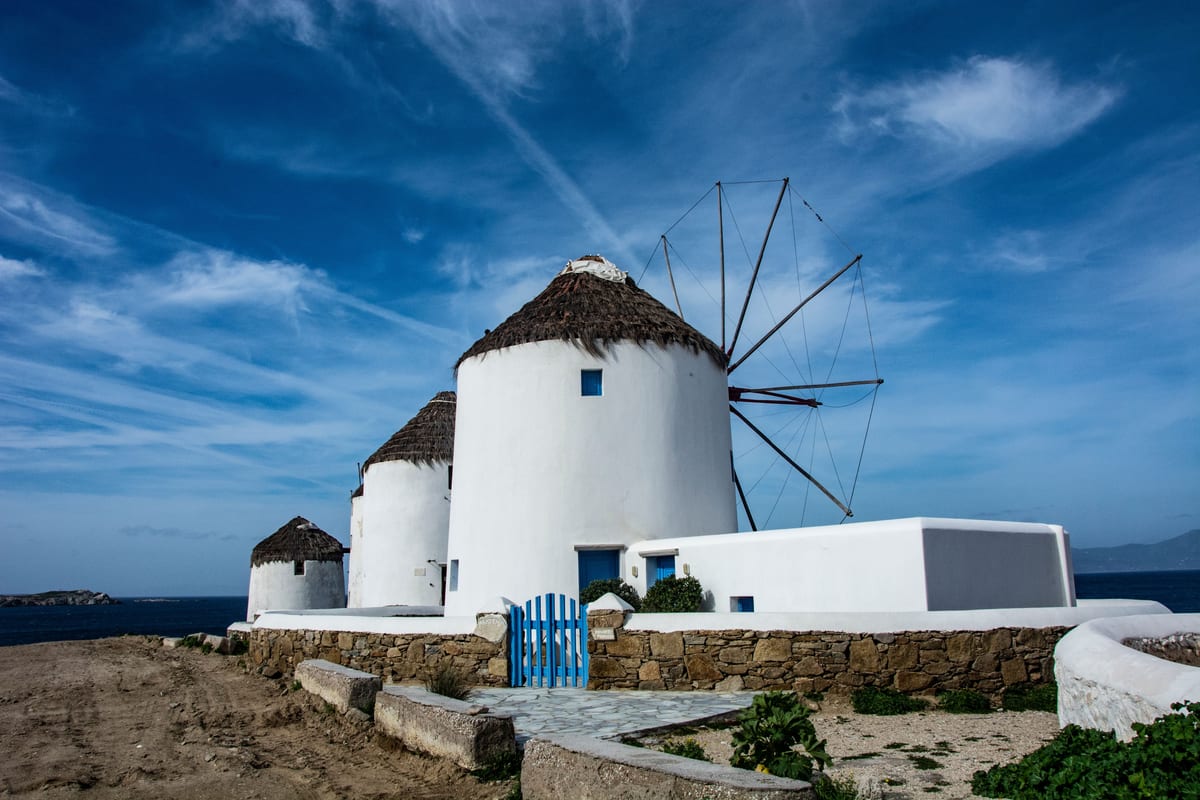
The windmills tell the story of wheat and bread in Mykonos history. Wikivoyage lists them among the widely recognised landmarks of the island. It dates them from as early as the sixteenth century. It places them in the western part of Mykonos Town, in the area that looks across to Little Venice.
According to the same Wikivoyage article, the island once produced great amounts of both wheat and bread. It also lists the Agricultural Museum at Apono Mili, close to the windmills. The museum holds a collection of traditional agricultural tools. Mykonos history keeps the grain story in one corner of the town, with mills and tools side by side.
Wikivoyage lists the Boni Mill as a windmill of the sixteenth century. It stands on the upper east section of Mykonos Town and overlooks it. The article also says the mill has been maintained and is now fully functional. A customary wood-burning stone oven is part of the mill, so flour and bread belong to the same building.
Wikipedia calls a windmill a machine whose sails or vanes are pushed by wind to grind grain. It adds that the jib sail is common in Mediterranean countries. This sail is a plain triangle of cloth that is wound onto a spar. Wikivoyage ties the windmills to wheat and bread, so Mykonos history reads them as grain machines.
Wikipedia names the panemone as one of the earliest recorded working windmills. Its sails are vertical and wooden. This Persian design dates from sometime between the years seven hundred and nine hundred. Pumping water was its first job, and builders later modified it for grinding grain. The Mykonos photo gallery page collects pictures of the island in one place.
Wikipedia says that windmills with a vertical axle had reached the Aegean Sea by the eleventh century. Tower mills in parts of the Mediterranean carried fixed caps, since the wind direction varied little, Wikipedia adds. Mykonos history meets this story of wind and grain late. Wikivoyage dates the windmills of the town from the sixteenth century at the earliest.
What does the Church of Panagia Paraportiani show about Mykonos history?
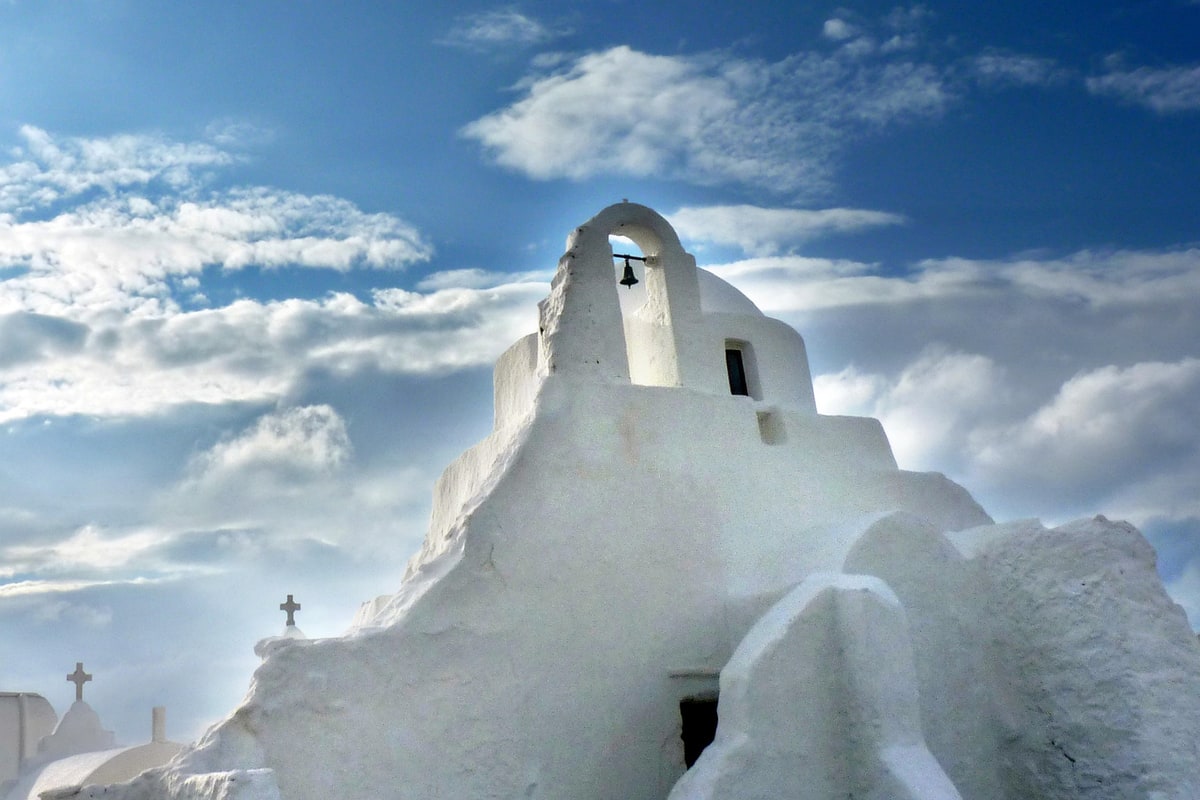
The Church of Panagia Paraportiani shows Mykonos history as a building project that took centuries. Wikipedia says that construction started in fourteen twenty-five. The church was not completed until the seventeenth century. The work therefore ran for more than a century and a half, between the first work and the completion.
Mykonos history places the church in Kastro, a neighbourhood of the town of Chora on the island, according to Wikipedia. Wikivoyage also names the same Kastro district and puts the church in the far western part of Mykonos Town. Wikipedia calls the church whitewashed, and Wikivoyage describes whitewashed lanes, houses and churches for the town as a whole.
Taken literally, the Greek name Paraportiani stands for Our Lady of the Side Gate, says Wikipedia. The reason lies in the position of the entrance. Wikipedia places the entrance at a side gate of the way into the Kastro area. The gate gave the church its title, and Mykonos history keeps the memory of that gate in one name.
Each of the four churches at ground level has a dedication of its own. Saint Sozon, Saint Anastasia, Saint Eustathios and the Saints Anargyroi are patron saints, Wikipedia lists. Only one of the ground-floor chapels is open to visitors, according to Wikivoyage. Mykonos history is told here in four dedications, side by side beneath the fifth church.
Wikipedia says that a fifth church, built above the four lower ones, rests on them as its base. Wikivoyage gives the same count of four chapels at ground level and one more above. Five separate churches are thus joined in one whitewashed group. On the Mykonos private tour, the church is one of the places visited in the town.
Wikivoyage counts four hundred churches on the whole island. It says that this church is photographed more than any other of them. Wikipedia and Wikivoyage agree on the year of the first work, fourteen twenty-five. Both place the end of the building in the seventeenth century. Mykonos history thus rests on two sources that match on the church dates.
What does the name Chora say about the town in Mykonos history?
Wikipedia gives Chora, a plain Greek word meaning Town, as the second name of the island’s main town. The first paragraph of its Mykonos article already carries it, long before the history section. Mykonos history therefore uses a plain Greek word, Chora, beside the name of the island itself.
Wikipedia explains the habit. Where the main town of a Greek island shares the island’s name, people call it Chora. The Wikipedia entry for Chora shows the same label elsewhere. It names the principal town of Patmos, the main town of Kythira and the old capital of Alonnisos. It lists a village on Folegandros and a town on Crete.
Two sources describe the town by its role in the island. Wikipedia names Chora as the principal town of the island. Wikivoyage names it as the island’s port town and capital. Each description names a function, and so does the Greek word Chora. That agreement lets Mykonos history use the word as a plain title for the town itself.
The neighbourhood of Kastro is part of the town of Chora. Wikivoyage calls it the oldest section of Mykonos Town. Wikipedia adds that a medieval castle once stood on this ground. In those days a castle was a strong fortification around a settlement. Wikipedia names the Ghisi family as its builders, the lords of the island at that time.
Wikivoyage dates the “Mykonos Castle” to the thirteenth century, which fits the Ghisi lordship above. Wikipedia says the castle was destroyed in the sixteenth century. Wikipedia adds that in the eighteenth century the town expanded and new buildings covered the remnants. This account of Mykonos history leaves lodging aside; another page deals with places to stay on the island.
Wikivoyage names the Byzantine churches and the castle as sites for learning about the island’s past. Wikipedia adds the reason for the abundance of churches. For a long time an islander had to put a church on the plot before raising a house. The rule helps to explain the churches that now stand as stone witnesses of Mykonos history.
What does the Municipal Library of Mykonos Town hold for Mykonos history?
Wikipedia opens the Landmarks section of its Mykonos article with the Municipal Library of Chora. The library fills a mansion of the eighteenth century, and Wikipedia counts over eight thousand volumes on its shelves. For Mykonos history that makes the building a store of printed pages, kept in an old house.
Wikipedia describes a vast collection of photographs and documents of the eighteenth and nineteenth centuries. It gives one pair of centuries for the photographs and the documents together. The same article places the island’s trade in the eighteenth century and its decline in the late nineteenth. The dates of the collection therefore reach across both periods of Mykonos history.
Wikipedia adds Cycladic coins and old seals to the list. The word Cycladic ties the coins to the island group of Mykonos. The list ends with sketches and books from the personal library of an American artist, John Ratekin. No other person appears in the library entry. Part of the stock thus comes from one person’s own library.
Wikipedia gives the Municipal Library an address: Ayia Kyriaki Square, in the town that the previous section described. The eighteenth century of its mansion falls inside the Ottoman rule that Wikipedia dates from fifteen thirty-seven until eighteen thirty. The house is therefore a building of the Ottoman years, and a piece of Mykonos history in the main town.
The article’s list of notable people names Mary Paraskeva, an early amateur photographer. It also names Ioannis Svoronos, an archaeologist and numismatist. Their fields match two kinds of holding, photographs and coins, though the library entry names neither of them. Wikipedia thus names two people of Mykonos history whose fields lie close to those holdings in the library.
After the library, the list of Landmarks names Petros the Pelican, the windmills, Camel Rock and Little Venice. It goes on with the Armenistis Lighthouse, the Tria Pigadia wells and the museums. The library stays the first entry of that list. Its volumes, photographs and papers serve Mykonos history as written sources, beside the stone ones of the town.
How did the Ministry of Culture start the Archaeological Museum in Mykonos history?
The Ministry of Culture’s page on the museum says it began with a need. Finds from Delos and from the burial ground of Rheneia called for a safe place on Mykonos. That need opened a long chapter of Mykonos history, one that starts in the early years of the Greek state.
Before any museum building stood, the finds sat in rented houses. The Ministry page says private homes held the funerary stelae, inscriptions and statues. At first the Council of Elders, called the Demogerontia, and the Municipality of Mykonos gave their help. The Archaeological Service helped later. These rented houses were the first home of the collection in Mykonos history.
In eighteen ninety-seven Dimitrios Stavropoullos, the first Superintendent of Antiquities for Delos and Mykonos, began digging on Rheneia. He was supervising French School digs on Delos. On Rheneia he found the Pit of Purification, where the Athenians left bones and offerings from Delian tombs. That was in the winter of four hundred twenty-six to four hundred twenty-five BC.
Thousands of finds made a proper museum for Mykonos history more necessary than ever. In late spring of eighteen ninety-eight, on the ninth day of the month, the Municipality of Mykonos made a grant. The Ministry of Ecclesiastical and Public Education received a field at Kaminaki. Pictures of the island behind those finds sit in the Delos photo gallery.
Building work on the museum began in eighteen ninety-nine, the Ministry page says. That date makes it one of the oldest museums in Greek territory, the page adds. The building took in two sets of antiquities. One set came from houses on Mykonos, the other from the digs on Rheneia. Both found a home together under one roof.
The late nineteen sixties brought the next chapter of Mykonos history for the museum. With the help of the Ephor Nikolaos Zapheiropoulos, the museum grew and the Rheneia display was reorganised. Apart from a small number of prehistoric pieces, finds from Mykonos itself went into storerooms for lack of space. The page adds that a further expansion has started.
What does the Aegean Maritime Museum keep of Mykonos history at sea?
Wikipedia says the Aegean Maritime Museum of Mykonos specialises in the history of Aegean merchant ships. For Mykonos history at sea, the article lists one lighthouse in the museum garden and two restored ships. It calls all three of these exhibits living restorations, made to follow the original design and construction.
Wikipedia calls the museum a non-profit institution. It was founded in nineteen eighty-three and opened to the public in nineteen eighty-five. It names George M. Drakopoulos as the founder and chairman. He received the Athens Academy Award and the World Ship Trust’s Award for Individual Achievement. These dates make the museum a late twentieth-century chapter of Mykonos history.
The museum opened inside a nineteenth-century Mykonian building, so the house belongs to Mykonos history. Wikipedia puts the building in the town centre, in the area known as Tria Pigadia. The garden of the museum holds ancient marble gravestones of sailors, gathered on Mykonos and Delos. The article treats the garden as a place of display, beside the lighthouse.
The article gives the aim of the museum as the preservation, promotion and study of Greek maritime history and tradition. The article says it was the Greek pioneer in restoring living historical exhibits as they were originally designed and built. Such restoration turns Mykonos history at sea into real objects, a lighthouse and two ships, not only texts.
The Armenistis Lighthouse, built in eighteen ninety, is the first living restoration the article names. It stands in the garden of the museum, among the sailors’ gravestones. It is nearly a century older than the museum that keeps it. Readers who want the sea trip to Delos can turn to the Delos and Rhenia boat cruise from Mykonos page.
Two ships are the other living restorations. Thalis o Milesios was built in nineteen oh nine, and Evangelistria in nineteen forty. Palaio Faliro, in the city of Athens, holds the Naval Tradition Park, where Wikipedia places both ships. So the museum shows its exhibits in two places, and Mykonos history at sea has a second address in Athens.
What else do readers ask about Mykonos history?
Which dates for the Ghisi lordship of the island do the sources give in Mykonos history?
Two Wikipedia articles give two different years for the Ghisi lordship. In the article on Mykonos, Andrea Ghisi occupies the island in twelve hundred four. Wikipedia links that year to the Fourth Crusade, when Constantinople fell. The date therefore belongs to a wider story than that of the island alone.
The article on the Duchy of the Archipelago starts three years later. Its date is twelve hundred seven, and the founder is Marco Sanudo, a Venetian nobleman. He was a nephew of the former Doge Enrico Dandolo. The Latin emperor Henry of Flanders had not consented to the venture, the article adds.
Mykonos history enters that second article through the Ghisi brothers. Andrea and Geremia Ghisi travelled with Sanudo. The northern Sporades, meaning Skiathos, Skyros and Skopelos, lay in their lordship along with Mykonos and Tinos. The article says they never recognised his suzerainty. Like him, they stood directly under the Latin emperors as vassals.
The Duchy article draws one more line on the map. Its opening paragraph leaves Mykonos and Tinos outside the Duchy, which covered the rest of the Cyclades. A reader therefore meets twelve hundred four in the island article. The Duchy article gives twelve hundred seven. Each date is attributed to its own source.
What do the building dates of the Archaeological Museum say in Mykonos history?
Near the Old Port of Mykonos is the Archaeological Museum. Wikipedia credits its establishment, in nineteen oh two, to the Greek Archaeological Service. The same article dates the original neoclassical building to nineteen oh five. So the founding of the museum and its first building are two separate years in that one article.
The Ministry of Culture gives a different start. Its page on the museum says construction began in eighteen ninety-nine. Mykonos history therefore holds three dates for one institution. Eighteen ninety-nine marks the works, nineteen oh two the founding and nineteen oh five the building. Each date belongs to its named source.
Wikipedia lists later work on the building. The museum was refurbished and expanded in the nineteen thirties and again in the nineteen sixties. The large eastern room followed in nineteen seventy-two. Rineia, a nearby islet with a burial site, supplied the finds the museum was first built to hold. It dates the finds to the fifth century BC.
Mykonos history also reaches the museum through its objects. Wikipedia names pottery, funerary urns and sculpture of the Cycladic, Geometric and Classical eras. Ceramic pottery of the ninth to eighth century BC from the Cyclades is listed. The article singles out the large Mykonos vase, Pithos two thousand two hundred forty. Its scenes show the fall of Troy.
What is the population of the island and its largest town in the latest census in Mykonos history?
Wikipedia gives the population in the opening paragraph of its article on the island. At the latest census it counts ten thousand seven hundred four inhabitants. The article names the neighbours of Mykonos in the Cyclades as Naxos, Paros, Syros and Tinos. Its section on villages adds that the island has ten villages.
The same sentence says the greater part of those inhabitants lived in the largest town. That town carries the name of the island and lies on the west coast. Wikivoyage names Chora as the island’s capital and its port town. Readers of Mykonos history therefore meet this one town under two names, Mykonos and Chora.
The geography section of the same article gives another count. It names a population of nearly twelve thousand five hundred. Again the greater part of the people live in the main town of Chora. The article therefore holds two figures. The census figure is the one the opening paragraph states, so it is the one used here.
In area, the island covers eighty-five point five square kilometres, says Wikipedia. The article’s section on government treats Mykonos as its own regional unit, set in the South Aegean. A single municipality makes up the whole of that unit. The Kallikratis reform carved the unit out of part of the former Cyclades Prefecture.
Which Byzantine churches and the castle remain as sites in Mykonos history?
Wikivoyage names two kinds of remains for readers who want to learn about the island through sites. One kind is the Byzantine churches. The other is the castle of Mykonos, which the same page dates to the thirteenth century. The page counts only a small number of sites in all.
Wikivoyage first notes a gap. It finds a lack of Cycladic Bronze Age, Archaic and Classical sites on an island so close to Delos. It ties this in large part to decades of uncontrolled property development, which razed ancient sites for villas and hotels. Mykonos history in stone is thus carried by a short list of survivors.
Wikivoyage sets that gap against mainland Greece. There, it says, the state keeps strong control over the preservation of archaeological sites. On the island itself, a small number of sites from after the sixteenth century are left, mainly Byzantine churches. The page also gives the castle its own name, Mykonos Castle.
In its description of Mykonos Town, Wikivoyage says the traditional Cycladic style of the town stayed intact despite rapid growth. The section on the name Chora, earlier on this page, sets the castle and churches in the town. This answer adds only the gap in ancient sites and the church count.
What does Wikipedia say about the tourism of Mykonos history after the nineteen sixties?
Wikipedia ties the rise of tourism on Mykonos to the French School of Archaeology. Its excavations on the nearby island of Delos began in eighteen seventy-three. Delos lies only two kilometres from Mykonos, the article notes. The article says tourism soon came to dominate the local economy, owing much to that important work.
The next step comes in the nineteen sixties. Wikipedia says Mykonos became popular with international “jet set” tourists in that decade. The article on tourism in Greece dates the flourishing of modern tourism to the nineteen sixties and seventies. It calls the movement mass tourism. The two articles thus point to the same decade.
By the two-thousands, Wikipedia says, Mykonos had become one of the costliest islands of Greece. Mykonos history in the article thus runs from excavations to a jet set and then to that standing. The article on tourism in Greece lists Mykonos among the major destinations of the country. Athens, Santorini, Rhodes, Corfu, Crete and Chalkidice stand beside it.
The same article adds a national frame. In those decades large-scale construction projects for visitor facilities were undertaken. The country saw an increase in international tourists over the years. For a single year it reports over nineteen point three million visitors. That is up from seventeen point seven million the year before.