Delos island is a small sacred island of the Cyclades and today an archaeological site. This page covers its myths, history, ruins and the facts of a visit. Our tours in Greece page lists trips to other islands.
Below you find the birth of Apollo and Artemis, the Delian League, the trading port, the sanctuaries, the houses and mosaics, the museum and short answers.
What myth made Delos island the birthplace of Apollo and Artemis?
UNESCO retells the legend in which Leto, made pregnant by Zeus, fled the vengeance of Hera. On an arid islet she gave birth to Apollo and Artemis after a difficult labour. That myth made Delos island the twins’ birthplace. The same text calls Apollo the god of daylight and Artemis the goddess of night light.
Delos, written Dilos in the transliteration of the Greek name, is a Greek island of small size near Mykonos. Wikipedia says the Odyssey already placed the births of the twin gods Apollo and Artemis there. In the Cyclades group, Delos island sits near the middle. The nearest neighbour, Mykonos, has a page of Mykonos tours.
The oldest surviving account of Leto’s wandering is Homeric Hymn 3, Wikipedia explains. It is concerned only with the birth of Apollo, which it sets on Delos island. Artemis is born instead on Ortygia. The hymn treats Artemis as an afterthought and does not call the children twins. The later poet Pindar is the first to do so.
The labour itself is tied to the landscape of Delos island. UNESCO places Leto’s nine days and nights of labour pains close to Mount Kynthos and a wheel-shaped lake. It calls both places essential landmarks of the sacred geography of the island. The additions to the sanctuary of Apollo between the sixth and first centuries BC defined that geography.
According to a Homeric hymn, quoted in the UNESCO text, the island had been floating until that moment. After the birth it became anchored to the floor of the ocean. UNESCO adds that Phoebus-Apollo, still a newborn, cast aside his swaddling clothes and flooded the universe with light. Then he started walking with his cither and his bow.
Wikipedia’s article on the god Apollo gives his birthplace as Mount Cynthus, a mountain of the island. Delos island therefore gave the god a number of titles. Cynthius means Cynthian, Cynthogenes means born of Cynthus, and Delius means Delian. Each name points back to the island and its mountain, and Wikipedia lists all three among the epithets of Apollo.
Why was no one allowed to be born or buried on Delos island?
Athens purified the island more than once, Wikipedia says, to make it fit for the worship of the gods. A later decree then banned both burials and births on the island because of its sacred importance. As a result, Delos island became a place where nobody was born and nobody was buried.
The first purification fell in the sixth century BC and came from the Athenian tyrant Pisistratus. Wikipedia says he had every grave within view of the temple opened up. The remains were carried away to another island nearby. Delos island thus lost the graves around its temple first, well before the wider clearing of the fifth century BC.
A second, wider purification came in the fifth century BC. It fell during the Peloponnesian War, in its sixth year. Wikipedia says Athens acted under instruction from the Delphic Oracle at that time. This time the entire island was purged of all dead bodies. That task was wider than the first removal of the graves near the temple.
A new decree was eventually issued. Nobody was permitted to be buried or to give birth on the island, because of its sacred importance. Wikipedia names a second purpose. With no births and no graves on the island, nobody was able to claim ownership of it through inheritance. Delos island therefore stayed neutral in commerce, as Wikipedia puts it.
The purge left two tombs in place, those of the Hyperborean Maidens, because a hero cult surrounded them. Wikipedia gives that cult as the reason for the exception. Every other grave on the island was cleared in the purge. The boat crossing to the island has its own page, Delos and Rhenia boat cruise from Mykonos, on this site.
Four years later, Wikipedia adds, all the inhabitants of the island were removed to Adramyttium in Asia. The same source calls this removal a further purification. It came after the clearing of the dead and after the decree on births and burials. Delos island was thereby emptied of its residents. Wikipedia lists the removal last among these steps.
Where does Delos island lie among the Cyclades and what status does it hold?
Delos island stands near the middle of the Cyclades group, a small island beside Mykonos. The World Heritage List of UNESCO includes Delos, and Greek law protects the whole island as an archaeological site. Both statuses rest on its sacred role in antiquity and on its past as a cosmopolitan Mediterranean port.
Wikipedia gives the Cyclades roughly two hundred and twenty islands and names Thira, or Santorini, among the major ones. Delos island is on that same list of major islands as well. The tourism site of Greece calls Delos the high priestess of the Cyclades. Readers who want that island can open the Santorini tours page of this site.
Wikipedia ranks Delos island high among the Greek sites of myth, history and archaeology. The article adds that the excavations still under way on Delos rank with the broadest in the Mediterranean. UNESCO calls the archaeological site there exceptionally extensive and rich. Its text says the monuments uncovered so far speak eloquently for the grandeur of the sacred island.
Greek law protects the entire island as a single archaeological site. UNESCO’s text cites Law three thousand and twenty-eight of two thousand and two, on antiquities and cultural heritage. The Ministry of Culture, Education and Religious Affairs supervises the site. UNESCO adds that the ministry monitors the condition of the monuments and provides for their protection and presentation.
UNESCO lists Delos island as a cultural site under four criteria, which are numbered ii, iii, iv and vi. Criterion ii credits Delos with a considerable influence on the development of architecture and monumental art in the Greco-Roman period. UNESCO’s text calls Delos one of the first sites in Greece to attract the attention of archaeologists and travellers.
UNESCO calls the island small and rocky, and places it at the Aegean’s centre. It says the island and its neighbours, among them Greater and Lesser Rematiaris, form one immense archaeological site. UNESCO adds that the authenticity of the site has not been challenged. Restoration aims to preserve the monuments in the state in which the excavations found them.
How did the first settlers and the Ionians shape Delos island?
Ancient stone huts on Delos island point to the third millennium BC as the start of settlement. Thucydides claims that the first inhabitants were piratical Carians. The Ionians made the island a place of pilgrimage for their patron god, Apollo Delios. Between nine hundred BC and one hundred AD, it was also a major cult centre.
Thucydides claims that the original inhabitants of Delos island were piratical Carians. King Minos of Crete, in the same claim, eventually expelled the Carians from the island. Wikipedia also reports a physical clue. Investigation of ancient stone huts found on the island shows habitation since the third millennium BC. UNESCO gives the same date for the first settlement.
UNESCO says the island bears traces of successive Aegean civilisations. They begin in the third millennium BC and end in the palaeochristian era. Wikipedia’s article on the Cyclades says the islands faded into insignificance once the palace culture of Crete arose. Delos was the one exception: it kept its archaic reputation as a sanctuary throughout antiquity, until Christianity emerged.
Wikipedia’s Delos article says the island was at first a religious pilgrimage for the Ionians. The Delia article names the patron god of the Ionians as Apollo Delios. It adds that he was believed to have been born on Delos island. The same article says Athens, as head of the Ionian confederacy, took the leading part in the festival.
Wikipedia names two gods revered on Delos island in those centuries. They were Leto, who bore Apollo and Artemis, and Dionysus. Its Leto article adds that her sanctuary, a Letoon, stood at Delos as well as near Xanthos in Lycia. The same Wikipedia article says Leto was worshipped together with her children, especially on Delos, the sacred island.
Wikipedia says Delos eventually gained a religious significance for all the Greeks, which it calls Pan-Hellenic. UNESCO places that change in the Archaic and Classical periods. In its short description, UNESCO says the sanctuary of Apollo attracted pilgrims from every part of Greece. Delos island thus drew worshippers beyond the Ionians, who had made it their own pilgrimage place.
What was the Delian League’s role on Delos island?
The Delian League owes its modern name to Delos island, the official meeting place of its member states. Writers of that age called the alliance simply “the Athenians and their Allies”. That plain title named Athens before its partners and said nothing of the island. The name therefore records where the allies met, not what they did.
Sparta wished to end its part in the war with Persia once Byzantion had fallen. A congress was then called on the holy island to set up a new alliance against Persia. Its congresses met within Apollo’s sanctuary on Delos island. Thucydides states the aim as repaying the wrongs the Greeks had suffered by raiding the Persian king’s land.
Athens supplied the greatest share of the League’s military power from the start. More and more allies preferred to pay their dues in cash rather than send ships. Athens spent the funds on purposes of its own, such as strengthening its navy. That use of the money led to conflicts with the weaker allies, at times ending in rebellion.
One such revolt came in four hundred and sixty-five BC, when Thasos rebelled. Halfway through the fifth century BC, the League had developed into a naval imperial power led by Athens. Historians call it the Athenian Empire. Athens held complete dominion, and the allies grew less and less autonomous. The alliance founded on Delos island had changed its nature.
Under the command of Cimon, the alliance met its main strategic goal. Its forces drove the Persian troops that remained out of the Aegean Sea. After that success, the Persian empire stopped posing a serious danger to the Greeks for half a century. Athens had also wished to extend its support to the Ionian Greek colonies of Anatolia.
The end of the group that met on Delos island came with the Peloponnesian War. The League’s threat to Sparta, and the harsh rule of Athens, prompted that war. The war ended in four hundred and four BC, and Lysander directed the dissolution of the League. Athens later revived the alliance in part as the Second Athenian League.
What were the Delia, the festival held on Delos island?
The Delia were festivals and games in classical antiquity, held at the great gathering, called the panegyris, on Delos island. UNESCO calls the same event the feast of the Delians. Wikipedia ties the gathering to a religious alliance that worshipped the god in the common sanctuary. The Greek word for such an alliance is amphictyony.
According to Wikipedia, the Delia took place every fourth year, apparently from very early times. The Cyclades and the neighbouring Ionians on the coasts belonged to this religious alliance. Its members assembled on Delos island in long garments, together with their wives and children. They came to worship Apollo with gymnastic and musical contests, choruses and dances.
UNESCO adds a fuller programme of the feast. The feast was held on Delos island in late spring, every four years until three hundred and sixteen BC. It offered gymnastic, equestrian and musical contests, Archaic dances, theatrical shows and banquets. UNESCO sets the feast beside the Olympic and Pythic Games as a major event of the Greek world.
The island’s own people had a practical role in the festival. Wikipedia says the Delians acted as cooks for the visitors who came to their island during the celebration. Athens joined in at a very early date too. The laws of Solon name the Deliastoi, later called Theoroi, which shows an old tie between Athens and Delos island.
Each year Athens sent a sacred ship to the island for the Lesser Delia, which the Delians called Apollonia. Tradition said it was the vessel that Theseus had sent after his return from Crete. While the ship was away, Athens was purified and no criminal was executed. The island the ship sailed to appears in the Delos photo gallery.
The sources differ on one detail, the length of the cycle. The Wikipedia article on Delos calls the first games held after the island’s purification quinquennial, which means every five years. The Wikipedia article on the Delia and UNESCO both give a cycle of every fourth year. This page follows that cycle for the festival of Delos island.
How did Rome turn Delos island into a trading centre?
The Roman destruction of Corinth in one hundred and forty-six BC left a gap in Greek commerce. Wikipedia says that Delos island, a small Greek island near Mykonos, stepped into that gap. The island took a share of Corinth’s role as the premier trading centre of Greece, at least in part.
UNESCO dates the start of the rise of Delos island as a port to three hundred and fourteen BC. From that year the cosmopolitan Mediterranean port began to prosper, in the words of its criterion four. UNESCO adds that the port reached outstanding levels during the second and first centuries BC. The port therefore grew in stages over time.
Wikipedia reports that buyers from Rome arrived on Delos island and bought slaves by the tens of thousands. Pirates from Cilicia had captured a part of these people. Further captives came from the wars after the Seleucid Empire fell apart. Delos thus turned into the hub of the slave trade, with the largest market of the wider region.
UNESCO says the settlers were ship-owners, bankers and rich merchants from all over the world. Their arrival drew builders, artists and craftsmen, who built houses richly decorated with frescoes and mosaic floors. UNESCO also cites S. P. Festus of the second century AD. For him the small island was the largest centre of commerce in the whole world.
UNESCO’s account says the island drew all of the commercial activity of the eastern Mediterranean to itself. Warehouses and trading companies abounded in its port. Wikipedia says it had no capacity to produce food, fibre or timber, which were all imported. The nearby island that sends the boats to Delos is described on the Mykonos history page.
UNESCO says that large residential areas were established in the port. Associations of bankers, traders and ship-owners founded the public buildings of the town. UNESCO calls the whole an outstanding example of an architectural ensemble. In its words, that ensemble restores the image of an extremely important cosmopolitan Mediterranean port. Delos island thus still shows that trading town.
Why did the trade of Delos island decline after Mithridates attacked it?
The trade of Delos island declined because trade routes shifted by the close of the first century BC. Wikipedia says that Puteoli took the lead in Italian trade with the east, and Delos lost that place. The cult centre of the island also fell into a sharp decline. Its trade had already waned after the assault by Mithridates.
Wikipedia says that Mithridates, after failed sieges of Rhodes and Patara, was called to Athens. There Aristion, the elected commander-in-chief of the city, allied with him to take Delos island. He also offered naval support for the capture of the island. The wars set the Roman Republic against the Pontic kingdom and ended only with the death of Mithridates.
Readers can also open the Mykonos Hotels page or the Mykonos Shore Excursion with Cruise Ship Pickup page. Our Mykonos Sunset Cruise with Snack page adds one more trip.
Excavators uncovered a number of wine presses in the remains of the old town on Delos island. Wikipedia dates them to the Roman period. It reads them as a sign that the people there put considerable effort into grape growing and wine making. Pottery found on the site shows that wine and oil also kept arriving from regional centres.
Wikipedia notes that the island kept a part of its population in the early Roman Imperial period, despite the decline. It cites Pausanias, a traveller who wrote in the second century AD. Pausanias writes that nobody lived on Delos island except the custodians of the sanctuaries. Those custodians are the only residents that he names for the island.
Excavators found Roman baths, coins, an aqueduct, residential and elite houses, a number of churches, basilicas and a monastery. Wikipedia dates all of these to the first to sixth centuries AD. It adds that the finds do not suggest continuous habitation in that period. The remains show building on the island, but they do not prove a steady town.
Wikipedia gives the eighth century AD as the time when Delos was eventually abandoned. UNESCO says that Byzantines, Slavs, Saracens, Venetians, the Knights of Saint John and Ottomans later captured it in turn. The site became a quarry, and lime was made by burning the columns of its temples. Delos island was then left with its houses in ruins.
Why do replicas stand on the Terrace of the Lions on Delos island?
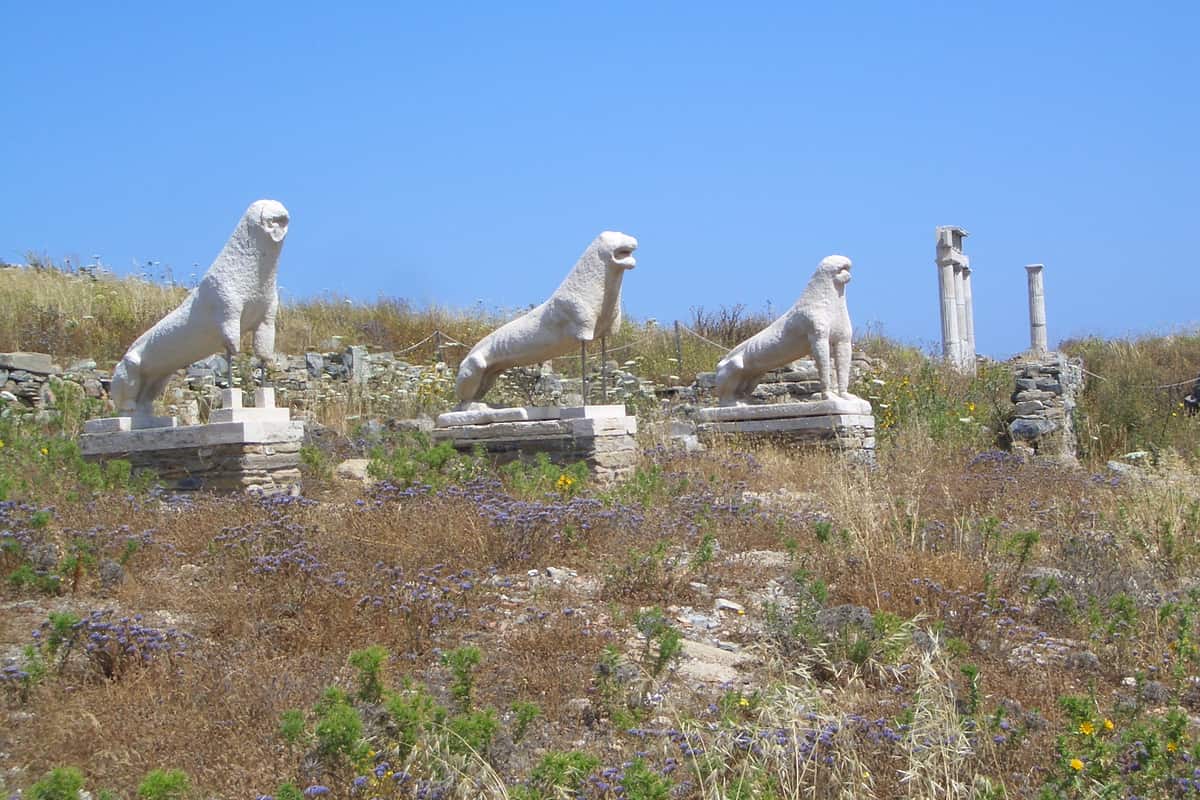
Replicas stand on the Terrace of the Lions because the north wind can damage fragile marble. UNESCO reports that the Naxian Lions were carried to the museum and replaced with exact replicas. A visitor to Delos island therefore meets the copies outdoors, while the original statues are kept in the museum.
The gallery of Wikipedia’s article on the Archaeological Museum of Delos shows the lion statues with a short caption. It calls them Naxian work and finds from the Lion terrace on Delos. The caption dates the group to the span from six hundred and twenty to six hundred BC. That span falls in the late seventh century BC.
UNESCO lists two major factors that affect the monuments of Delos. One is the strong north wind that dominates the central Aegean. The other is the nearness of the sea. The same text says research has been undertaken on the structural materials of the monuments, their origin and pathology. Studies of the overall conservation are ongoing on Delos island.
Wikipedia’s article on the museum says the building holds a set of large lion statues that are originals. Their reproductions stand outside on the site. The museum itself lies on the island, near Mykonos in the South Aegean. The article calls it noted for an extensive collection of statues unearthed around the ancient site of Delos island.
Wikipedia reads the lions as a monumental avenue. A row of squatting, snarling marble guardians once lined the Sacred Way of the island. Naxos dedicated the terrace to Apollo, god of the sanctuary. The article sets that scene beside the Egyptian avenues of sphinxes. The replicas on Delos island keep the line of guardians in view on the terrace.
A bracketed remark in the same Wikipedia passage adds that a Greek sphinx is kept in the Delos Museum. The remark places the Greek sphinx of Delos island beside the Egyptian avenues of sphinxes in the comparison. UNESCO adds that a great part of the treasure of masterpieces from the excavations is exhibited in the museum today.
Which temples and monuments stood in the sanctuary of Apollo on Delos island?
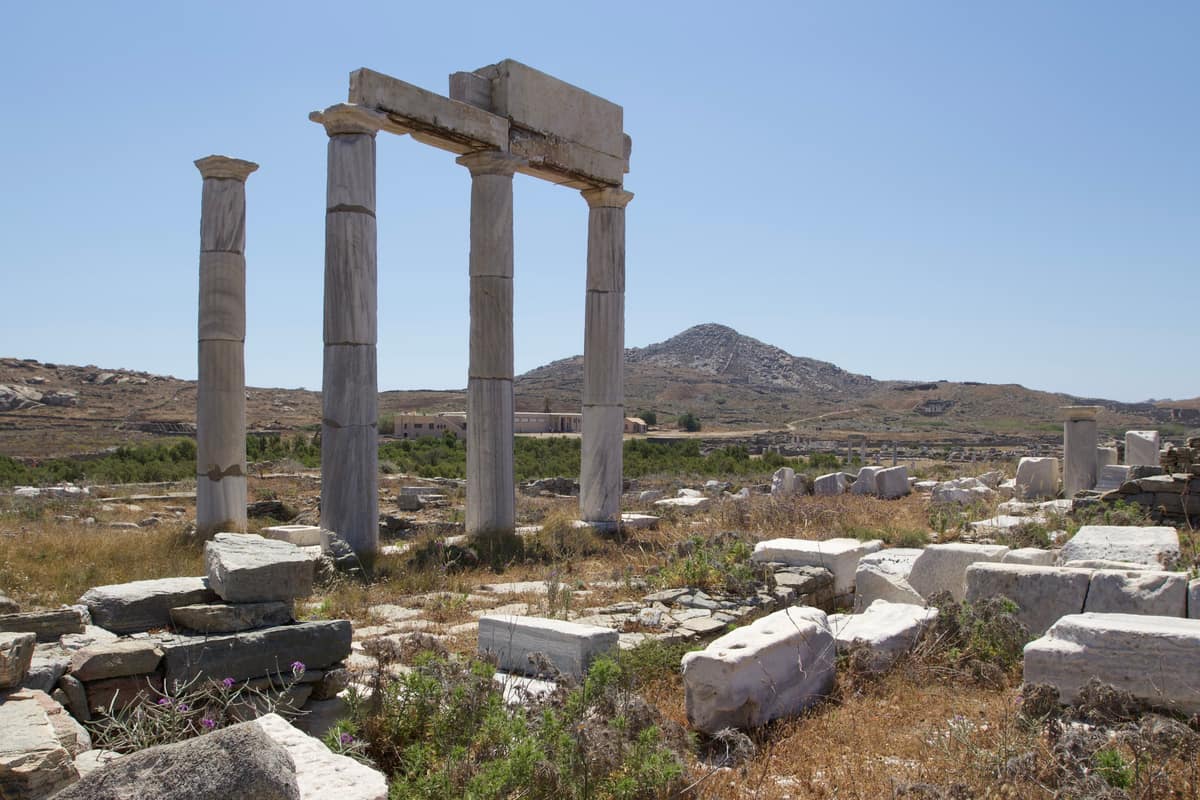
Wikipedia’s list of landmarks on Delos island names the Temple of the Delians and the Oikos of the Naxians. It also names the Temple of Hera and the Minoan Fountain. A colossal kouros of Apollo stood beside the Temple of the Delians, and only parts of it remain. Three conical mounds mark ground sacred to a goddess.
Wikipedia dates the colossal kouros of Apollo to the sixth century BC. It once stood beside the Temple of the Delians on Delos island, which the article dedicates to Apollo. Parts of the upper torso and the pelvis remain in place. The museum on the island holds the hand, and a foot lies in the British Museum.
Wikipedia dates the Oikos of the Naxians to the first quarter of the sixth century BC. It is also called the House of the Naxians. It has a long hall with one central colonnade of the Ionic order. The entry also lists a west porch and an east marble prostasis. The prostasis dates to the middle of the century.
Wikipedia dates the Temple of Hera on Delos island to about five hundred BC. It calls the temple a rebuilding of an earlier Heraion there. The museum article adds a Corinthian alabastron, a small container for perfumed oil, found in the Heraion. Its decoration shows two swans around Potnia Theron, protectress of hunting and lady of the beasts.
The Minoan Fountain of Delos island, a public well hewn in the rock, is rectangular and has a central column. Wikipedia says an inscription dates its reconstruction to one hundred and sixty-six BC. A flight of steps on one side still leads to the water. The nearby island of Mykonos has pictures on the Mykonos photo gallery page.
Wikipedia adds a feature of the landscape, not a building. From the Sacred Harbour, one sees three conical mounds. The article says the mounds identify landscapes holy to a goddess, presumed to be Athena. UNESCO says Apollo’s sanctuary on Delos island has existed at least since the ninth century BC. It reached its peak in the Archaic and Classical periods.
Which foreign gods and peoples had places of worship on Delos island?
Sanctuaries for foreign religions stood on Delos island in an unprecedented number, UNESCO says in its text on criterion four. The Egyptian side of that list names temples of Sarapis, Isis and Anubis in the island’s port. Such shrines support the image that UNESCO gives of the whole archaeological site: a great cosmopolitan Mediterranean port.
UNESCO’s list of foreign cults continues with the east. The same sentence also names Haadad and Atargatis, two Syrian gods with temples there, after the Egyptian ones. Wikipedia adds a much earlier detail from the days of the Delian League. Then a separate quarter of Delos island was reserved for foreigners and for the sanctuaries of foreign deities.
Wikipedia says that Phoenician settlers formed a colony on the island and kept wide trade links in the Hellenistic age. A note in the same article points to a study of inscriptions by two Phoenician groups on Delos island. One group came from Ashkelon and the other from Yavneh. The note therefore ties the colony to two named towns.
A house of prayer received gifts from Cretans, and two marble stelae record them. The shape of the letters dates them to between about two hundred and fifty and fifty BC. The community calls itself Israelites on Delos making offerings to hallowed Argarizein. Wikipedia reads this as a clear reference to Mount Gerizim, the site of the Samaritan sanctuary.
Wikipedia also documents two Jewish women on the island, named Heraclea and Marthina. Among its landmarks it lists the so-called Delos Synagogue, ruins that were once taken for a Samaritan synagogue of antiquity. UNESCO, for its part, places a synagogue in the stadium district. Delos island therefore holds more than one trace of Jewish and Samaritan life in antiquity.
Wikipedia says an inscription honouring Herod the Great, King of Judaea, was found in the Temple of Apollo. A second inscription honours his son, the tetrarch Herod Antipas. Rulers of Judaea were thus honoured in writing on the island, far from their own land. Taken together, the inscriptions on Delos island mention Cretans, Samaritans and rulers of Judaea.
Which merchant clubhouses and houses stand on Delos island?
The Establishment of the Poseidoniasts on Delos island was the clubhouse of a body of Berytian merchants, shipmasters and warehousemen. Wikipedia dates the building to the late second century BC, in the early years of Roman hegemony. The article lists it among the landmarks of the island, with the temples, market squares and private houses.
A protective triad watched over the club. Wikipedia pairs its three gods with Greek counterparts: Baal with Poseidon, Astarte with Aphrodite and Eshmun with Asklepios. The name of the club points to Poseidon, the first of the pairs. The members added Roma to the triad. Delos island thus shows a clubhouse that honoured Roma beside the older gods.
The Archaeological Museum of Delos holds marble figures of Kleopatra and her husband Dioskourides. Wikipedia’s museum article says that the couple lived on Delos island. The statues were unearthed at their former residence, and they date from one hundred and thirty-eight BC. The article thus links two named people to a house and to an exact date.
A house in the Skardana Quarter once carried a fresco on its outer wall, and the museum now keeps it. The scene has Heracles, two boxers and a man who plays a flute or a trumpet. An inscription that reads Kalamodrya is believed to name a prominent boxer of the first century BC. Wikipedia calls this painting valuable.
A mosaic found on Delos island depicts the killing of Ambrosia by King Lycurgus of Thrace. Its caption in Wikipedia dates the scene to the second century BC. The gallery lists mosaics from the Insula of the Jewellery and the House of the Masks. The article gives the second and first centuries BC for its mosaics, figurines and jewellery.
One caption in the museum article names a relief of Hermes, Athena and Apollo from the house near the lake. An archaizing style marks the relief, which belongs to the second century BC. Another caption names a mural of the preparations for a Dionysiac symposium, painted about one hundred BC. Both captions place the works on Delos island.
What did the excavations and the museum of Delos island bring to light?
The French School at Athens began to dig on Delos island in eighteen seventy-two. Wikipedia calls the project massive in scale and still ongoing. UNESCO agrees that the work is still in progress today. It adds that the digs brought to light the sanctuary, along with a large share of the cosmopolitan Hellenistic town.
The museum stands on the island of Delos itself. In nineteen hundred and four, the Archaeological Society of Athens built it on the site, as the finds accumulated. Wikipedia says the museum is known for its statues, a large collection unearthed around the ancient site. Delos island keeps part of its own record in a building on the spot.
Wikipedia says the original five rooms grew in nineteen thirty-one and again in nineteen seventy-two, to nine rooms. Statues and reliefs from the digs fill six of the rooms. Two hold the pottery, and one holds objects of everyday life in ancient Greece. The museum of Delos island is now nearly twice the size of the first building.
One find on Delos island is an ivory plaque of fourteen hundred to twelve hundred BC, Wikipedia says. It shows a Mycenaean soldier in a helmet of wild boar teeth, with a defensive shield and a spear. Excavators found it at the Artemision with other gold, ivory and bronze items. Wikipedia calls it a find of major note.
The museum does not hold everything that came out of the ground. Wikipedia adds that the National Archaeological Museum in Athens shows a large quantity of the finds from Delos. The finds are therefore split between the collection on the spot and the collection in the capital. Both collections come from the same excavations on the island.
Wikipedia says the pottery in the museum dates from the twenty-fifth to the first century BC. The clay figurines, jewellery and mosaics that the museum conserves date back to the second and first centuries BC. The pottery alone therefore spans a period longer than two thousand years. The collection of Delos island thus reaches far back in time.
What does a visitor need to know about Delos island today?
Visitgreece says Delos island lies a short sea distance from Mykonos, and visitors arrive by boat from the surrounding islands. The opening days and hours change, so check the current page of the Ministry of Culture. The ferry timetable changes by season as well, so that check belongs in any plan.
Visitgreece also says what sets the island apart from the others. No other Greek island holds such a number of monumental relics from the Archaic, Classical and Hellenistic periods. Delos island is used only as an archaeological site, and the relics all stand within it. The page adds that the relics span the centuries of great Greek art.
UNESCO says a scientific committee for the conservation of Delos monuments plans and supervises the works. The same text says its programmes cover conservation, support, restoration, presentation and protection of the monuments. The Ephorate of Antiquities of Cyclades, the regional service of the Ministry, manages and protects the site. Each work on the site passes under its eye.
UNESCO says the guards of the antiquities live on the island all year, with archaeologists, conservators, architects and technicians. They carry out conservation and restoration work. The same text says the remote location makes every kind of work harder. The staff gradually make the site easier to read and understand. Delos island is a workplace, not only a ruin.
The landscape remains unaltered, UNESCO says, because not a village or a town was ever built over the ancient ruins. Nothing modern stands there apart from the museum, the refectory and a number of small houses for the personnel. None of them is a hotel. Overnight stays take place on the island of Mykonos, see the Mykonos hotels page.
UNESCO says that designated itineraries reduce the risk that visitors pose to the fragile landscape and the monuments. Temporary personnel also work there in the high tourist season. Greek and European funding paid for the creation of new pathways for visitors across Delos island. The pathways aim at access to the whole site, people with disabilities included.
What do readers ask about Delos island?
What do the Greek forms of the name Delos island show?
The Wikipedia lead gives the name of Delos island in Greek letters and in two dialect forms. The Attic form is written Dêlos and the Doric form Dâlos, so the long vowel changes between the dialects. The article also gives the Greek pronunciation in phonetic symbols, which begin with the th of the English word this.
A footnote in the article explains the letter combination nth. It marks Pre-Greek words, and Corinth, menthos and labyrinth are examples. Cynthus, the name of the mountain on the island, belongs to the same older group of words. The footnote adds that Artemis, and even Diana, kept the name Cynthia.
The Suda, which Wikipedia cites here, records a Greek proverb: a happy person sings like a traveller sailing to Delos. Wikipedia says the Greeks used it of someone who is cheerful, light-hearted and enjoying himself. The saying thus turns the voyage to the island into an image of a good mood.
The English pronunciation in the same lead is printed in symbols too. It starts with a d, then a long ee vowel, then an l, a short o and an s. The mountain’s spelling varies as well. UNESCO and the museum article write Kynthos with a k. The Delos article writes Cynthus with a c.
Did Delos island have its own mysteries and a local historian?
Wikipedia cites Iamblichus for one remark: the Delos Mysteries were established, and they resembled the Eleusinian Mysteries. The footnote points to the Life of Pythagoras, at section twenty-eight point one hundred and fifty-one. Wikipedia places the remark in its section on ancient Greece, right after the proverb from the Suda.
Semos of Delos wrote a number of works, among them eight books on the history of the island. Wikipedia gives his name in Greek as Semos the Delian, which ties him to the place. The Suda, the same work that gives the proverb above, mistakenly lists him as a man from Elis.
Wikipedia’s opening paragraphs date the oldest layer of the story. For a thousand years the sanctuary of Delos was holy ground. Only after that did Olympian mythology make the island the birthplace of the twin gods. So Delos island was already holy when the birth myth of the twins arrived there.
The Stoivadeion on Delos island honours Dionysus. Its statue shows Dionysus, called a god of wine and of the life-force. Its southern pillar shows scenes from the Dionysiac circle. It dates to about three hundred BC and marks a winning theatrical performance. The museum keeps the statues of two actors that once flanked the god.
What is the Agora of the Competaliasts on Delos island?
The Agora of the Competaliasts is an ancient Greek site on Delos island. Wikipedia dates it to the last quarter of the second century BC. It is a public space and commercial centre, directly next to the Sacred Harbour. The ground is paved with gneiss, and holes in the stones mark where tent poles went.
Two marble monument bases, one square and one round, stand in the centre and are dedicated to Hermes. Around them lie the remains of monuments that merchants, sea captains and bankers put up. The remains of shops from the heyday of this Hellenic trading centre lie in the east and south.
The Delos article adds that statues and columns in this market were dedications from two powerful Italic merchant guilds. It also says the Agora of the Italians, a label from modern literature, was probably not a market square. The label persists despite the doubt. So of the two names, only the Competaliasts market clearly names an agora.
The north side of the market holds the Portico of Philip. An Ionic temple dedicated to Hermes stands there as well. Wikipedia’s Delos article adds that different regions of the island operated their own agorae. So the market by the harbour was one of a number of squares found on the island.
What is the population of Delos island in the census figures?
The Wikipedia article on Delos island has a section headed Current population. It opens with the count of two thousand and one from the Greek census, which found fourteen inhabitants there. This is the older of the two counts that the section gives, and it is the lower of the two.
The same section then turns to more recent numbers for the whole island. In two thousand and eleven, it says, the island counted twenty-four inhabitants, ten more than in two thousand and one. The summary box of the article also lists a density of six point seven people per square kilometre.
Wikipedia places Delos under the municipality of Mykonos for administration. A maintenance notice at the top of that section says it cites no sources. The notice adds that material without sources can be challenged and removed. So both figures for Delos island, fourteen and twenty-four, stand there without a citation.
UNESCO takes a longer view of habitation. Its text says Delos has remained uninhabited since the seventh century AD. UNESCO credits that long emptiness and the remote location for the preservation of the site through the centuries. In this reading, a lack of residents helped to keep the ruins of Delos island intact.
What did Callimachus call Delos island, and why?
UNESCO credits Callimachus, who lived in the third century BC, with the title for the island. In ancient Greek culture, UNESCO writes, Delos island counted as holy above all other islands. Criterion six explains the title: the island is tied directly to one of the main myths of Hellenic civilisation.
UNESCO’s text on criterion three follows the story of the island into the Palaeo-Christian era. In that era, the island held the seat of the Cyclades bishopric. Palaeo-Christian is a term for the early Christian period. The bishop’s seat shows that the island kept a religious role after the age of its Greek sanctuaries.
The same criterion dates the rank of the sanctuary. From the seventh century BC, the island ranked among the principal Pan-Hellenic sanctuaries. That lasted until the pillage by Athenodoros in sixty-nine BC. The span runs for more than five hundred years. Pan-Hellenic means shared by all the Greeks, and pilgrims came from all over Greece.
The renown of the island did not end with antiquity. UNESCO’s criterion two says Delos has played an important role since the fifteenth century. The role lies in extending what is known about ancient Greek art. UNESCO also notes that the property receives more than one hundred thousand visitors in a year.