
Mykonos accommodation is the practical side of a stay on the island: how guests arrive, what the wind and the heat do to a room, where the water comes from and which rules apply. Trips to other islands are collected on the tours in Greece home page.
Below are the arrival with luggage, the car and the quad bike, the summer winds, the shape of a Cycladic room, water and power, noise and access, the registry number and the questions visitors ask.
How does arriving with luggage work for the Mykonos accommodation?
Wikipedia says a taxi service is available outside the terminal building of the island’s airport, around the clock. On arrival by air with luggage, this is the first fact for the Mykonos accommodation. The service covers day and night alike. The article states it as a plain feature of the airport.
A taxi, Wikipedia explains, is a vehicle for hire. The ride runs from one point to another, and no other passengers share the vehicle. A party with luggage rides alone, bags included. The article adds that public transport differs, as the provider chooses where passengers board and leave. The way to the Mykonos accommodation begins with that choice.
The same article names two main forms of taxi. Hackney carriages, also called street taxis, are licensed for hailing in the street. Private hire vehicles, also called minicabs, are licensed only for hire arranged in advance. The outings of the island sit on a separate page, Mykonos tours. This page stays with the arrival and with the base.
Wikipedia says that the types of vehicle differ from country to country. The same holds for the regulation of taxis, their hiring, their dispatching and their payment. A traveller reading about the Mykonos accommodation from abroad meets Greek rules on arrival. The habits of the home country do not carry over to the island exactly as they are.
The article lists two further forms. Taxibuses carry independent passengers along fixed routes with a number of stops. Limousines are specialised vehicles licensed to be hired in advance. Each form carries its own licence, and the licence sets how a traveller hires it. A traveller hails a taxi, joins a fixed route or arranges a limousine ahead of time.
App-based ridesharing services carry passengers point to point, Wikipedia says. They are regulated separately from taxis. For the Mykonos accommodation, a traveller with luggage therefore tells apart two things. One is the licensed taxi at the terminal, the other a ridesharing service on a phone. The article keeps the two under different rules, and the traveller does the same.
Why does a car or a quad bike matter for a base at the Mykonos accommodation?
A car or a quad bike matters because a vehicle has to stop somewhere at the end of each day. Wikipedia says a road can allow parking along one side or along both, though sometimes with limits. For the Mykonos accommodation, the base and the place to leave a vehicle belong together.
Wikipedia divides parking facilities into public and private parking. Local government authorities manage public parking, and it is open to every member of the public who drives there. Near the Mykonos accommodation, a visitor with a rented car or quad bike asks first whether a space is public. In that case the local authority manages the space itself.
A private entity owns private parking, as Wikipedia puts it. It can be open to the public, or it can keep its spaces for customers, employees or residents. The guests of a lodging fit the words customers or residents. A space kept for them is private parking in the article’s terms. A guest asks which kind a stay offers.
Wikipedia describes on-street parking as parking at the side of a road, in a parallel, angled or perpendicular layout. Off-street parking sits in a parking lot or a parking garage. The quad tours of the island are described on a separate page, the Mykonos ATV quad tour. This page keeps to the Mykonos accommodation and gives no route.
The article says on-street parking can face restrictions for a number of reasons. It names waiting prohibitions, time limits, a payment requirement at a meter or by phone, and permit zones. A permit zone reserves the space for residents. A driver reads the signs of the street before leaving a car or a quad bike at the kerb.
Wikipedia says the airport is easily reached by car on the Mykonos provincial road. A guest who drives from the airport to the stay follows that road. At the end of the drive, the parking question of the Mykonos accommodation starts again. The article adds that countries and local governments make rules for how spaces are designed and used.
How do the summer weather and the northerly winds reach a room at the Mykonos accommodation?
Wikipedia names the etesian winds a dominant weather influence of the Aegean basin, and says they temper the summer heat. A stay at the Mykonos accommodation therefore meets sun, dry air and a northerly wind together. Two Wikipedia articles, one on the climate and one on the wind, supply the plain facts here.
The Wikipedia article on Greek climate describes a Mediterranean zone that takes in part of the Cyclades. Summer weather there is sunny and dry for the greater part of the days. Any precipitation falls as showers or thunderstorms. The Mykonos article says the island shares traits of that type. The Mykonos accommodation begins from a dry, sunny setting.
The same climate article says daytime air is hot, while nights are pleasantly warm. Very windy days also occur, and the Cyclades and their surrounding waters are named in particular. Heat and wind therefore sit side by side in that summer description. These are statements about the region as a whole, and they promise nothing about any single room.
In the ordinary course, Wikipedia’s wind article says, etesian weather is fine and clear. At times the heat of a summer in this region turns fierce, and the northerly winds hold it in check. The Mykonos accommodation lies in that region, so clear weather and lower heat share one wind. The article states both facts in one sentence.
The direction ranges from the north-east round to the north-west, and the lie of the land settles it. Over the northern Aegean the winds are north-easterly to northerly. Over the central Aegean they are northerly. Wikipedia places Paros, an island of the Cyclades, in that central Aegean. Anyone weighing Mykonos accommodation can ask which way a balcony faces.
The climate article adds that heatwaves can occur. At the coast, the cooler sea and its breeze hold heat down. The Mykonos article agrees that the sea moderates summer days. It gives the winter night an average of eleven degrees Celsius. For the Mykonos accommodation, sea and wind are summer facts, and the cool night is the winter fact.
What is the Cycladic room shape at the Mykonos accommodation: whitewash, flat roofs and vaults?
Whitewash is a lime paint, mixed from slaked lime or chalk, says Wikipedia. Slaked lime is calcium hydroxide and chalk is calcium carbonate, the article adds. The Cycladic room shape in the Mykonos accommodation therefore starts with the wall and its coat. Flat roofs and vaults, defined in the paragraphs that follow, complete that shape.
Wikipedia says whitewash cures through a reaction with carbon dioxide in the air, which forms calcite. The article calls this reaction carbonation, and also carbonatation. Masonry absorbs the paint easily, and the resulting reaction hardens it. For the Mykonos accommodation, that chemistry explains why a masonry wall and lime paint suit each other so well.
The article says whitewash is applied to exteriors. It is also applied inside rural dairies, because of its mildly antibacterial properties. The paint can be tinted for decorative use. It is sometimes painted inside, in the hallways of apartment blocks. A small amount can rub off onto clothing, the article adds, a plain fact of any lime wall.
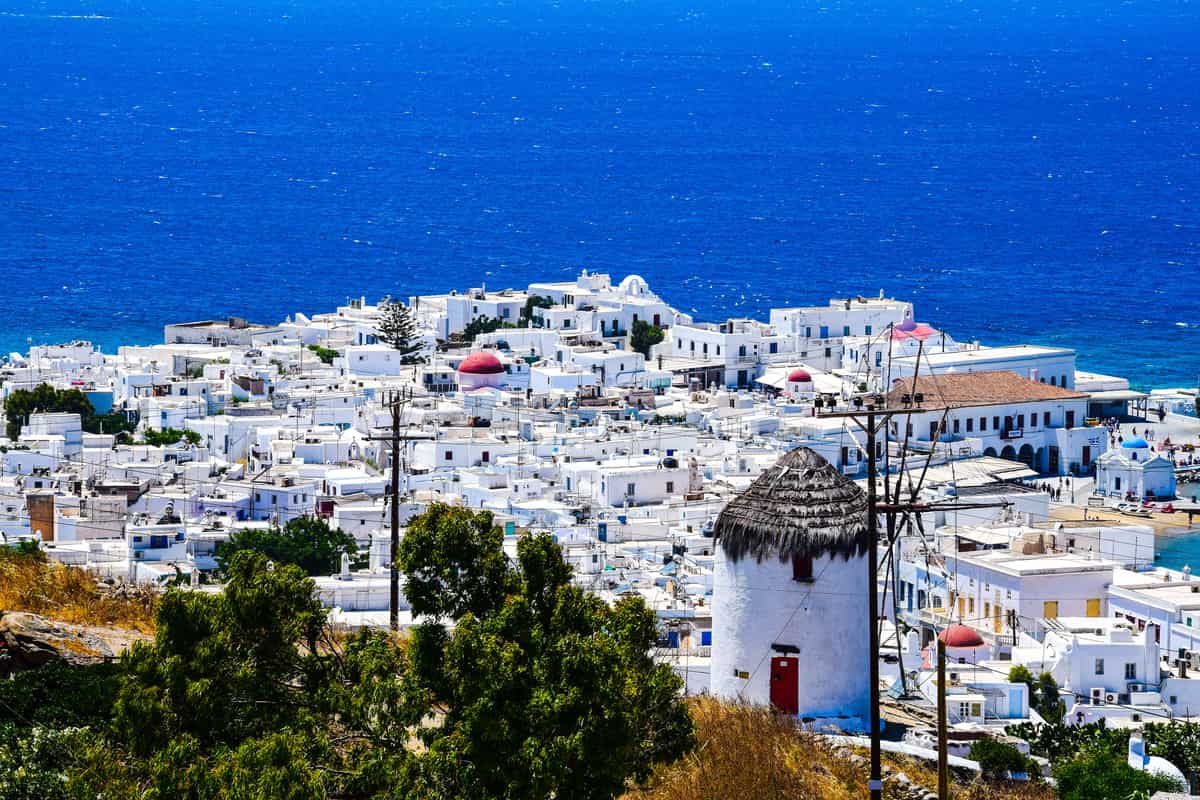
The national tourism website describes the Hora with narrow, paved streets. The houses are small and whitewashed, with windows in blue and balconies of wood. Wikipedia locates the Cyclades in the Aegean, to the southeast of mainland Greece. The page on the Cyclades islands sets that group out. That picture of the Hora frames any talk of Mykonos accommodation.
Wikipedia defines a flat roof as one that is almost level, with a pitch of up to about ten degrees. It calls the form ancient and found in arid climates, and says the roof space can serve as living space. In warmer places with less rainfall, flat roofs of masonry or concrete keep out the heat of the sun.
Wikipedia defines a vault as a self-supporting arched form, commonly of stone or brick. It covers a space with a ceiling or a roof. Until the topmost stone, the keystone, is in place, the vault is not self-supporting. A reader who meets the word vaulted in a room description for the Mykonos accommodation now knows the form overhead.
How do water and power reach the Mykonos accommodation on an island with no rivers?
Water for the Mykonos accommodation cannot come from a river, since the island itself features none, says Wikipedia. The same article lists seasonal streams instead and notes that two of them have been converted into reservoirs. Those reservoirs are the surface storage that the article names for the whole island.
Stored water is a plain topic for the Mykonos accommodation, and a cistern is one way to hold it. Wikipedia defines a cistern as a waterproof receptacle for holding water. It adds that a number of cisterns are built to catch and store rainwater. Modern cisterns range in capacity up to thousands of cubic metres, forming covered reservoirs.
Wikipedia separates a cistern from a well by its lining, which is waterproof. It names hydraulic plaster as a lining that prevents leakage. A separate article on the water tank lists the materials of a tank: plastics, fibreglass, concrete, stone and steel. The same article also gives the uses as drinking supply, irrigation, fire suppression and food preparation.
Reverse osmosis is a water purification process, says Wikipedia. It uses a semi-permeable membrane under pressure to separate water molecules from other substances. The article ties the process to drinking water made from sea water, since it removes the salt and other materials. For the Mykonos accommodation, the process stays a general explanation, not a claim about any room.
Wikipedia’s article on energy in Greece describes electricity for the whole country. In recent years renewables and hydropower rose from over a fifth of electricity generation to around half. Reliance on lignite fell sharply over the same time. The article on Mykonos gives no account of the island’s water network or power supply, so this page names none.
Wikipedia says present-day cisterns are in a number of cases used only for irrigation, because of concerns over water quality. A cistern for drinking water can be fitted with filters or other purification methods. The article calls it important that water is not left open to algae or mosquitoes. Water quality is a topic for the Mykonos accommodation too.
Start wider with the Mykonos History page, then the Greece Destinations page. Compare the Mykonos Shore Excursion with Cruise Ship Pickup page with the Delos and Rhenia Boat Cruise from Mykonos page. Another trip is the Mykonos Sunset Cruise with Snack.
What does quiet and noise mean for a room at the Mykonos accommodation?
Noise at the Mykonos accommodation has the same general sources as anywhere else that people live. Wikipedia names loud music, transportation, construction and electrical generators among the main sources of noise in residential areas. These are general sources, not a list of what stands next to any room on the island.
A room at the Mykonos accommodation meets quiet and noise through the building around it. In Wikipedia’s definition, a courtyard is open to the sky and can be surrounded by a building or complex. The article lists air, light, privacy, security and tranquillity as comforts that a courtyard offers. Tranquillity is the item in that list bearing on sound.
Wikipedia says courtyards have historically been used for cooking, sleeping, working, playing, gardening and keeping animals. The list shows that an open yard has served quiet purposes and busy ones alike. The article adds that courtyard homes have been designed and built throughout the world with variations. The Mykonos photo gallery here holds pictures of the island itself.
Wikipedia defines noise pollution as sound with potential harmful effects on humans and animals. It says poor urban planning can give rise to it. Industrial and residential zones that lie side by side are one example. The Mykonos accommodation topic borrows only this general definition. Wikipedia’s article on the island gives no sound measurement for any street or area.
Wikipedia calls tourism a major industry of Mykonos and adds that nightlife is what Mykonos is known for. Its economy section calls Mykonos a party destination during summer. Those lines describe the island as a whole, not one street. For the Mykonos accommodation, the night rhythm of an area is a separate fact that these lines do not measure.
The national tourism page for Mykonos says the island invites visitors to dance at beach bars and clubs. It also lists a lively atmosphere among the island’s highlights. That page lists neither hours nor a map of the venues. Quiet and noise at the Mykonos accommodation thus link to the island’s beach bars and clubs only in general.
How does access work at the Mykonos accommodation for guests with limited mobility?
Wikipedia links the growth of accessible tourism largely to the rise of senior tourism. That need grows as life expectancy increases in developed countries. For the Mykonos accommodation, access therefore concerns a widening group of travellers. The sources behind this page state nothing about the access features of any lodging on the island.
Wikipedia turns to Article 9 of the United Nations convention that protects the rights of disabled persons. It is the closest match to an international standard for tourism access. It deals with accessibility and with the equal access and the chance to take part that people with disabilities need. The Mykonos accommodation belongs inside that frame of rights.
The convention was adopted on the thirteenth of December in two thousand and six. Wikipedia gives it one hundred and sixty-four signatories. Its aims include legal protection of rights and freedoms, wider access to services for independent living, and less discrimination. It also raises awareness of disability issues. That is the legal background of access at the Mykonos accommodation.
A number of individual countries have laws that support the needs of people with disabilities, Wikipedia says. The United States requires access ramps at virtually all businesses and public places. Portugal, Spain, the United Kingdom, Germany and France are increasingly ready to receive tourists in wheelchairs. They are also prepared to provide disability equipment and wheelchair accessible transport.
Wikipedia presents its examples of solutions as a list that is not exhaustive. They address common problems that travellers with disabilities meet. The article calls the market an opportunity for new investment and new services. Key players of the tourism sector rarely provide such services. How the Mykonos accommodation answers such needs stays a matter for each lodging.
Wikipedia adds that the European Commission commissioned research into the accessible tourism market. Accessibility and universal design also feature in the international symposia of bodies such as the Commission. Modern society, the article says, grows more aware of integrating people with disabilities. Major resources now go to accessible tourism. That wider debate frames every Mykonos accommodation question on access.
What do the registry number and the climate-crisis resilience fee mean for the Mykonos accommodation?
A news page on the Greek registry of short-term rentals says every rented property gets a Property Registry Number. The number is called the AMA, and the tax authority runs the registry. The Mykonos accommodation touches the number only as a national rule. This page names no number for any property on the island.
The same news page says an AMA can be obtained only by registering online and giving proof of ownership. A host logs on to the registry with a personal code of the tax system. The page adds that a host registers each rented property on its own. Hosts who rent through online platforms must enrol in the registry.
A second news page, on stricter tax rules, says each room must have its own AMA. A new number must be issued whenever a property changes owner or manager. The registration covers rentals listed through platforms and rentals let privately. Authorities warn that non-compliance will trigger penalties. These are national rules, and they frame the Mykonos accommodation too.
One page says that services beyond the basic amenities, meaning bed sheets, require registration with the Tourism Ministry. That registration is the one of a tourist accommodation business. The live page on Mykonos hotels sets out the kinds of lodging and the areas of the island. This page covers only the registry and the fee of the Mykonos accommodation.
The Greek climate resilience fee is a nightly charge on hotel stays and short-term rentals, one news page says. A tax law of the Greek Parliament outlined its revised rates. The fee replaced the former stayover tax. One page says it funds preparedness and response for natural disasters. Another says it helps pay for reconstruction after a disaster.
News pages say rates differ with the type and star rating of the lodging and with the season. One page says exemptions cover youth hostels, campsites and lodgings in heritage buildings. Guests are charged on departure with a receipt, and receipts are declared monthly to the tax administration. This page lists no rate for the Mykonos accommodation itself.
What else do visitors ask about the Mykonos accommodation?
What does a kitchenette mean for a longer stay at the Mykonos accommodation?
Wikipedia defines a kitchenette, also written kitchenet, as a small cooking area. Its normal fittings are a refrigerator and a microwave oven, and a sink is another appliance that it can hold. A longer stay at the Mykonos accommodation makes the word matter, because it names a small place to cook.
The article finds the kitchenette in studio apartments and in a number of motel and hotel rooms. College dormitories, office buildings, furnished basements and the bedrooms of shared houses hold them too. In hotel rooms it is a common feature. It can hold a coffeemaker and a bar refrigerator, commonly called a mini-bar.
A stay of weeks at the Mykonos accommodation brings laundry as well, which Wikipedia defines as the washing of clothes. An apartment building or a student hall of residence can have a shared laundry facility. A stand-alone business is a self-service laundry, called a launderette in British English and a laundromat in North American English.
What is the number of visitors and inhabitants of the island for the Mykonos accommodation?
Wikipedia estimates at least one and a half million visitors to Mykonos in each year. For the Mykonos accommodation, that is a figure for the whole island, not for one lodging. The same article calls tourism a major industry there. In the article’s own wording, the visitor count is an estimate.
The island held ten thousand seven hundred and four inhabitants at the latest census, as the Mykonos article reports. The greater part lived in the largest town, Mykonos, on the west coast. Greek practice names that town Chora, meaning Town, whenever a town and its island carry one name.
A second figure sits in the geography section of the article. It states nearly twelve and a half thousand inhabitants, again with the greater part in Chora. The two counts differ, though both come from one article. The municipality reaches beyond the island, because it includes Rineia, Delos and a number of islets with no residents.
What is a tourist tax on accommodation, and how is it collected for the Mykonos accommodation?
Wikipedia says tourist taxes aim to raise revenue from tourists or from the tourism industry. The taxes can ease the demand that visitors place on infrastructure and public services. The article adds that they can be used to address the environmental impact of tourism. For the Mykonos accommodation, this is the general purpose of a tax on lodging.
Wikipedia calls the tax on accommodation the main type of tourist tax in Europe and the United States. The article names it the hotel tax, the occupancy tax, the lodging tax or the bed tax. It is levied on an individual who rents a room, rooms, an entire home or other living space.
Wikipedia says that in a greater part of countries municipal, regional or national governments levy the tax. It is collected at check-in and paid in addition to value-added tax. The way it works differs from city to city. Reykjavik, for example, charges a flat rate per room for each night.
What is a holiday home, and how does it differ from a hotel room at the Mykonos accommodation?
Wikipedia gives a holiday home three uses: holiday vacations, corporate travel and temporary housing. A stay of less than thirty days goes with that kind. Vacation home and vacation property are two more names for it in the article. A reader who sorts the Mykonos accommodation by kind can set the holiday home against the hotel room.
Wikipedia draws the line between the two kinds in a single sentence. The holiday home is a private residential unit that a traveller rents. Its spaces commonly include kitchens and living areas for the occupants. The article pictures small homes, such as cottages, that travellers rent for the duration of the stay.
The owner of a holiday home can use it for a vacation, and then the term second home applies. An agency can instead rent it to holidaymakers. Wikipedia adds that the names change by country. In Australia the word is weekender, in New Zealand bach or crib, and in the United Kingdom holiday cottage.
What does a cruise ship day mean for a stay at the Mykonos accommodation?
Wikipedia defines cruise ships as large passenger ships used mainly for vacationing. Unlike ocean liners, they are not used for transport. Each voyage is a round trip that calls at ports along the way. A day in port is one stop on that route. That stop differs from a stay at the Mykonos accommodation, where the traveller sleeps ashore.
Wikipedia adds that passengers can go on shore excursions at the ports of call. The excursion is a trip ashore from the ship, taken during the call. It forms part of the cruise itself. A traveller who sleeps ashore has no ship to return to. That is the plain difference between the two kinds of visit.
Wikipedia says cruising has become a major part of the tourism industry. The same word, major, appears in the Mykonos article, which calls tourism a major industry of the island. A cruise ship day and a stay on land are therefore two parts of one tourism picture. Each part fills a different place in that picture.