
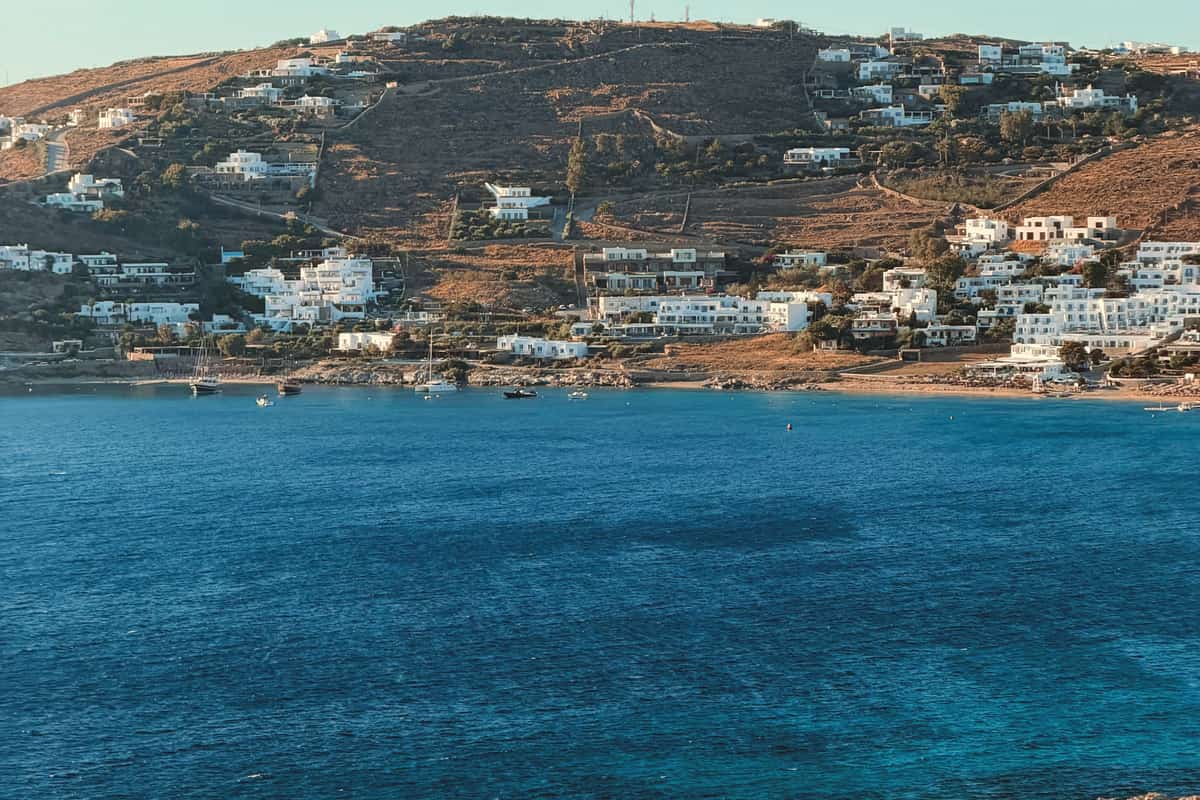
Mykonos Psarou beach hotels stand around a sheltered beach of medium size on the south coast of the island. Boat days and island tours from Mykonos are collected on our tours in Greece home page.
The sections below cover the position, the walk, the bus, the sand, the sea, the old index and questions. Each section answers one plain question about the beach, so a visitor can read only the part needed.
Where do the Mykonos Psarou beach hotels lie on Mykonos?
On the south coast of Mykonos, next to Platis Gialos, stand the Mykonos Psarou beach hotels. Wikipedia and the old entry give four kilometres to Mykonos Town. One travel page says four and a half, and the travel wiki says five. This page keeps each figure apart and merges none.
The old entry fixes the beach by a short walk. It says the beach lies within walking distance of the Platis Gialos bus terminus. It adds four kilometres from Mykonos Town. A footer marks that text as belonging to the years that end at two thousand and ten. The Mykonos Psarou beach hotels appear as that period described them.
Later sources give three figures for the same road from Mykonos Town. One travel page puts the bay four and a half kilometres out. The travel wiki lists five, and the Wikipedia article on the village says four. Start with Mykonos tours, the page for the whole island, if the layout of the coast is new to you.
Its short Wikipedia article describes a beach with a village, close to Platys Gialos. The infobox of that stub lists a latitude of about thirty-seven degrees and twenty-five minutes. Its longitude is about twenty-five degrees and twenty minutes. A map reads those numbers as one fixed point, and that point marks the Mykonos Psarou beach hotels.
Wikipedia puts Chora, the chief town of the island, along the western shore. The travel page puts this beach on the south coast. The two points sit on different coasts of an island that the travel wiki calls very small. The older sources give four kilometres between them, and that figure shows how short the distances on Mykonos are.
None of the four sources says where its measure starts. The start in the town can be the square, the bus station or the old port. None says whether it measured along the road or across the map. The gap of one kilometre between the figures for the Mykonos Psarou beach hotels stays open without a map.
Ask the lodging for its own distance to the town and for the road its guests drive. Check the current timetable of the buses before a walk. Compare each answer with a current map of the coast. Each of the Mykonos Psarou beach hotels stands at its own spot on the shore. Its figure is its own.
What is the name and the village history of the Mykonos Psarou beach hotels?
Psarou is the name on this page, and Wikipedia heads its article Psarrou. Wikipedia calls the place a beach and a village of Mykonos. It counts 106 people there at the twenty twenty-one census. The Mykonos Psarou beach hotels belong to that village. The old entry adds a claim of age.
Wikipedia heads its article Psarrou and doubles the letter r. Its infobox and one photo caption write Psarou with a single r. The old entry, the travel wiki and the keyword of this page use the single r as well. A search that finds nothing for the Mykonos Psarou beach hotels deserves a second try with the other spelling.
The Wikipedia entry describes Psarrou as a beach and village of Mykonos, a Greek island. It is a stub with no text on sand, sea or sports. For its beach information it cites a page of the Municipality of Mykonos on the island’s beaches. The stub tells a reader where the place is, not what the beach is like.
The stub gives a population of 106 for the village. It rests on the twenty twenty-one census, published by the Hellenic Statistical Authority. The Wikipedia article on the island counts 10,704 residents in the same census. The village holds about one resident in every hundred. That is a small place for the Mykonos Psarou beach hotels to stand in.
The article on the island lists ten villages, Psarrou among them. The nine others are Chora, Ornos, Platys Gialos, Tourlos, Ano Mera, Ftelia, Kalafati, Agios Ioannis and Agios Stefanos. Wikipedia files Psarrou in four layers: the South Aegean region, the Mykonos regional unit, the municipality and the community. For lodgings in the other bays, use the Mykonos hotel index.
A village, says Wikipedia, is a settlement larger than a hamlet and smaller than a town. It adds that geographers use a range of about five hundred to two thousand five hundred people. A count of 106 lies far below that band. The Mykonos Psarou beach hotels belong to a village by the island’s list, not by that range.
The old entry calls the beach one of the earliest established. No source read here dates the first visitors, and the stub gives no founding year. Wikipedia says the island drew the international jet set in the nineteen sixties. That sets the old claim in context for the Mykonos Psarou beach hotels. It does not prove the claim.
How large and how sheltered is the beach of the Mykonos Psarou beach hotels?
Two sources give two words for the size of the beach of the Mykonos Psarou beach hotels. They do not agree with each other. Both call the water sheltered. No source gives a figure for the length or the width. Check the size on the beach itself before planning a day there.
In the old entry, the beach of the Mykonos Psarou beach hotels is a medium size, well-sheltered beach. The page behind it carries a copyright line that begins in two thousand three and ends in two thousand ten. So the claim is dated. The entry gives no measure. Read it as the old index’s description, not a survey.
One travel page, which carries photographs and captions, speaks of a small sandy beach at Psarou. That is where the two sources part ways: medium in the old entry, small on the travel page. Neither gives a figure to settle the point. The words are impressions of two writers, so look at the sand for yourself on arrival.
A bay, says Wikipedia, is coastal water set back from a larger water body and linked to it. The Aegean Sea is the larger water body for the Mykonos Psarou beach hotels. So the bay is the water, and the beach is one edge of it. The long past of the island is told under Mykonos history.
Wikipedia notes that land surrounding a bay lowers the strength of winds and blocks waves. That is a general statement about bays and not a measurement of this beach. It explains why writers use the word sheltered for a place like this. How well the shelter holds on a given day, only the beach can show.
Wikipedia sorts bays by shape. A bay whose widest part lies at the mouth, between headlands, counts as open. A bay with a mouth narrower than its widest part counts as enclosed. No source says which shape fits the Mykonos Psarou beach hotels. A look along the shore from the sand is the only simple check.
Wikipedia adds how bays arise: softer rock wears away faster, and harder rock is left behind as headlands. It adds that bays mattered to settlement for their fisheries, and later became ports, thanks to safe anchorage. No source says how the bay of the Mykonos Psarou beach hotels formed. Check the size and the shelter on arrival.
What is the water like at the Mykonos Psarou beach hotels and how safe is a swim?
One travel page captions the water at the Mykonos Psarou beach hotels as clear. No source gives the depth or the type of sea floor, so check both on the beach. In Wikipedia, leisure craft are the main danger to snorkellers, and swimming with a buddy is a basic safety skill.
One travel page puts the word clear under a photograph of the water at Psarou. It is the only description of the water in the sources, and it is a caption, not a test result. For the Mykonos Psarou beach hotels, clear is therefore one writer’s impression. The water on the day is the final judge.
On the same stretch of coast, the next bay along is found at Mykonos Platis Gialos hotels. No source states how deep the water runs at Psarou or what the sea floor is made of. Both stay marked check on the beach, since the old entry says nothing. Learn them with a wade near the shore before swimming out.
Wikipedia states the risks of swimming plainly. A swimmer can be incapacitated by panic and exhaustion, and both are possible causes of drowning. It adds that currents and underwater obstacles are hazards to watch for. No source reports such a hazard at the Mykonos Psarou beach hotels. So this advice is general and fits any shore.
In Wikipedia, motorised boats working inshore, jet skis and speed boats among them, head the list of dangers to snorkellers. A snorkeller floats face down with just the tube showing, so a collision is possible. No source says whether boats pass close to the shore at the Mykonos Psarou beach hotels. Look at the water before entering.
Wikipedia adds that sailboats and sailboards are a particular hazard, because their quiet propulsion gives no warning. A swimmer can come up beneath a hull. Bright outfits and a dive flag towed on a float make a swimmer easier to see. Such care is a general habit, not a local rule at the Mykonos Psarou beach hotels.
A swimming buddy is a basic safety skill, says Wikipedia, which also advises watching the partner’s own condition. Drinking well beforehand matters as well, since good hydration prevents cramps. For sea life the rule is observe but do not touch, and that includes coral. No source reports coral at the Mykonos Psarou beach hotels, so that rule stays general.
How do the buses of the island reach the Mykonos Psarou beach hotels?
A travel page says buses from Fabrika in Mykonos Town serve Psarou, and the stop lies above the beach. Riders then walk downhill to the sand. The old entry only mentions a local bus that stops nearby. Anyone heading for the Mykonos Psarou beach hotels checks the current timetable.
That entry of the old index on this site is a dated claim, not a current timetable. It says a local bus service stops nearby. It gives no route, no stop and no hour. Readers planning a stay at the Mykonos Psarou beach hotels take that line as a pointer, not a plan. Look elsewhere for current facts.
The same travel page names Fabrika as the bus station of Mykonos Town where the Psarou buses start. It puts the stop above the beach. A rider walks downhill to reach the sand. A walk down to the beach means a walk up to the stop afterwards. The page gives no bus time and no route number.
Wikipedia defines a bus stop as a place where buses halt for passengers to get on and off. The article adds that a busy stop can have a shelter, seating and electronic displays. A quiet stop can be only a pole with a flag. No source tells which kind of stop serves the Mykonos Psarou beach hotels.
The flag on a stop pole commonly shows the route numbers of the buses that call there, Wikipedia says. The same article says a stop can also carry timetable information. A rider at this stop reads the flag first, then any posted times. Delos, the sacred island close to Mykonos, is described on the page called Delos island.
Wikipedia adds that certain stops serve as timing points, where a bus waits if it runs ahead of schedule. In busy urban areas, a bus can skip stops to save time and reduce delays. No source names a timing point or a skipped stop near the Mykonos Psarou beach hotels. Which stop applies is a matter for the lodging.
Wikipedia says buses commonly run to a published timetable that sets out both the route and the timing. This page gives no bus time for the beach, because no source states one. Before a day at the Mykonos Psarou beach hotels begins, the current timetable needs a check. The lodging can name the stop nearest to its door.
How do guests reach the boats from the Mykonos Psarou beach hotels?
A travel page says Psarou has no water taxi stop of its own. Guests walk to Platis Gialos, about ten minutes away, to catch boats to six other beaches. The way to the boats therefore starts on foot. For the Mykonos Psarou beach hotels, a check of the boat times follows.
The same page names six places that the boats from Platis Gialos reach. In alphabetical order they are Agrari, Elia, Ornos, Paradise, Paraga and Super Paradise. This page lists the six as places only, with no order, for the Mykonos Psarou beach hotels. At the landing, a guest can ask which of the six run that day.
The travel page calls Platis Gialos a walk of about ten minutes from Psarou. Paraga, a beach of the same south coast, is listed under Mykonos Paraga beach hotels. The page says nothing about the path, its surface or its shade. A guest asks the lodging how the route feels at midday and with heavy luggage.
Wikipedia says a small passenger ferry with multiple stops, as in Venice, is sometimes called a water taxi. It adds that ferries form part of the public transport of a number of waterside cities and islands. The travel page mentions a water taxi stop, and Psarou has none. Boats for the Mykonos Psarou beach hotels leave from Platis Gialos.
Wikipedia dates the earliest recorded water taxi service to the area that became Manchester. Marinas, harbours and cottage areas commonly have water taxis that run on demand, the article adds. Their job is to reach boats and waterfront properties that land routes miss. No water taxi stop serves the Mykonos Psarou beach hotels, says the travel page.
Wikipedia calls a quay, or wharf, a shore structure where ships dock. Passengers and cargo are loaded and unloaded there. A quay has at least one berth, a place for mooring a boat, and sometimes piers. Smaller wharves are sometimes built on pontoons, which keep them level with the boat. No source describes the landing at Platis Gialos.
Wikipedia notes that in certain countries even boats, such as gondolas, are or were used as taxis. A taxi runs from point to point, while public transport keeps to stops set by the provider. Check at the landing for the current times and the last return. That advice holds for every stay at the Mykonos Psarou beach hotels.
What is on the sand at the Mykonos Psarou beach hotels, and who uses it?
One travel page says the waterfront at the Mykonos Psarou beach hotels holds a public space for a towel. Organised sunbeds and restaurants take up much of the rest, the same page adds. One travel wiki calls the beach popular amongst Greeks. Check at the beach for the rules of each strip.
At the Mykonos Psarou beach hotels, a visitor can lay a towel in a public space, says one travel page. Wikipedia notes that a jurisdiction can make all beaches public by law. In Florida, it is not always clear which parts of a beach are public or private. Signs are sometimes posted where public access ends.
Much of the beachfront is taken by organised sunbeds and restaurants, says the same travel page. Notes that apply across the island are collected in Mykonos island information. The travel page names no business, and neither does this page. The sources give kinds of use at the Mykonos Psarou beach hotels, not a plan of the strips.
Wikipedia calls a sunlounger bed-like furniture, close to a deckchair. Its back can tilt up for sitting and reading, or lie flat for sleeping. A deckchair is a simple folding chair with a folding frame and one strip of canvas for seat and back. People use deckchairs on a ship’s deck, on a beach or in a garden.
In Wikipedia’s words, an umbrella is a folding canopy on ribs, mounted on a pole. In warm countries it first shaded people from the sun, in the early thirteenth century. Larger parasols can shade a group and serve as points of shade on a sunny beach. Ask who sets out the shade at the Mykonos Psarou beach hotels.
This site’s old entry places restaurants beside lodging and water sports in a single sentence about the beach. Its text is dated, so read it as a claim of its time. One travel wiki lists hotels, apartments and restaurants for the area. On this page about the Mykonos Psarou beach hotels, restaurants stay a kind, never a name.
One travel wiki says the beach is popular amongst Greeks. That line names a clientele, not a headcount or a share of visitors. Wikipedia adds that social norms on a beach in hot weather differ from the norms of nearby areas. Whether a sunbed carries a charge at the Mykonos Psarou beach hotels must be asked on the sand itself.
What kinds of water sport run from the Mykonos Psarou beach hotels?
A range of water sports at the Mykonos Psarou beach hotels appears in the old entry. A diving school is among them. The text is dated, and no fetched source names a sport that runs today. Ask at the beach for the current list before planning a day.
The old entry names one service among its water sports, a diving school. It gives no school name, no sport list and no opening season. The claim is a dated one, not a statement about today. A diving school is a kind of service. A visitor checks whether one runs now at the Mykonos Psarou beach hotels.
Wikipedia sorts water sports by how far the body is immersed in the water. Boating, canoeing, kayaking, paddleboarding and sailing belong on the water. Swimming, water polo and water aerobics belong in the water. Snorkelling and freediving belong under the water. These are kinds of sport, not a list of services at the Mykonos Psarou beach hotels.
Ornos is a small cove on the island’s west coast, and Mykonos Ornos beach hotels lists it separately. Wikipedia names dive centres, dive schools, live-aboard boats and day charters as providers of equipment, training and dives. A diving school is one provider. Whether the Mykonos Psarou beach hotels have one today, only the beach can say.
A scuba diver brings a personal gas supply, so movement is freer than on a surface line. Wikipedia adds that such divers stay under water longer than freedivers, who hold their breath. The kit includes a mask, fins, a diving suit, weights and buoyancy gear. A school at the Mykonos Psarou beach hotels can say which gear it lends.
Instructors tied to a certifying organisation train divers, says Wikipedia. The level of certification also sets a depth limit. Wikipedia gives 18 or 20 metres for entry-level divers and 30 to 60 metres for advanced divers. For junior divers the limit is 12 metres. A visitor to the Mykonos Psarou beach hotels asks which level a school teaches.
Windsurfing needs wind, and Wikipedia gives figures. A board starts to plane, or skim the surface, at about 12 knots with modern gear. Recreational riders find 15 to 25 knots right for planing. Experts can sail in much windier conditions. The sources hold no wind data for the Mykonos Psarou beach hotels. Ask at the beach about the wind.
Which lodging does the older page of this site file under the Mykonos Psarou beach hotels?
The Mykonos Psarou beach hotels have a page of their own in the old index. One lodging stands in the header and returns in a class list. The text is dated, because its footer closes at two thousand and ten. Each lodging states its own class today.
The old page prints its title in capitals as Mykonos Psarou beach hotels. A line beneath names the island and the country. A trail of five steps leads to it: the site home, the destination, the Cyclades, the island and the hotels. A top bar lists home, destinations, Greek hotels, car hire, cruises, tours, travel links and contact.
The old page shows a menu of hotels in Mykonos by category. Six group labels follow, four with stars in brackets. Deluxe has five, class A four, class B three and class C two. The last two labels read apartments and studios, then villas and private houses. These labels cover the island, including the Mykonos Psarou beach hotels.
The list below holds lodging pages that this group of the old index files at the Mykonos Psarou beach hotels. Each entry opens a page of its own with the details of that lodging. Treat this list as an old filing record, never as a ranking. Only each lodging can say which class it holds now.
- The old index of this site files one lodging under this beach: Psarou Beach Hotel Mykonos, and the Psarou Beach Hotel photo gallery shows its pictures.
Further down, the old page prints the class lists of the whole island, each under a row of asterisks. The old index files one lodging beneath the Mykonos Psarou beach hotels, and it returns in one of those lists. The lists give bare names and no detail. A reader who wants facts opens the page of the lodging.
A row of thirteen area names follows the class lists, one name for each area page. The Mykonos Psarou beach hotels are the third entry, after the town and Platis Gialos. The row sits above the closing menus of the page. For a comparison, the old index offers the separate beach of Agrari under Mykonos Agrari beach hotels.
A lower row of the old page leads to four island pages: home, tools, photographs and Delos. A last menu adds contact, car hire, cruises, tours, weddings and travel links. The footer span opens at two thousand and three and ends at two thousand and ten. Each claim about the Mykonos Psarou beach hotels belongs to that span.
What kinds of lodging are found near the Mykonos Psarou beach hotels?
Three kinds of lodging fill the old index: the hotel, the apartment and the villa. Wikipedia defines each of the three kinds in plain words. One travel page says the beachfront of the Mykonos Psarou beach hotels holds hotel-style lodging. Each lodging states its own kind and class.
A hotel, in the words of Wikipedia, gives paid lodging for a short term. Guest rooms run from small ones with a plain mattress to big suites. A suite can hold a dresser, a refrigerator, upholstered chairs and its own bathroom. Room kinds differ among the Mykonos Psarou beach hotels, so ask each lodging for its own list.
A separate page, Mykonos accommodation, collects the lodging of all other kinds on the island. English took hotel from French hôtel, a word with the same root as hospital. French first used it for a building with frequent visitors and care, not for beds. The inn of medieval Europe was the precursor of the modern hotel.
Smaller hotels, says Wikipedia, keep to the basic guest services alone. Larger ones can add a pool, a gymnasium, a day spa and restaurants. One travel page describes the beachfront of the Mykonos Psarou beach hotels as holding hotel-style lodging. It names no count and no class for any lodging. Only the lodging itself can supply those details.
A villa, says Wikipedia, is a type of house. It began as an ancient Roman country house that offered an escape from urban life. In early modern times the name tended to fit a detached house near a town, with comfort and a garden. Today the word covers residences of a wide range of sizes, says the same page.
Wikipedia names four Roman kinds of villa. The villa urbana was a suburban or country seat that was easy to reach from Rome or another city. The villa rustica was a farm-house estate that servants occupied permanently. The otium villa served rural retirement or pleasure. A seaside villa on the coast was called a villa maritima.
An apartment is a self-contained housing unit in part of a building, says Wikipedia. British English says flat, Australian English unit. A multi-storey building with three or more residences is an apartment building. The old index keeps apartments and villas apart from hotels. Among the Mykonos Psarou beach hotels, each lodging names its own kind and its own class.
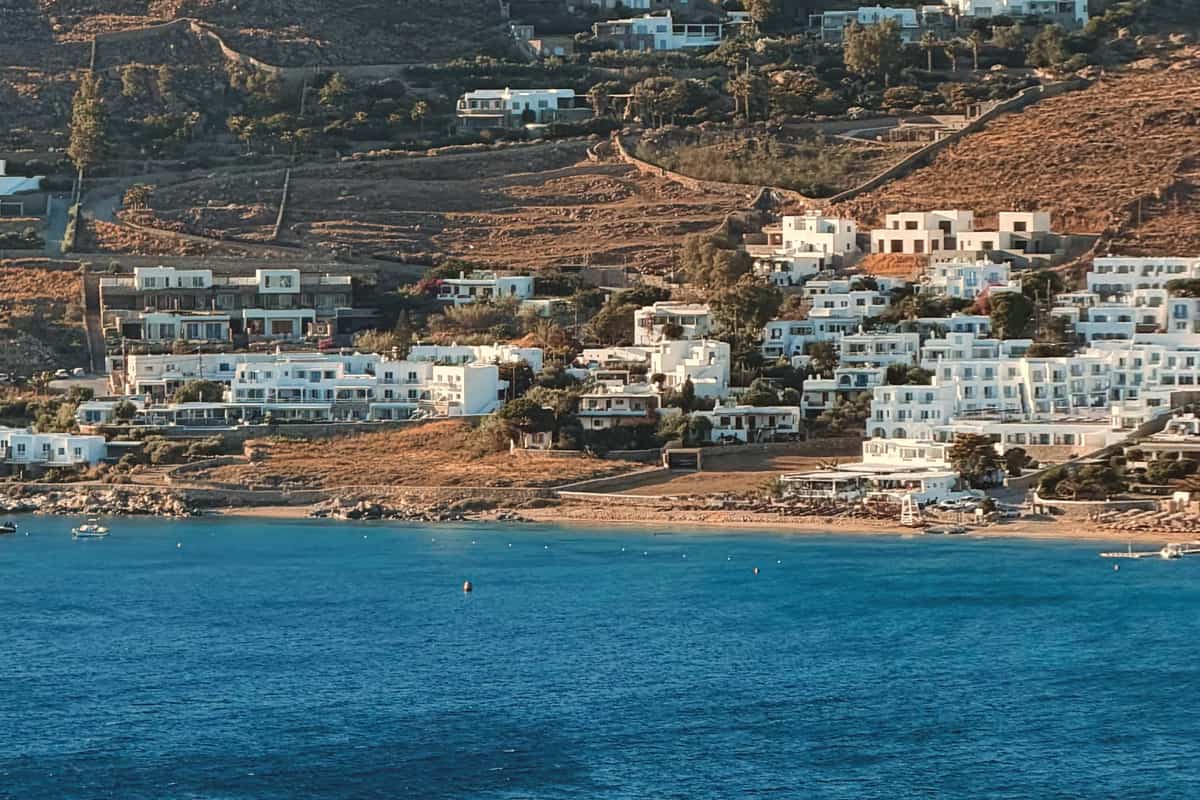
Which neighbouring beaches compare with the Mykonos Psarou beach hotels?
One travel page compares Psarou with two neighbours. It calls Psarou busier and more social than Agios Ioannis, and busier and smaller than Elia. Both neighbours appear here as places only. Anyone weighing the Mykonos Psarou beach hotels against them checks the map, because no source gives a walking time.
The old entry, a text whose copyright line ends in two thousand and ten, names no neighbouring beach. Any comparison rests on one travel page. It uses plain words such as busier, more social and smaller. It gives no figure, no rating and no distance. Anyone reading about the Mykonos Psarou beach hotels hears a mood, not a measure.
Agios Ioannis is Greek for Saint John. Wikipedia lists more than a dozen places with that name, among them villages in Cyprus, Corfu and Crete. One line reads Agios Ioannis, Mykonos, a beach resort on the island. Add the island’s name to any web search, or a village of another region appears first on the screen.
Elia is a plain name in the Wikipedia list of that title, shared by villages in Cyprus and Sithonia. The Mykonos entry is one bare line. Photographs of the island’s bays fill a page of their own, Mykonos photo gallery. A glance at them tells more about the Mykonos Psarou beach hotels than the word busier can.
Wikivoyage splits the island’s bus network between two stations, one on each side of Mykonos Town. Buses for Agios Ioannis start at the southern station. Buses for Elia start at the northern one, a short way from the ferry quay of the old port. The two neighbours of the Mykonos Psarou beach hotels start from different sides of town.
Wikivoyage adds that no bus links the two stations. Going on foot between them takes roughly twenty minutes along the streets of Mykonos Town. A day that joins Elia with a beach on the south coast therefore spends time between the two stops. Planning around the Mykonos Psarou beach hotels means counting that walk into the day.
The same wiki lists six daily departures from the northern station to Elia, each returning thirty minutes later. Paraga, Paradise, Agrari and Elia all have a bus link with the town, it adds, though Super Paradise has none. Schedules change about every two weeks, so check the current times before any trip from the Mykonos Psarou beach hotels.
What is the wind and the season of the sea at the Mykonos Psarou beach hotels?
Fetched sources hold no wind figure for Psarou. Wikipedia says the meltemi is dry and strong, a north wind that crosses the Aegean. Its run starts in late spring and finishes in mid-September. Wikivoyage calls it constant in July and August. Check on the beach for the Mykonos Psarou beach hotels.
Wikipedia names these winds the etesians, from a Greek word for year, because they return with the yearly cycle. Meltemi is the Modern Greek name. The article says it and the Turkish meltem were probably borrowed from the Italian for bad weather. Sometimes called a monsoon wind, it is dry and has no winter counterpart, the article adds.
Wikipedia dates the season from the middle of late spring onward. It adds that these winds dominate the weather of the Aegean. Counted to its end in mid-September, that makes about four months for the Mykonos Psarou beach hotels. Wikivoyage finds the beaches warm and sunny enough from the middle of late spring until the middle of October.
According to Wikipedia, the etesians are strongest after midday and ease off by night. Now and then a spell lasts days without pause. A separate article calls the sea breeze an afternoon wind that blows from the water to the land. At night a land breeze reverses the flow. That article calls both winds more local than prevailing winds.
Local topography shapes the direction of the etesians, says Wikipedia. The wind can arrive from the north-east, the north or the north-west. It gives the central Aegean a northerly wind and the southern part a north-westerly. Elia is a separate beach with another page, Mykonos Elia beach hotels. The article names no zone for the Mykonos Psarou beach hotels.
Beaufort force 7 or 8 is within reach of the meltemi, says the article. It can strike under clear skies, giving no notice. Such weather keeps certain yachts, and the greater part of the ferries, from sailing, it adds. Leisure sailors like the steady push. A swimmer at the Mykonos Psarou beach hotels reads the sea first.
Island of the Winds is the island’s nickname in the Mykonos article. It credits the meltemi and the sea for cool, dry, sunny summer days. The average summer high is near twenty-seven degrees Celsius, with nights above twenty-four. Rain falls from October until March. Island figures are the only weather facts that reach the Mykonos Psarou beach hotels.
What are the sand and the shore like at the Mykonos Psarou beach hotels?
Wikipedia describes a beach as land beside water, formed from loose particles. It treats sand as a granular substance made of tiny mineral particles. No source describes the sand or the shore of the Mykonos Psarou beach hotels. A visitor checks the colour and the grain on the beach.
Beaches form beside lakes and rivers as well, says Wikipedia, but the greater number lie on coasts. There, wave and current action deposits and reworks the sediment. The travel page calls the shore of the Mykonos Psarou beach hotels a sandy beach. It gives no depth of sand and no word on where the grains came from.
Wikipedia traces beach material to rocks eroded offshore, to eroding headlands, and to scree from slumping slopes. It adds that a coral reef off the coast supplies grains in large amounts. Fish that feed on algae on coral and rock also create sand, as they nibble and discard ground particles. No source names the origin of this sand.
Wikipedia sorts waves by what they do to a beach. Constructive waves arrive far enough apart for the water to recede and the sediment to settle. They move material up the beach. Destructive waves arrive close together and move material down. That balance shapes the shore of the Mykonos Psarou beach hotels. No source says which kind prevails.
Grain size gives sand its classes. Wikipedia reports five classes of sand in the United States: very fine, fine, medium, coarse and very coarse. The line between sand and gravel has held for more than a century. The town of the island is listed under Mykonos Town hotels. No class is on record for the Mykonos Psarou beach hotels.
Sand varies with the local rock. Wikipedia ranks calcium carbonate second among the constituents of sand. Coral and shellfish created one form of it, aragonite. Sands rich in magnetite are dark to black, and so are sands from volcanic basalt. Green sands owe their colour to chlorite, glauconite or olivine. No source gives the minerals of this beach.
Quartz and eroded limestone make a beach look white, says Wikipedia, as their grains reflect light and absorb no colour. In hot calm seasons the sun evaporates water on ocean beaches and leaves a salt crust. For the Mykonos Psarou beach hotels, no source gives the sand colour. A visitor judges colour and crust on the beach.
How do guests protect themselves from the sun at the Mykonos Psarou beach hotels?
Sunscreen is a product for the skin against sunburn, and Wikipedia measures its strength by the sun protection factor. No source gives any figure for the shade or the sun at the Mykonos Psarou beach hotels. A guest checks the shade on the beach itself before settling down on the sand.
Wikipedia calls sunscreen a supplement to other kinds of protection from the sun. Its examples are sunglasses, sunhats, clothing made for sun protection and umbrellas. The article lists sunscreen among the Essential Medicines of the World Health Organization. It sets no rule for the Mykonos Psarou beach hotels, and no source describes the sun on that shore.
The sun protection factor dates from nineteen seventy-four and measures the fraction of sunburn-producing ultraviolet rays that reach the skin. An Austrian chemist adapted earlier calculations for it. Wikipedia calls it the global standard for measuring UVB protection. An early glacier cream is estimated to have had a factor of two. No source advises a factor for this beach.
Wikipedia reports that in eighteen twenty an English physician found signs that something besides heat causes sunburn. He also recorded the protective effect of dark skin. An experiment in eighteen eighty-nine tied ultraviolet rays to skin burns. Research into blocking those rays began there. It leads to the sunscreen that a guest of the Mykonos Psarou beach hotels packs.
Wikipedia credits an Australian chemist with the first sunscreen, made in nineteen thirty-two with tannic acid as the filter. A German filter substance was patented in nineteen thirty-three. In nineteen forty-four, an airman made a protective product for soldiers who faced sun overexposure in the Pacific tropics. This page names no product for the Mykonos Psarou beach hotels.
Medical organisations recommend sunscreen, says Wikipedia, because it aids the prevention of squamous cell carcinoma. Routine use also carries a possible reduction in the risk of melanoma, the article adds. The article finds little evidence that sunscreen prevents basal cell carcinoma. These are statements about skin cancer in general, and no source links them to this shore.
Wikipedia adds that active ingredients differ in effectiveness, safety and effect on the environment. Allergic reactions and harm to marine life can come from certain ingredients, it says. Public health bodies generally consider the benefits of approved products to outweigh the risks. These points are general, and no source reports a sunscreen rule at the Mykonos Psarou beach hotels.
Can guests go snorkelling at the Mykonos Psarou beach hotels?
No source says whether snorkel hire or a marked snorkelling spot exists at the Mykonos Psarou beach hotels. Wikipedia treats snorkelling as floating on the surface, face down, and breathing through a tube. A guest who wants to try it asks at the beach about hire, rules and water conditions.
Wikipedia defines snorkelling as swimming at the surface with the face in the water. Breathing happens through a curved tube, and the swimmer puts on goggles or a mask, plus fins. A wetsuit joins the kit in cooler waters. At the Mykonos Psarou beach hotels, no source mentions the activity, so the definition given here stays general.
Wikipedia says the snorkel is a tube curved like an L or a J, with a mouthpiece at its bottom. The mouthpiece is gripped between the teeth. Light metal, rubber or plastic forms the tube. A loop or a clip holds it on the strap of the mask. Side-mounted tubes replaced front-mounted ones in the late nineteen fifties.
Wikipedia lists three parts of a diving mask: lenses, a soft rubber skirt over the nose, and a head strap. Goggles, which leave the nose uncovered, are enough for a swimmer who stays at the surface of the water. Across the island, the beach of Kalo Livadi is described on a separate page: Mykonos Kalo Livadi hotels.
Bare feet give little thrust, says Wikipedia, because they are small and poorly shaped for pushing water. Swimfins of rubber or plastic give the swimmer a more efficient stroke. Open-backed fins fit over wetsuit socks or boots in cooler water. A guest at the Mykonos Psarou beach hotels asks at the beach whether any fins are for hire.
A wetsuit is a garment of foamed neoprene, says Wikipedia, worn mainly for thermal insulation. It also gives buoyancy and protection from abrasion and stings from marine organisms. Thickness, fit and coverage decide how much warmth it holds. A hood, gloves, socks or boots can be added. No source gives the water temperature at the Mykonos Psarou beach hotels.
Wikipedia says snorkelling is possible in nearly any body of water. Snorkellers gather where the water is warm, the waves are small and a reef or wreck lies near the surface. No source reports a reef or wreck at the Mykonos Psarou beach hotels. Check on the beach what the water offers before packing any kit.
What distances separate the airport and the main port from the Mykonos Psarou beach hotels?
The old entry puts the airport 3 km and the main port 5 km from the Mykonos Psarou beach hotels. The airport article gives 3.5 km by road, about ten to fifteen minutes. These are claims of two sources, so check each distance on a map.
Only the old entry gives a figure for the port. It says the beach is 3 km from the Mykonos airport and 5 km from the main port. It does not say which port counts as the main one. A reader of the Mykonos Psarou beach hotels takes both figures as dated claims, not as a measurement.
The Wikipedia article on the airport says it lies 4 kilometres from the town of Mykonos. Further down, under ground transport, it states 3.5 km from Chora instead. The article gives two figures for one distance. This page repeats both and merges neither. The article puts the drive between the town and the airport at about ten minutes.
The same section lists the beach together with Ornos and Platis Gialos, at 3.5 km from the airport. The drive from the airport takes about ten to fifteen minutes. So the article’s figure for the Mykonos Psarou beach hotels is 3.5 km. Half a kilometre separates the old entry’s 3 km from the figure of the article.
Wikipedia dates the start of flights at the airport to nineteen seventy-one. In the off-peak tourist season, it says, the flight connections and operating hours are limited. The article names no months for that season. A guest arriving outside high summer checks the current flight list first. The sources give no opening hours of the airport for any month.
The article says taxis wait outside the terminal building, day and night. A bus service between Chora and the airport runs in the summer season only. Drivers reach the airport along the Mykonos provincial road, and the article calls the way easy. For the Mykonos Psarou beach hotels, check the bus timetable and the taxi stand.
Wikivoyage says boats call at the old port in Mykonos Town or the new port in Tourlos. Tourlos is about 2 km from town, to its north. Ferries mainly use the new port; fast catamarans use the old one. For the Mykonos Psarou beach hotels, the old entry’s 5 km to the main port fits neither port for certain.
Which remaining questions come up about the Mykonos Psarou beach hotels?
What is the count of lodgings at the Mykonos Psarou beach hotels?
None of the pages consulted for this work states a count for the Mykonos Psarou beach hotels. The old entry, a travel page, the village stub and a travel wiki were checked. None gives the number of lodgings or of rooms. A figure offered without a source is only a guess, so none appears here.
A travel wiki says the beach has hotels, apartments and restaurants, yet it gives no number for any of them. For the island as a whole, Wikipedia gives room for roughly 50,000 visitors each night. That figure spans every bay of Mykonos, so it says nothing about one beach.
Hotels differ in size, function and complexity, says Wikipedia. A count of lodgings tells little about beds, since a small house and a large resort each count once. Ask the lodging for its own number of rooms, and compare the reply with a current map before travelling.
Do taxis serve the Mykonos Psarou beach hotels, and how are the fares set?
Wikipedia defines a taxi as a hired vehicle carrying passengers from point to point, normally unshared. Public transport differs, because the operator fixes where passengers board and alight. No source names a taxi stand at Psarou, so ask the lodging where the nearest one is.
The travel wiki says taxis on the island do not use meters. It adds that a notice board gives the charge for each destination. So the fare follows the destination. This page writes no figure, because no fetched source copies the board. Read the board at the stand before the ride.
Wikipedia adds that the methods of regulation, hiring, dispatching and paying differ from country to country. It lists street taxis licensed for hailing and private hire vehicles licensed for orders made in advance. No source says how drivers on Mykonos take a request, so the lodging is the place to ask.
Which months are the busiest at the Mykonos Psarou beach hotels?
One travel wiki calls the island extremely crowded in July and August. It gives this as a fact about Mykonos as a whole, not about one beach. No source counts the visitors at Psarou. The two summer months are the island’s peak, and no source narrows that down to a single beach.
Wikipedia puts Mykonos in second place among the summer destinations of Greece. Its figure is 1.5 million visitors or more per year. The article does not split that total by month or by bay. These figures show that summer draws the crowd. They do not show how full the sand at Psarou becomes on a particular day.
On the island, Wikipedia gives summer nights above twenty-four degrees Celsius and a daily high near twenty-seven. The travel wiki’s two crowded months fall inside that warm season. For the weeks around July and August, no source gives a crowd figure at Psarou. Ask the lodging about its own busy and quiet weeks.
Which Psarou is meant in the Mykonos Psarou beach hotels?
This page means the beach and village of Psarou on the Greek island of Mykonos, and no other place. The sources read for it name no other place with that name. Wikipedia heads its short article Psarrou and describes a beach and village on Mykonos. That fits the keyword of this page.
In Wikipedia, Mykonos is one of the Cyclades, near Tinos, Syros, Paros and Naxos. Mykonos spans 85.5 square kilometres, and its summit rises 341 metres above the sea. It sits in the Aegean Sea, about 150 kilometres east of Athens. Every statement on this page concerns that one island.
Wikipedia puts the Cyclades at about 220 islands in the Aegean basin. The name points to the ring of islands around Delos, a sanctuary in ancient Greek religion. A search result for a Psarou outside Mykonos concerns another place. Only the Mykonos beach is covered here.
Does a sunbed at the Mykonos Psarou beach hotels cost a fee?
No source gives a fee for a sunbed at the Mykonos Psarou beach hotels. None gives a charge for a towel. This page writes no figure. A visitor checks at the beach what the sunbeds and the towels cost. A visitor also asks the lodging whether they are part of a stay.
In Wikipedia’s entry, a sunlounger is a chair-like seat for lying back. Terraces, gardens, pool decks and beaches are the places where it appears. The back is adjustable, so a user can sit up and read or lie flat. The article calls it widespread in the tourist resorts of Europe.
Wikipedia defines an umbrella, or parasol, as a folding canopy on a pole. It protects a person against sun or rain. Big parasols, it adds, make spots of shade on a sunny beach. The word parasol joins a Latin verb for ward off with the Latin word for sun. No source says whether shade is offered at Psarou.
Is there a lifeguard at the Mykonos Psarou beach hotels?
No source names a lifeguard or a lifeguard post at Psarou. The old entry, the village stub and one travel page say nothing on the point. Before a swim, a visitor checks whether anyone is on watch. A visitor also looks for a notice posted at the shore.
In Wikipedia, a lifeguard is a rescuer who watches over swimmers and other water-sport users. The setting can be a beach, a pool or a lake. Lifeguards are trained in swimming and in first aid with CPR. For the Mykonos Psarou beach hotels, this tells a swimmer what to look for.
The same article describes a drowning chain, in which each link can lead to an incident. The links include a lack of water-safety education, no warnings, no supervision and a weak swimmer facing strong conditions. It names prevention as the aim. Where no source names a lifeguard, the swimmer supplies the caution.
Which months are the Mykonos Psarou beach hotels open?
The sources give no opening months for any lodging at the Mykonos Psarou beach hotels. None is written here. Each lodging has its own dates for opening and for closing. Ask the lodging for them before planning a stay, and check them again close to the day of travel.
The travel wiki speaks for the whole island. It says the greater part of the hotels shut at the close of October. They reopen between the end of April and the first days of late spring. This is a statement about hotels as a group, not a date for any lodging at Psarou.
The same wiki names a stretch of the year with sun and warmth enough for the beaches. That window begins in late spring and ends in mid-October. It describes the weather of the island, not the calendar of one house. Each lodging remains the only source for its own dates.