
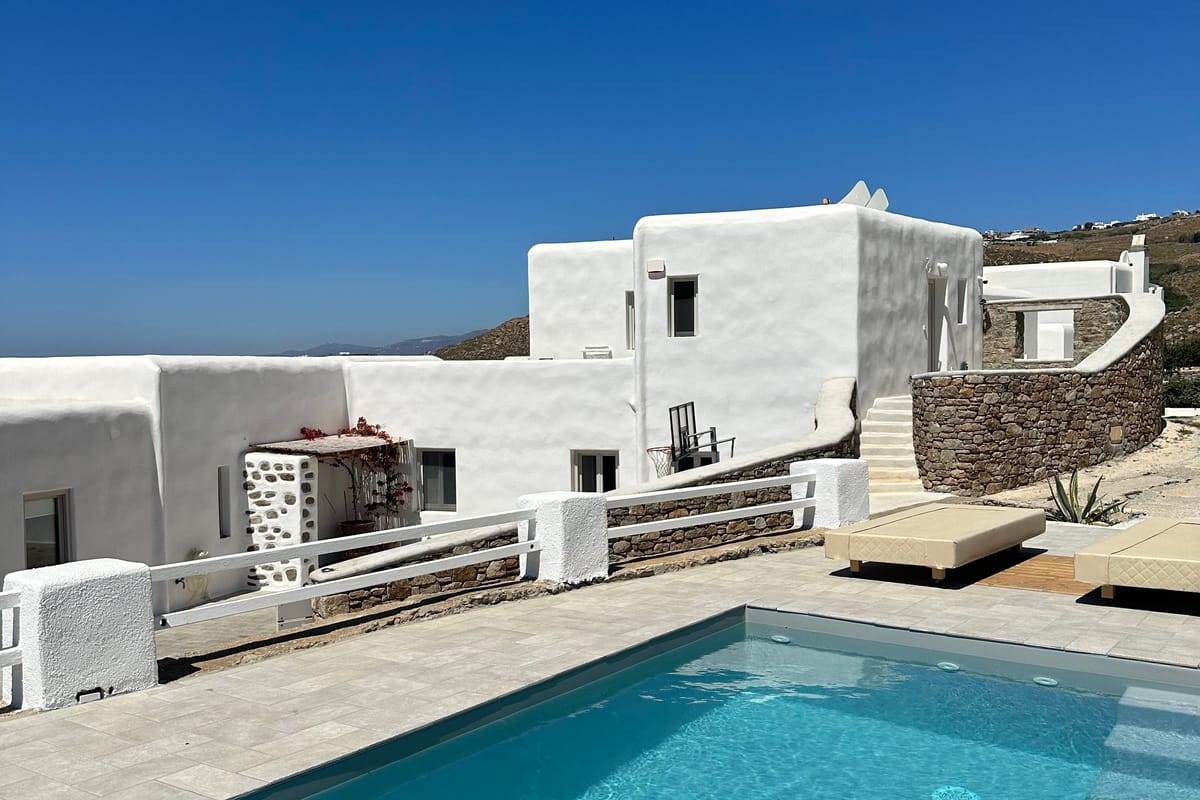
Mykonos villas are private houses with terraces and a pool, rented by the week or by the night. Boat days and island tours from Mykonos are collected on our tours in Greece home page.
The sections below cover the house, the pool, the bedrooms, water and power, the areas, the old index and questions. Each section answers one plain question about villas, so a visitor can read only the part needed.
What are Mykonos villas, and where does the word villa come from?
Mykonos villas are houses of the villa kind on Mykonos, and the word villa begins in ancient Rome. Wikipedia says a villa was first an upper-class country house that provided an escape from urban life. Over the centuries the word has moved from farm estate to monastery to suburban house.
Wealthy Romans escaped the summer heat in the hills round Rome, says the article, especially around Tibur. Imperial villas also clustered on the Gulf of Naples, on the Isle of Capri, at Monte Circeo and at Antium. Cicero allegedly owned at least seven villas, and he inherited the oldest. Mykonos villas share their word with these Roman retreats.
Roman writers praised the self-sufficiency of their estate villas, says the article. There the owners drank their own wine and pressed their own oil. In Roman Britain, villas were complete working farm societies of fields and vineyards. Each ranged round a high-status centre with baths and gardens. Day trips and boat trips have their own pages under Mykonos tours.
After the fall of the Roman Republic, villas became small farming compounds. In Late Antiquity they grew more isolated and were fortified with walls. Aristocrats gave working villas to monks, and such a gift sometimes became the nucleus of a monastery. The farm and the monastery are old senses of the word, not the sense of Mykonos villas.
Through the Middle Ages the villa re-evolved into country homes of the upper class. After the Middle Ages, the name readily fitted a comfortable house standing alone in a garden near a city. Suburbs have since swallowed the greater part of the survivors. Lodgings are sorted by kind in this site’s old index, as the Mykonos hotel index shows.
Present-day use is broad, says the article. The word can name a suburban semi-detached double villa. Especially around the Mediterranean, it names a country residence of above-average size. Spanish and Portuguese placenames hold the word too, where a vila is a town with a charter. So anyone reading about Mykonos villas meets this wide range of houses and places.
So the answer has layers. The word began in Rome and has meant a farm, a monastery and a suburban house. Today it names a certain kind of house. This page names no villa, so the lodging itself is the only source. A guest who reads Mykonos villas on a lodging page asks what size of house is meant.
How do Mykonos villas differ from a hotel room and from a detached house?
Mykonos villas differ from a hotel room because a villa is a whole house. A hotel room is one unit inside a hotel. They differ from a plain detached house because guests stay for a short time. Wikipedia’s definition of the detached home leaves out hotels, motels and other short-term stays.
Wikipedia defines a single-family detached home as a stand-alone residential building. The article lists other names: independent house, separate house and single-detached dwelling. It sets this home against the multi-family dwelling. Its list of house types names the villa beside the cottage, the bungalow and the mansion. Only the lodging can say whether Mykonos villas stand alone.
The word detached carries a rule, says the article: the building shares no wall with other houses. That rule excludes duplexes, triplexes, fourplexes and linked houses. It excludes terraced houses too, and tower blocks, which can hold hundreds of families in one building. A guest of Mykonos villas asks the lodging whether the house stands apart on every side.
Single-family means one household and one dwelling unit, says the article. The same definition leaves out short-term accommodation such as hotels, motels and inns. It also leaves out large-scale rental accommodation, such as rooming houses and apartments, and condominia. By that wording, a house let to guests for a short stay falls outside the definition of a detached home.
Wikipedia says a hotel gives each guest, or each group of guests, a private room. Small hotels can provide only the basic guest services. The article sorts hotel facilities by position, in the guest room itself or elsewhere on the premises. Ask the lodging which facilities of Mykonos villas sit inside the house and which sit beyond it.
A hotel can also hold a suite, which Wikipedia describes as linked rooms that carry the same number. By dictionary definition, a single large room is not strictly a suite. Hotels apply the same word to a roomier grade of lodging. A suite is still part of a hotel building, while Mykonos villas are whole houses.
The three forms differ in what the guest rents and for how long. A hotel room is one numbered room. A suite is a set of linked rooms behind one number. A detached house is one stand-alone building. Mykonos villas take the house form, so the guest asks the lodging what the stay includes, and for how long.
Do Mykonos villas have a private pool, and what kind of pool is it?
Wikipedia says private residences in warm climates can have their own pools. One travel magazine mentions a pool in six of its seven villa entries. Which pool a given house has today is for the lodging to say. Ask which kind of pool belongs to Mykonos villas.
For Wikipedia, a swimming pool is a structure that exists to hold water, which lets guests swim. It adds that a pool is either built into the ground or set above the ground. For the guests of Mykonos villas, the first question is plain. Is the pool sunk into the ground, or does it stand above it?
In-ground pools, the article says, are made of metal, plastic, composite, fibreglass, concrete or natural stone. They can follow a standard size or take a custom shape. The island’s past has its own full page, Mykonos history, and this page keeps to the pool. The material and shape of a villa pool are for the lodging to state.
Private pools run smaller than public ones, says the Wikipedia article. A home pool can be built in, or assembled above ground and taken down after summer. A plunge pool is a smaller pool that stays in one place for good. Which of these three kinds fits Mykonos villas is a fact that only each house can give.
The same article also records private pools in ancient Rome. It says the Roman emperors had private swimming pools in which fish were also kept. For that reason one of the Latin words for a pool was piscina. A pool beside a house is therefore a very old idea, and the article gives it a long record.
Wikipedia names Gaius Maecenas as the builder of the first heated swimming pool. He built it in his gardens on the Esquiline Hill of Rome, in a period between thirty-eight and eight BC. The article calls him a wealthy imperial advisor to Augustus. That garden pool is an early step in the history behind the pool of Mykonos villas.
The depth of a pool depends on its purpose, says Wikipedia, and on whether it is public or strictly private. A private pool for casual relaxing runs from one to two metres deep. A public pool for diving slopes from three to five and a half metres. Ask the lodging how deep the pool of Mykonos villas is.
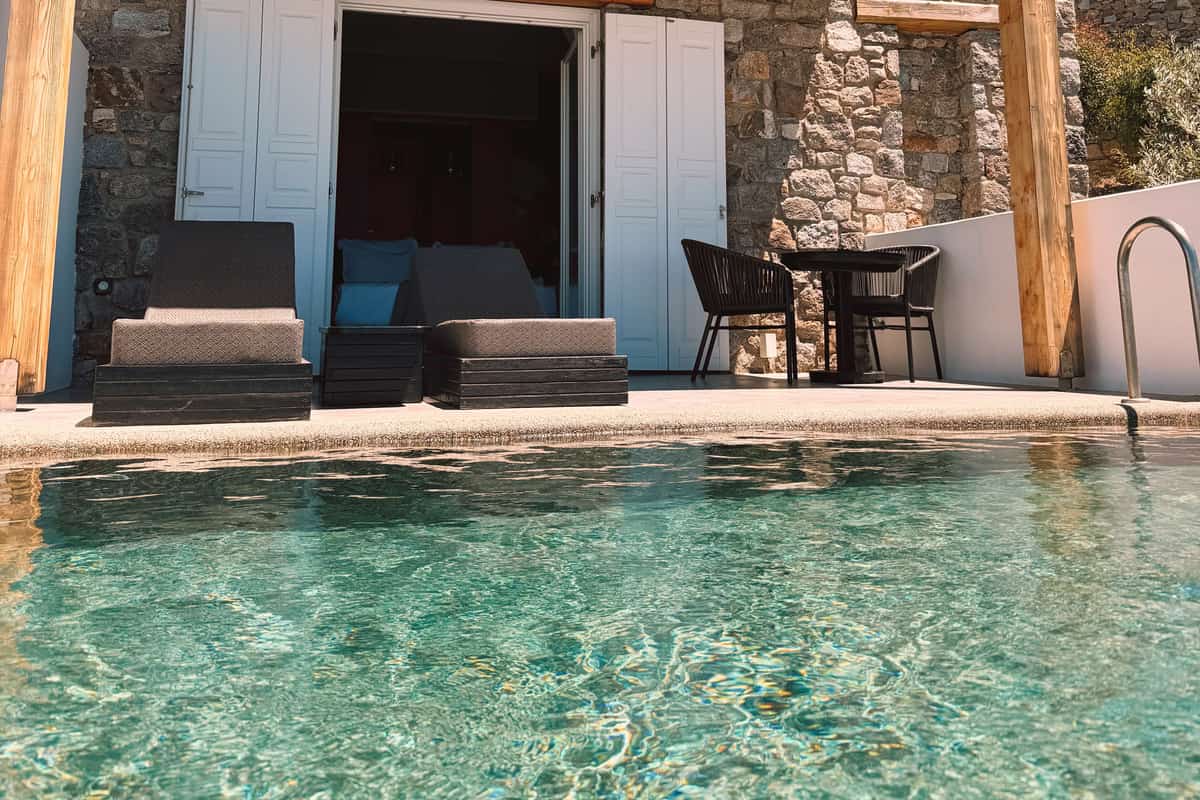
What do the plot, the garden and the terraces give the guests of Mykonos villas?
A garden, in Wikipedia’s account, is a planned space kept for the cultivation and enjoyment of plants. One travel magazine describes villa terraces that look out over the sea. The size of the plot and the plants of the garden at Mykonos villas are questions for the lodging.
The encyclopedia article defines a garden as a planned space for growing, showing and enjoying plants and nature. It adds that control is the single feature that identifies even the wildest garden. A garden at Mykonos villas is therefore a space that someone has planned and keeps. It is not open land left alone to grow wild.
The word garden goes back to a Germanic word meaning an enclosure, says the article. Yard, court and the Latin hortus belong to the same word family. In British English, a garden is a small enclosed area of land that adjoins a building. The size of the plot is a point to ask the lodging about.
Wikipedia names statuary, follies, pergolas and trellises among the design features of gardens. Water can join them in the form of a fountain, a pond, a waterfall or a creek. That list is general, drawn from gardens of every region of the world. The features of any garden at Mykonos villas are a question for the lodging.
Wikipedia lists relaxation and family dinners on the terrace among the uses of a garden. It also lists basking in warm sunshine and escaping oppressive heat. One travel magazine describes a villa that has two terraces. Its dining table faces the pool, under a wooden-beamed ceiling, with sea and mountain views. That entry shows the terrace kind.
The encyclopedia lists the flat roof as an old building form of dry climates. Its space can serve as a living space or as a living roof. In warm climates, a flat roof of masonry or concrete turns away the sun’s heat. For Mykonos villas the point is general: a flat roof can add living space to a house.
Wikipedia defines privacy as the condition of being kept clear of unwanted access, observation or disclosure. It says a right to be let alone has been read to include shelter from scrutiny at home. Each house screens its plot in its own way, so the lodging holds the answer. Ask about the privacy of the plot at Mykonos villas.
What bedrooms and places to sleep do Mykonos villas have?
Mykonos villas hold bedrooms for sleeping, and the number differs from house to house. One travel magazine describes a five-bedroom house with five bathrooms and another house with four bedrooms. The number of guests a house sleeps is not stated in these sources, so ask the lodging before a stay.
An encyclopedia article defines a bedroom as a room in a residential or lodging unit, used mainly for sleeping. A standard Western bedroom holds a clothes closet, a bedside table and a dressing table, with one or two beds. Mykonos villas can follow this pattern, but the article sets no rule for them. The lodging answers for each room.
Beds come in a range of sizes, says the article. A crib suits an infant, and a single or twin bed suits a child, a teenager or one adult. Larger sizes run from full and double to queen, king and California king. A guest who needs a certain bed can ask which sizes each room of Mykonos villas holds.
Two or more people who share a room can sleep in bunk beds, the article adds. In a dwelling of more than one storey, the bedrooms can sit on the upper floors. A family therefore asks which rooms hold bunk beds and which lie up a stair. Each of these points depends on the house and its plan.
Beds and bedrooms are devised to block insects and vermin, with mosquitoes singled out. The same devices dampen light and noise, which helps sleep and privacy. The article names no device, so guests of Mykonos villas check with the lodging about each room. Rested guests can plan a day trip, and the page on Delos island covers one.
One entry of the travel magazine lists five bathrooms on top of the sleeping space. Another entry describes calm en-suite bedrooms. The encyclopedia article calls a master bedroom joined to its own bathroom an ensuite. Whether Mykonos villas offer such a pairing of room and bathroom, only the lodging can say. The magazine gives no island-wide count.
The places to sleep in Mykonos villas are therefore a matter of count, size and layout. The sources describe the kinds of bedroom, bed and bathroom and leave the numbers to each house. The lodging states the bedrooms, the beds and the guest numbers of its own house. A guest asks for them all before the stay.
Which kitchen and outdoor cooking come with Mykonos villas?
The sources state no kitchen equipment for Mykonos villas, so the lodging has to say what its kitchen holds. Outdoor cooking has a plain meaning: barbecue is cooking over an open flame, with smoke as part of it. One travel magazine describes a campfire area with curved stone seating beside a pool.
An encyclopedia article describes barbecue as a wide family of ways to cook with fire and smoke. The word also names the devices of those methods and the meals or the gatherings where the food is served. For Mykonos villas the article lists no equipment, so a guest asks the lodging whether a house has a grill.
Direct heat means grilling food above hot coals or a gas flame, the article explains. The cooking takes minutes over a dry, hot flame. British usage matches this idea, since the article says barbecuing there means fast cooking directly over high heat. A guest who wants quick grilled food can ask the lodging which fuel its grill uses.
Indirect heat works the other way. In that style, meat roasts or smokes over wood or charcoal at low temperatures. The cooking runs for hours, and the article ties this style to American cooking. A guest who likes slow food asks what the house offers. Readers who want the bay of Ornos alone can open Mykonos Ornos beach hotels.
The Spanish word barbacoa gave English barbecue, says the article, and it began as a Taíno word. Etymologists link it to barabicu, a word recorded among the Arawak of the Caribbean. One dictionary quoted there reads it as a frame of sticks on posts. Hence the plain question about Mykonos villas: is there a barbecue, and of which kind?
One entry of the travel magazine describes a campfire area beside the pool, with curved and cushioned stone seating. That corner is for late evenings rather than cooking, yet it shows fire used outdoors at Mykonos villas. Whether a house allows a grill or an open fire is a matter for the lodging and its own rules.
In short, the kitchen and the outdoor cooking of Mykonos villas are described here by kind. Barbecue methods use direct or indirect heat, and the magazine adds a campfire area. The sources name no appliance, no fuel and no kitchen fitting for any house on the island. Each guest asks the lodging which equipment the kitchen has.
What kinds of staff service stand beside Mykonos villas?
Staff service for Mykonos villas comes in kinds that encyclopedia articles name: housekeeping, a butler and a personal concierge. None of these sources states which kind of service a given house provides. The lodging holds that answer for its house, so a guest asks about each kind of service before the stay.
An encyclopedia article defines housekeeping as the routine work that keeps an occupied building running. It names a house, a ship and a hospital as examples of such buildings. For Mykonos villas the idea is plain: someone keeps the house in shape. The article says nothing about the island, so the lodging describes what its own house receives.
The article lists the tasks of housekeeping as cleaning, cooking, organisation, shopping and bill payment. A separate page, Mykonos island information, sets out the practical facts of the island. A guest can hold each task against the answer of the lodging, one by one. Which of the five tasks does the house cover, and which does the guest keep?
Members of the household can carry out these tasks, the article says, or persons hired for the purpose. The article adds that a housekeeper has a wider role than a cleaner, who does the cleaning alone. In rented Mykonos villas the guest forms the household for the whole stay. Who then does the work? The lodging has to say.
A second article describes a butler as a domestic worker serving a large household. The article adds that a great house can split its household into departments. That pattern describes great houses and their staff, not a rented house on an island. Whether a house keeps a butler is a question for the lodging, since no source answers it.
The pantry, the wine cellar and the dining room fall to the butler, the article says. The housekeeper is in charge of the female staff of the house. These are roles of a staffed household, and the article describes no villa. A guest of Mykonos villas reads them as kinds of service to ask about, not as a promise.
A third article, on concierges, adds the personal concierge, who manages the errands of private clients. In short, three staff kinds can stand beside Mykonos villas: a cleaner, a butler and a concierge for guests. Each house decides for itself what it provides. Ask the lodging which services come with the stay and which are paid for separately.
Where on the island do Mykonos villas stand as areas?
Mykonos villas stand in areas that these sources name only in part. They are the Agios Stefanos beach beside Tourlos, the countryside next to the main town, and the bay of Kalafatis. Each area has its own distance from the town, so a guest checks the map and asks the lodging.
An encyclopedia article calls Agios Stefanos a sandy beach lying close to Tourlos, where the new harbour of Mykonos stands. A house in this area lies near the new port, which a guest can find on the map. The article names no villa or house there, so Mykonos villas of this area are placed by the lodging alone.
The article puts Agios Stefanos about three and a half kilometres from Mykonos Town by road. The figure belongs to the beach itself, not to a house. A villa set back from the shore lies at its own distance, which the article does not measure. A guest asks the lodging how far the house lies from Mykonos Town.
According to the article, guests on the beach find sunbeds, umbrellas and a choice of water sports. It also says visitors arrive by taxi, by private vehicle or on a regular bus from Mykonos Town. A guest of Mykonos villas in this area checks the current timetable for the bus line. The article gives no times and no frequency.
One travel magazine places one of the Mykonos villas between the quiet countryside and the busy main town. Its entry says a guest there can enjoy both sides of the island. That is the magazine’s own description of one particular house. It gives no distance, so the lodging has to say how far the town lies by road.
Another entry of the magazine puts a house just off the main path to the nearest beach. The town of Kalafatis, with its wide bay, lies a drive of ten minutes away. Water sports are also available there. For a guest of Mykonos villas, ten minutes is the figure for one house, not a rule for the area.
In these sources Mykonos villas stand in three kinds of place. They are the shore beside the new port, the rural land outside Mykonos Town and the Kalafatis bay. Each source speaks of one beach or house, never of the whole island. A guest asks the lodging where the house stands and how the road to town runs.
What do Mykonos villas look like from outside, and what is vernacular architecture?
One travel magazine describes whitewashed curves, rustic stone and wooden accents on the outside of Mykonos villas. The encyclopedia calls local building of this kind vernacular architecture. It means building made apart from any academic tradition, with no professional designers or architects. It names a broad category, not one fixed style.
Vernacular architecture is also called folk architecture, says the encyclopedia article. It stresses that the term is not a particular movement or style. The term covers a wide range of building types, built by differing methods from around the world. For Mykonos villas this means that the outside look grows from the habits of local builders, past and present.
The article gives a number for the size of this kind of building. In nineteen ninety-five, one scholar put vernacular building at ninety-five per cent of the built environment of the world. The scholar set it against the small share of new buildings that architects design and engineers build each year. The figure is an estimate, not a count.
The word itself comes from the study of language. In linguistics, vernacular names the speech of one time, place or group. Builders borrowed it for houses that belong to one place in much the same way. Lodgings of a smaller kind stand on another page, Mykonos apartments studios, apart from the whole houses of Mykonos villas.
The magazine pairs white walls with stone. It writes of whitewashed curves that blend into castle-like stone walls. Elsewhere it mentions patchwork stone walls beside traditional Grecian features, and another entry mentions sparkling white exteriors. These are the magazine’s words for single houses, which this page leaves unnamed. They show the outside that Mykonos villas are given in print.
The idea reached a wide public through an exhibition at an art museum in New York in nineteen sixty-four. It showed black-and-white photographs of buildings from around the world, made without architects. The article adds that the study of vernacular building looks at the skills of local builders. These builders were rarely given credit for their work.
Even scholars find the edges of the word hard to draw, the article says. As of nineteen eighty-six, no clear definition had been offered. The building rules of the island are a matter for the authority, so check the current rules. This page therefore describes Mykonos villas by the look of their walls, not by a rule.
What is whitewash, and what does it do on a wall of Mykonos villas?
Whitewash is a wall paint built on slaked lime or chalk. On a wall it hardens by absorbing carbon dioxide out of the air, and masonry takes it in easily. A wall of Mykonos villas can carry such a coat, and the lodging knows which paint its own walls hold.
The encyclopedia gives the same product a row of names: whitewash, calcimine, kalsomine, asbestis and lime paint. Its base is slaked lime, which is calcium hydroxide, or chalk, which is calcium carbonate. The word whitewashing comes from the product itself. The magazine calls the walls of Mykonos villas whitewashed, and this page describes the paint behind that word.
The coat hardens by chemistry, not by drying alone. Carbon dioxide in the surrounding air meets the lime, and the product is calcium carbonate, in the form of calcite. The article names this reaction carbonation, or the more exact term carbonatation. Chalk is made of the same compound. Air is therefore the second ingredient of the finish.
The article says the paint goes on exteriors. Whitewash is mildly antibacterial, which explains a second use: the inner walls of rural dairies. Trunks of fruit trees get a coat to prevent sun scald. Glasshouse roofs were whitewashed at the start of summer to cool the air below. On Mykonos villas the coat is a wall finish only.
The article calls whitewash especially compatible with masonry, because the wall absorbs it easily and the reaction then hardens it. Limewash is drawn into a wall, unlike modern paint that sits on top. A wall is damped down before the paint, or the lime stays powdery. The point holds for any wall, including a wall of Mykonos villas.
A second lime material stands beside the paint: lime plaster, a mix of sand, water and lime. The traditional kind, called non-hydraulic, sets only when kept moist and reached by carbon dioxide from the air. Under water it does not set at all. A very thick layer, or more than one layer, can stay soft for weeks.
Unlike plaster of gypsum or clay, lime plaster is sturdy enough for outer walls, the article says. Whitewash and lime plaster both depend on air and on a wall that takes them in. Neither article says that a given house uses either one. Which paint or plaster the walls of Mykonos villas carry, only the lodging can say.
How is water made for Mykonos villas, and what does desalination cost?
Water for Mykonos villas can come from desalination, a man-made way to take the salt out of sea water. The process leaves brine behind as a by-product. Its energy use makes it dearer than water drawn from rivers, lakes or wells. Ask each lodging where its own water comes from.
Desalination removes salts and minerals from a substance, and for water the substance is sea water. The encyclopedia article says the fresh water can serve people as drinking water or serve irrigation. Whether Mykonos villas use such a plant is a question to put to each lodging. A single house can draw its water in other ways too.
Desalination also sits on a short list of water sources that do not depend on rainfall. The encyclopedia article names recycled wastewater as another source of that same kind. Readers who want every kind of lodging in one place can open the page called Mykonos accommodation. It sets the house kind beside the rest of the island’s lodgings.
Energy is the reason for the higher cost. The encyclopedia article calls desalinating sea water generally more costly than fresh water from surface water, groundwater, recycling or conservation. It adds that these alternatives are not always available. Mykonos villas therefore sit inside a choice that only the lodging can describe. Ask which source it chose and why.
The energy needed for each cubic metre has fallen. In twenty eighteen the world’s desalination used about three kilowatt-hours for each cubic metre of water. In nineteen seventy the figure stood at twenty to thirty kilowatt-hours, so the improvement is tenfold. These are global figures, and they say nothing at all about the plant behind any single house.
Even at the lower figure, the share is large. Desalination represented about a quarter of the energy used by the water sector in twenty sixteen, says the encyclopedia article. A guest of Mykonos villas never sees that share on a tap. The lodging can say how its water is made. A question about the supply is easy to ask.
The idea of desalination is old. A besieged Spanish garrison on an island off Tunisia reportedly built a still in fifteen sixty. The details of the device are unknown. The same aim, fresh water from the sea, stands behind the question of how Mykonos villas receive their water today. The lodging can say which source its house uses.
What do air conditioning and solar water heating mean for Mykonos villas?
Air conditioning cools a house in hot weather. Solar water heating warms water with sunlight. Both matter to Mykonos villas. The first takes heat out of a room. The second needs a collector that faces the sun and a storage tank. Whether a house has either is a question for the lodging.
Cool indoor air helps protect against heat stroke. The encyclopedia article names dehydration from heavy sweating, electrolyte imbalance and kidney failure among the other problems of overheating. On a hot day, cooling is a health matter for a guest of Mykonos villas. Cooling is more than a comfort. Ask the lodging what kind of cooling each room has.
Cooling also uses power. As of twenty twenty-two, air conditioning used about seven per cent of global electricity. It also emitted about three per cent of greenhouse gas, says the article. Those are global shares, not a figure for any one house. A guest can still ask how the cooling of Mykonos villas is controlled and who services it.
Cooling also changes how people work. The article says air conditioners increase productivity in hot climates. It adds the historians’ view that the technology shaped the growth of cities after the war, alongside highways and cars. That is a point about cities, not about a rented house. It does show why cooling spread so widely in hot places.
The United Nations has called for alternatives to the powered unit, and the same article names five. They are passive cooling, thermal insulation, windcatchers, evaporative cooling and selective shading. Ask whether Mykonos villas rely on a powered unit, on shade, on wind or on insulation. For the hotel kind of stay, a separate page covers Mykonos luxury hotels.
Solar water heating means heating water by sunlight. A solar thermal collector faces the sun and heats a working fluid. The fluid then passes into a storage system for later use. The systems are either active, with a pump, or passive, driven by convection. A visitor to Mykonos villas can ask whether the roof carries a solar collector.
The article calls solar water heating widely used for residential applications. It adds that such systems can run as hybrids with an electric or gas heater. It also lists Greece among the leading countries by capacity per person, alongside Austria, Cyprus and Israel. For Mykonos villas, then, cooling and sun-heated water are two plain questions for the lodging.
How do guests reach Mykonos villas by car and by air?
Guests reach Mykonos villas by car, by air or by both. A car rental agency lends cars for short periods. The island’s airport handles flights to Greek and European cities. Wikipedia gives both facts. Only the lodging can say how the last stretch of road to the door runs.
A car rental agency rents automobiles to the public for short periods, from hours up to weeks. Wikipedia says the earliest known case of cars offered for rent dates back to nineteen hundred and six. For Mykonos villas, the plain question is whether a car is needed at all. The lodging can answer that question for its own house.
Wikipedia adds that an agency is organised with local branches. A branch network lets a renter return the vehicle at a different place from where it was taken. The pictures of the island are in the Mykonos photo gallery. Ask the lodging whether a rented car is easy to leave at the door of the house, and where.
Agencies stand mainly near airports or in busy city areas, says the article. An office stocks a range of vehicle sizes. It can also carry specialised types, such as convertibles, hybrid or electric cars, SUVs and passenger vans. Guests of Mykonos villas can ask an agency which types it holds. The article gives no list for the island.
Car rental agencies serve people who need a temporary vehicle, says Wikipedia. They include those who do not own a car and travellers who are out of town. A valid driver’s licence is required in all cases, the article adds. A number of countries ask for an International Driving Permit as well. Ask the agency what Greece requires.
The island’s airport serves flights to Greek and European metropolitan destinations, says Wikipedia. Wikipedia names the leisure appeal of the island as the reason for them. The article calls it international. Guests who fly to Mykonos villas land there. The ride from the terminal to a villa is a question for the lodging, as no source here gives it.
Nineteen seventy-one marks the first operation of the airport, says the article. In twenty fourteen the airport capped general aviation at a technical stop of two hours in the peak season. A notice for the summer of twenty sixteen cut the stop to one hour. Both ways of arrival shape a stay in Mykonos villas. Ask the lodging.
How does the old index of this site file Mykonos villas and private houses?
This site’s old index lists Mykonos villas and private houses on one dated page. Its heading names the summer of two thousand and five and a winter list. Below it stands a short group headed villas in Mykonos island, with three entries of one bay resort. All figures are claims.
The old page carries the title Mykonos island villas and private houses. The same heading carries the year two thousand and five. A second heading line names a winter list, from November two thousand and four to March two thousand and five. Both dates belong to the old hotel lists. The villas below them are dated claims too.
The page says that the list below holds selected villas in Mykonos. The page sorts the selected lodgings of the site by category and then by alphabet. The categories run from the deluxe list through the A, B and C class lists to the villas. A row of six links near the top of the page repeats them.
Here follow the links to the pages of the villas that the old index files in this group. Open a page to read what that villa says about itself. The list shows only how the old index sorted its entries. It makes no claim about size, class or availability today. It does not rank the Mykonos villas it holds.
- The old index of this site files three villas of one Ornos bay resort: Santa Marina Villas 101 and 102 Mykonos.
- The second entry of the group is Santa Marina Villa 144 Mykonos.
- The third entry is Santa Marina Presidential Villa Mykonos.
The group of Mykonos villas carries the heading villas in Mykonos island. It holds three entries, and all three belong to one resort at the bay of Ornos. The first entry joins a pair of villas, with two and four bedrooms, for four to eight guests. The other two entries give four bedrooms and eight guests each.
The old text places the bay of Ornos seven hundred metres from the main beach. It gives four kilometres to Mykonos Town and five to the old port. The airport is four kilometres away, and the new port six. Each entry repeats these figures. Read these numbers as the old text’s claim about Mykonos villas, not as today’s.
Class lists of hotels follow the villa group on the old page. Bare names fill those lists. The villas return at the foot as a plain row of three names. The old index thus files Mykonos villas beside the apartments and studios, under a heading of their own. Check the current page of a lodging before any plan.
What do the season and the rent by night or by week mean for Mykonos villas?
Wikipedia ties the Greek coasts and islands to a Mediterranean climate: summers are hot and dry, winters mild and wet. That season frames Mykonos villas. A vacation rental can run by the night, like a hotel room, or for a longer span. Each lodging states its own terms and dates.
Wikipedia’s tourism article gives Greece a Mediterranean climate along its coasts and islands. Inland, it adds, a number of areas and cities have a continental climate instead. Mykonos villas stand on an island, so the coastal line of the article is the one that fits. The article gives no weather figures for the island, and this page adds none.
Summers are hot and dry, says the article, and winters are mild and wet. Northern Greece can have cold winters. Southern Greece and the islands have considerably milder winters. For guests of the island, the cold of the north is not the picture to expect. Ask the lodging which months it takes guests, because the article names none.
The same article adds that initiatives are being made to promote seasonal tourism as well. It names no month, no island and no house. So the length of the season at Mykonos villas is not settled by it. A guest planning a stay outside the summer asks the lodging whether the house is open and for how long.
The airport article says that off-peak months bring fewer flights and shorter opening hours. For the south coast bay of Platys Gialos, a separate page exists: Mykonos Platis Gialos hotels. For a stay at Mykonos villas, which days does a flight land? Which hours does the terminal keep? Check the current timetable.
The vacation rental article says a number of rentals are let on a nightly basis, similar to hotel rooms. Each owner sets terms of payment, a cancellation policy and a key pick-up procedure, it adds. The guest contacts the owner directly. The same questions fit Mykonos villas: which nights does the lodging let, and what happens if plans change?
The article says owners generally hire a rental management company. A commission basis is the usual form, and it gives the owner no guarantee of weeks rented or revenue earned. In a second arrangement, the manager buys all the weeks in one transaction, which guarantees income. Which arrangement stands behind Mykonos villas is a question for the lodging.
How do sun and water safety apply to Mykonos villas?
Wikipedia describes sunscreen as a skin product against sunburn and skin cancer, and drowning as a type of suffocation. Sun and water are the two plain risks of a warm shore, and Mykonos villas share both. The risks are general, and each lodging states what its own house offers to its guests.
People guarded the skin from the sun long before lotions. Wikipedia says ancient Egyptians used extracts of rice, jasmine and lupine plants. Among the sea-going Sama-Bajau people of the Philippines, Malaysia and Indonesia, a common sun protection is a paste called borak. It was made from water weeds, rice and spices. Guests of Mykonos villas meet the same sun.
Wikipedia sorts sunscreens into mineral, chemical and hybrid kinds. A mineral product works mainly by absorbing ultraviolet rays, with a little reflection and scattering. A chemical product absorbs the rays and releases the heat. A hybrid product combines the two kinds. Which product a guest packs for a stay is a personal choice, and this page names no brand.
Wikipedia says medical bodies such as the American Cancer Society recommend sunscreen. The reason is the prevention of squamous cell carcinomas, a type of skin cancer. The article adds a possible second benefit, a lower risk of melanoma. Clothing, sunglasses, sunhats and umbrellas work beside the lotion. Ask whether the terrace of Mykonos villas has shade and umbrellas.
Wikipedia defines drowning as a type of suffocation caused by submersion of the mouth and nose in a liquid. It sorts the result into three types: death, long-lasting health problems or no complications. The article lists natural and man-made water, bathtubs and swimming pools as common places. Mykonos villas fall under the same plain rule: any water needs care.
Wikipedia says fatal cases happen alone, or where others nearby are unaware of the victim or unable to help. A person who cannot swim has just twenty to sixty seconds of struggling at the surface, the article adds. Children between one and four drown more commonly in home pools than elsewhere. A family weighing the pool needs that line.
The article ties drowning to extended periods near large bodies of water, so the risk rises with a long stay. It names steps such as learning to swim, never swimming alone, watching children closely and fencing a pool. Ask the lodging whether the pool of Mykonos villas has a fence, and who watches the children at the water.
Which other questions do guests ask about Mykonos villas?
What do the rules of short-term rentals say about Mykonos villas?
The encyclopedia article on short-term rentals defines them as furnished lodging rented out for brief stays. It calls them alternatives to hotels, for holidays and for housing during a move. The article’s see-also list names apartment hotel, condo hotel and vacation property. A villa let furnished for a short stay fits this description.
Rules exist, the article explains, because critics argue that short lets reduce affordable housing and push up long-term rents. Supporters answer that the effect on housing is minimal and that more homes are the remedy. The hotel industry has asked for tighter rules. Homeowner associations limit short stays too, and neighbours raise worries about noise, congestion and safety.
The article lists what a rule can require. Examples are a business licence, hotel taxes and a limit on rental days. Its European list gives Paris a limit of 120 days a year and London a limit of ninety. It names no rule for Greece. For Mykonos villas, ask the lodging which registration it holds.
What is a holiday, and how does a stay in Mykonos villas fit into it?
The encyclopedia article defines a holiday as a day or period set aside for festivals or recreation. The word comes from the Old English term for holy day, and it first named religious days only. In Commonwealth English it has a second sense, a spell of rest from work. A week in Mykonos villas belongs to that sense.
The article separates two uses of the word. In the United States it names a day of rest or celebration observed nationally, religiously or culturally. In the United Kingdom and other Commonwealth nations it can also mean leave from duties, a synonym for vacation. Entire industries aim at that time for rest, travel and recreation, the article notes.
Public holidays are set by public authorities and vary by state or region, the article says. Religious holidays are set by religious organisations for their members. When a holiday falls on a weekend, a substitute day can be recognised in its place. Ask the lodging how it handles arrival and departure on a holiday.
What is soundproofing, and can Mykonos villas use it?
The encyclopedia article calls soundproofing every means of impeding sound propagation. It names five methods. One is more distance between source and listener. Another is decoupling, which separates a source from the mass beside it. Noise barriers reflect or absorb the sound, damping structures such as baffles absorb it, and active generators cancel it.
On distance, the article says that sound intensity falls as the inverse square of the distance from its source. On mass, it says that only dense material stops sound from passing through a wall. It names concrete, plywood, fibreboard and rubber among the materials. Ask the lodging how thick the walls are and what they are built of.
For a house, the article puts the focus on windows and doors. A solid wood door blocks sound better than a hollow one. Heavy curtains dampen sound, although they lack a seal at the edge. Well-sealed double-pane windows insulate somewhat better than single panes. Ask the lodging which doors and windows its bedrooms have, and whether they seal.
What is water heating, and what uses does it serve in Mykonos villas?
The encyclopedia article defines water heating as a process that uses an energy source to raise the temperature of water. It lists the domestic uses as cooking, cleaning, bathing and space heating. Domestic hot water is the term for water heated for uses other than space heating. Which of these a given house serves depends on its fittings.
Traditionally, the article says, a kettle, a cauldron, a pot or a copper does the heating. Such a vessel heats a single batch and gives no steady supply at a set temperature. Appliances that give a steady supply carry names that differ by region. Boiler, hot water tank, heat exchanger and calorifier are four of them.
The article describes a storage tank as a vessel that keeps water hot and ready. Heat escapes through the tank wall, and heavy use leaves a delay before hot water returns. For small buildings, the article calls one central heater a good choice. Larger buildings can add small heaters at the taps to shorten the wait.
Who provides the water supply of Mykonos villas?
The encyclopedia article describes water supply as water delivered by a public utility, a business, a community or a person. Pumps and pipes carry it to the user, as a rule. Public systems, it adds, are crucial to a properly functioning society. The article names no supplier for Mykonos villas. Ask the lodging where its water comes from.
Service quality covers continuity of supply, quality of the water and water pressure, the article says. Continuity means that water flows without breaks, every day. Quality begins with treatment, and disinfection by chlorination or ultraviolet light is the common method. Pressure shows at the tap, and the lodging can answer on each of these points.
Pressure depends on height, the article explains. It gives about one bar for each ten metres. A house at the foot of a thirty-metre hill therefore gets about three bar more than one at the top. A booster pump or a hydrophore is installed to raise and hold pressure. Ask the lodging how the water reaches the taps.
What kind of coastline does Greece have around Mykonos villas?
The encyclopedia article on Greece gives the country nine regions and up to 227 inhabited islands. It adds that Greece has the longest coastline of the Mediterranean basin. The article gives no length for that coast and no description of the shore of Mykonos. For the nearest beach and the kind of shore, ask the lodging.
The article sets the Greek mainland on the Balkan peninsula, with thousands of islands reaching towards Asia Minor. The Ionian Sea lies west of the mainland. Turkey lies to the east, by land and across the Aegean Sea. The capital, Athens, is the largest city, and the country has a population of around ten million.
The article says the Cycladic culture thrived across the Aegean islands from around three thousand two hundred BC. That culture produced marble figurines, among them figures with folded arms. The island lies among the Cyclades, which lend the culture its name. The article adds that Greece is considered the birthplace of Western civilisation.
Is the pool at Mykonos villas chlorinated or salt water?
Only the lodging can say what water fills a pool at Mykonos villas. The encyclopedia article on swimming pools names two common fills, water treated with chlorine and salt water. A pool, it says, can be warmed or left unheated. A natural pool uses no chemicals and no disinfecting devices, only biological filters and plants.
A pool needs sanitation, the article says, because bacteria, algae and insect larvae breed in water that is not sanitised. Pumps, sand filters and disinfectants keep the water clean. It names chlorine and bromine as the chemicals in common use. It warns that poor upkeep of chemical sanitation can create high levels of disinfection by-products.
Hot tubs and spas are small heated pools for relaxation or hydrotherapy, says the article. Spa water is warm, between 38 and 42 degrees Celsius, so bathers stay in for twenty to thirty minutes. The article cites bromine or mineral sanitisers for spas, because chlorine fades in high heat. Ask the lodging whether a villa has a spa.