
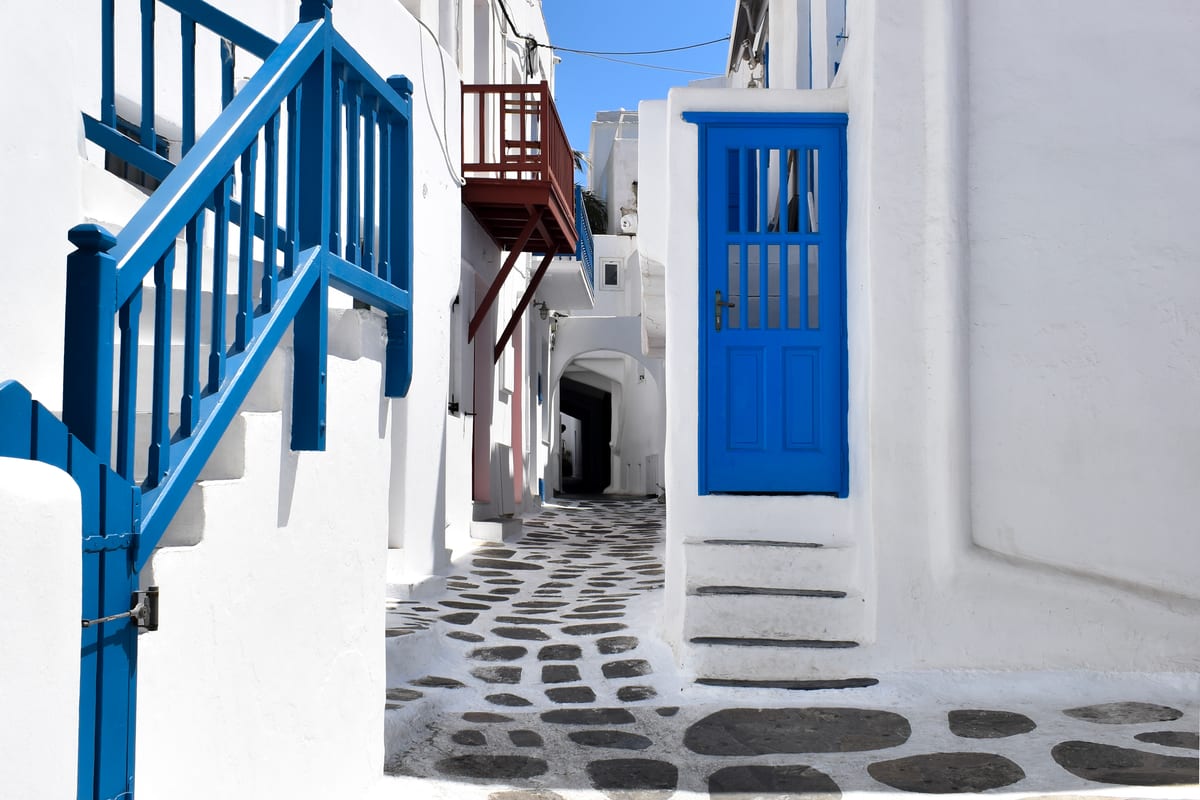
3 star hotels in Mykonos are the middle class of the island, built as small houses in white and blue. Boat days and island tours from Mykonos are collected on our tours in Greece home page.
The sections below cover the star scale, the old index, the house style, the positions and common questions.
What are the 3 star hotels in Mykonos on the star scale?
3 star hotels in Mykonos sit on the third step of a scale from one star to five stars. A news report of January two thousand and fifteen calls the Greek scale mandatory. The old index of this site named the same steps with letters, one letter for each step.
A ministerial decision, published in the Government Gazette, set up the system. Every hotel must follow minimum standards and collect a minimum number of points. Under that frame, 3 star hotels in Mykonos hold the third step. The report adds a closing date for the seal of the previous system: the end of two thousand and seventeen.
The old index of this site arranges the island’s hotels under four letters: deluxe, A, B and C. Its headings pair them with five, four, three and two stars. Its footer dates the text to the first decade after the year two thousand. Class A is its four star group and class C its two star group.
Wikipedia dates the founding of the Hotelstars Union system to a Prague conference in September two thousand and nine. The first member countries began to apply it in January two thousand and ten. Greece appears in the list of later members, under the year two thousand and thirteen. For the island itself, a reader turns to Mykonos tours.
The Hotelstars Union page for Greece lists five levels, and 3 star hotels in Mykonos belong to the third. Behind the levels stands a catalogue that groups two hundred and forty-seven elements into seven qualification areas. Every catalogue entry carries points. A level is reached when the total passes a set minimum, and certain criteria are obligatory.
What must the 3 star hotels in Mykonos hold under the scheme?
3 star hotels in Mykonos must meet three items listed on the Hotelstars Union page for Greece. They cover reception hours, a buffet or equivalent menu at breakfast, and one seat for each person in the rooms. Each is a plain fact that a visitor can ask the hotel about.
On reception, the page asks for ten hours of physical availability at the hotel. A second route is eight hours of availability plus guests who check themselves in and out, day and night. A traveller asks the hotel which route applies on arrival day. For 3 star hotels in Mykonos, that answer matters after a late ferry or flight.
On breakfast, the page requires a buffet or an equivalent menu. Which of the two a hotel serves, and what that menu holds, only the hotel itself can answer. Other questions fit here as well: at what hours is breakfast served, and in which room? A wider list of the island’s hotels sits in the Mykonos hotel index.
In the rooms, the page names one item for the third level: one seat for each person. For the class one step lower, the page states nothing of the kind. 3 star hotels in Mykonos carry three stated items, which a traveller reads as a short list of basics. A visitor can ask what seat each room holds.
Wikipedia adds that, for the Hotelstars Union, mystery guests check service quality at regular intervals. The checks cover hotels with three, four or five stars, and no lower level. Because of that range, the third step is the lowest one that they reach. One step higher on the scale stands 4 star hotels in Mykonos, the next class.
How does the traditional Cycladic house style show in the 3 star hotels in Mykonos?
Wikipedia ties the island itself to traditional Cycladic architecture in a single sentence. The old index of this site describes 3 star hotels in Mykonos through white and blue colours and Cycladic design. This section keeps the two statements apart and marks the old one as dated.
Wikipedia lists Mykonos in the Cyclades, an island group beside Tinos, Syros, Paros and Naxos. It adds that beaches, nightlife and traditional Cycladic architecture make the island widely known to travellers. A reader who wants the long story of the island opens Mykonos history. Five entries of the old index use the word traditional or traditionally about their own hotels.
One entry says its hotel was built in Cycladic style and uses the colours white and blue. Another entry says its hotel respects the Mykonian landscape through a traditional style in white and blue. Both claims are dated, since they come from an older text. 3 star hotels in Mykonos show their present look on their own hotel websites.
Wikipedia describes hotel classification in general terms, not for Greece. Classic systems focus on what a hotel offers: food service, entertainment, view, spas and gyms. Room size, access and location can enter the count, and other schemes add the quality of design and service. The three items of the third level, named above, mention no design.
One entry of the old index calls its hotel recently refurbished and counts twenty-one years of service. The word recently belongs to that older text, so the claim is dated. A visitor can ask each hotel when it last refurbished. Among 3 star hotels in Mykonos, the last refurbishment is a fact only the hotel can state.
Where do the 3 star hotels in Mykonos stand in Mykonos Town?
The old index gives eight of its ten 3 star hotels in Mykonos the label Mykonos Town. The town is Chora, the harbour town that serves as the island’s capital, with lanes of whitewashed houses. The old text adds position claims: facing the windmills, by the sea, close to the shops.
Wikivoyage names Chora as the capital, a town that grew around its harbour. It describes tiny whitewashed streets with houses and churches, all arranged around the harbour. Before a stay in the town, ask the hotel which lane holds its entrance. Ask also how long the walk from the nearest road takes, and where a taxi can stop.
The windmills stand along the western edge of Chora. Wikivoyage says the area around them looks out over Little Venice, which lies on the seafront. It calls the spot popular for the sunset. The page Mykonos Town hotels looks at the same lanes by area. This page sorts the 3 star hotels in Mykonos by class.
The old index entry was written in the period from two thousand three up to two thousand ten. It gives every hotel a place label and a short description. One description says its hotel faces the windmills. Another says its hotel stands by the sea. A third places its hotel within walking distance of the centre.
Another description puts its hotel at the quietest spot of the town. It adds that shopping areas, restaurants, bars and discos lie close by. That is a claim of the old text, and a quiet spot beside nightlife is worth a question. Ask the hotel whether its rooms face the lane, and until what hour the bars stay open.
Which 3 star hotels in Mykonos sit near the beaches?
The old index places three of its 3 star hotels in Mykonos on or beside a beach. One is at Megali Ammos, one on the walkway toward Platys Gialos and one at Agrari. Two more stand in the Vrissi area, up the hill from the town.
Wikivoyage places Megali Ammos about one kilometre south of Mykonos Town, roughly a ten-minute walk along the coast. The old entry includes one hotel directly on that beach among its 3 star hotels in Mykonos. The old text puts the town five minutes away. The two texts give different times, so only the hotel can answer.
Wikivoyage calls Vrissi a quiet area, a trek of fifteen minutes up the hill from the town. Two entries of the old text carry the Vrissi label. One lies on the way toward Platys Gialos. The other is a group of four hotels in one complex above the sea. For lodging of every kind, see Mykonos accommodation.
Wikivoyage says Agrari is less popular than its neighbour Elia and much calmer. The old entry places a hotel from its list of 3 star hotels in Mykonos on Agrari beach. It gives the distance from the town as seven kilometres. The hotel can confirm the road distance today. The page Mykonos photo gallery shows pictures of the island.
One more hotel of the old entry stands on the walkway toward Platys Gialos. It gives four kilometres to the town and the port, and three to the airport. Ask the hotel how it measures those distances and by which road. On the class scale, the page 2 star hotels in Mykonos covers the next class down.
How does the B class list of this site’s old index treat the 3 star hotels in Mykonos?
Class B of the old index covers the 3 star hotels in Mykonos. That index sorts every hotel of the island by category first and then by alphabet. The entries of this class therefore follow each other in the order of their names, from first letter to last.
A list under this paragraph gathers the pages of hotels in class B of the old index. The old entry introduces them as a list of selected hotels, grouped by category. The old index counts ten entries in all. Each entry has a name, a place label, a link to a photo gallery and a short description.
- The old B class list opens with Despotiko Hotel Mykonos.
- Next in the alphabetical order stands Iliomaris Hotel Mykonos.
- The group page of K Hotels Mykonos follows.
- Then comes Myconos Bay Hotel Mykonos.
- The fifth entry is Petasos Town Hotel Mykonos.
The short descriptions of the old text repeat the same themes. These are family ownership, the colours white and blue, and rooms with views of the town and the sea. Those are claims of the old text, not checks made today. The old index lists lodging only, so the neighbouring island has its own page, Delos island.
A second list continues below with the pages of the remaining entries that the old index files under that class. The index is the source of the class label, and it is not a current register. A label of that time cannot say what a hotel holds now. Ask each hotel which name and which class it holds today.
- The second half of the list begins with Petinos Hotel Mykonos.
- The page of Poseidon Hotel Mykonos comes next.
- Sunrise Hotel Mykonos is the eighth entry.
- The ninth entry is Vencia Hotel Mykonos.
- The list ends with Vienoula’s Garden Hotel Mykonos.
The old index used letters for its classes. The sources read for this page speak of stars, and none of them confirms the old letters as current labels. A hotel that the old text files among the 3 star hotels in Mykonos can hold another class today. Only the hotel can name its class now, so ask first.
What else do visitors ask about 3 star hotels in Mykonos?
How large is the resident population of Mykonos beside the 3 star hotels in Mykonos?
The Mykonos article puts the number of islanders at close to twelve and a half thousand. The greater part of them have a home in the main town, which carries the name Chora. For the 3 star hotels in Mykonos this is the resident base: one island, one main town.
In its opening lines, the article quotes the census of twenty twenty-one. That count is ten thousand seven hundred and four people, below the figure above. The text gives no reason for the gap. The largest settlement is Mykonos town, which lies along the western edge of Mykonos itself.
The article adds that the island produces water from sea water by reverse osmosis. It names four thousand five hundred cubic metres a day, meant to serve residents and guests alike. The same article puts the nightly capacity for visitors at about fifty thousand. Ask the hotel for its own room count.
What is whitewash on the walls of 3 star hotels in Mykonos?
Wikipedia treats whitewash as a type of lime paint. Its base is either slaked lime (calcium hydroxide) or chalk (calcium carbonate). Among the other names the article lists are calcimine, kalsomine and asbestis. The word whitewashing comes from this product. The article also says additives are sometimes used.
The paint hardens through carbonation. Carbon dioxide in the air reacts with it, and the result is calcium carbonate, as calcite. The article says limewash and whitewash end up as the same material once cured. For the 3 star hotels in Mykonos, ask the hotel which finish its walls carry.
Per the article, new paint has low opacity, and drying and curing add opacity. It also says basic limewash can fall short at keeping out rain-driven water. Additives named include egg white, glue, salt, milk and flour. Silicate paints are gaining ground over limewash in the United Kingdom.
Which wind blows over 3 star hotels in Mykonos in summer?
The wind that blows over the island in summer is the meltemi. Wikipedia also gives the name etesian, from the Greek word for year. It describes strong dry north winds, a pattern that starts after spring and fades around mid-September. The island’s nickname in that article is the Island of the Winds.
Afternoon brings the strongest wind, and it eases at night. Now and then one spell runs for days without a break. Such wind stops a number of yachts and the greater share of ferries between islands from sailing. Before a crossing, a guest at the 3 star hotels in Mykonos reads the current timetable.
Wikipedia calls the etesians dangerous to sailors, since they spring up under a clear sky unannounced. Because of the winds, the climate article adds, Aegean temperatures stay lower than Ionian ones. The Mykonos article credits the meltemi and the sea with relatively cool, dry summer days.
What climate and tourism setting surrounds 3 star hotels in Mykonos?
Wikipedia’s climate article names the Mediterranean type as the leading climate of Greece. The hot semi-arid group, it says, covers a large share of the Cyclades instead. Within that group it calls Schoinoussa, a place in the Cyclades, the driest area in Greece. Greece has eleven climates in all, it says.
The tourism article places the Mediterranean climate on the coasts and the islands of Greece. It describes summers as hot and dry and winters as mild and wet. In the south and on the islands, winters are considerably milder than in the north. Ask the hotel which months it stays open.
Wikipedia calls Greece a developed country that depends heavily on tourism. The article lists religious, eco, conference and medical tourism among the prominent kinds. The article counts about one hundred and fifty museums across the country that visitors reach easily. Among the major tourist destinations it names Mykonos.
Why do ratings of 3 star hotels in Mykonos vary by market?
Wikipedia sorts hotels by criteria such as their quality, their size, their site and their guests. A rating system is focused on the first of these, which covers amenities and the level of service. So a rating speaks to quality, not to the size or the location of a hotel.
The article states that hotel ratings have no global standard. So one rating level carries different amenities in different markets. Its example: a spa fits a higher rating, a television in every room a lower one. In Greece, the 3 star hotels in Mykonos follow a national scheme, not a world scale.
The article also ties a hotel to its customers. Business, conference and leisure travel are common reasons for a trip. Facilities and services vary with the customers a hotel aims to serve. It adds that no single country leads the travel industry, so hotels serve travellers of different countries and languages.