
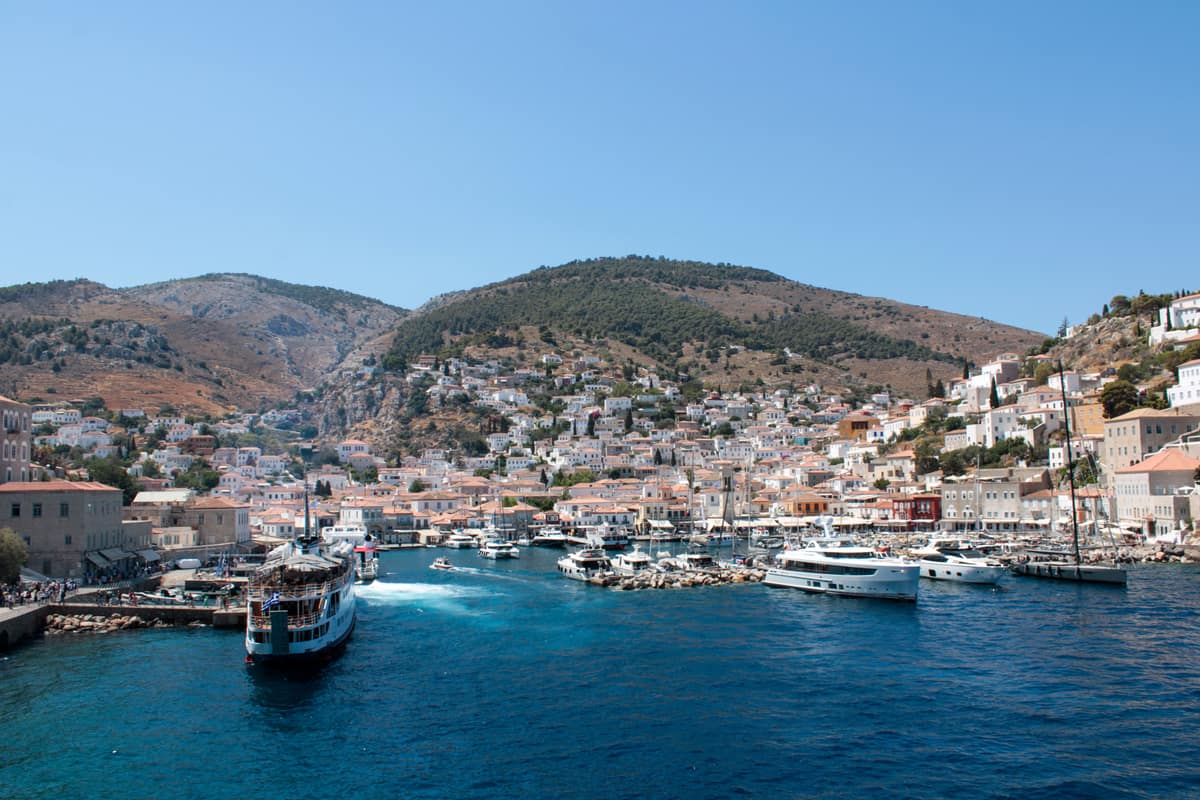
Hydra hotels stand on a car-free island of the Saronic Gulf, and the greater part of them cluster around the crescent harbour of Hydra Town. For tours and day trips from Athens, see our tours in Greece page.
The sections below cover the kinds of lodging, the star classes, the old index of this site, the ban on wheeled vehicles, the sea routes from Piraeus, the island history and a short list of common questions.
What kinds of Hydra hotels does the island have?
Wikivoyage says the island holds small hotels and guest houses for travellers who stay beyond a day trip. A traveller sorting the Hydra hotels meets three lodging words that Wikipedia defines: hotel, apartment hotel and vacation rental. Each word names a different arrangement between guest and host.
Start with the plain hotel. Wikipedia defines it as an establishment that rents out rooms for a short stay, against payment. Two ideas carry the word: the stay is paid, and the stay is short. Among the Hydra hotels, this is the plainest kind. A traveller who wants only a day on Hydra reads about Hydra tours instead.
An apartment hotel is a different arrangement. Wikipedia describes a serviced apartment complex that takes guests the way a hotel does, with no fixed contract. Each unit is normally a fully fitted apartment. Occupants check out whenever they wish, after the shortest stay the company requires. Wikipedia adds that guests use such places as long-term accommodation.
Wikipedia explains a vacation rental as a furnished apartment, house or managed resort complex. Tourists rent it for a limited period, as an alternative to a hotel. A traveller who compares Hydra hotels with that choice weighs a hotel’s lodging against a furnished property. A night in the capital before the boat belongs to Athens accommodation.
Wikipedia’s entry on the island describes steep streets of stone that climb and spread outward from the harbour area. The same entry places the greater part of the local homes and hostelries on these streets. A steep street means a climb to the door, whatever the kind of lodging: hotel, guest house or rental.
Wikivoyage warns that a number of lodgings on the island are reached only by climbing stairs. A guest who finds stairs hard asks the hotel before choosing. For Hydra hotels, that question comes first. On which floor does the room sit? Do stairs lead up to the door? Does a ground-floor room exist, or a lift?
Where do Hydra hotels sit outside Hydra Town?
Outside Hydra Town, Wikipedia names six small settlements on the island: Episkopi, Kamini, Mandraki, Molos, Palamidas and Vlychos. A traveller weighing Hydra hotels beyond the port asks each hotel for the walk to the harbour. Wikivoyage gives a distance for Kamini and for Vlychos.
Wikipedia calls Hydra port the one main town on the island. It calls the six places it names small villages or hamlets. The Hydra hotels outside Hydra Town therefore stand in villages or hamlets. A name such as Palamidas or Molos gives no distance. A traveller asks the hotel for the road and the walk to the quay.
Episkopi comes with a find from the past. Wikipedia reports that vases and coins from the Byzantine era were found in the area of Episkopi. The finds point to settlers on Hydra at that time. A room in Episkopi calls for a question about the road, the stairs and the time to the port.
Kamini has the clearest directions of the six. Wikivoyage says a walker who heads west from the port for about a kilometre, past a little headland, reaches Kamini. It calls the village far less touristy than the port. Anyone weighing Hydra hotels in Kamini sets that less touristy village against about a kilometre to the boats.
Wikivoyage describes Vlychos, spelled Vlihos there, as a pebble beach west of the port. The same page puts it about a 45-minute walk from the main port. Wikipedia lists the name among the six small settlements of the island. A room near Vlychos calls for a question about the path, its slope and the time on foot.
Three questions suit every settlement outside the port. How far does the walk to the harbour run? Is the road to the door paved, or does it climb stairs? For the wider picture, a separate page on this site gives Hydra island information. The same questions fit all Hydra hotels beyond the quay, whatever the village.
How do star classes read for Hydra hotels?
Star classes sort lodgings by quality, and more stars signal a higher standard. For Hydra hotels the stars mean little until a reader knows which scheme set them and when. Wikipedia counts a wide variety of schemes across the world, run by different bodies.
Reading the stars of Hydra hotels starts with what traditional systems count. Food services, entertainment, a view, spas and fitness centres all count. Location, ease of access and room size can enter the score as well. A number of standards add design and service quality. One missing item can hold a smaller hotel in a lower class.
A Swiss scheme from nineteen seventy-nine was the earliest formal hotel classification run outside government. A German hotel association launched its own in nineteen ninety-six. In that year 80% of guests named hotel stars as their main criterion for choosing. That German step helped shape a common European scheme, which began in two thousand and ten.
HOTREC is an umbrella body for 39 associations from 24 European countries. The partners drafted a system in Bergen in two thousand and four. In Prague, the Hotelstars Union followed in two thousand and nine. The year two thousand and thirteen brought Greece into the system. Greece also sits among the member countries where law sets standards.
Hotels of three to five stars receive regular visits from mystery guests, who test the service. A catalogue of seven areas and 247 elements replaces fixed room sizes. A number of elements are mandatory for a star, while others are optional. A fair question for any of the Hydra hotels is whether it sits inside this scheme.
The old index of this site heads its list of Hydra hotels B Class (3 Star). That label is the claim of an old text, and this page states no class of its own. Ask the hotel for its class today, the body that checked it and the date. Then compare the answer with the hotel’s own website.
What does the old index say about Hydra hotels near the port?
The old index of this site puts two Hydra hotels three minutes’ walk from the port of Hydra Town. The grouping and the walking time are the old index’s own claims. Check both with the hotel and its own website.
Wikipedia names one main town on the island, known simply as Hydra port. It counts 1,900 residents as of two thousand and eleven. The Hydra hotels of this group lie in that town, says the old index. Its harbour forms a crescent. Galleries, markets, shops and restaurants stand along the waterfront for tourists and locals.
The list that follows gives the pages of the hotels in this three-minute group of the old index. Wikivoyage says all hydrofoils and catamarans dock at the centre of the north side, at the port of Hydra. That dock is the starting point of every walking time given in the old index, as the entries read.
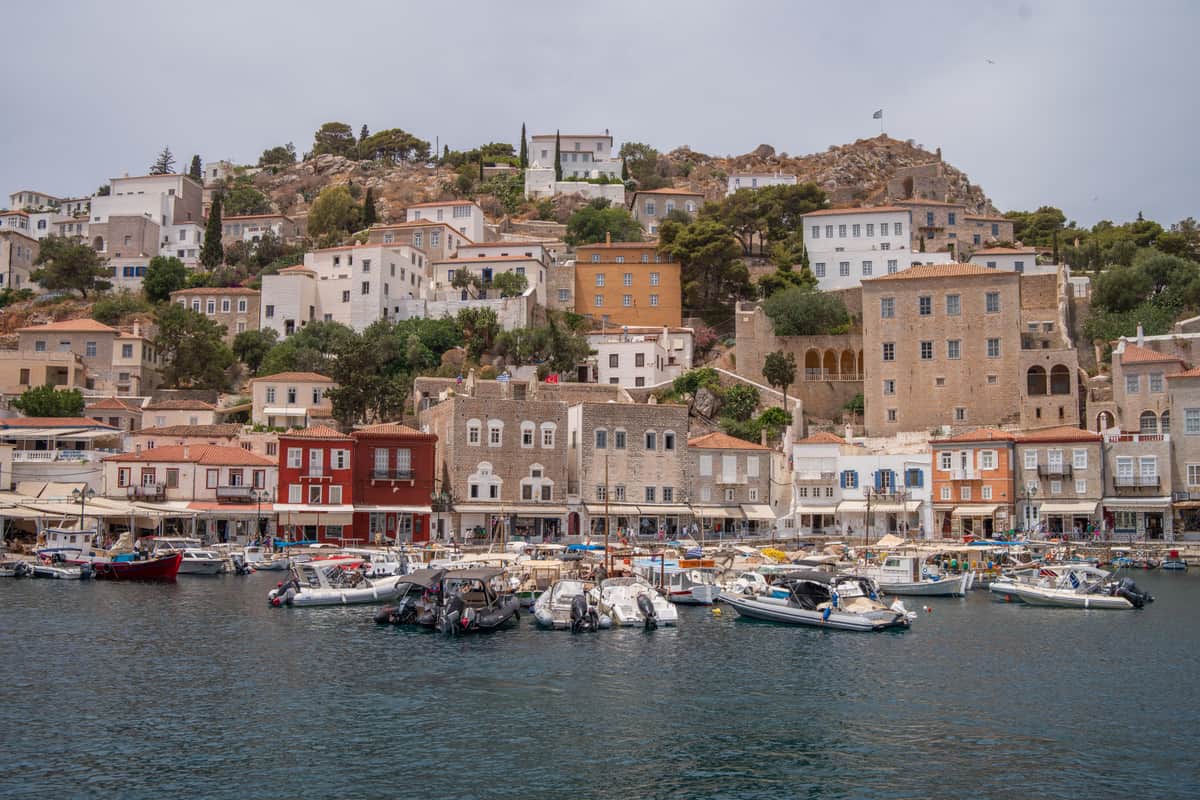
- The old index places Angelica Hotel Hydra three minutes on foot from the port, and its pictures sit in the Angelica Hotel photo gallery.
- Mistral Hotel Hydra is the second entry of the three minute group, with the Mistral Hotel photo gallery beside it.
Wikivoyage names three places that hold practically everything of interest to a visitor. These are the waterfront, the main streets behind the harbour and the coastal road with the blocks beside it. The old index names none of these places for its Hydra hotels. Ask each hotel which of the three its door is closest to.
Wikipedia says Hydra depends on tourism, with Athenians forming a sizable segment of visitors. Wikivoyage adds that a number of cafes stand on the harbour, the greater part serving ouzo, other drinks and coffee. For each lodging the old index gives three items only: the town, a central position and a walking time. It names no street.
Wikipedia calls the built-up area so compact that the greater part of people go on foot. In that compact area the old index counts three minutes from the port to these Hydra hotels. Ask the hotel whether the time is still three minutes today, and from which door. Its own website is the place to compare the answer.
How does the car-free rule shape Hydra hotels?
Wikipedia names cars and scooters among the barred wheels, with motorcycles, bicycles and e-bikes on the list. For the Hydra hotels this means no car can bring a guest to any hotel door. A news report says the island is tightening its checks.
Wikivoyage describes the same policy in its own words. It says the island’s development policy has kept out high-rise houses, cars and motorbikes. The same page pictures the port as whitewashed houses rising on the hills on both sides of the harbour. A traveller can ask each of the Hydra hotels which lane leads to its door.
Wikipedia adds that no motor vehicle runs on the island except rubbish trucks. By law, cars and motorcycles are barred. Wikivoyage lists the city-owned trucks and a fire truck as the only internal combustion vehicles on the island. A guest can ask the hotel whether rubbish trucks ever pass the lane of its door.
A news report describes a meeting of officials, police, coast-guard and municipal leaders. It says the legal framework already exists, but enforcement has not always kept pace. A live online register is to show every permitted vehicle on the island. For a traveller comparing Hydra hotels, the report is a reminder to check the current rules.
The report adds a hotline at the Hellenic Police and the Coast Guard for vehicles that break the ban. It says the Ministry of Culture must license every bicycle and delivery cart. Wikipedia lists bicycles among the banned wheels, so the two sources differ on bicycles. Ask the hotel which rule applies to a guest’s bicycle.
The report names its aim: keeping the silence, the sea breezes and the slow rhythms of Hydra and Spetses. This site keeps a Hydra photo gallery with views of the island. For the Hydra hotels the rule is the setting every guest meets on arrival. Each question above can go to the hotel before the stay.
What does the old index say about the second group of Hydra hotels?
The old index puts the second group of Hydra hotels in Hydra Town, five minutes’ walk from the port. It is an old text, so the hotel can say whether that walk and its class label still hold today.
The old entry sorts its lodgings by walking time from the port. Two lodgings sit in the group of five minutes. The entry sets both in Hydra Town and calls them centrally located. It gives one class label, B class with three stars, to the whole index. Those are the old index’s claims, not a current rating.
The old index’s second group of Hydra hotels appears in the list of hotel pages that follows this paragraph. It follows the old grouping only. Before a traveller relies on a walking time, the hotel can confirm the route and the minutes. Each page of the list stands on its own and covers one hotel.
- Ippokampos Hotel Hydra stands in the five minute group of the old index, and the Ippokampos Hotel photo gallery holds its pictures.
- The other entry of that group is Leto Hotel Hydra, which has its own Leto Hotel photo gallery.
The old entry states the walk in minutes only, with no distance and no street. Wikivoyage describes the town around the port boulevard. It says the boulevard is packed with visitors in season, while quiet back alleys lie only minutes away. A traveller can ask whether the hotel’s lane is a back alley or part of the boulevard.
The same page says that a large share of those visitors on the boulevard are day trippers. Their departure leaves the town relatively peaceful by night, Wikivoyage says. The old index says nothing about the nights. A guest who sleeps on the island can ask the Hydra hotels how the nights sound on their lanes.
The old index shows no date for its walking times or its class label. So class and walk are the two claims that need a check. Ask the hotel which class is current and how long the walk takes today. The answers show whether the old grouping still describes the Hydra hotels of this second group.
How do travellers reach Hydra hotels by sea?
Travellers reach Hydra hotels by boat, either from Piraeus or from the Metochi shore of the Peloponnese. Wikipedia says hydrofoils and catamarans sail from Piraeus, a port 37 nautical miles off. Poros is their first stop, and Spetses comes after it.
Wikivoyage lists two ways to make the crossing from Piraeus. A slow car ferry takes around three hours, and a fast catamaran takes an hour and a half. That note dates from two thousand and nineteen, so check the current times. A guest at one of the Hydra hotels can ask which boats sail on arrival day.
Wikipedia names a second route, which begins on the mainland. Hydra Harbor and Metochi are linked by a small passenger ferry, and the crossing takes 20 minutes. A number of Athenians arrive by road at Metochi, park in its secure car park and take that boat. Whether that ferry runs on the arrival day is a question for the hotel.
Tourism keeps Hydra going, says Wikipedia, and a sizable segment of its visitors comes from Athens. Another Wikipedia article explains the hydrofoil. As the craft gains speed, its underwater foils raise the hull out of the water. Drag falls, and the craft can reach greater speeds. Such boats serve the island where the Hydra hotels stand.
Wikivoyage warns that small boats on this run can sell out in peak periods, especially the sailings at convenient hours. It adds that agencies at the harbour sell tickets for all boats, whichever operator runs them. Travellers who fly in can turn to Athens airport transfers on this site for the step before the sea leg.
Four questions help to plan the sea leg of a stay at the Hydra hotels. Which port suits the trip, Piraeus or Metochi? At what hour does the last boat dock on the day of arrival? Can the hotel hold the room for a late boat? Does the hotel know the current sailing times from Metochi?
How do bags and guests move between the port and Hydra hotels?
Wikivoyage names three ways to move around Hydra: on foot, by donkey and by boat taxi. Walking suits the town centre, while the donkey and the boat taxi serve trips elsewhere. A guest of the Hydra hotels has these three choices.
Wikipedia gives the island’s public transport as horses, mules, donkeys and water taxis, since wheeled vehicles are banned. A trip to the Hydra hotels therefore runs on foot or with one of those carriers. A Wikivoyage photo caption calls the port a multimodal transport hub. It puts taxi boats on the left and donkeys on the right.
Wikivoyage says donkeys and boat taxis both wait at the centre of the port. For the boat taxis, it describes a Greek-only sign listing fixed fares for popular destinations. The sign covers trips between a short hop to Kamini and a full circuit of the island. Anyone who reads no Greek can ask the hotel to explain it.
Wikipedia keeps the words apart. It reserves water taxi for a boat sailing on demand, and water bus for one sailing to a schedule. A shuttle between two points normally counts as a ferry instead. For a stay at the Hydra hotels, the useful word is taxi. Such a boat sails when called, not at a fixed hour.
Wikipedia says the donkey was domesticated in Africa between five and seven thousand years ago. Since then it has been used mainly as a working animal. Where the greater part of the world’s donkeys live, they principally pull or carry loads. Whether a hotel on Hydra uses a donkey for luggage is a question for that hotel.
Wikivoyage’s safety note names a side effect of the island’s transport: large amounts of what it terms donkey exhaust. It tells walkers to watch their step. Before arriving at one of the Hydra hotels, a guest can ask three questions. Who carries the bags? How long is the walk? Does a boat taxi stop nearby?
How does the island’s history shape Hydra hotels?
The history of the island sets the scene for the Hydra hotels. Wikipedia describes an island named for its springs and grouped with the Saronic Islands. It also names the Hydra-born admiral who led Greek naval forces in the War of Independence. A bronze statue of him now overlooks the port.
The Hydra hotels stand on an island that Wikipedia lists with the Saronic Islands. That group lies just off the Greek mainland. Wikipedia says the province of Hydra was abolished in two thousand and six. The municipality now belongs to Attica, in a regional unit called Islands. Another page on this site lists Greek islands cruises.
The island measures 49.6 square kilometres, and Dokos adds 13.5. With a number of uninhabited islets, they form a municipality of 64.443 square kilometres, as Wikipedia gives it. The larger of the two gives the Hydra hotels their name. A one-day trip from Athens gives a first look from the sea: Hydra, Poros and Aegina day cruise.
Wikipedia traces the ancient name, Hydrea, to the Greek word for water and to the island’s springs. Wikivoyage reads it as a short form of Hydrea, meaning spring. It says the spring ran dry long ago, while the name stayed. A narrow strip of water separates the island, and so each of the Hydra hotels, from the Peloponnese.
Wikipedia places the Saronic Gulf within the Aegean Sea, between the Attica and Argolis peninsulas. It calls the islands of the gulf pivotal to Greek history. Saron, a king of myth, drowned at Lake Psiphaea, and the gulf carries his name. Aegina, a neighbour in the same gulf, also has a page on this site: Aegina tours.
Wikipedia says Andreas Miaoulis, born on Hydra, was a corn trader and merchant captain. Through the war of eighteen twenty-one to eighteen twenty-nine, he headed the Greek navy. In nineteen ninety-three his bones were moved to Hydra and buried under a bronze statue above the port. Ask the Hydra hotels how long the walk to the statue takes.
What else do travellers ask about Hydra hotels?
What is the Miaoulute festival on Hydra?
Wikipedia says the Miaoulute is a big festival held on Hydra every year, on the weekend closest to 21 June. It honours Admiral Andreas Miaoulis. A guest who stays at the Hydra hotels near that weekend can ask the hotel about rooms.
The same article gives his name as Andreas Vokos and calls Miaoulis his nickname. The Hellenic Navy named a cruiser after him in eighteen seventy-nine. His son Athanasios was Prime Minister of Greece from eighteen fifty-seven to eighteen sixty-two.
Wikipedia dates his death to 24 June in eighteen thirty-five, in Athens. It says his heart rests in an urn at the Ministry of Commercial Navy. Ask the hotel about the days around the festival.
What is the number of Hydra hotels in the old index of this site?
The old index of this site lists four Hydra hotels, in two groups of two. The groups are sorted by the walk from the port. That is a count from a dated page, not a count of what stands today.
Ask each hotel which class and which walk are current. The old index gives only its own labels and its own walking times, and it lists no room totals. Only the hotel can confirm the present facts.
A Wikivoyage note, dated August two thousand and twenty-two, says the main town had 4G from all Greek mobile carriers. Elsewhere on the island, the note says, there was no signal. Ask the hotel what the phone coverage is like at its own address.
How did a travel panel in two thousand and seven rate the island?
In two thousand and seven, Wikipedia says, a panel of 522 experts rated Hydra above every other Greek island. The panel belonged to a travel magazine. Among 111 islands worldwide, it placed Hydra eleventh.
Wikipedia words the praise of the panel this way: the island keeps the character of its place. The rating describes the island as a destination, as one panel saw it in that year.
A rating of the island is not a rating of the Hydra hotels. The same article says that Hydra depends on tourism, and that Athenians make up a sizable share of its visitors.
Which islands lie close to the Hydra hotels?
For a guest at the Hydra hotels, Wikivoyage’s notes on where to go next name Spetses. They say a number of the ferries that stop at Hydra go on to Spetses, just thirty minutes away. The same notes list Attica and the Peloponnese as the nearest mainland regions.
Wikipedia counts four main inhabited islands in the group. They are Salamis, Aegina, Agistri and Poros. Lists of the group sometimes add Hydra and Dokos too. Regular ferries link the group with Piraeus and with the Peloponnese.
Wikipedia says no island of the group is bigger than Salamis. In 480 BC the ancient Greek navy won the Battle of Salamis there, against the Persians. A number of mainland Greeks keep holiday homes on these islands.
When does the meltemi wind blow around the Hydra hotels?
Meltemi is another name for the Etesian winds, says Wikipedia: strong, dry winds that cross the Aegean from the north. Their season opens halfway through late spring and closes halfway through September.
The afternoon is when the winds blow hardest, says Wikipedia. A single spell can run on for days with no pause. At their strongest they reach force 7 or 8 on the Beaufort scale. Clear skies give no warning before they rise.
Wikipedia says the greater part of the ferries between the islands are unable to sail in such winds. The northerly winds also ease the summer heat. For guests of the Hydra hotels, the wind is a question for boat days: check the current sailings.