
Aegina tours are the simplest way to see a Saronic island a short ferry ride from Athens. For the wider picture, start with our tours in Greece page.
This page covers what Aegina tours include, how to reach the island, the sights they visit, the boat trips around the islets, where to stay, the island and its past, and the questions travellers ask.
What do Aegina tours include?
Aegina tours are boat cruises, island trips and private tours on a Saronic island that lies 27 km from Athens. Operators sell small-group outings, full-day trips from Athens and day cruises for single travellers or groups.
Aegina tours on the water can start at Perdika. One operator runs small-group cruises from Perdika to Moni, Agistri and Metopi. Another cruise visits Moni alone and lasts half a day.
A listing site shows a yacht day trip from Athens to Aegina, Agistri and one more islet. The trip lasts ten hours. It has swim stops, a visit to the main villages of the islands and meals on board.
Aegina tours on land run as guided island trips. One local company lists a six-hour tour with an English-speaking archaeologist and a break for bathing and food. Another day trip from Athens is also led by an archaeologist.
For private Aegina tours, a transfer company on the island offers rides. They link the airport of Athens, the ports of the island and the hotels. A full-day outing from Athens adds a traditional local lunch. A local travel office also arranges excursions of three or four days or longer.
Aegina tours cover more than ruins. A local tourism site names hiking, bird-watching, yoga, kayaking, diving and pilgrimage tours. A travel site also lists a pottery class, a coffee roaster visit and an olive oil tasting.
Try a Hydra, Poros and Aegina day cruise for a wider trip. It takes one day out of Athens and calls at Hydra, Poros and Aegina.
How do you reach Aegina for tours?
Boats to Aegina leave from Piraeus, the largest harbour in Greece, so Aegina tours from Athens begin there. Hydrofoil ferries from Piraeus take forty minutes to reach the island, and the standard ferry needs about an hour.
Piraeus is the port of the Athens urban area and lies beside the Saronic Gulf. It began as the port of Athens in the early fifth century B.C.
People have lived at Piraeus since at least the twenty-sixth century B.C. In ancient times it had three deep-water harbours: Cantharus, Zea and Munichia. For passengers, it is fifth in size among the ports of Europe.
One operator of Aegina tours from Athens sets its meeting point at Piraeus Port, Gate E8. The spot is a ten-minute walk from Piraeus metro station, and the operator sends directions by email. It asks guests to arrive ten minutes before departure, and a trip attendant rides the ferry with the group.
Hellenic Seaways is a Greek ferry company founded in the nineteen-eighties. It belongs to Attica Group, which also holds Blue Star Ferries, Superfast Ferries and ANEK Lines. Its fleet holds high-speed craft and conventional ferries.
The company lists a route from Piraeus to Aegina and Agistri with its Aero high-speed craft. Check the current timetable of any ferry company before you travel.
A local tourism site lists the ways to cross the water for Aegina tours. They include the ferryboat, the flying dolphin, the sea-taxi, the speedboat and the sailboat. It calls Aegina a base for excursions because other destinations are close.
A travel office on the island also issues ferry tickets for Piraeus and the other Greek islands. It sells air tickets for travel around the world too.
The capital of Greece, Athens, is also its largest city. Athens works well as a base for Aegina tours. The port of Piraeus is about five miles from its centre.
Our Aegina travel information page collects the ferry and island connections in one place. Read it next to this page when you plan Aegina tours.
Which sights do Aegina tours visit?
Aegina tours visit the Temple of Aphaia, Aegina town, the Byzantine town of Paleochora and the Monastery of Saint Nektarios. One operator adds the prehistoric site of Kolona and a pistachio tasting to the same day.
Aegina tours that stop at the Temple of Aphaia climb a hill, about 160 metres high, in the island’s east. Aphaia was a goddess honoured at this sanctuary alone. The temple standing today dates from about 500 B.C. and replaced an older one of about 570 B.C. By road it lies about 13 kilometres from the main port.
The sanctuary seen on Aegina tours once covered about 80 by 80 metres. Fire destroyed the older temple around 510 B.C., and its remains were buried in the terrace of the new one. Neoclassical and Romantic artists such as J. M. W. Turner admired the temple.
Its pediment sculptures are in Munich today, while other fragments rest in Aegina’s museums and at the site. The hilltop also has a museum with a rebuilt end of the older temple’s entablature and pediment.
The town of Aegina lies at the island’s northwestern tip. Its houses mix Neoclassical style with village touches and date to the 19th century. One operator closes its day trip with free time among the alleys and the mansions.
Aegina tours that include Kolona visit the leading settlement of the Early Bronze Age on the island. It was a fortified site built of stone. The name is also spelled Kolonna. At Cape Kolonna, diggers uncovered a workshop for purple dye from the 16th century B.C.
Ioannis Kapodistrias, the first governor of free Greece, founded the Archaeological Museum of Aegina in October of the eighteen-twenties. Three rooms hold vessels, pottery, statuettes, inscriptions, coins and weapons.
Aegina tours reach Paleochora, a Byzantine town. One operator says 28 churches survive there, with wall paintings inside.
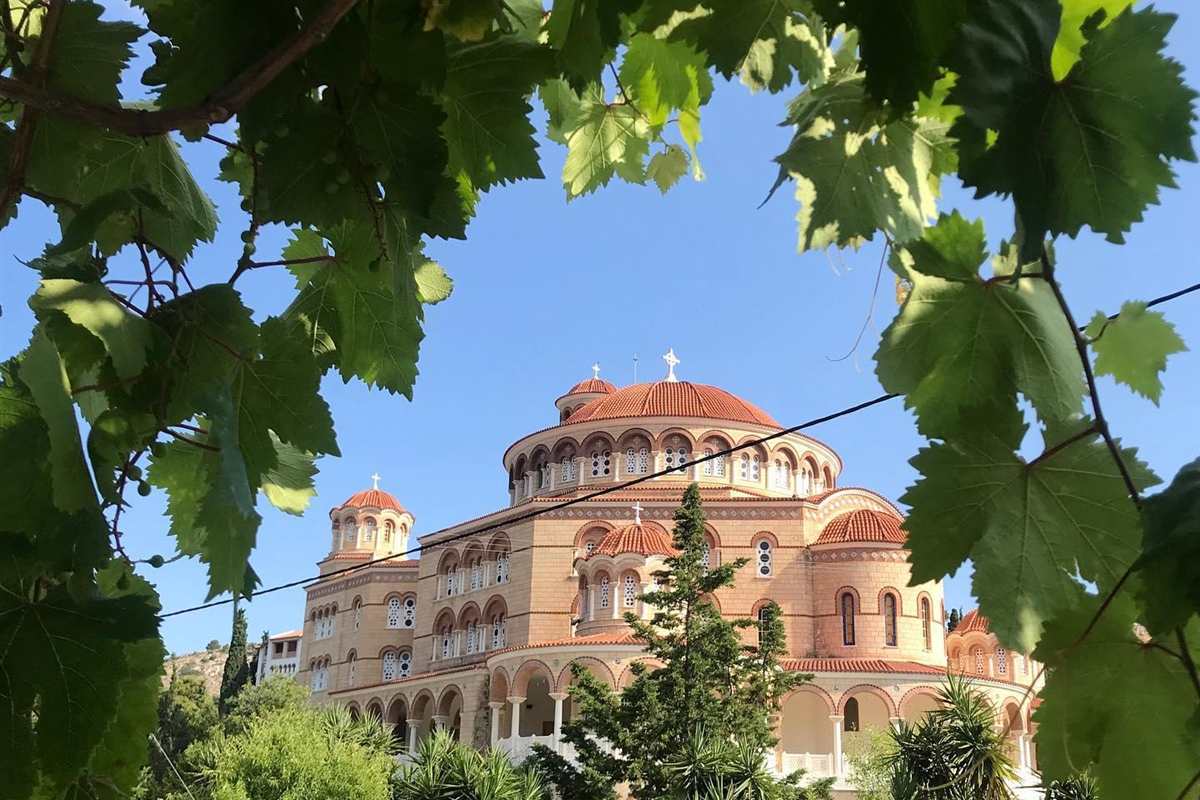
On Aegina tours, the monastery stop leads back to Nectarios. He founded Holy Trinity Monastery on Aegina for nuns who asked him to. Later he withdrew there and stayed as a monk to the end of his life.
Besides grain, almonds, olives, figs and vines, the farms of Aegina produce pistachio, now the signature crop. Aegina tours add a pistachio tasting, and one listing offers an organic orchard visit with snacks. Photos of these places sit in the Aegina photo gallery.
What do boat tours add around Aegina?
Boat tours add the sea: swim stops in clear water, small islets and the neighbouring island of Agistri. Aegina tours by boat see the coast from the water, and Agistri lies close enough for a short crossing.
Aegina tours that stop at Agistri reach a pine-covered island. Its name means “fishing hook” in Greek. Only three villages exist there: Milos, Skala and Limenaria. A boat from Aegina takes just ten minutes.
Swimming is part of the sea trips. One listing for a yacht day trip says guests swim in clear waters. The same trip visits an islet in the Saronic Gulf. On another operator’s island day trip, the plan sets aside two hours for the beach and a swim.
The archipelago of the Saronic Islands is named after the Saronic Gulf and sits close to the Greek mainland. Four islands are the main inhabited ones: Salamis, Aegina, Poros and Agistri. Dokos and Hydra sometimes count as members too.
The island of Poros sits in the south of the Saronic Gulf, about 58 kilometres from Piraeus. Two islands, Sphaeria and Kalaureia, make it up, and a bridge joins them over a narrow strait. Its town climbs a hillside like an amphitheatre, with a clock tower as its landmark.
The island of Hydra keeps cars and motorcycles off its streets by law. Water taxis, horses, mules and donkeys take people around instead. The harbour of Hydra port is shaped like a crescent, ringed by restaurants, shops and galleries.
Where do you stay on Aegina?
You can stay in Aegina town, the regional capital of the island. Coastal villages such as Agia Marina and Perdika are other bases. Aegina tours begin in more than one place, so check the starting point of each tour before you choose.
Aegina town is the regional capital of a municipality in the Islands regional unit of Attica. One local operator starts its land trips at the town harbour. That makes the town a simple base for those Aegina tours.
Perdika is the village where the small-group boat cruises named earlier begin. So it suits anyone who wants a sea day on Aegina tours. Agia Marina is also on the tour map. One island tour leaves free time there for swimming and a meal.
A local travel office, working on the island since the late nineteen-eighties, books hotels, apartments, rooms, houses and villas. It also rents cars and coaches. It also plans Aegina tours of one day or of three to four days, alone or in groups. Athenians own second houses on the island.
Our own list of Aegina hotels sorts places by class. It has a 3-star group, a 2-star group, and a group of apartments, studios and villas. Choose the group first, then match it with the starting point of your Aegina tours.


What is Aegina like, and what is its past?
Aegina is a roughly triangular island in the Saronic Gulf. At its widest it spans about 15 km from west to east and 10 km from south to north. The area is 87.41 square kilometres. Aegina tours cover an island that once rivalled Athens as a strong city-state in classical times.
The island that Aegina tours cover has a dead volcano at its core, two-thirds of its area. Farmers work the stony but fertile plains in the north and west. Hills and mountains fill the south, where little grows. Mount Oros, a cone, rises 531 metres. A ridge stretches north from it, with narrow fertile valleys on both sides.
Aegina tours run inside one municipality, which takes in the island and its offshore islets. The communities are Vathy, Kypseli, Mesagros, Perdika and the town of Aegina. That town community, home to the regional capital, counts 6,976 residents.
The story behind Aegina tours starts with a myth. Tradition names the island after Aegina, mother of the hero Aeacus, who was born here and became king. Ephorus wrote that Pheidon of Argos opened a mint here. That made it Europe’s earliest city-state to mint coins. Its staters carried a sea turtle until the end of the fifth century B.C.
Unlike other trading states of its day, Aegina founded no colonies. It still shared in the trade at Naucratis in Egypt. Athens grew into a rival of its sea power from about the sixth century B.C. Solon limited Aeginetan trade in Attica. Around 456 B.C. a siege forced Aegina to submit to Athens.
In the twelfth century a bishop of Athens called the island a pirate base. Ottoman rule returned in the early eighteenth century. Apart from a brief Russian occupation in the early seventeen-seventies, it lasted until the war for Greek freedom broke out.
Aegina tours also touch the war years: the revolutionary authorities used the island as an administrative base. Ioannis Kapodistrias lived here briefly. In the late eighteen-twenties the temporary government had its headquarters in the Tower of Markellos. Kapodistrias also built a home for war orphans, known locally as The Prison because it later served as a jail.
Inland, a church from the thirteenth century stands over an older temple of Zeus Hellanios, close to Pachia Rachi village. The staircase and parts of the original walls remain. Pistachio growing began on the island in the nineteenth century and now covers about 29,000 acres.
What else do travellers ask about Aegina tours?
How do you get around the island besides Aegina tours?
Aegina tours are not the only way to move about. Buses leave Aegina town on regular routes and reach villages around the island, Agia Marina among them. The east coast holds a fishing village called Portes.
Local firms add other options alongside Aegina tours. One travel office lists car rentals on its Greek homepage. A transfer company offers private transfers to the ports and hotels of the island.
A local website titled Aegina Tours, Activities & Excursions also lists sea taxis, speedboats and sailboats. They are ways to reach nearby places by water.
How is the name Aegina written in Greek and in English?
In modern Greek the island is written Αίγινα, and the ancient spelling is Αἴγῑνα. The modern name is pronounced roughly as [ˈeʝina]. English texts write it Aegina.
Operator sites show both forms: Aegina Tours in English headings and Αίγινα on Greek pages. Greek texts call the island’s saint Νεκτάριος Αιγίνης, which in English is Nectarios of Aegina.
Why do pilgrims travel to the island?
Aegina is a pilgrimage site of Saint Nektarios, who is known as the Wonderworker of Aegina. He was born Anastasios Kephalas to a poor family and took the name Nectarios when he became a deacon. His feast day falls every year on 9 November.
He first took a teaching post on the island of Chios. He later directed a school for priests in Athens for fifteen years. He then spent his last years as a monk on the island, where he wrote, preached and heard confessions. He died at the age of 74.
The Patriarch of Constantinople named him a saint in the church. Multitudes of mourners came to his funeral. He is a patron saint for people who suffer from illness.
What is a hydrofoil, and why is it fast?
A hydrofoil is a lifting surface, or foil, that works in water. As speed rises, the foils raise the hull above the surface. Drag falls, so the boat goes faster and saves fuel.
Building and maintaining hydrofoils is complex, so the craft stay small. They serve mainly as high-speed passenger ferries. Early hydrofoils used V-shaped foils that pierce the surface. Fully submerged foils feel steadier at sea, because waves affect them less.
How early do you book Aegina tours, and what is the weather like?
One tour site notes that availability is limited in the high season. It says the island offers a small number of tours, so it advises booking Aegina tours in advance.
The climate is hot and dry, classed as semi-arid. The yearly average temperature is near 20 degrees Celsius. Annual rainfall is less than 340 mm.
For summer days, one operator lists water, a hat, sunscreen and sunglasses to pack. Its list adds walking shoes, swimwear and a towel.