
Athens airport transfers link Athens International Airport with the city, the ports and the coast. For other trips, see our tours in Greece page.
This page covers the metro, the suburban train, the buses, the taxi and the private driver, the roads and the timings, the ports of Piraeus, Rafina and Lavrio, and the day trips.
What are Athens airport transfers?
Athens airport transfers are the rides between Athens International Airport and a hotel, a port or a station. Sources list the metro, trains, buses, taxis and private drivers. Each choice changes the travel time, the stops and the space for luggage.
Greece governs from Athens, and no other Greek town has more residents. Of the continent’s mainland capitals, none lies farther south. Over 3.6 million people live across the urban area, and the documented past of the city extends beyond 3,400 years. Athens airport transfers end in that city, and the page about Athens tours covers its sights and museums.
Wikipedia locates the airport among four towns: Spata, Loutsa, Markopoulo and Koropi. It lies east of central Athens. The convention and visitors bureau of the city gives 33 km to the southeast. It adds that the Attiki Odos ring road leads there. Wikivoyage calls the airport a major hub for the Aegean, Balkan and East Mediterranean regions.
Construction ended in October of the year two thousand. The opening waited one more month, because the surface links to Attiki Odos were not ready. Today’s Athens airport transfers serve an airport that began operation on the 28th of March, two thousand and one. Wikipedia adds that the date fell in time for the Summer Olympics in Athens.
Wikipedia describes a main terminal and a satellite building. An underground passage with moving walkways links them. The main terminal stacks three floors, for arrivals, for departures and for dining. The satellite holds two floors, one for incoming and one for outgoing flights. Which building does the flight use, and where does the driver wait?
Athens airport transfers serve flights that land on two parallel runways. Wikipedia gives their lengths as 4 km and 3.8 km. Two aviation safety agencies also gave the airport a clearance for the A380, which is the biggest airliner flying. It also says the runway system is designed for the final expansion phase.
The airport carries two names, Athens International Airport and Eleftherios Venizelos, with the codes ATH and LGAV. Eleftherios Venizelos was a Greek statesman, born in Crete in eighteen sixty-four. He served as prime minister for over 12 years, in eight terms between nineteen ten and nineteen thirty-three. Wikipedia records the title The Maker of Modern Greece for him.
On travel pages, a transfer means a ride from the arrivals hall to a hotel, a port or a station. One transfer page says a driver meets the guest in the arrivals area with a name label. The same page tracks the flight. Athens airport transfers of that kind end at one of the Athens hotels.
Which kinds of Athens airport transfers exist?
Athens airport transfers come in eight kinds: metro, suburban train, express bus and local bus with the metro. The rest are taxi, private driver, minibus and hire car. Each kind answers questions about time, luggage, landing hour, group size and the final stop.
Two kinds of Athens airport transfers run on rails. The metro joins the airport to the underground lines. The suburban train joins it to the railway lines. The city’s visitor bureau says the suburban train connects the airport with Larissis Station, the central railway station. Which station stands closest to the hotel?
Two kinds use the road. The express bus follows numbered lines. The local bus is a short ride to a metro station outside the airport, where the metro takes over. Which line stops near the square or the port? How long does a ride take in heavy traffic? Do buses run when the plane lands at night?
The taxi and the private driver both start in the arrivals area, yet differ in timing. The taxi is found on the spot, while a driver is arranged before the flight. Which kind suits a landing at midnight? Athens airport transfers of the second kind carry a name label and a tracked flight, as one transfer page describes.
A minibus carries a group in one vehicle. One transfer page sets the taxi limit at 4 people and the minibus limit at 14. The hire car puts the traveller behind the wheel. Another transfer page offers it to those who prefer to drive. How large is the group, and how much luggage travels with it?
Five questions sort Athens airport transfers. How much time is there? How much luggage travels? At which hour does the plane land? How large is the group? Where does the ride end? A traveller who answers these five questions cuts the list of eight kinds to one or two before leaving home.
Transfer pages name the travellers each kind suits. One page tailors its rides to business trips and private events. A ride-hailing page asks the traveller to pick a vehicle by group size and luggage. One bus page names a line for travellers whose final stop is the city centre. It names another for the port of Piraeus.
Athens airport transfers end where the traveller sleeps, so the district of the hotel matters. Which area holds the hotel, and which station lies closest? One transfer page lists the city centre, the Acropolis, Vouliagmeni, Piraeus port and Larissa railway station as end points. The page about Athens accommodation sorts the hotel pages by class.
How do Athens airport transfers by metro work?
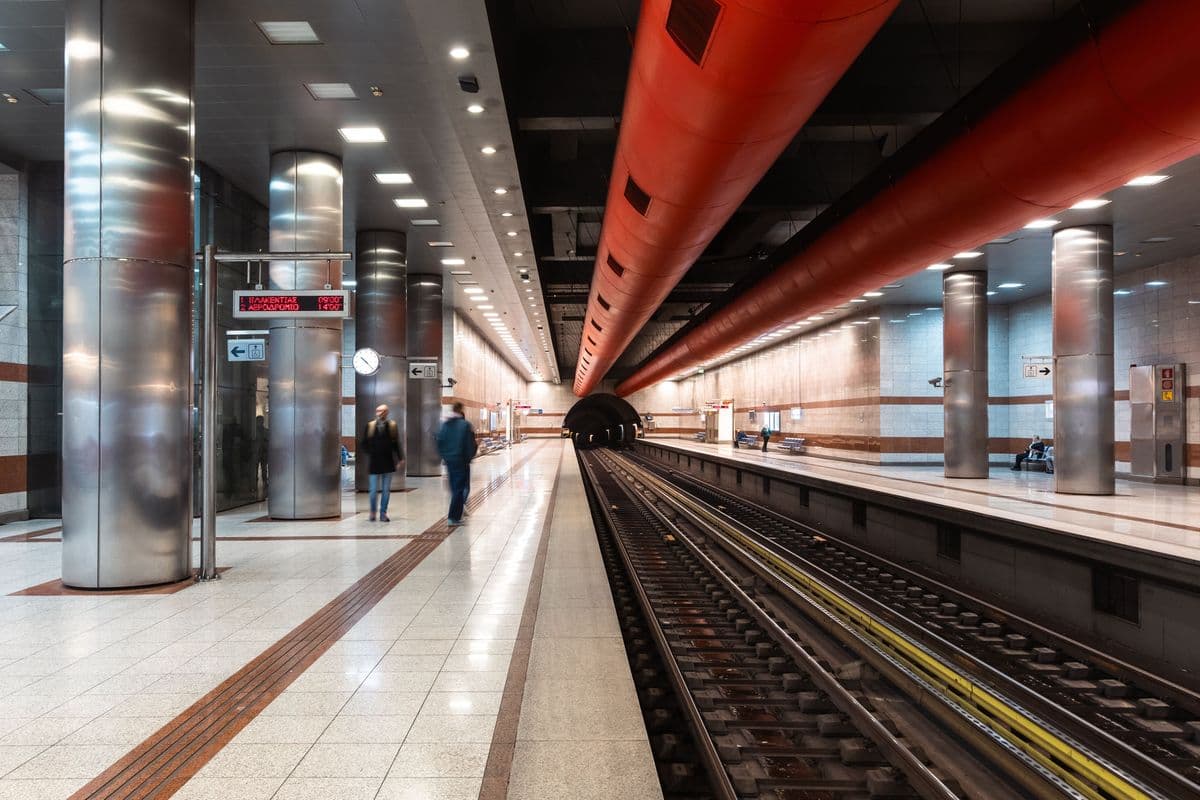
Athens airport transfers by metro run on Line 3, the blue line. Wikipedia dates the extension to the airport to summer, two thousand and four. A traveller boards a train marked for the airport and checks the current timetable first.
For Athens airport transfers by metro, the line to know is Line 3, one of three in the system. Wikipedia gives it 24 stations over 47.3 kilometres. Wikivoyage lists its route as Dimotiko Theatro, Doukissis Plakentias and the airport. By that source, it joins Piraeus and the western suburbs with the eastern suburbs, Halandri among them.
Wikipedia says Lines 2 and 3 were inaugurated in January of the year two thousand. The airport branch came later, as an extension of Line 3. The airport station belongs to the airport’s operator. Three other stations, Pallini, Paiania-Kantza and Koropi, belong to the owner of the national rail infrastructure, the same article states.
The greater part of Line 3 runs underground. Wikipedia says the open-air stretch lies east of the tunnel portal near Doukissis Plakentias. Only trains that end at the airport use it. Athens airport transfers on this branch also need trains fitted for the overhead wire. The article counts seven second-generation trains with that equipment.
Wikivoyage says the airport trains run every 36 minutes. Not every Line 3 train from the centre reaches the airport. The same source says trains in the gaps turn around at Doukissis Plakentias. A traveller looks for the airplane logo on the front of the train. The schedule and the signs on the platform mark airport trains too.
Athens airport transfers reach the centre at Syntagma and Monastiraki, the two central stops on Line 3. Wikipedia counts both among the five interchange stations. At Syntagma, the timetable of the airport train hangs on the window at the shelter. Wikivoyage suggests visiting that station the day before and asking the agent which airport train to catch.
At the airport, metro and suburban trains use the same platform, says Wikivoyage. The same source says the airport metro station has a desk. A speaker of English staffs the desk through the larger share of each day. Wikivoyage advises the metro train for smaller stations along the way, since the metro stops at more of them.
Athens airport transfers by metro start with a ticket. Wikivoyage says a vending machine takes a credit card or cash. A contactless card also works at the gate. Wikipedia adds that the ordinary city ticket is not valid on trains and buses to the airport. Check the current timetable and the ticket rules before the trip.
How do Athens airport transfers by suburban train work?
Athens airport transfers by suburban train use Line A1, a route that joins the port of Piraeus to the airport. According to Wikivoyage, the train leaves the airport at seven minutes past the hour and passes through central Athens. It runs more sparsely than the metro.
A commuter service called Proastiakos in Greek carries Athens airport transfers by suburban train. Wikipedia says it links the city and its metropolitan area with nearby settlements. These lie in Attica, Boeotia and Corinthia, with Chalcis in Euboea. Hellenic Train operates the service, according to Wikipedia. The article counts 45 stations on the network.
The first section ran from the main Athens railway station to the airport. Its opening day was 30 July, two thousand and four. Wikipedia says that was two weeks before the Olympic Games began in the Greek capital. The line was not yet electrified then, and diesel units ran every half hour.
Athens airport transfers by suburban train gained electric power in steps. Wikipedia says the network grew from two thousand and five to two thousand and eighteen. It reached Piraeus in the south, Corinth and Kiato in the west, and Chalcis in the north. The Athens to Piraeus section was electrified on 1 February of that final year.
Wikipedia lists four lines. Line A1 runs between Piraeus and the airport. Line A2 reinforces it along the median of the A6 motorway between the airport and Ano Liosia. Line A3 runs between Athens and Chalcis, and Line A4 links Piraeus with Kiato. Of the four, only A1 and A2 name the airport.
Athens airport transfers by suburban train pass through the centre, says Wikivoyage. The train goes from the airport to Athens Central station, then on to Piraeus. Wikipedia gives daily service hours of half past 4 in the morning to midnight. On Line A1, the Larissa Station article lists up to one train each hour. Check the current times.
Trains to northern Greece and the Peloponnese leave from Athens Central station, says Wikivoyage. Wikipedia calls it the main station of Athens and the second-largest in Greece. It stands in the Kolonos quarter and formed in two thousand and five from two terminals. Locals still say Larissa Station; the Line 2 metro stop beside it shares the name.
Wikivoyage describes a change at Neratziotissa station, which connects to Metro Line 1. That change leads on to Monastiraki station. The same source names a second route: change at Doukissis Plakentias to Line 3, which serves Monastiraki and Syntagma. Athens airport transfers by suburban train need a glance at the current times before either change.
How do Athens airport transfers by express bus work?
Athens airport transfers by express bus use four numbered lines: X93, X95, X96 and X97. The airport’s bus page says they run round the clock. Wikivoyage puts the journey between 45 minutes and one and a half hours, as traffic decides.
The airport’s bus page lists four express lines run by the city’s transport organisation. Each line ends in a different place: a coach station, a square, a port or a metro station. So Athens airport transfers by this route start with one question. Where in the city does the traveller want to end up?
Line X93 runs between the airport and the Kifissos coach station. The airport’s bus page calls it the intercity bus station. It gives a ride of about 65 minutes and a bus every 40 minutes. Wikivoyage lists three routes from that station. They are 051 to the centre, 052 to Elaionas metro station and 420 to Piraeus port.
Athens airport transfers on line X95 end at Syntagma Square. The airport’s bus page points travellers bound for the city centre to this line. It gives about 60 minutes. Wikivoyage adds a tip for early flights. Before the metro opens, a kiosk beside the Syntagma bus stop sells tickets for the ride to the airport.
Line X96 ends at the port of Piraeus. The airport’s bus page calls the port the destination for island trips. It gives a ride of about 90 minutes and a bus every 20 to 25 minutes. That is the shortest gap between buses of the four lines. A later section covers the port itself.
Line X97 ends at a metro station, and the station changes with the hour. By day the last stop is Elliniko metro station. At night it is Dafni. The airport’s bus page gives a bus every 40 to 60 minutes and a ride of 45 minutes. Athens airport transfers on this line depend on the hour.
Wikivoyage notes that the buses, unlike the metro, run 24 hours a day. The airport’s bus page agrees, and the city’s visitor bureau adds that they run daily, public holidays included. The bus page says the express lines make limited stops and that certain rules apply to getting off. Check the current times before a night trip.
The bus page places the city bus stop outside arrivals, between Exits 4 and 5. The ticket kiosks stand there too, and the express buses accept contactless cards. Arriving buses unload at the departures level. Luggage raises questions for Athens airport transfers by bus. Where does a suitcase go? Is there a rack?
How do Athens airport transfers by local bus and the metro work?
Athens airport transfers by local bus and the metro split the trip into two legs. Wikivoyage describes a regional coach to Koropi. An ordinary city ticket then covers the metro or local bus 308. Check the current timetable first.
The express lines of the last section go straight to one place. A second family of Athens airport transfers splits the trip in two. First comes a bus ride out of the airport, then a metro or city bus ride inward. Wikivoyage describes one such route in detail. The next paragraphs follow its steps.
Wikipedia describes the Greek regional coach system as a federation of regional bus companies. It was founded in nineteen fifty-two and covers the mainland and the islands. The airport’s bus page says five regional coaches serve the airport, and all are express lines with limited stops. One runs to Rafina. Another goes to Markopoulo and reaches Koropi too.
Wikivoyage says a regional coach leaves from a stop in front of a hotel. It reaches Koropi station in about 15 minutes. The gaps between coaches run from half an hour to more than three hours. The workers at the express bus stop have no news of them. Athens airport transfers on this route need the regional schedule.
From Koropi, Wikivoyage says, the metro reaches the city centre on an ordinary city ticket. That avoids the extra airport ticket. The alternative is local bus 308 from the Koropi metro stop, on the same ordinary city ticket. For the way back, the regional coaches pass Koropi 20 to 30 minutes before the listed airport departure.
Wikipedia names the Athens Urban Transport Organisation as the city’s public transport operator. Its subsidiary companies run the metro, the trams, the trolleybuses and the buses. The same article counts the suburban railway between Piraeus, Magoula and Koropi as the urban part. For Athens airport transfers, Koropi therefore sits at the end of the urban part.
Wikivoyage explains the ticket idea in plain terms. One ticket works on the metro, the tram and the buses, with unlimited changes inside Athens for 90 minutes. The ordinary ticket leaves out the airport express lines, it adds. A traveller who joins a bus leg and a metro leg therefore checks which ticket covers both.
Wikivoyage says smart displays at central bus stops show arrival times and announcements. Wikipedia adds that buses, trolleybuses and trams use validation machines, while the metro uses turnstiles. Sightseeing buses are a different service from a transfer, and another page covers Athens hop-on hop-off bus tour rides. Athens airport transfers by local bus need a timetable check.
How do Athens airport transfers by taxi work?
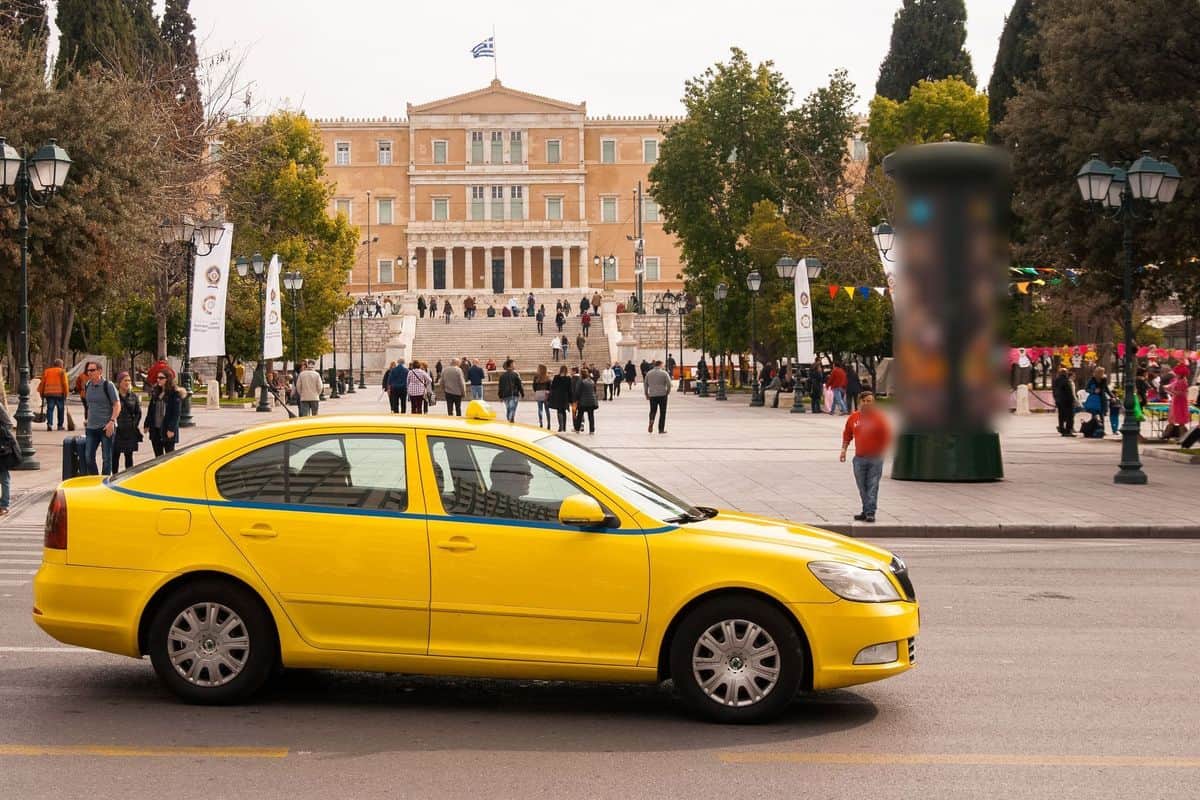
Athens airport transfers by taxi start at the taxi rank by Exit 3 on the arrivals floor. The official visitor page of Athens describes a flat rate to the centre with two time bands. Wikivoyage adds that tolls sit inside it.
The Wikipedia article calls a taxi a vehicle that passengers hire. It carries passengers from one chosen point to another, normally without other riders on board. The word taxicab joins taximeter and cabriolet, the article explains. The meter tracks time as well as distance, and the state and city where a cab operates set the fare.
Athens airport transfers begin at a stand. Wikipedia says stands sit at airports, railway stations and hotels, where a large number of passengers appear. Whichever cab waits first in the queue picks up the following rider. The visitor page of Athens locates the airport stand beside Exit 3 on the arrivals floor.
The same page describes a flat rate for the ride from the airport to the city centre. It has two time bands. The first band covers the hours from 5 in the morning up to midnight, the second the night hours. The arrival time at the destination sets the band, and the rate covers every legal supplement.
Wikivoyage calls it a special rule for Athens airport transfers by taxi. A ride to the centre follows one fixed tariff by day and another by night, tolls included. The tariffs are updated now and then, so the traveller checks the current one. One transfer page shows a notice of a new tariff set by the authorities and the taxi unions.
Away from the flat rate, the yellow cabs of Athens run on the meter, Wikivoyage says. Rate 1 applies inside the city limits, airport included. Rate 2 applies outside the city and from midnight to 5 in the morning. Legal supplements apply to a radio call, to a trip to or from the airport, and to heavy bags.
Athens airport transfers by taxi go smoothly when the rider insists on the meter and checks the rate. Wikivoyage warns that at busy tourist spots drivers try a set rate far too high. A driver must give a receipt. With the plate number, a rider can report the ride to the tourist police on 171.
Wikivoyage adds that cabs are shared in rush hours and at night. An occupied taxi shows a lit TAXI sign, and the driver asks the newcomer’s destination first. Drivers rarely obey road rules, so an early flight can mean a fast, sharp ride. Strikes by cabbies are common, so check the local news before Athens airport transfers.
How do private Athens airport transfers with a driver work?
Private Athens airport transfers are rides arranged ahead, with a driver and a vehicle set in advance. Transfer pages describe a driver at the arrivals area, a tracked flight and a flat rate. The vehicle is a taxi, a minivan or a minibus.
A private ride resembles the old job of the chauffeur. Wikipedia defines a chauffeur as a professional driver of a passenger vehicle. The article says the work moved from personal employees of the car owner to specialist services and single drivers. These supply both the driver and the vehicle. Private Athens airport transfers fit that pattern.
One transfer page says its driver meets the traveller in the arrivals area with a label showing the traveller’s name. It follows the flight, so the driver knows about a delay and is there at the right time. The page states that its drivers hold a licence of the Greek Ministry of Tourism and speak English.
A rate agreed in advance is the second mark of a private ride. For Athens airport transfers, a second transfer page lists what its fixed rate includes. The list names the driver and vehicle, taxes, tolls, luggage, waiting time, flight monitoring and extras like child seats. Is payment made online ahead, or to the driver on arrival?
The first transfer page names a taxi that carries 4 people and a minibus that carries 14. Minivans sit in between. The second page offers van, minibus and private coach transfers for large groups on request. A group that does not fit one vehicle can use two, as one ride-hailing page notes.
The number of bags shapes the choice of vehicle as strongly as the headcount in Athens airport transfers. One ride-hailing page says cargo space is not guaranteed and varies with the body type. It names 158 centimetres, length plus width plus depth, as the largest size of a checked bag. Help with the bags is up to the driver.
Late flights raise another question. The ride-hailing page says the driver gets the schedule changes of a reserved flight. It names a wait of 45 minutes after landing for standard rides, 60 for higher classes, before late payment applies. The second transfer page counts waiting time inside its fixed rate, so the traveller asks which rule holds.
A number of travellers drive themselves, and car hire is a different service. Wikivoyage names two rental car parks at the airport, A and B, and the car returns to its own. Cash tolls on Attiki Odos need euro coins or notes. Private Athens airport transfers differ: the second transfer page puts tolls inside its fixed rate.
Which roads do Athens airport transfers use to reach the centre?
Athens airport transfers by road reach the city over the Attiki Odos, a tolled ring motorway. Its A6 branch ends at the airport. From that ring, avenues such as Mesogeion, Kifissias and Vouliagmenis lead towards the centre, as Wikipedia and Wikivoyage describe them.
Wikipedia describes the Attiki Odos as a tolled system of motorways making the outer ring roads around Greater Athens. Its motorways total 70 kilometres. The A6 links Eleusis with the airport, while the A64 joins Koropi to it. Olympia Odos also begins at Eleusis, a tolled road that hugs the Gulf of Corinth and reaches Patras.
Athens airport transfers by road start on a motorway built with the airport. Wikipedia says work on the A6 began in nineteen ninety-six. Part of it opened with the airport in March two thousand and one. The airport’s own article says a month’s delay came from unfinished links to the Attiki Odos.
Wikipedia says the toll is paid a single time, at the entrance to the motorways. The toll does not grow with distance, though the class of vehicle and the way of paying affect it. Payment is possible in cash, by card, or electronically with a transponder or an account card. Transponders from other motorways are accepted.
Athens airport transfers begin in Mesogeia, the plain beyond Mount Hymettus. The mountain separates the plain from the Athens basin, Wikipedia says. The airport occupies the east side of Spata. Wikipedia puts that town 20 kilometres east of downtown. Wikivoyage puts the airport 27 kilometres from the centre. The tourism bureau says 33 kilometres southeast.
Wikipedia says the Ymittos Ring cuts across the hills of Hymettus on their northern side, and it has tunnels. It opened in September two thousand and three. It lets traffic skip Mesogeion Avenue and ties the airport to Kifissou Avenue. Metro Line 3, which runs towards the airport, passes 22 metres below Mesogeion Avenue at Holargos station.
Kifissias Avenue is the main artery between the northern suburbs and the centre, Wikipedia says. Athens airport transfers to the north meet it. The avenue is about 20 kilometres long and joins the Attiki Odos at a circular interchange in Marousi. Vouliagmenis Avenue runs from central Athens to Vouliagmeni and crosses the link to the Hymettus Ring.
Athens airport transfers end in the centre on narrow streets. Wikivoyage says corners are blind and tight, drivers are aggressive and signs are small. It also describes the Daktylios, an area in the centre with pollution controls. The restriction is in effect mostly from October to July. Ask whether the vehicle is allowed to enter on the day.
How long do Athens airport transfers take at different hours?
Athens airport transfers by road take 30 to 45 minutes, says the Athens tourism bureau, with traffic setting the pace. Wikivoyage puts the express bus between 45 and 90 minutes. These are estimates, so check the current times before travelling.
The tourism bureau’s page gives the drive between the airport and downtown Athens as 30 to 45 minutes. It adds that the time depends on the traffic on the day. The same page says the Attiki Odos gives easy access to the airport. Treat the figure as an estimate and confirm it on the day.
Athens airport transfers by express bus run round the clock, Wikivoyage says. Across the lines, the ride takes as little as 45 minutes and as long as 90 minutes. The airport’s own bus page gives about 45 minutes for the quickest line and 90 for the slowest. These are estimates, so check the current times of each line.
The sources differ on trains. Wikivoyage says airport trains run every 36 minutes. Metro trains in the gaps turn back at Doukissis Plakentias. The tourism bureau says the suburban railway reaches Larissis Station in about 45 minutes. It adds that the airport sees a departure every 15 to 25 minutes, bound for Doukissis Plakentias. Check the current timetable.
Athens airport transfers by metro follow the opening hours of the line. Wikivoyage lists metro service from half past 5 each morning to half past midnight. Trains keep running until around 2 in the morning on Friday and Saturday nights. The same holds the night before a public holiday. Trains can be crowded in rush hour.
Traffic is the part that changes the time. Wikipedia says congestion on Kifissias Avenue is a daily event. It is worst at peak hours in the early morning and in holiday seasons, and heaviest in Marousi. Wikivoyage says the peak traffic hour makes the main roads a bit smoggy. It blames the basin that the mountains enclose.
Athens airport transfers at night work differently. Wikivoyage says the express buses run 24 hours a day, unlike the metro. The tourism bureau says the taxi tariff for the centre changes at midnight. It changes back at 5 in the morning. Wikivoyage adds that passengers share taxis at night, once the metro has shut.
What does a late-night arrival mean for Athens airport transfers? Ask which mode still runs when the plane lands. Ask whether the hotel reception stays open and whether the driver tracks the flight. One transfer page says its team monitors arrivals. Wikivoyage adds that stoppages by cab drivers and transit workers are common, so follow the local news.
How do Athens airport transfers reach the port of Piraeus?
Athens airport transfers reach the port of Piraeus by the X96 express bus, which runs round the clock. Rail and metro with a change also reach it. Wikivoyage and the airport’s own bus page both name the port as the end of that line.
Wikipedia places Piraeus on the Saronic Gulf, 8 kilometres from the centre of Athens towards the south-west. Its port is the largest in Greece. Ferries leave this harbour for Crete, the Dodecanese, the northern Aegean islands, the Cyclades and the Saronic group. Athens airport transfers to this port therefore serve travellers bound for any of those island groups.
The airport’s own bus page lists the X96 as one of four express lines. It names Piraeus port as the end of the line and estimates the journey at 90 minutes. The page calls the buses non-stop and says they run daily, including public holidays. Wikivoyage’s Piraeus article also says to allow 90 minutes for the trip.
One transfer page lists departures every 20 to 25 minutes for Athens airport transfers by the X96. Check the current times before relying on that interval. Wikivoyage reports pickpocket gangs working on the bus between Piraeus and the airport. It also refers readers to its Athens safety section for a full description of that risk.
Piraeus metro station sits beside the port. Wikipedia names it the stop where Line 1 meets Line 3, and the southern end of Line 1. Wikivoyage places it near gate E6, a short walk from the Saronic Gulf ferries. It adds that the airport is reachable by metro from Piraeus with a change at Monastiraki.
The suburban railway serves the port as well. Wikipedia puts its Piraeus station north of the metro station. Trains run towards Acharnes Junction, and a transfer at Athens Central Railway Station gives intercity links. Wikivoyage says the airport train passes through central Athens before Piraeus. Athens airport transfers by rail therefore cross the middle of the city.
Wikivoyage groups the gates by destination. Gate E8 serves the Saronic Gulf islands. Gates E6, E7, E9 and E10 serve catamarans and ferries to the Aegean islands. Gates E3, E2 and E1 serve Crete, Lesvos, Chios and the Dodecanese. Gates E11 and E12 serve Cyprus and the Middle East. It advises checking the gate number in advance.
Wikipedia lists three cruise terminals with shuttle buses between them and to the exits. Wikivoyage warns that crossing the whole port takes 15 minutes in a car or 30 minutes walking. Before Athens airport transfers to the port begin, ask which gate or terminal serves the ship. Ask how far the drop-off lies from it.
How do Athens airport transfers reach the ports of Rafina and Lavrio?
Wikivoyage calls Rafina and Lavrio alternative ports of Athens, at 25 kilometres east and 60 kilometres south from the centre. It says regional buses serve both. Athens airport transfers to them start on the Mesogeia plain, where the airport stands.
On the eastern coast of Attica, Wikipedia describes Rafina as a port town in the suburbs of Athens. It lies east of Mount Pentelicus, 5 kilometres north of Artemida. Sailings from its harbour reach southern Euboea and the larger share of the Cyclades. Athens airport transfers to Rafina therefore reach what Wikipedia calls the second port of Athens.
Spata lies in the centre of the Mesogeia plain, and the airport takes up its eastern portion. Wikipedia places Spata south-west of Rafina and 20 kilometres east of downtown Athens. The Mesogeia article names Spata as its main settlement and Rafina as its main harbour. The airport and the harbour therefore belong to one region.
Greek National Road 83 links Athens with Marathon and Rafina. Wikipedia says it passes through Nea Makri, 7 kilometres north of Rafina. The airport’s bus page lists one regional express route from the airport to Rafina. One transfer page names Rafina port among the drop-off points of its Athens airport transfers. Check the current route and times.
Wikipedia places Lavrio in the south-eastern part of Attica. It lies about 60 kilometres from Athens city centre, with the island of Makronisos across the bay to the east. The EO89 road runs through it. Athens airport transfers to Lavrio end where the ancient silver mines of Laurium lay. The Archaeological Museum of Lavrion tells that story.
The airport’s bus page lists a regional route to Markopoulo and says passengers change buses there to reach Lavrio port. One transfer page names Lavrio Port and Lavrio Marina as drop-off points. The Saronic Islands, such as Hydra and Poros, lie elsewhere. They feature in the trip named Hydra, Poros and Aegina day cruise.
Wikipedia calls Kea the Cyclades island closest to Attica, about 1 hour by ferry from Lavrio. Cape Sounio lies 20 kilometres from it. Kythnos lies between Kea and Serifos. Its port of Merichas has ferry links to Piraeus and Lavrion that take one to four hours. Greek islands cruises are voyages, not ferry crossings.
Wikipedia says Tinos ports send passengers and cars to places including Mykonos, Piraeus, Rafina, Andros and Syros. Andros is the northernmost Cyclades island. Syros sits 144 kilometres from Athens, in Wikipedia’s figures. Athens airport transfers end where ferries begin. A similar ride waits at the island end, as the Santorini port transfers page describes.
How do Athens airport transfers fit a day trip from Athens?
Athens airport transfers fit a day trip when the ride and the trip are two separate parts of the plan. One transfer page lists Epidaurus, Nafplion, Arachova and Kalabaka as drop-off points. A ride from the airport can therefore end outside Athens.
Another transfer page names Sounion, Glyfada, Voula and Vouliagmeni among its popular destinations. The same page says a ride can end in the centre, elsewhere in the Athens area, or even further away. That wording points to one idea: Athens airport transfers serve the day of arrival or departure. The trip itself stays a separate plan.
One page names the driver, the vehicle, the taxes and tolls and the baggage. It adds child seats, the waiting time and the tracking of the flight. It names no entrance ticket and no tour leader. Before a day trip, a traveller asks what the ride leaves out and what is paid separately.
The earliest written mention of Sounion is in Homer’s Odyssey, about the helmsman of Menelaus. Wikipedia dates the Temple of Poseidon to between 444 and 440 BC, almost 60 metres above the sea. Of the 34 columns, 15 still stand. A separate page covers the Cape Sounion sunset tour; Athens airport transfers cover only the ride.
At Delphi, the people of Chios paid for the main altar. Black marble forms all but its base and cornice, and it was restored in nineteen twenty. Wikipedia says the Stoa of the Athenians keeps seven fluted columns, each carved from one piece of stone. The Athens and Delphi mythology tour has its own page for that excursion.
Six monasteries remain at Meteora. Ascetics lived in the rock hollows first, and building began in the fourteenth century. Long ladders and nets were the first way up. One transfer page lists Kalabaka as a drop-off point, so Athens airport transfers can end near the rocks. The Meteora day trip is described on a separate page.
Wikipedia says experts wrongly warned Caligula that a Corinth canal threatened Aegina with a flood. Tourist ships use it chiefly, about 40 passages a day. Submersible bridges at each end give road traffic two more crossings. Landslides kept the canal closed to ships until eighteen ninety-four. Ancient Corinth lies about 5 kilometres southwest of the modern city.
Under Venetian rule, Nafplio was called Napoli di Romania in Italian. Mycenae lies about 120 kilometres southwest of Athens, with the town of Argos 11 kilometres to its south. Romans added 21 rows to the 34 of the theatre at Epidaurus. Athens airport transfers here mean a longer drive, so travellers ask about the length of the day.
How do Athens airport transfers reach the Athens Riviera and Glyfada?
Athens airport transfers to the Athens Riviera end on a coast that Wikipedia places about 16 kilometres from downtown Athens. Glyfada joins the city by Poseidonos Avenue along the shore, Vouliagmenis Avenue inland and a tram line by the sea.
Poseidonos Avenue, whose second name is Paraliaki, serves as the chief shoreline road of Athens and its suburbs. Starting in Neo Faliro, in Piraeus, it continues past Glyfada, and it passes the Faliro and Hellinikon Olympic complexes. Wikipedia calls it busy all year, so travellers on Athens airport transfers ask about traffic at their hour.
Andrea Syngrou Avenue is named for Andreas Syngros, who planned and built it. The avenue links the centre with the coast near the Bay of Faliro. Nea Smyrni, Kallithea and Palaio Faliro lie along it. Wikipedia calls it one of the business districts of Athens. A station of the Red Line metro stands near its northeastern end.
Vouliagmenis Avenue is one of the longest avenues in Greater Athens, running 21 kilometres to Vouliagmeni. Seven metro stations of the Red Line lie under or beside it. Wikipedia also lists an intersection with the road to the Hymettus Ring of the Attiki Odos. A traveller asks whether Athens airport transfers take that junction or the shore road.
Glyfada was a deme called Aixone in ancient times. Metaxa Avenue and Grigoriou Labraki Street carry the main shopping district, as Wikipedia describes the town. Offices and shops also stand on Vouliagmenis, Gounari and Gennimata avenues. The town has a modern marina, and the Glyfada Golf Club lies to the northwest. The municipality covers about 25 square kilometres.
Voula lies 16 kilometres south of the city centre, at the foot of Mount Hymettus. Vouliagmeni lies 18 kilometres south, and Varkiza lies 22 kilometres south. These figures start at the city centre, so Athens airport transfers cover a different distance. Wikipedia says the name Vouliagmeni means sunken, after a brackish lake nearby.
Before Piraeus, Phalerum served as the harbour of Athens, and Themistocles began developing Piraeus in 491 BC. Archaeologists found pottery, cart tracks and makeshift fireplaces at the site of its first port, where waiting travellers cooked. The Athens photo gallery holds pictures of the city for readers who want to see it first.
Ellinikon International Airport stood seven kilometres south of Athens, just west of Glyfada. It served the city from nineteen thirty-eight to two thousand and one. Athens airport transfers now start at the new airport in Spata, which replaced it. Tram line T7 runs along this coast, and the tram depot stands in Elliniko.
What else do travellers ask about Athens airport transfers?
Does the passport check slow down Athens airport transfers?
The Schengen Area is a zone of open borders that links 29 European countries, Wikipedia explains. Greece takes part in it. Border guards no longer check the identity of passengers who fly between two Schengen countries. The airline can still run its own security checks.
A flight that starts outside the area is different. The article says its passengers go through an entry check on arrival. Border guards decide how thorough the check is, so its length differs between countries. EU advice also tells its citizens to travel with a passport or an identity card of their country.
Wikipedia notes that the document rules differ by country and by airline. Two questions go to the airline. Does the flight count as coming from inside or outside the Schengen Area? Which identity document does it want to see? Athens airport transfers begin only after this step, so the answers shape the wait.
What does baggage reclaim mean for Athens airport transfers?
Wikipedia defines baggage reclaim as the area where arriving passengers collect their checked bags after leaving the aircraft. It generally holds carousels or conveyor belts. It also holds a counter of the airline for oversized, missing or damaged bags.
For arrivals from abroad, the article places the baggage reclaim after the passport check and before customs. It also lists what affects the time at the carousel. These are the seats on the aircraft, the share of travellers with checked bags and the party size.
Before Athens airport transfers begin, ask the airline which carousel holds the flight and where its counter is. A number of airports match the baggage receipt to the bag tag, Wikipedia adds. The check stops a passenger from leaving with another bag that looks alike.
What do parents ask about child safety seats on Athens airport transfers?
A child safety seat is built to protect a child in a crash, says Wikipedia. A number of jurisdictions require an approved seat and set the rule by age, weight or height, it adds. It also reports a European Union directive. A child under 135 centimetres needs an approved restraint that suits the child’s size.
Wikipedia sorts seats into groups. Group 0 covers babies up to 10 kilograms. Group 1 covers 9 to 18 kilograms, and Group 2 covers 15 to 25 kilograms. A Group 3 booster covers 22 to 36 kilograms. It lifts the child so that the adult belt crosses the collar bone and hips.
Questions for the provider of Athens airport transfers follow from this. How old and how heavy is each child? Which group of seat is in the vehicle? Wikipedia adds that the ISOFIX standard, launched in nineteen ninety, set one way to fit a seat into different cars.
How does a toll road affect Athens airport transfers?
A toll road is a road on which drivers pay to pass. Tolls on roads go back at least 2,700 years, says Wikipedia. Travellers already paid on the road between Susa and Babylon in the seventh century BC.
The article names Italy as the builder of the first motorways. Greece followed in nineteen twenty-seven, when users began to pay for the motorways around and between its cities. Today a transponder in the car can collect the toll without a stop. A camera that reads the number plate can do the same.
Wikipedia lists three layouts: barrier plazas, entry and exit tolls, and open roads with gantries only. For Athens airport transfers the useful question is simple. Is the toll included in the agreed ride, or paid separately?
What lies at Brauron, Nea Makri and Marathon on the east coast of Attica?
Travellers who plan Athens airport transfers toward the east coast of Attica ask what lies there. Wikipedia lists Brauron among the twelve settlements of ancient Attica. Its site holds the remains of a temple, a stoa and a theatre, tied to the worship of Artemis. The Archaeological Museum of Brauron keeps the finds.
The article puts Nea Makri beside the Petalioi Gulf, 25 kilometres northeast of Athens city centre. It stands 7 kilometres north of Rafina and 8 kilometres south of Marathon. National Road 83, which links Athens, Marathon and Rafina, passes through the town. Refugees who settled there after nineteen twenty-two gave it the name New Makri.
Marathon is the site of the Battle of Marathon in 490 BCE, where the Athenian army defeated the Persians. A mound called the Soros marks the 192 Athenian dead. The legend of the herald Pheidippides inspired the marathon race. The town is also the start of the Athens Classic Marathon.