
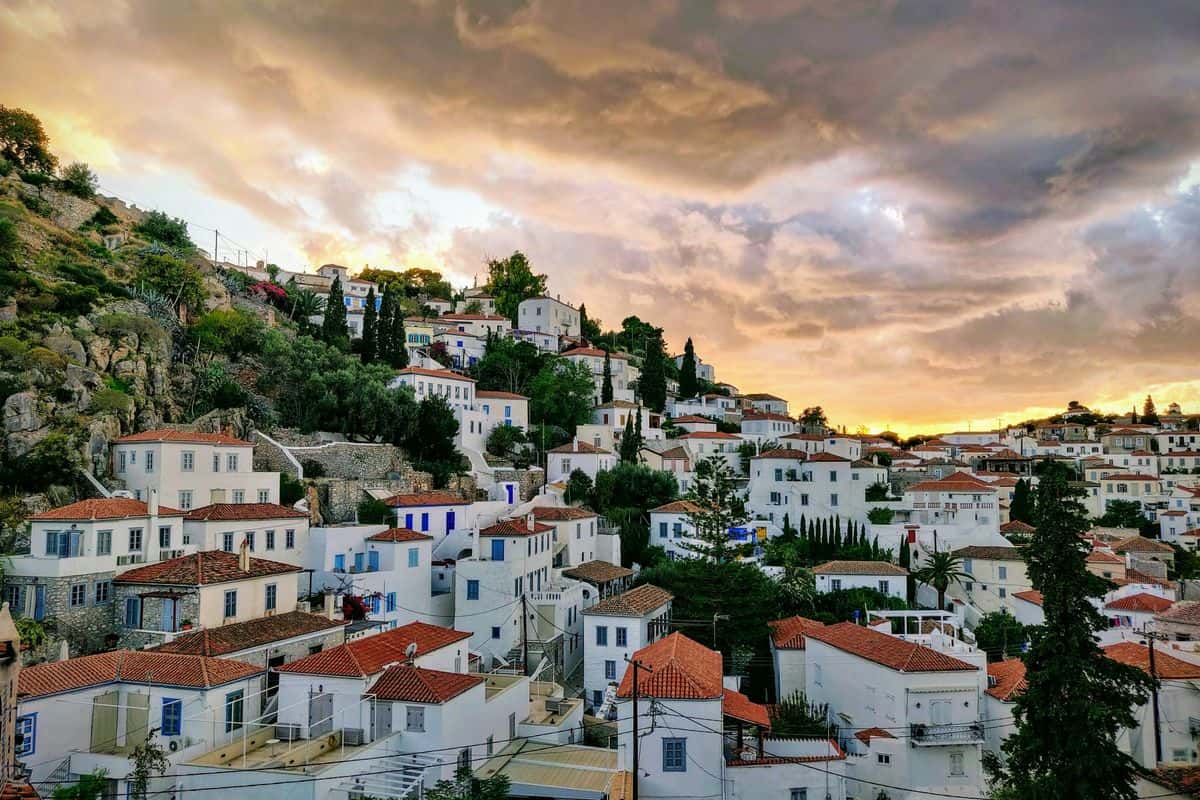
Ippokampos Hotel Hydra is a small hotel in the old town of Hydra, close to the harbour, set in a renovated mansion. For tours and day trips from Athens, see our tours in Greece page.
Read on for what the old entry of this site says, what the hotel’s own pages state, the rooms, the yard, the mansions and churches of the old town, the check-in times and short answers to common questions.
What is the Ippokampos Hotel Hydra today?
The Ippokampos Hotel Hydra is a hotel in the centre of Hydra Town. According to the hotel’s web pages, the port is three minutes away on foot. Those pages describe a hotel in operation and say nothing about a closure or a new name.
The hotel’s web pages write the name as “Ippokampos Hotel”. They set the building in the centre of the city of Hydra. By that text, the Ippokampos Hotel Hydra lies three minutes’ walk from the port, on a level, paved road. A traveller with a heavy suitcase can ask the staff what the last stretch looks like.
That earlier text on this site carries the title “Hotel Ippokampos Hydra”. It files the hotel under the line “Hydra Island – In Town” and words the place as “Hydra Town – Centrally located”. Its general text repeats the point and puts the hotel at the town centre. The island beyond this hotel has its own page, named Hydra tours.
The old entry gives the distance to the port twice. It puts the walk at five minutes and the hotel one hundred metres from the harbour. The hotel’s web pages say three minutes and give no metres. That makes three distance figures for the Ippokampos Hotel Hydra. Which of the three fits is a question for the reception.
In Wikipedia’s definition, guests of a hotel pay for lodging and stay a short time. The hotel’s web pages add a short portrait in their own words, “a traditional, very quiet and clean Hotel”. This page repeats that wording only as the hotel’s claim about itself. It is not a finding or a rating of this page.
The building has no year in the old entry, and none appears on the hotel’s web pages. The age of the house stays open. Two questions go to the reception. In which year was the building of the Ippokampos Hotel Hydra put up? And does the name on its sign today match the name on its website?
What star class and what number of rooms did the Ippokampos Hotel Hydra have?
The earlier text on this site lists the hotel as “CLASS B” with sixteen rooms. The hotel’s current web pages name no class and give no total of rooms. The Ippokampos Hotel Hydra therefore has two old labels from one text and no current figure on its own pages.
The old entry places the Ippokampos Hotel Hydra in “CLASS B” and does not explain the letter. The word class stands there alone, with no number of stars beside it. A letter without a named scheme is hard to read. Who gave the letter, and does the hotel still hold that class? Only the reception can say.
On its home page and on its four room pages, the hotel’s site states no class and no stars. Those pages speak of rooms, services and position only. Other lodging pages of the island sit together on the Hydra hotel index, a page of this site. Only the hotel can show the document that gives its class today.
According to Wikipedia, hotel rating means grading lodgings by quality, and the schemes differ widely between organisations. Its text uses grading, rating and classification for the same concept. The old entry names no scheme for the letter that it prints. These texts therefore leave the Ippokampos Hotel Hydra outside every scheme that has a name.
On the number of rooms, the old entry says sixteen. The figure stands once in the header block and once more in the general text. The hotel’s web pages give no total. They describe the rooms on four pages, one for each type of room. The old entry gives one sum, and the web pages give four types.
Three answers from the reception settle the matter of class and rooms. Which document proves the class now? How large is the total of rooms? How do those rooms divide among the four room types? Until then, the class and the sixteen rooms stay old figures. The Ippokampos Hotel Hydra gets no present claim from them.
Which rooms does the Ippokampos Hotel Hydra offer?
The website of the Ippokampos Hotel Hydra shows four room types. The types are two double rooms, a triple room and a two-room suite. One double room has a double bed, the other has twin beds. Each page gives the size in square metres.
The Ippokampos Hotel Hydra lists the double room with one double bed first. Its page gives 13 square metres for two people, air conditioning and an LCD satellite TV. A communications satellite in orbit relays satellite television to the viewer’s location. The page lists a mountain, garden or sea view. Pictures sit in the Ippokampos Hotel photo gallery.
The second type is the double room with two single beds. Its page repeats the size of 13 square metres and lists twin beds. It also lists air conditioning and an LCD satellite TV. A number of the rooms have access to a balcony, says the same page. The page leaves open which rooms have one.
The triple room of the Ippokampos Hotel Hydra is for three people and measures 15 square metres. Its beds are one double and one single, with air conditioning and an LCD satellite TV. Its page lists a mountain, yard or sea view, where the first double room lists a garden view. The balcony note appears here too.
The two-room suite is for two people and measures 30 square metres. A bedroom with a double bed joins a living room with a sofa, and the two rooms communicate. A large terrace of 24 square metres overlooks the garden. The suite page lists air conditioning and an LCD satellite TV. Ask the hotel where it lies.
In the old entry, every room carries a private bathroom, a telephone, a mini fridge, satellite TV and air-condition. Wikipedia describes air conditioning as removing heat from a closed space. It calls a balcony a railed platform jutting from a wall. Ask the Ippokampos Hotel Hydra for the room total and whether each room has the mini fridge.
Which reception, reception lounge and bar does the Ippokampos Hotel Hydra list?
The Ippokampos Hotel Hydra lists a reception with a desk, a lounge around it and a bar. On the website, the reception and the bar both sit on the ground floor. It adds a wake-up service and baby sitting upon request.
According to its website, the ground floor of the Ippokampos Hotel Hydra opens with the reception room. A reception desk stands there with a comfortable sofa. The same page then names the morning buffet room and the hotel’s bar, in that order. Ask the hotel how the three rooms connect and where the sofa stands.
The website says the reception welcomes guests and serves them in anything they ask for. The staff also talk with guests about sights and things to do on the island of Hydra. The services page names the reception but gives no opening hours. Ask the hotel at which hours the desk is staffed each day.
The reception lounge of the Ippokampos Hotel Hydra surrounds the reception area. Guests can relax there for a while, says the website. That lasts until the staff can inform them about the stay and answer all their questions. Ask the hotel what number of guests the lounge seats and what it holds besides the seating.
A wake-up service for customers appears on the services page of the website. The page gives no hours and no method for the service. The same page lists a baby sitting service upon request. Baby sitting upon request also stands in the old entry. Ask the hotel when the wake-up service and the baby sitting are available.
At the bar of the Ippokampos Hotel Hydra, guests listen to music, the website says. They can have a coffee, a drink, an iced fruit juice or a snack. Wikipedia defines a bar as a retail business that serves drinks such as beer, wine and soft drinks. Ask the hotel when the bar opens this year.
How are the yard and the morning buffet of the Ippokampos Hotel Hydra arranged?
The hotel’s own website describes an inner courtyard with a garden and a fenced yard. It also lists a daily morning buffet in a room of its own. The old entry, an earlier text on this site, adds a stone-paved yard. Ask the Ippokampos Hotel Hydra which space serves the morning buffet today.
“A traditional islander’s corner” is how the website describes the inner courtyard of the Ippokampos Hotel Hydra. It holds a garden with pots, flowers and sitting areas. The website says guests can have the morning buffet there, drink a coffee and relax all day. A heading on its areas page names the morning buffet in the yard.
The old entry mentions a stone-paved yard, where guests have a meal in the morning or at dinner. Its facilities line also lists a place for the morning meal in the garden. Is that yard the courtyard of today’s website? Ask the Ippokampos Hotel Hydra how big the space is and when it is open.
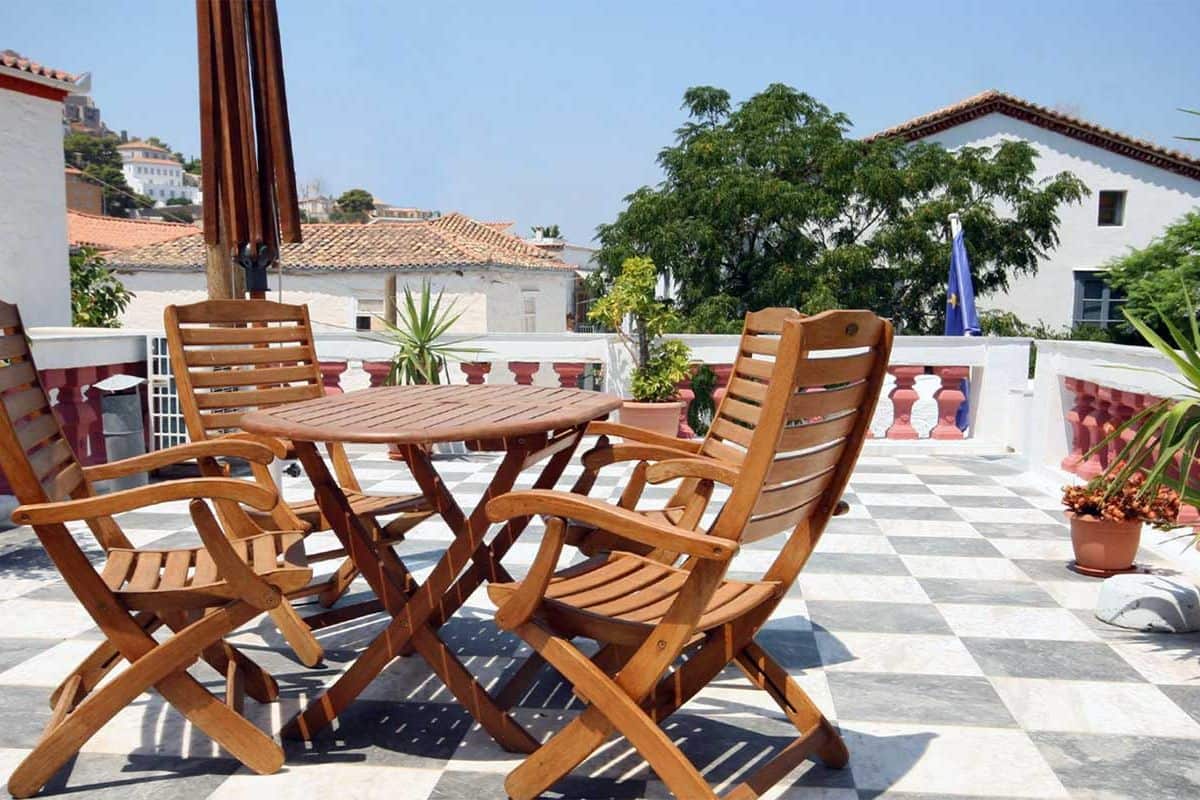
The fenced yard is a separate item on the website’s areas page. The page calls it a representative corner of Hydra. Guests relax there with a coffee or a drink, while children play safely. The home page shows the courtyard twice, under The Entrance and under The Yard. The Hydra photo gallery holds pictures of the island.
The hotel’s services page says the morning buffet is offered daily, in buffet style. The website lists the morning buffet room on the ground floor, after the reception room and ahead of the bar. At the Ippokampos Hotel Hydra, the areas page describes a homemade Greek spread. It names local products, sweets, pastries and different kinds of cookies.
Wikipedia defines a courtyard as an area open to the sky that a building or walls enclose. That plain meaning fits the inner space the website describes. Ask the Ippokampos Hotel Hydra whether the morning buffet moves into the yard in every season. Ask also at what hours the buffet room serves it each day.
Which winter lounge, fireplace and conference room did the Ippokampos Hotel Hydra have?
A lounge TV room with a fireplace for the winter months appears in the old entry that this site holds. It also lists a conference room for up to 40 persons at the Ippokampos Hotel Hydra. The hotel’s own website names neither of them. Ask the hotel whether both still exist.
In its general information the old entry says the hotel provides a bar. It adds a lounge TV room with a fireplace for the winter months at the Ippokampos Hotel Hydra. These lines give no size for the room, no fuel for the fire and no hours of use. Ask in which months the lounge is open today.
The facilities list in the old entry marks two spaces by season. One is a bar in the garden for the summer. The other is a fireplace for the winter. Read together, the items set the garden against the lounge, one for warm months and one for cold. Ask whether the garden bar still serves drinks in summer.
The old entry also lists a conference room for up to 40 persons at the Ippokampos Hotel Hydra. The website of the hotel itself lists no conference room, no fireplace and no seasonal bar. A reader therefore cannot tell from today’s pages whether meetings still take place there. Ask for the capacity of the room today.
Wikipedia explains the word fireplace. It is a structure of brick, stone or metal that holds a fire. People use it to warm a room or a home. Fireplaces burn different fuels, such as wood, charcoal or gas. Ask the Ippokampos Hotel Hydra whether the fire is lit today and which guests can sit near it.
Wikipedia’s entry on the conference hall describes a room for one-off events, for example a business conference or a meeting. The old entry uses the simpler words conference room. Ask the Ippokampos Hotel Hydra what furniture and equipment the room holds. Ask also for the number of seats and whether a group can use the room today.
Which mansions of Hydra Town can visitors to the Ippokampos Hotel Hydra see?
The hotel’s own sightseeing page lists the manors of the island for visitors to the Ippokampos Hotel Hydra. It calls them buildings over 200 years old. It names the mansions of Pavlos and Lazaros Koundouriotis, Tombazi, Tsamadou, Kriezi, Voulgari and Bountouris.
Wikipedia says that on entering the harbour, the Tsamadou mansion lies on the left. It is now a Maritime Academy. The hotel’s website names the home of the Tsamadou family on its port-tour page. It says the building houses the School of Merchant Marine. The two pages name the school differently. Ask which one it holds today.
In Wikipedia’s account, the Athens School of Fine Arts now includes the Tombazis mansion. The hotel’s own list spells the name Tombazi, so a reader meets two forms. A guest at the Ippokampos Hotel Hydra can ask the hotel about a visit to this mansion. Does the school admit visitors, and at which days and hours?
Wikipedia lists the Voulgaris, Miaoulis, Boudouris, Sachinis and Kriezis mansions. It adds the Kountouriotis houses of Lazaros and George. All of them hold collections of eighteenth-century island furniture. The hotel’s own list names Pavlos Koundouriotis, who is not in the Wikipedia line. Visitors to the Ippokampos Hotel Hydra can ask which collections are on show.
The hotel’s own pages say the historical house of Lazaros Kountouriotis holds a branch of the National History Museum. The same website’s port-tour page dates this mansion to the late eighteenth century. A guest of the Ippokampos Hotel Hydra can ask the hotel for the days and hours of the branch. Is a ticket paid separately?
Wikipedia defines a mansion as a large dwelling house. It adds that the word comes through Old French from the Latin mansio, which means dwelling. Three of the mansions above now serve as a school or a museum branch. Ask the Ippokampos Hotel Hydra which mansions are open to visitors today and at which hours.
Which museums and the art hall of Hydra Town can visitors to the Ippokampos Hotel Hydra see?
Visitors to the Ippokampos Hotel Hydra can see four places that the hotel’s own website lists. The list holds the Historical Archive-Museum of Hydra and the Ecclesiastical and Byzantine Museum. It also holds the Post-Byzantine Art and History Museum and the Art and Concert Hall.
The hotel’s own sightseeing page says the Historical Archive-Museum of Hydra operates daily. It lists relics, archival material and a library of publications on display. Another page puts the museum in the port. A guest at the Ippokampos Hotel Hydra can find out from the hotel when the museum opens. The pages say daily and no more.
Our Greece Hotels page and our Mistral Hotel Hydra page add more detail.
The same sightseeing page names the Ecclesiastical and Byzantine Museum, right in the centre of the port. The page pairs it with the church of the Assumption. The port-tour page says the museum is housed in buildings of the monastery. Visitors to the Ippokampos Hotel Hydra can ask the hotel for the opening days of this museum.
The hotel’s own pages place the Post-Byzantine Art and History Museum in the house of George Kountouriotis. Wikipedia notes that Constantinople fell in fourteen fifty-three. Art made by Eastern Orthodox Christians in the Ottoman Empire after that date carries the label post-Byzantine. A guest of the Ippokampos Hotel Hydra can ask what the museum shows.
The hotel’s own pages list the Art and Concert Hall “Melina Mercouri” of the Municipality of Hydra. They say it hosts works by artists all year round. Wikipedia describes Melina Mercouri as a Greek actress, singer, activist and politician. A visitor to the Ippokampos Hotel Hydra can ask the hotel which works the hall hosts during the stay.
The hotel’s pages say cultural events take place on the island from time to time. They name talks, exhibitions, cultural evenings, workshops and concerts in the Art and Concert Hall and other art spaces. A separate page of this site, headed Hydra, Poros and Aegina day cruise, covers the trip by sea. Ask which events fall in a stay.
What is the cathedral of Hydra Town that visitors to the Ippokampos Hotel Hydra can see?
Guests of the Ippokampos Hotel Hydra can look for the Cathedral of Hydra in the centre of the harbour. According to the touring page of the hotel’s website, it was built in sixteen forty-eight and reconstructed in seventeen seventy-four.
On the hotel’s own touring page the cathedral is a basilica with three aisles and a dome. It counts two towers of marble and, inside, two chandeliers of silver. At the Ippokampos Hotel Hydra, a traveller can check that list against the building. Walking time from its front door to the cathedral is a question for the hotel.
As the hotel’s own touring page tells it, the courtyard of the cathedral holds a statue of Lazaros Kountouriotis. A second statue there shows Andreas Miaoulis. The page adds the tomb of Lazaros Kountouriotis to the same courtyard. A visitor can therefore count two statues and one tomb. Ask the hotel whether the courtyard is open to visitors.
The sights page of the hotel’s website lists a seventeenth-century church whose name is the Assumption of the Virgin. It also stands in the centre of the port. A large clock on its high bell tower announces major religious events. Whether this church and the cathedral are one building is a question for the Ippokampos Hotel Hydra.
Wikipedia calls the Dormition a Great Feast kept by Eastern Orthodox churches. The article is titled Dormition of the Mother of God and says the feast marks the falling asleep of Mary. Western churches keep the matching feast as the Assumption of Mary. The sights page uses that Western name. Ask the hotel when its church keeps it.
Wikipedia describes a cathedral as a church that holds the seat of a bishop. It is the central church of a diocese. Travellers at the Ippokampos Hotel Hydra can note that the hotel’s page lists a dome. Wikipedia says the Byzantine style is based on arches, vaults and domes. Ask the hotel which style the cathedral follows.
Which churches of Kiafa lie near the Ippokampos Hotel Hydra?
The hotel’s own touring page names four churches around Kiafa. Saint Constantine and Saint John the Faster stand in Kiafa itself. The Visitation follows the harbour square, and Ypapanti lies on the way up. Ask the Ippokampos Hotel Hydra how long each walk takes.
The touring page puts the Church of Saint Constantine on the top of the hill of Kiafa. It says the church was built on the site where the saint’s home stood. The sights page adds wooden carvings and a gilded iconostasis. Whether the hilltop church opens for visits is worth asking at the Ippokampos Hotel Hydra.
The touring page lists the old Church of Saint John the Faster in Kiafa. It dates the frescoes to the seventeenth century and calls the church one of the oldest on Hydra. The sights page names the church with Ypapanti and gives frescoes of the eighteenth century. Ask the hotel to confirm the century, because the pages differ.
The touring page places the Church of the Visitation on the left, after the square of Paul Kountouriotis. That square lies in front of the monastery buildings, with a statue of the Greek politician at its centre. The church holds a wooden iconostasis. How far is the square from the Ippokampos Hotel Hydra? Ask the hotel.
The touring page dates the Church of Ypapanti to seventeen eighty and says it holds a carved iconostasis. It lists the church among the sights on the road up to Kiafa. The sights page pairs Ypapanti with Saint John the Faster and mentions domes on marble arches. Ask the hotel which of these details a visitor can see.
Wikipedia describes an iconostasis as a wall of icons that divides the nave from the sanctuary of an Eastern church. Boat trips to other islands appear on the site’s page about Greek islands cruises. The opening hours of each church and visitor access to the carved screens are questions for the Ippokampos Hotel Hydra.
What is the Kiafa old town near the Ippokampos Hotel Hydra?
Kiafa is the medieval fortress town of Hydra, a village of stone-built houses, high walls and narrow streets. Guests of the Ippokampos Hotel Hydra climb the stairs of the town to reach it, per the hotel’s own website.
The hotel’s own touring page places Kiafa at the top of those same stairs. A second page of the site calls it the old settlement of the town. That page links Kiafa to the narrow alleys. Both pages treat Kiafa as the old part of Hydra Town, and the Ippokampos Hotel Hydra presents it that way.
On the way up the stairs, the touring page lists what greets a walker. First comes the smell of cut wood from carpentry. Around it stand brightly coloured houses and churches, and the page says these colours lift the mood of the visitor. Which carpentry workshops still work in Kiafa today? Only the hotel can say.
From the hill of Kiafa, the touring page says, the view reaches across the Peloponnese. The hotel’s website gives no walking time from the port and no hour for the view. Two questions for the hotel follow for anyone staying at the Ippokampos Hotel Hydra. How long does the climb take, and which stairs lead up?
The touring page names Kala Pigadia, a district on the uphill road to Kiafa. Two wells stand there, built in eighteen hundred and three under the administration of George Voulgaris. The district takes its name from them. Townspeople drew water there for over two centuries. Are the wells still visible today, and where? The hotel can say.
Wikipedia describes the Saronic Islands as a group of islands close to the Greek mainland. The group’s four main inhabited islands are Salamis, Aegina, Agistri and Poros. Wikipedia adds that Hydra and Dokos are sometimes counted with the group. Readers of the Ippokampos Hotel Hydra pages who want the wider group can turn to Aegina tours here.
What do the paved lanes on the way to the Ippokampos Hotel Hydra look like?
The hotel’s website describes the road from the beach to the Ippokampos Hotel Hydra as paved, without stairs. It passes between shops and houses of “traditional architecture”. Another page of the same website mentions alleys paved with slabs.
The location page on the hotel’s site starts the road at the beach and ends it at the hotel. Shops and houses line the way between the two points. Guests at the Ippokampos Hotel Hydra read no more than that. The page names no surface material and no width. What lies underfoot is a question for the hotel.
The sightseeing page of the website describes roads and alleys paved with slabs and houses adorned with flowers. The activities page uses a different word and speaks of cobblestone streets. Two pages use two words for the pavement. Which surface lies on the lane to the hotel’s door, slabs or cobblestones? Only the hotel can say.
The activities page invites readers to stroll along the cobblestone streets, between taverns and small shops with colourful folk art. The same website places the hotel in the middle of the old town. So these streets set the scene for the Ippokampos Hotel Hydra, as the hotel itself describes them. The page names no tavern and no shop.
Wikipedia defines a cobblestone as a natural building material made of cobble-sized stones, used to pave roads and streets. It sets cobblestones apart from setts, which come from a quarry and are cut to an even shape. Cobblestones are naturally rounded and less uniform in size. The website does not name the kind that lies on its lane.
The hotel’s page on Hydra today names a stroll through the town’s cobblestone streets as a way to know Hydra. The touring page adds a narrow, paved, winding road that leads to the old town of Kiafa. Which route from the door of the Ippokampos Hotel Hydra to the port has no steps? How wide are the lanes?
Which architecture styles appear in Hydra Town and in the Ippokampos Hotel Hydra building?
The old entry speaks of an old mansion. No style is named for the Ippokampos Hotel Hydra building there or on the hotel’s own website. Visitors are pointed toward the houses of Hydra Town by the hotel’s own website. Ask the hotel for the style and the date.
Two general terms help a reader who looks at the houses of Hydra Town. Wikipedia says neoclassical architecture is the style of a movement that began halfway through the eighteenth century. It started in Italy, France and Germany. No line in the old entry or in the hotel’s pages places the Ippokampos Hotel Hydra within that style.
The second term is vernacular architecture. Wikipedia defines it as building carried out outside any academic tradition, with no trained designers or architects. Neither the old entry nor the own site uses the word for the town or the hotel. Treat it as background only, and ask the hotel how the building was made.
The hotel’s own activities page asks visitors to admire the Hydra houses for their architecture. It names no style and no date for the houses. A reader curious about one house’s style can ask at the reception of the Ippokampos Hotel Hydra. Put the same question about the hotel building: which style, if any, the front follows.
In the old entry the hotel is an old mansion, renovated with care and respect. It gives no year for the building, none for the renovation, and no name for the builder. That entry is years old, so check each detail. Ask whether the hotel still keeps the old rooms and the old walls of that mansion.
Wikipedia defines historic preservation as the effort to preserve and protect buildings, objects and landscapes of historical significance. The term concerns the built environment, not forests or wild land. Which parts of the Ippokampos Hotel Hydra did the renovation keep? Which parts are new, and does a record of the work exist? Put both questions to the hotel.
What check-in and check-out times and what season does the Ippokampos Hotel Hydra give?
The hotel’s own health page lists check-in from three in the afternoon, with check-out until eleven in the morning. The page dates from the pandemic years and follows the final health protocols of that time. Only the Ippokampos Hotel Hydra can confirm the current times and the months of opening.
One short health page, with Covid-19 in its heading, carries the time rule on the hotel’s own website. In that text the hotel says it follows the final sanitary protocols for hotels and accommodation. Early arrivals and late departures need a plain question. Does the Ippokampos Hotel Hydra still keep these times, and what happens outside them?
The same page describes the cleaning of that period. It lists disinfection of the rooms and of all the common areas, with chlorine and detergents. Hand sanitizer is available in each guest room and throughout the public areas. The text belongs to the pandemic years, so ask the hotel which of these routines still apply today.
The hotel’s own holiday page adds a word on the season. It says Hydra is not only a summer place and that autumn suits walks in the alleys. It describes walks “without much heat to make you tired” and without crowds. Visitors planning an autumn stay at the Ippokampos Hotel Hydra ask which months the hotel is open.
A note on geography helps a guest who plans an autumn visit. Wikipedia lists the Saronic Gulf as a piece of the Aegean Sea. Attica lies on one side and Argolis on the other. Ask the hotel how autumn weather and sea affect a guest’s journey to the island. A direct reply from the hotel is the safest source.
Guests of the Ippokampos Hotel Hydra find no airport route on the hotel’s own pages, so they ask the hotel. This site also carries a page on Athens airport transfers for readers who land in the capital. The hotel can describe the last stretch from the port. Ask again for the current times and the health protocols.
What else do travellers ask about the Ippokampos Hotel Hydra?
Is the Ippokampos Hotel Hydra open all year?
The hotel’s own website gives one line on each of its four room pages. It reads “Our Hotel is open from March to October”. That is eight months of the year. The line names no winter opening. The room pages set out no dates of a single year.
The same website names no closure, no sale and no change of name for the Ippokampos Hotel Hydra. The section above on check-in, check-out and the season holds its words on autumn. A season is a span of weeks. Only the hotel can say when it starts and ends in a given year.
Ask the hotel for the first and the last night of the season this year. Ask whether the bar and the yard open on the same days as the rooms. Ask whether the season moves from one year to the next.
Is the Ippokampos Hotel Hydra on a second website the same property?
A second website uses the same name, “Ippokampos Hotel”, for a hotel placed in Hydra town, in its centre. It says the hotel stands only 150 metres from the port. The text of that website names no street, so it gives a length and no address.
On a level paved road, the walk from the port takes three minutes, says the hotel’s own website. That is a time, where the second website gives a length, so the two do not measure alike. The opening section above puts the website’s three minutes next to the old entry’s words.
The same name, the same island and the same town centre point to one hotel, yet no page proves it. Ask the Ippokampos Hotel Hydra to confirm its street address. Ask whether both websites belong to the hotel. Ask which distance the hotel stands behind.
Are the rooms of the Ippokampos Hotel Hydra air conditioned?
The hotel’s own website says so on its home page. Its list of room features carries the line “Air conditioning (cooling-heating)”, beside the line on the view. The brackets name two modes, cooling and heating. No room is marked there as an exception.
Each room page states it again in its own description. The double room with a double bed is called “air conditioned”. The same word covers the room with two single beds and the triple room. The page of the two-room suite says the same.
The room pages do not say how the unit is controlled. Ask the Ippokampos Hotel Hydra whether a guest sets the temperature in the room. Ask whether the heating works in the cooler weeks of March. The section above on the rooms gives the sizes and the views.
What is the number of rooms in the Ippokampos Hotel Hydra?
Sixteen rooms appear in the old entry of this site. Its room list and its general text both carry the figure. The website of the hotel states no total of rooms. The section above on the star class and the number of rooms holds the old entry’s wording.
The hotel’s own website lists four room types instead. Two are double rooms, one with a double bed and one with two single beds. The remaining two are the triple room and the suite with two rooms. It gives no count for any type, so the types cannot be added up to a total.
Put the question of the total today and of the number per type to the Ippokampos Hotel Hydra. Ask whether rooms were joined or divided since the old entry was written. The figure of sixteen is the only total this page can quote, and it comes from an old text.
Does the Ippokampos Hotel Hydra have a safe deposit box in each room?
The hotel’s own services page says there is “a safe deposit box for your items in each room”. The page gives no size, no type of lock and no list of what fits inside. That one line is the whole of the claim.
The old entry of this site does not list a safe among the fittings of its sixteen rooms. The safe is therefore a fact of the hotel’s own website, not of the old text. The two texts come from different years, so the line of the website is the one to ask about.
Ask the Ippokampos Hotel Hydra whether every room has the box today, including the triple room and the suite. Ask where it stands in the room and how large it is. Ask how a guest locks it. Ask whether the box is the same in every room type.