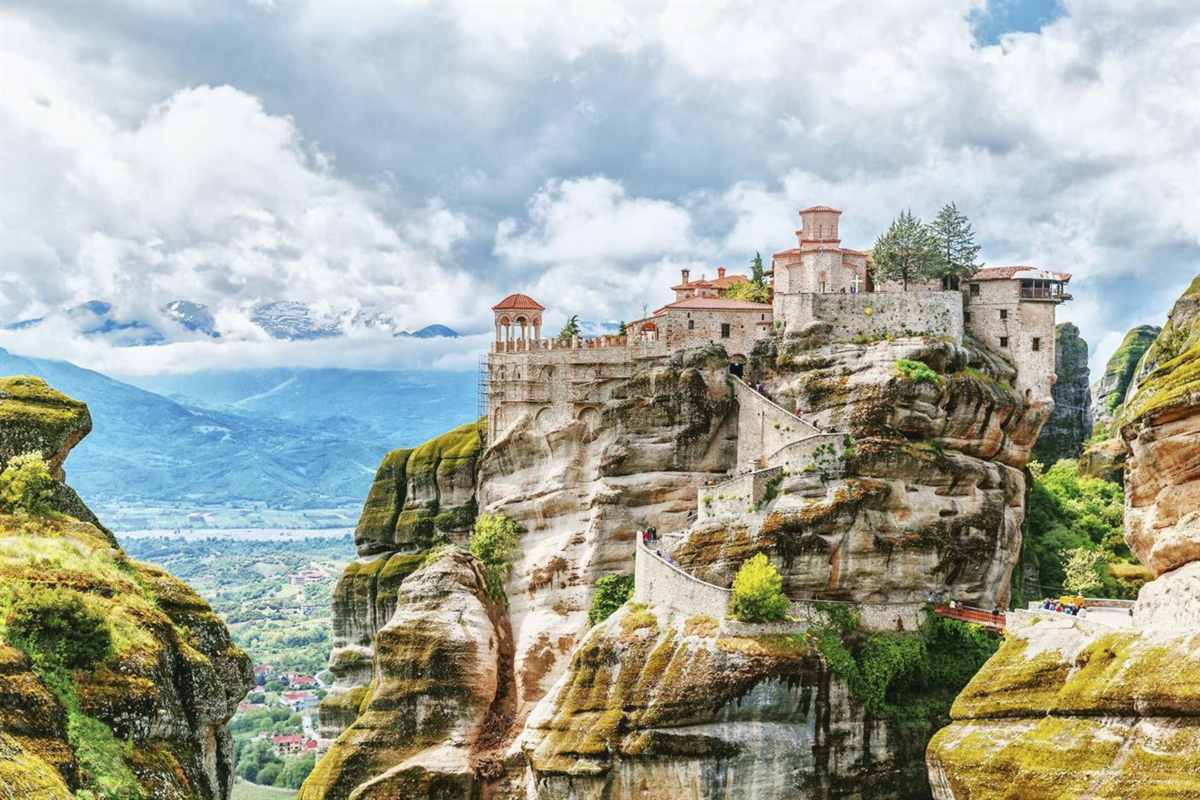
The road south from Thessaloniki crosses the Thessaly plain and ends at the sandstone towers of Meteora, so a Meteora day trip from Thessaloniki fills the whole day. For other routes and longer stays, see the tours in Greece on this site.
The sections below cover what the trip includes, the length of the drive, where the bus leaves in Thessaloniki, the choice between bus, train and car, the road across the Thessaly plain, Larissa, Kalabaka, the monasteries on the route, Thessaloniki itself, the months to travel, what to pack, the two-day option with a night in Kalabaka and the questions travellers ask.
What does a Meteora day trip from Thessaloniki include?
Each Meteora day trip from Thessaloniki runs as a full-day coach tour with return transport and a trip leader. You enter two of the six monasteries, stop at viewpoints and break for lunch in the village of Kastraki.
One operator’s list covers round-trip transport, an English-speaking archaeologist on board as attendant, and basic travel insurance. The insurance applies during the transport. The coach is air-conditioned and makes a planned rest stop. A second operator names Wi-Fi on its coach.
The first operator leaves three things to you.
- Lunch at a restaurant.
- A tour guide inside the monasteries.
- The entrance fee for each monastery, paid in cash.
A third operator lists the entrance fees, a licensed tour guide and pickup and drop-off as included. Lists differ from one seller to the next. Read the inclusions before you choose a Meteora day trip from Thessaloniki.
Full-day tours take you inside two of the six active monasteries. Which two depends on the opening schedule of each monastery that day. Panoramic stops show all six from outside. One operator says its coach stops right at the monastery entrances.
Groups differ in size between operators. One caps the group at 49 people. Another caps its groups at 16 to 20 people. Its archaeologist gives an introduction to the monastic traditions on arrival, before you enter the monasteries.
Lunch happens in Kastraki, a village below the rocks, or in the town of Kalabaka. You pay for the meal yourself. One operator adds a stroll past the shops of Kastraki to the break.
The first operator rates the walking as easy to moderate, with short climbs and stairs. It adds that travellers with reduced mobility are not a fit for the tour. Your Meteora day trip from Thessaloniki means climbing those stairs on foot, so plan for it.
How long is the drive from Thessaloniki, and how is the day timed?
Road distance for the Meteora day trip from Thessaloniki is about 230 kilometres. One operator lists the drive as 3 hours each way. A 30-minute stop for rest and coffee comes on the way there.
The day follows a fixed clock on that operator’s Meteora day trip from Thessaloniki.
- 8 in the morning: the coach leaves Thessaloniki.
- Around half past 12: the group reaches Meteora.
- 1.5 hours: the visit to two monasteries.
- 1.5 hours: the lunch break in Kastraki.
- Around half past 3 in the afternoon: the coach leaves for Thessaloniki.
- About 7 in the evening: the group is back in the city.
The trip home has one last stop, 20 minutes long, for coffee and rest. Six hours of the day go to driving, against 1.5 hours inside the monasteries. The operator wants you at the start point 10 minutes early, at the least.
Another operator’s Meteora day trip from Thessaloniki covers around 230 kilometres too, with 3.5 to 4 hours one way. Photo stops on the drive show cliffs rising above the plain of Thessaly. Time on site runs from 1.5 to 3 hours, set by the tour type. The group returns between late afternoon and early evening.
A third operator leaves half an hour earlier, at half past 7 in the morning. Start times and drive times differ between sellers. Compare the schedules first when you pick a Meteora day trip from Thessaloniki.
Where does the bus leave in Thessaloniki?
The coach for the Meteora day trip from Thessaloniki meets at the corner of Aristotelous and Egnatia Street. It waits beside the statue of Eleftherios Venizelos. Tour listings name a start at 8 in the morning, and one names half past 7.
One operator gives Egnatia 78 as the street address for its Meteora day trip from Thessaloniki. The postcode is 546 24, and that listing starts the day at half past 7. A second operator names 8 in the morning. Its page says to be at the statue at least 10 minutes before the coach leaves.
Not every coach starts at the statue. A different operator, whose trip runs on the public intercity bus, begins at the Macedonia Intercity Bus Station. The start is half past 9 in the morning. The listing asks guests to reach the station no later than 30 minutes before the bus leaves.
Travellers who pick the public bus begin their Meteora day trip from Thessaloniki in the west of the city. A travel wiki places the Macedonia Intercity Bus Station at Giannitson 244. Bus line 01X links it with the airport and the New Railway Station, day and night.
The operator tells guests to visit the ticket desk first. They bring the PDF tickets from their email and collect printed tickets.
Bus, train or car: how do you get from Thessaloniki to Meteora?
A guided coach is the simplest way to do a Meteora day trip from Thessaloniki, says one operator’s page. On your own, you can take the train, the public bus or a car. The same page puts each between 3 and 4 hours one way.
According to the page, the direct Intercity train from Thessaloniki Railway Station reaches Kalabaka after 3 to 3.5 hours. A taxi or minibus then runs from the station to the monasteries. Kalabaka is the last stop on the Palaiofarsalos line.
Rail riders need one answer first, because their Meteora day trip from Thessaloniki depends on the line being open. A travel wiki reports that storm damage once put the route to Kalabaka out of service. The nearest working stops were then Lamia, Palaiofarsalos and Larissa.
The public bus leaves the Macedonia Bus Terminal for Kalabaka. The page gives the trip as roughly 3.5 to 4 hours. It calls the coaches comfortable and air-conditioned, but warns that schedules can be limited. Check ahead.
A travel wiki describes a change at Trikala Bus Station. There, travellers swap to a local bus for Kalabaka, with an hourly service and a ride of roughly 45 minutes.
Public transport adds one more step to the Meteora day trip from Thessaloniki. From Kalabaka bus station, a local bus to the rocks runs only a handful of times each day. The wiki says to ask at the station for times.
The same page gives the drive as roughly 3.5 to 4 hours via the E90 and E92 roads. A car lets you stop in towns on the way.
Car parks stand close to the monasteries. Space runs short in peak season, which the page dates as June to August. The page presents the car as the flexible way to run your own Meteora day trip from Thessaloniki.
Every independent Meteora day trip from Thessaloniki needs a second ride from Kalabaka to the rocks. It goes by taxi, minibus or local bus. Tour listings describe round-trip transport by coach instead.
What does the road from Thessaloniki to Meteora cross?
Any Meteora day trip from Thessaloniki sets out in Macedonia and crosses the plain of Thessaly. It ends in the Trikala region, at the plain’s north-western edge. The Pindus mountain range and the Pineios river are close by.
One operator calls the ride a drive southwest through the Macedonian countryside. Its page lists rolling farmlands, Byzantine churches and villages such as Grevena. It also mentions cliffs rising above the Thessalian plains. Another operator names the Egnatia road in its highlights.
Egnatia Odos is the name of the A2 motorway in northern Greece. The A2, also called the E90, runs through the north-western corner of the Trikala regional unit, near Panagia. One operator gives the E90 and E92 as the car route if you drive the Meteora day trip from Thessaloniki.
The Thessaly plain sits between Mount Othrys and Mount Olympus. Thessaly borders Macedonia to the north, so the trip passes from one region into the other on its way south-west.
The Meteora day trip from Thessaloniki reaches its goal inside the Trikala regional unit. Its south-eastern part belongs to the Thessalian plain. Forested Pindus mountains fill the west, and the Chasia and Antichasia ranges rise in the north. The unit includes the Meteora monastery complex.
Trikala, the capital of the unit, stands near Meteora and the southern Pindus range. The city straddles the Lithaios river, a tributary of the Pineios, and has 62,064 inhabitants.
The farms of the Trikala region grow fruit and vegetables, cotton and olives, and they raise cattle. Along the Meteora day trip from Thessaloniki, the Trikala region is farm country as well as rock country.
What is Larissa, the big city on the way?
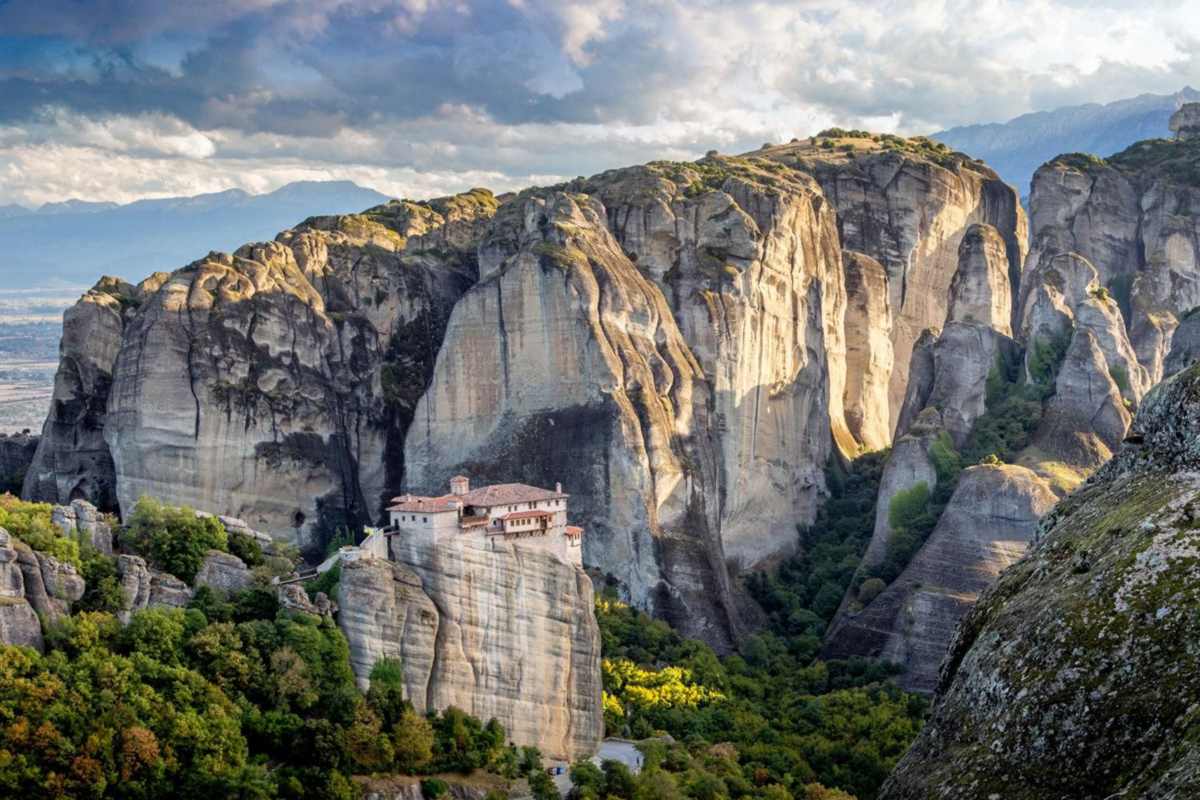
Larissa, with 148,562 residents, is the regional capital and also Thessaly’s largest city. The city stands in the middle of the Thessaly plain. The Meteora day trip from Thessaloniki ends at that plain’s north-western edge.
Larissa is about 120 kilometres south-west of Thessaloniki and about 210 kilometres north-west of Athens. By population it is the fifth largest city in Greece. Road and rail link it with Thessaloniki, Athens and the port of Volos, which makes it a national transport hub.
The A1 motorway and the national roads EO3 and EO6 connect to the city. The Larissa regional unit lies east of the Trikala regional unit, where the Meteora day trip from Thessaloniki ends.
Larissa railway station sits in a residential area near the centre. InterCity trains between Athens and Thessaloniki serve it, along with express services to Kalambaka and regional services to Volos.
Beyond the Meteora day trip from Thessaloniki, Larissa has an ancient story of its own. Builders raised its first ancient theatre under Antigonus II Gonatas. It stayed in use for six centuries.
Larissa is a major agricultural centre because of the Thessaly plain. Horses made the area known in antiquity, and the ancient coins of the city show one. The Greek physician Hippocrates is thought to have died there.
The Pineios river crosses the city centre, and Alcazar Park lies along its banks. The same river flows near the rocks where the Meteora day trip from Thessaloniki ends. Mount Olympus and Mount Kissavos stand north and north-east of the city.
What is Kalabaka, the town below the rocks?
Kalabaka is a Thessalian town below the Meteora cliffs, where the municipality of Meteora has its administrative seat. The monasteries stand close to it, which gives any Meteora day trip from Thessaloniki its destination.
Pages that sell the Meteora day trip from Thessaloniki spell the town three ways: Kalabaka, Kalambaka and Kalampaka. All three name one place, in the Trikala regional unit. A census counted 11,492 people in its municipal unit, and 8,573 of them live in the town proper. The unit covers 277.1 square kilometres and holds the whole Meteora massif.
The town’s past runs deeper than the monasteries that bring a Meteora day trip from Thessaloniki here. An inscription on a church wall proves that an ancient Greek settlement named Aiginion stood here. By the tenth century it was a Byzantine fortress and bishopric called Stagoi. Its cathedral, named for the Dormition, is the only medieval monument left.
The Greek Orthodox Church still calls the town Stagoi, and its district there is named Stagoi and Meteora. Older traces lie close to town. Theopetra Cave lies 4 kilometres from Kalambaka. A stone wall at its entrance is the oldest built structure known from the caves near Meteora.
Kastraki is a village community of the same municipal unit, on the western flank of the massif. Meteora itself lies between Kalabaka and Kastraki. Operators put the lunch break in Kalambaka or in Kastraki, whichever Meteora day trip from Thessaloniki a traveller picks. The former province of Kalabaka covered the lands that the municipality of Meteora covers today.


Which Meteora monasteries do the Thessaloniki trips visit?
Full-day buses from Thessaloniki enter two monasteries out of six, and each monastery’s own schedule decides the pair. Viewpoints on the same Meteora day trip from Thessaloniki show all six monasteries from outside.
One operator fixes the pairs by weekday for its Meteora day trip from Thessaloniki. Monday brings Varlaam and Rousanou. Wednesday and Sunday bring Saint Stefanos and Varlaam. Friday brings Rousanou and Saint Stefanos. No monastery appears on all four weekdays. A traveller who wants one chosen monastery must pick the day with care.
A second operator rotates the Great Meteoron, Varlaam and others through its own Meteora day trip from Thessaloniki. That trip enters two of them. The largest monastery of Meteora is the Great Meteoron. A third operator also sends its group into two of the six monasteries that remain.
The first operator describes each monastery on its pairs in one short line:
- Saint Stefanos has a wood-carved iconostasis and looks over Kalambaka, the river Lithaios and the plain.
- Rousanou has wall paintings in its small church and a green path leading up to it.
- Varlaam keeps frescoes by the icon painter Frangos Katelanos and a wooden barrel of thirteen tons.
On the first operator’s Meteora day trip from Thessaloniki, the weekday pairs leave out Holy Trinity and Saint Nicholas Anapafsas. Yet its page names both. Holy Trinity sits on the steepest rock, and a stairway carved into the stone leads up to it. Saint Nicholas Anapafsas holds frescoes by Theophanes the Cretan. The bus halts at the monastery entrances.
What is Thessaloniki, and what do you see before the bus leaves?
Thessaloniki is the largest city of Northern Greece, and only Athens is bigger. Every Meteora day trip from Thessaloniki starts here. The city stands on the Thermaic Gulf, which marks the northwest side of the Aegean Sea.
A recent census counted 319,045 people inside the city limits. The metropolitan area is home to just above one million. Its founding dates to 315 BC. In Greek it also holds the title co-capital, a nod to its Byzantine role beside Constantinople.
The White Tower is the symbol of the city. It rises about 34 metres on Nikis Street, the waterfront boulevard, and a museum inside tells the history of Thessaloniki. The tower makes a short stop for anyone planning the Meteora day trip from Thessaloniki.
Ottoman builders raised the tower after the city fell to them in the fifteenth century. It began as a fortress, housed troops, and later became a prison and place of execution. People called it the Red Tower. A convict painted it white in the late nineteenth century, earning his freedom.
The tour takes a full day, so city sights fit in the days around it. Four places reward the walk, whichever Meteora day trip from Thessaloniki you choose:
- The Rotunda of Galerius, a fourth-century Roman monument that UNESCO lists as World Heritage.
- The Arch of Galerius, named for the ruler who ordered an imperial palace, a hippodrome, a triumphal arch and a mausoleum.
- Ano Poli, the heritage-listed district north of the centre that the great fire left standing.
- The Church of Saint Demetrius, named for the patron saint of Thessaloniki.
Which months suit a Meteora day trip from Thessaloniki?
Spring and autumn are the mild months, according to one operator: March to late spring, then September to October. Weather is gentler and crowds are thinner in those months, which suits the Meteora day trip from Thessaloniki.
Spring brings mild temperatures and wildflowers along the trails, says the same operator. Autumn has cool weather, smaller crowds and rich foliage on the cliffs and in the valleys. A second operator calls its Meteora day trip from Thessaloniki a year-round outing and also favours spring and autumn.
Summer is hot. Downtown Thessaloniki is warmest in July and August, with a day-and-night average near 28 degrees Celsius. The summers there are moderately dry. The Meteora area lies in the Trikala regional unit, where the Mediterranean climate brings hot summers and cold winters.
One operator names June to August as peak season, when parking near the monasteries is limited. Drivers on their own Meteora day trip from Thessaloniki face that limit.
Winter is cooler. January is the coldest month downtown, averaging 8 degrees Celsius day and night, and morning frost is common. The city is quite windy in winter.
Snow falls in Thessaloniki nearly every winter, but the white cover stays only briefly. A travel blog notes that snow is possible near Meteora too. Look at the forecast before a winter Meteora day trip from Thessaloniki.
The monasteries change their opening days and times with the season. The stops can therefore differ between a winter day and a summer day.
What do you bring on a long day by bus?
Start with sturdy walking shoes, because the monasteries have stairs and uneven stone paths. The Meteora day trip from Thessaloniki also calls for a light jacket, a phone charger, water and a snack.
Three operator pages for the Meteora day trip from Thessaloniki mention footwear. One calls the walk easy to moderate and asks for proper shoes, with stairs and small climbs at the monasteries. Another names closed-toe shoes. A third lists comfortable walking shoes and calls the visit unsuitable for travellers with mobility impairments.
One operator tells travellers to bring a scarf or a light jacket. Operators describe air-conditioned coaches, which is one more reason to carry a thin layer. Photography of the cliffs and valleys is allowed outdoors, and one operator says you cannot take photos inside.
Maps, photos and music drain a phone before the Meteora day trip from Thessaloniki ends. An operator lists Wi-Fi on its coach. The operator of a two-day trip adds free Wi-Fi and USB chargers on its bus. Carry your own cable and a power bank, because charging points depend on the coach.
Water and a snack fill the hours between stops. Operators list a coffee halt on the road and a separate lunch break. That leaves long stretches on the coach during the Meteora day trip from Thessaloniki.
Why do travellers choose two days with a night in Kalabaka?
One operator sells a two-day alternative to the Meteora day trip from Thessaloniki. It adds a hotel night in Kalabaka, a sunset tour that evening and a 4-hour tour the next morning. An English-speaking tour guide leads the tours.
Two days turn the Meteora day trip from Thessaloniki into a different plan. Travellers gain a second tour, a hike option and a night in town.
On day one, departure from the Macedonia Intercity Bus Station in Thessaloniki is at 9:30. A quick bus change in Trikala comes next, and the group reaches Kalabaka around 1:15 in the afternoon. A host with a name signboard waits at the Kalabaka bus station and transfers guests to the hotel.
The first evening belongs to the sunset tour, with pickup from the hotel. Afterwards, guests go back to the hotel or to the centre of Kalabaka for a short walk. Next morning at 9, travellers pick a panoramic tour or a hiking tour. Either one runs for 4 hours.
Free time in town follows the morning tour. Guests can have lunch, a coffee or homemade ice cream, or stroll past the souvenir shops.
The way home differs from the Meteora day trip from Thessaloniki, which ends that evening. Three buses leave the Kalabaka bus station, each needing a quick change in Trikala. The earliest leaves at quarter past 3 and arrives at half past 6 in the evening. The latest leaves at quarter past 7 and arrives at half past 10 at night.
This package goes beyond the Meteora day trip from Thessaloniki. It lists a coach round trip and a night in a 3-star hotel with breakfast. Hotel pickup for the tours and a small-group minibus come with it. A free audio guide comes in 12 languages, so bring earpads and a smartphone.
Bus tickets arrive as a PDF by email one day before. A desk at the Thessaloniki bus station prints them, and the page wants guests there 30 minutes before departure.
What else do travellers ask about a Meteora day trip from Thessaloniki?
Which region does the Meteora day trip from Thessaloniki reach?
The monasteries stand in Thessaly, a region of northern central Greece. Macedonia lies to its north, Epirus to its west and Central Greece to its south. The Aegean Sea lies to its east. Greece gained Thessaly in the nineteenth century, after four and a half centuries under Ottoman rule.
Meteora belongs to the Trikala regional unit in the north-west. Since the nineteen eighties, Thessaly has formed one of the 13 regions of Greece, split into five regional units.
How big is the Trikala regional unit?
The regional unit covers about 3,383 square kilometres and had 122,081 residents at the latest census. Five regional units border it. Karditsa lies to the south and Arta to the south-west. Ioannina lies to the west, Grevena to the north and Larissa to the east.
Four municipalities share the area, and one of them is named Meteora. The monasteries and the lunch village of Kastraki, a community of Kalabaka, sit inside this unit. The Meteora day trip from Thessaloniki therefore ends up here.
Which mountain range lies near the Meteora day trip from Thessaloniki?
The Pindus range is roughly 160 kilometres long. Its highest peak, Mount Smolikas, reaches 2,637 metres.
The range runs through northern Greece and southern Albania and extends the Dinaric Alps. Bears, wolves and jackals live in its forests.
What is the history of Trikala, the regional capital?
The Meteora day trip from Thessaloniki ends in a regional unit whose capital is Trikala. The city is built on ancient Trikka. That town dates to about the third millennium BC. It took its name from the nymph Trikke, a daughter of the river god Peneus.
The Persians took Trikka in 480 BC. In 352 BC the town was united with the Macedonia of Philip II. Later, the city came under the Roman Republic, after 168 BC.
Does the Meteora day trip from Thessaloniki change the clock?
No. Thessaloniki and Thessaly both keep UTC+2, called Eastern European Time. In summer, both move to UTC+3, called Eastern European Summer Time. The town of Kalabaka and the city of Trikala follow the same rule. The Meteora day trip from Thessaloniki therefore runs on one clock from start to finish.