
Classical tours Greece take a traveller from the Acropolis in Athens to the sanctuary of Apollo at Delphi, with stops in the Peloponnese and the north. For the full range of routes, see our tours in Greece page.
This page covers what classical tours include, what classical Greece means, the Athens sites and museums, the Corinth Canal and Ancient Corinth, Mycenae, Epidaurus, Nafplio, Olympia, Delphi, Meteora, Macedonia, where to stay and how to plan the trip.
What do classical tours Greece include?
Classical tours Greece are guided trips from Athens to the ancient sites of the mainland. Operators build them around Delphi, Olympia, Mycenae, Epidaurus and Meteora, and each tour lists its own stops and services.
Classical tours Greece fall into three route families. The Peloponnese route links Mycenae, Epidaurus, Nafplio and Ancient Olympia. A second route joins Delphi with Meteora. A third route heads north. One operator’s seven-day Northern Greece tour adds Kastoria and Thessaloniki to Delphi and Meteora.
The sites carry weight on these routes. One operator counts five UNESCO World Heritage Sites on its five-day classical tour: Mycenae, Epidaurus, Olympia, Delphi and Meteora. That operator starts and ends every tour at the Athens hotel.
On classical tours Greece the group visits archaeological sites and ancient places of great interest. One operator names a professional tour guide who leads its three-day trip through Epidaurus, Mycenae, Olympia and Delphi.
Operators write the inclusions into each tour description. One operator lists pick-up at an Athens hotel, a private vehicle with a driver, bottled water and hotels with breakfast. Licensed tour guides and entrance tickets are optional extras with that operator.
Another operator lists a bilingual English tour guide and entrance fees to the sites and museums. Each tour has its own list, so read the list of the tour you pick.
Classical tours Greece also differ in how the group travels. Operators run private trips with a driver, coach trips with a group, and small-group or semi-private trips. The site keeps its own trips on the tours and cruises page.
How long do classical tours Greece last?
Classical tours Greece last from one day to thirteen days. A day trip reaches a single region, such as Delphi or Meteora. The longest journey one operator lists runs through the whole classical and Byzantine mainland of Greece.
Day trips are the shortest classical tours Greece offer. Operator pages list a full-day trip to Delphi and a full-day trip to Meteora. They also list a full-day excursion to Mycenae and Epidaurus. Each one covers a single region.
One operator says Delphi, Olympia and Meteora can each be reached on a day trip from Athens. Another operator lists a half-day Athens sightseeing tour of 3.5 hours.
Two-day tours pair Delphi with Meteora, or Delphi with Ancient Olympia. Three-day tours stretch to Olympia, Delphi and Meteora, or to Epidaurus, Mycenae, Olympia and Delphi. For that length, see the three-day classical tour.
Classical tours Greece grow to four days when Meteora joins the Peloponnese and Delphi. Operator pages list four-day tours through Epidaurus, Mycenae, Olympia, Delphi and Meteora. Meteora joins the route on the four-day classical tour with Meteora.
Five-day and six-day tours add more stops on the same ground. One operator runs the five-day tour over the same ground. Its six-day tour adds Mystras to those sites and counts six UNESCO World Heritage Sites.
Classical tours Greece of a week or longer cover more regions. One operator lists a ten-day grand tour through the Peloponnese, Delphi, Meteora and Macedonia. One seven-day holiday package spends four days on the classical route, then adds Athens and a one-day island cruise. The site also lists a seven-day classical tour.
What does classical Greece mean?
Classical Greece is the period of about 200 years in the fifth and fourth centuries B.C. Classical tours Greece borrow this name for trips to the ruins and old cities of the country.
Scholars date the period from the fall of the last Athenian tyrant in 510 B.C. The end comes in 323 B.C., when Alexander the Great died. The Archaic period comes before it. The Hellenistic period follows.
The word “classical” names a style that later observers held up as a model. They pointed above all to the Parthenon of Athens. Classical tours Greece bring visitors to places linked with that style and its ideas.
Much of the early mathematics, science, theatre, literature, philosophy and politics of Western civilization derive from this age. So do the first ideas in architecture and sculpture. All of it had a powerful influence on the later Roman Empire.
Ancient Greece is the wider term. It was a loose collection of culturally and linguistically related city-states and regions, centred on the northeastern Mediterranean. It was never one country, and its city-states began to form in the eighth century B.C. Classical Greece is one era inside it, between the Archaic and Hellenistic periods.
The age also holds the peak of democratic Athens. Athenian democracy developed around the sixth century B.C. in the city-state of Athens. Classical tours Greece visit the city where that idea took shape.
The age was not peaceful. Athens and Sparta fought the Peloponnesian War, which began in 431 B.C. Athens lost it decisively in 404 B.C.
Later the rise of Macedonia changed the map. Philip II united the larger part of the Greek world against the Persian Empire. His son Alexander conquered that empire within 13 years.
Why do classical tours Greece start in Athens?
Classical tours Greece start in Athens, because the capital of Greece is also its biggest city. The urban area counts over 3.6 million residents, and the city spreads across a plain in the middle of Attica.
The city of Athens keeps written records that span more than 3,400 years. It is regarded as the cradle of Western civilisation. Ancient Athens was a hub of democracy, learning, art and philosophy.
The tour itself begins at the door of the group. One operator states that every tour starts and ends at the hotel in Athens. On classical tours Greece with a private driver, the vehicle collects the guests there. The same operator lists Piraeus port and Athens Airport as other pick-up points.
Piraeus is a port city eight kilometres from central Athens, to the southwest. It is Greece’s main port. Europe has only one busier passenger port. The Saronic Gulf also lies southwest of Athens, so the sea is close to the start of the route.
Longer classical tours Greece also open with a stay in the capital. One seven-day tour begins with arrival in Athens, a transfer to the hotel and free time. The sightseeing starts on the second day.
Another tour begins at the airport. The group lands at Athens International Airport and transfers to a hotel in the heart of the city. That tour spends its first two nights in Athens. Flights, ports and hotels all meet in the capital, so the route starts there.
Which Athens sites do classical tours Greece visit?
Classical tours Greece visit the Acropolis first, the rocky citadel above Athens that carries the Parthenon. One seven-day itinerary also passes the Temple of Olympian Zeus on the way there.
The Acropolis sits on a flat-topped rock, and its summit stands at 150 metres, measured from sea level. Pericles coordinated the fifth-century B.C. building work behind its main remains. The list covers the Parthenon, the Propylaea, the Nike temple and the Erechtheion. On classical tours Greece, the group climbs to the Propylaea gate with a tour guide.
The Parthenon was a temple of the goddess Athena. Work began in 447 B.C. and the building was finished in 438 B.C., while the sculptures went on until 432 B.C. One operator’s day plan walks from the Temple of Athena Nike to the Erechtheion and its porch of Maidens. On classical tours Greece the walk ends at the Parthenon.
An archaeological society pairs the hill with the museum, as in this guided Acropolis tour with the Acropolis Museum. The museum has its own section below.
Northwest of the Acropolis lies the Ancient Agora, a public square of ancient Athens. People used it for trade, assembly and daily gatherings. The Stoa of Attalos is a shop-lined arcade from the second century B.C. It was later reconstructed and now serves as a museum.
The Temple of Olympian Zeus stands in the centre of Athens and is now in ruins. Work on it began under the tyrants of the sixth century B.C. Emperor Hadrian finished it in the second century A.D. The plan held 104 colossal columns. One operator’s plan for classical tours Greece passes the temple on the way to the Acropolis.
The Kerameikos also lies northwest of the Acropolis. Potters worked in this quarter of the ancient city, and their trade gave English the word ceramic. It was also an important cemetery, and the area around the Dipylon Gate spread out on both sides of it. The Sacred Way ran through the Sacred Gate to Eleusis.
Which Athens museums do classical tours Greece visit?
Classical tours Greece go to the Acropolis Museum. Its builders planned it for all the finds from the rock and from its slopes. The National Archaeological Museum adds finds from sites across the country.
The Acropolis Museum is 280 metres away from the Parthenon, by the slope of the hill. Bernard Tschumi’s design won the fourth architectural competition for it. The top level shows the Parthenon marbles. In parts of the building the floor is glass, so visitors look down at the excavations beneath.
In one archaeological society’s plan for classical tours Greece, the morning begins on the Acropolis. A short walk down the street then leads to the museum, where the group takes a guided tour. The rest of that day is free time in Athens.
The National Archaeological Museum shows important objects from places around Greece, dated from prehistory to late antiquity. Its holdings of Greek antiquity are called the richest in the world. The museum was founded on the island of Aigina in the eighteen-twenties. Work on the Athens building began in the eighteen-sixties and ended in the eighteen-eighties.
Its highlights include the bronze statue of Zeus or Poseidon in room 15. The main fragment of the Antikythera mechanism is in room 38. The Egyptian collection has more than 6,000 objects, and about 1,100 of them are on public display. The museum library holds about 20,000 volumes.
What do classical tours Greece show at the Corinth Canal?
Classical tours Greece cross the narrow Isthmus of Corinth and reach the Corinth Canal, a straight channel of 6,343 metres. Its two ends open onto the Saronic Gulf in the east and the Gulf of Corinth in the west.
The canal cuts through rock, so the sides are steep. Its walls climb 90 metres above sea level. Across the top the cut measures 24.6 metres, and the water is 8 metres deep. Ships meet no locks, because the canal sits at sea level.
Three routes span the cut at about 45 metres: rail, road and motorway. Two submersible bridges also sit at sea level, one at each end.
On classical tours Greece the canal tells a story older than the cut itself. The tyrant Periander planned a canal in the seventh century B.C. He gave it up. Instead he built the Diolkos, a stone carriageway where ships were towed from one gulf to the other. Its remains lie beside today’s canal.
Nero, a Roman emperor, was the first to start digging. In AD 67 he lifted the first basket of soil himself, but the work ended when he died. His workers left a relief of Hercules on the northern wall. Today’s canal runs along his line. Builders finished it in the eighteen-nineties.
Classical tours Greece see a canal that saves a sea journey of 700 kilometres around the Peloponnese. It is too narrow for large ocean ships. Traffic is one-way, so vessels take turns in convoys. Each year about 15,000 vessels make the trip, mainly tourist boats. Today the canal is mainly a sight to see.
What do classical tours Greece show at Ancient Corinth?
Classical tours Greece stop at Ancient Corinth, a city-state between Athens and Sparta. The Temple of Apollo has stood there since the sixth century B.C.
Ancient Corinth ranked among the biggest and strongest cities in Greece. Around 400 B.C. its people numbered 90,000. The Romans burned the city in 146 B.C. and built a new one in 44 B.C. They later made it the provincial capital of Achaea.
Builders raised the Temple of Apollo around 550 B.C. It dominates the site, and it stayed in view long before archaeologists arrived. Excavations by an American school began in the eighteen-nineties and go on today. The present-day city is 5 kilometres from the ruins, towards the north-east.
Visitors on classical tours Greece also meet the story of Paul the Apostle, who lived in Corinth for eighteen months. The Bema, later a church of Paul, is among the listed monuments. The Archaeological Museum of Ancient Corinth keeps the finds from these digs.
For this site on its own, there is an Ancient Corinth tour.
Acrocorinth, the old acropolis, rises above the ruins. It is a single block of rock. People lived on it from archaic times until the early nineteenth century. Three circuit walls guarded the hill. Armies made their final stand in its fortress, because it commanded the isthmus and had safe water.
Classical tours Greece look up to the summit, where a temple of Aphrodite once stood. The spring called Upper Peirene is within the walls. According to legend, the winged horse Pegasus drank there before the hero Bellerophon tamed him.
Why is Mycenae on classical tours Greece?
Classical tours Greece stop at Mycenae because during the second millennium B.C. this stronghold dominated much of southern Greece. The ruined citadel stands in Argolis, 120 kilometres south-west of Athens, on a hill rising 274 metres above the sea.
The Lion Gate is the doorway into the citadel and went up in the thirteenth century B.C. Two lionesses carved in high relief face each other across a central pillar above the entrance. The animals lost their heads long ago, yet the necks survive. No other Bronze Age Aegean sculpture that survives is larger than this one.
On classical tours Greece the group meets the stepped ramp that leads past Grave Circle A up to the palace. The circle is a walled enclosure with six shaft graves. Engraved swords and daggers found inside show that warrior chieftains and their families lay there. The Mask of Agamemnon came from these graves.
The walls are called Cyclopean. The blocks are so massive that people in later ages believed one-eyed giants, the Cyclopes, had built them. Gate jambs and lintels were cut from stones that weighed well over 20 tonnes. The Treasury of Atreus is the biggest of the nine tholos tombs at Mycenae.
A secret passage of 99 steps also runs under the wall to a cistern cut 15 metres into the rock. A spring on higher ground fed the cistern through a tunnel.
Myth gives classical tours Greece a second reason for the stop. In legend Agamemnon, son of Atreus, ruled Mycenae. Homer places him at the head of a loose confederacy of city-states in the Iliad. Mycenae and nearby Tiryns are listed as World Heritage by UNESCO. The listing cites their role in the Mycenaean civilization.
What do classical tours Greece show at Epidaurus?
Classical tours Greece show the Ancient Theatre of Epidaurus, which rose in the late fourth century B.C. beside a sanctuary built for Asclepius, the Greek healer god. Its seats hold up to 14,000 people, and plays are still staged there today.
The architect, according to Pausanias, was Polykleitos the Younger. Builders first laid 34 rows of seats, and the Romans later added another 21. A horizontal corridor splits the auditorium in two. The lower half has twelve wedge-shaped sections, the upper half has twenty-two. The circular orchestra at the centre measures 20 metres across.
Tour guides tell a tale about the theatre’s exceptional acoustics, and it reaches classical tours Greece with every group. Measurements on the spot soften the claim, because clear speech is not guaranteed in every seat. The limestone rows dull deep sounds, such as the hum of a crowd. They also lift the sharper sounds from the stage.
Classical tours Greece also reach the sanctuary of Asclepius, about eight kilometres from the town of Epidaurus. In the Classical world no healing centre was more celebrated. Sick visitors slept for a night in a long hall called the enkoimeteria. In their dreams the god named the cure. A guest house with 160 rooms served the sanctuary.
The Epidaurus Festival fills the theatre with ancient drama during the summer months. The singer Maria Callas performed Norma there. In antiquity people believed that watching a play was good for the health of body and mind. The theatre and the sanctuary also hold a place on the UNESCO list of World Heritage.
What is Nafplio like on classical tours Greece?
Nafplio, a seaside city, is the capital of Argolis and sits on the Argolic Gulf. Classical tours Greece reach it for its old town and its fortresses. It was also the first official capital of the Greek state, from eighteen twenty-seven to eighteen thirty-four.
A peninsula holds the bulk of the old town and gives it a naturally protected bay. Colourful buildings line the old town, and the Venetians shaped their style. The city also holds neoclassical buildings. Marshes once almost isolated the city. Landfill projects, mostly from the nineteen-seventies onward, have almost doubled the land area.
On classical tours Greece the fortress of Palamidi is the big sight above the town. The Venetians built it on a hill 216 metres high, in a relatively short time in the early eighteenth century. Its eight bastions are named for ancient Greek leaders and heroes, plus Saint Andrew and a French philhellene.
Out in the middle of the harbour lies the Bourtzi fortress. Acronauplia has walls from pre-classical times. The Miltiades bastion of Palamidi served as a prison, and Theodoros Kolokotronis was held within its walls. Ioannis Kapodistrias, who led the new Greece, named Nafplio the official capital in eighteen twenty-nine. In eighteen thirty-four the capital passed to Athens under King Otto.
Itineraries give the town different amounts of time. The article calls Nafplio a popular place for weekend or one-day excursions. One operator ends a day in Nafplion, then climbs to Palamidi Castle next morning. A four-day route from another operator passes the town with a short photo stop. Classical tours Greece treat Nafplio in both ways.
What do Argolis classical tours Greece cover?
Argolis is the region of the eastern Peloponnese that holds Nafplio, Argos, Mycenae and Epidaurus. Nafplio is the regional capital. Argolis classical tours Greece are built around these places and the land between them.
Argolis occupies the east of the Peloponnese and is a regional unit of Greece. Much of it lies on the Argolid Peninsula. The Saronic Gulf washes its northeast coast, and the Argolic Gulf borders it to the south and southeast. Arcadia lies to the west and Corinthia to the north. Ancient Argolis included Troezen.
Nafplio, Epidaurus, Ermionida and Argos-Mykines are its four municipalities. The Mycenae, Epidaurus and Nafplio day trip takes its name from three of these places. The E65 highway and two national roads serve the area. Argolis became a separate unit from Corinthia in nineteen forty-nine.
In antiquity Nauplia served as the seaport of Argos. One operator drives through Argos on the way from Nafplio to Mycenae. Classical tours Greece in this region link a port, a city and a citadel. The Argolis classical tour is one trip on this ground. The port of Nafplio hosts leisure ships in the tourist season.
The land around Nafplio is a fertile irrigated plain. Its crops include oranges, lemons, peaches, apricots and almonds, besides olives. Oranges and olives are its main farm products. Argolis classical tours Greece cross this farmland between the sites. Argolis also holds Tiryns, Troezen, Ermioni, Kranidi and Tolo. For a longer stay in the region, look at the two-day Argolis tour.
Why does Ancient Olympia feature on classical tours Greece?
Classical tours Greece include Ancient Olympia because the ancient Olympic Games belonged to this sanctuary of Zeus. Every fourth year, from the eighth century BC until the fourth century AD, athletes gathered here to compete.
Today Olympia is a small town in the region of Elis, on the western side of the Peloponnese. Beside it lies the sacred precinct called the Altis, where Zeus was the god worshipped above all. Within the Altis stood the Pelopion, the burial place of King Pelops. His name became the root of the word Peloponnese.
Classical tours Greece come to this valley because the sanctuary united the Greek world. Visitors travelled from every direction to attend. A shared festival of this kind helped the ancient Greeks see themselves as one people. Unlike the modern Olympics, the contests never moved to another city.
Tradition places the first games in 776 BC, a date that goes back to Aristotle. No one can verify it. Each four-year gap between games became an Olympiad, a unit for counting years. The last games on record were held in AD 393. At Ancient Olympia a group stands where that long run of games was staged.
While the games lasted, a sacred truce protected people on the road. On classical tours Greece the story includes its limit. The truce covered the safe journey of athletes and pilgrims. It did not end every war. Fighting elsewhere in Greece carried on.
What do classical tours Greece show at Olympia?
Classical tours Greece show the Temple of Zeus, the old stadium and the Archaeological Museum of Olympia. Each stop covers one part of the story. The temple honours the god, the stadium holds the athletes, and the museum keeps the finds.
Work on the Temple of Zeus ran from roughly 472 until 456 BC. It became the pattern for the fully developed Doric temple. Inside stood a Zeus in gold and ivory, shaped by the sculptor Phidias and around 13 metres tall. Ancient writers ranked that statue among the Seven Wonders of the World.
Stone carvings also decorated the temple. On the eastern pediment, Pelops and King Oenomaus race their chariots. The carved panels called metopes tell of the twelve labours of Heracles. The building rested on a platform of three steps, and its columns stood in a pattern of six by thirteen.
At the stadium, classical tours Greece reach a simple strip of ground. Two stone kerbs mark where a race began and ended. Runners came out through a vaulted passage, and the crowd watched from the grassy slopes. The length of this track gave the Greeks their standard unit of distance, the stadion. Walking the whole site takes real effort.
The Archaeological Museum of Olympia ranks as a leading museum of Greece. Its rooms hold clay figures, sculptures, bronzes and items linked to the games. One room holds Hermes carrying the baby Dionysus, credited to Praxiteles. Another shows the Nike of Paionios. Sculpture from the Temple of Zeus stands here as well.
The size of its bronze collection gives the museum a place among the important ones worldwide. Classical tours Greece reach a building from the eighteen-eighties. It was the first museum in Greece outside Athens. Its twelve exhibition rooms are sorted by theme and age.
Why is Delphi central to classical tours Greece?
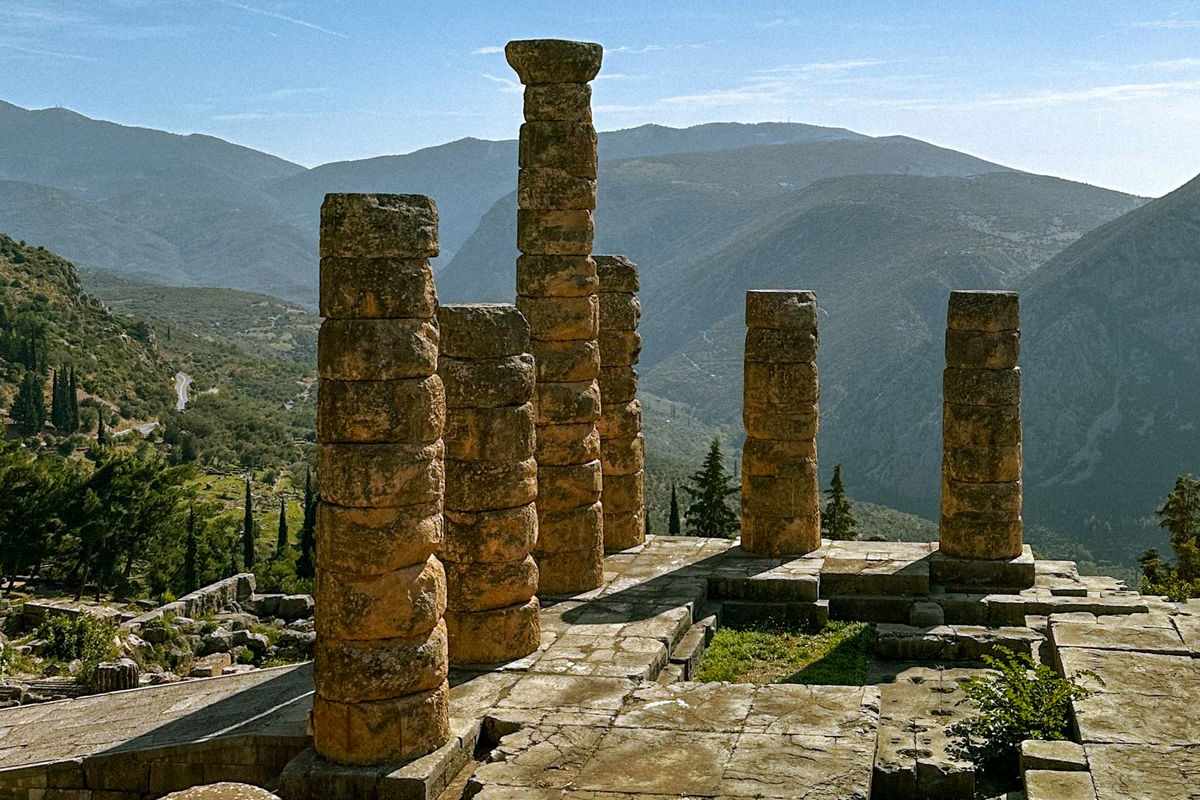
Delphi was home to the Pythia, the oracle that Greeks asked about big decisions. Classical tours Greece treat it as a core stop, because the ancient world called this spot its centre.
The sanctuary clings to Mount Parnassus in central Greece, on its southwestern side. UNESCO names it a World Heritage Site, since important city-states of ancient Greece raised monuments here. A small town with the same name sits beside the ruins. Our page for Delphi adds the place itself.
On classical tours Greece the oracle story begins at the Temple of Apollo. A high priestess called the Pythia served in that temple. People came to her until the late fourth century A.D., when the emperor Theodosius I destroyed it. The ruins in view now come from the fourth century B.C.
The Greeks marked their centre of the world with a stone monument, the Omphalos of Delphi. Omphalos was the Greek word for navel. In a myth, two eagles flew from the east and the west, sent by Zeus, and met over Delphi. For a trip built around this place, see the Delphi classical tour.
Cities also gave thanks at Delphi. Along the Sacred Way they raised treasuries that held gifts for Apollo and marked victories. The Athenians built theirs after the Battle of Marathon. Classical tours Greece reach a site whose monuments record real wars. The two-day Delphi tour is another way to see them.
Sport belonged here too. Starting in 586 B.C., athletes from all over the Greek world met every four years for the Pythian Games. Delphi stood apart from other games sites, because it also staged music contests. The stadium above the theatre held six thousand five hundred spectators.
What do classical tours Greece see in the Delphi museum?
Classical tours Greece see the Charioteer of Delphi in the Delphi Archaeological Museum. The bronze shows a chariot driver at life size, cast around 470 B.C.
The statue stands 1.8 meters tall. In its day it belonged to a larger group with a chariot, horses and child attendants. The group was set up at the Sanctuary of Apollo to mark a win at the Pythian Games. Excavators found the driver in the eighteen-nineties.
On classical tours Greece the hands deserve a close look. The sculptor modeled them in fine detail, and the fingers still curl around the reins. The statue survived because rubble from the great earthquake of 373 B.C. buried it.
The museum holds more than the Charioteer. Its rooms show the Sphinx of Naxos and pieces of reliefs from the Siphnian Treasury. Gold treasures found beneath the Sacred Way are on display too.
You also meet Kleobis and Biton, two brothers shown in two of the oldest athletic statues at Delphi. Written music survives here too: the oldest known notation of a melody belongs to this collection.
Myth runs through the site. In the old stories, Apollo killed a serpent named Python at Delphi, and the title Pythia comes from that name. Classical tours Greece reach a place where those myths and the museum finds meet. For the stories behind the objects, see the Delphi mythology tour.
How do classical tours Greece cross to central Greece?
Classical tours Greece leave the Peloponnese and reach the Greek mainland over the Rio-Antirrio Bridge. The bridge spans the Rion Strait between two gulfs, Corinth and Patras. By road it joins the town of Rio with Antirrio.
The Charilaos Trikoupis Bridge is the formal name of this crossing. The deck runs 2,380 metres and is 28 metres wide. Each direction has two vehicle lanes, and the deck adds an emergency lane and a walkway for pedestrians. Ferries and the isthmus of Corinth were once the only ways into the Peloponnese.
Officials inaugurated the bridge a week ahead of the Athens Summer Olympics, and torchbearers with the Olympic flame crossed first. On classical tours Greece the road from Olympia to Delphi uses this crossing. One operator’s itinerary passes Patras, crosses the bridge and follows the coast road past Nafpaktos to Delphi.
Patras, the capital of Western Greece, lies in the north of the Peloponnese. The city sits 215 km west of Athens and is Greece’s third-largest city. It climbs the slopes of Mount Panachaikon and faces the Gulf of Patras. Its busy port serves trade and contact with Italy and Western Europe.
Classical tours Greece also pass Thermopylae. On the way back from Meteora, one operator’s itinerary drives by the monument of Leonidas of Sparta there. In 480 B.C. the Persian Empire under Xerxes fought an alliance of Greek city-states led by Sparta under Leonidas I. The battle lasted three days.
What is Meteora on classical tours Greece?
Meteora is a group of giant natural stone pillars in Thessaly, in northwestern Greece, topped by Eastern Orthodox monasteries. Classical tours Greece reach it after Delphi, as the longer operator itineraries show. The pillars stand near the town of Kalambaka.
Monks founded 24 monasteries on the stone towers, mainly after the middle of the 14th century. Six remain, and four of those are living monasteries that welcome visitors: Varlaam, Saint Stephen, Great Meteoron and Holy Trinity. UNESCO lists the six as a World Heritage Site, a status granted in the nineteen-eighties.
On classical tours Greece, Meteora stands apart from the ancient sites. Classical Greek myths never mention it, and neither does ancient Greek literature. Hermit monks are the first known residents after the Neolithic age. They climbed the rock towers in the ninth century. The word Meteora itself means “lofty”.
Sandstone and conglomerate make up the rock. Weathering by water, wind and extremes of heat and cold carved the pillars. Long ladders and hauling nets were the first way up, for monks and supplies alike. In the nineteen-twenties steps were carved into the cliffs, so visitors now climb stairs and paths.
Meteora stands at the plain of Thessaly’s northwestern edge. Kastraki village sits on one side and Kalambaka town on the other. One operator’s itinerary says appropriate clothing is required in the monasteries: women need a long skirt, men need long trousers. For a single visit to the rocks, there is the Meteora day trip.
Kalambaka serves as the administrative seat of Meteora municipality. Operators of classical tours Greece describe it as a small traditional town below the grey rocks. The two-day Delphi and Meteora tour pairs the oracle with the monasteries.
Delphi and Meteora also come together on the three-day Delphi and Meteora tour. It joins the oracle and the rock monasteries in one longer trip.
What do classical tours Greece show in Vergina and Pella?
Classical tours Greece reach two old Macedonian capitals in the north. Vergina stands on Aigai, the first capital, and Pella took over the role of capital later. Both lie in Central Macedonia. Vergina holds royal tombs, and Pella is where Alexander the Great was born.
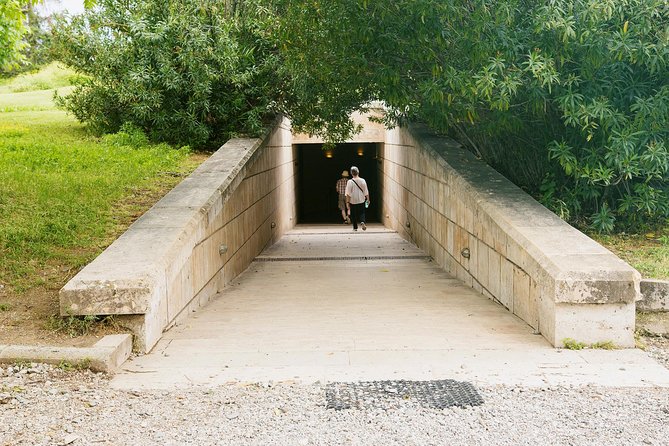
Vergina is a small town in Imathia, in Greek Macedonia. Beneath a hill called the Great Tumulus lay the burial places of Macedonian kings. A six-week dig led by Andronikos in the nineteen-seventies opened three tombs, numbered I, II and III.
Andronikos took the tombs to be royal graves, among them one for Philip II, who was the father of Alexander. Classical tours Greece that head north to Vergina arrive at a site with UNESCO World Heritage status. A museum for the Royal Tombs of Aigai was built right over the tumulus.
Inside is a golden larnax. Its metal is 24-carat gold, and it weighs 11 kilograms. The Vergina Sun symbol is embossed on it, and bones lay inside. One operator names Vergina and the Royal Tombs of Macedon in the highlights of its classical itinerary.
From the fourth century B.C. until the Roman conquest in 168 B.C., Pella was the capital of Macedon. Philip II was born in the city in 382 B.C. His son Alexander followed in 356 B.C. The site lies 1 km outside the present-day town of Pella.
On classical tours Greece, Pella stands out for its pebble-mosaic floors. One scene shows a lion hunt, and another shows Dionysus on a panther. The finds from the site are on display in a museum of their own.
What do classical tours Greece add around Dion and Mount Olympus?
Classical tours Greece add Dion, an ancient city below Mount Olympus. Its sanctuary of Zeus was the leading one in Macedon. Olympus itself rises higher than any other mountain in Greece, and in myth it is where the gods lived.
Dion sits in the Pieria region, 17 km from the town of Katerini, right at the base of the mountain. The sanctuary of Zeus gave the city its name. King Archelaus I started a nine-day festival there. It held sport and drama contests to honour Zeus and the Muses.
Both Philip II and Alexander the Great marked victories at Dion. Before his campaign into Asia in 334 B.C., Alexander made sacrifices there and brought his armies together. Classical tours Greece that call at Dion meet the place where Macedonian kings honoured their chief god. Besides the large temple of Zeus, the site has shrines to Demeter and Isis.
A park and a museum, both named for Dion, show much of the ancient city. One rare find in the museum is a bronze hydraulis, a pipe organ worked by water. It was found in a former workshop.
Olympus climbs to 2,917 metres, and Mytikas is its top peak. Greece made it the first National Park in the country, and it also counts as a World Biosphere Reserve. The usual starting point is Litochoro, a town in the eastern foothills.
For the north, this site has a trip of its own: the five-day Central Greece and Macedonia tour.
Which cities appear on longer classical tours Greece?
Longer classical tours Greece head north into Macedonia. Thessaloniki, Edessa, Kastoria and Naousa are four towns there. Each one adds a different piece of the ancient and Byzantine story.
The city of Thessaloniki is the number two city of Greece by size. In 315 B.C. it was founded by Cassander, who gave it the name of his wife, Thessalonike. Her father was Philip II, and her brother was Alexander the Great. A set of Paleochristian and Byzantine monuments in the city holds World Heritage status.
Edessa is the capital town of the Pella regional unit within Central Macedonia. Ancient writers say Caranus made Edessa the first capital of ancient Macedon. Its Greek name translates as “tower in the water”. Today the town lives from services and tourism.
One operator runs a seven-day Northern Greece tour that joins Athens, Delphi, Meteora, Kastoria and Thessaloniki. That shows how classical tours Greece can reach the north. Kastoria stands on a headland that juts into Lake Orestiada, with limestone mountains around the valley. Kastoria takes its name from kastori, the Greek word for beaver.
The oldest churches of Kastoria, including St. Stephan and the Taxiarchs, date from the ninth century. Kastoria is known for Byzantine churches, old Ottoman-era houses, the lake and a fur industry. Each of these gives the stop a character unlike the ancient sites further south.
Naousa lies below the Vermio Mountains in Imathia. The town is known for wine, a carnival and a ski resort. Near it, the site of ancient Mieza held an ancient theatre, Hellenistic tombs and the school of Aristotle.


Where else do classical tours Greece go?
Classical tours Greece also leave the main route. They visit Sparta and Mystras in the south, Marathon and Cape Sounion near Athens, and the Saronic Islands by sea. Each stop adds one plain piece of the story.
Sparta was an ancient city-state in Laconia, around the Evrotas River. In the seventh century B.C. it became the leading land military power in the Greek world. A Theban victory at Leuctra in 371 B.C. ended that lead.
On one operator’s route, classical tours Greece stop at the Evrotas, the statue of Leonidas, the site and the museum.
The Mystras stop on classical tours Greece rests on Byzantine history. The town rises in the Taygetus range, over ancient Sparta. The Byzantine Despotate of the Morea had its capital here in the fourteenth and fifteenth centuries.
Constantine XI Palaiologos was despot at Mystras. He later became the last Byzantine emperor, in Constantinople. Today Mystras is a World Heritage site.
The Battle of Marathon took place in 490 B.C. The Athenians, aided by Plataea, beat a Persian force there. The bay where the Persians landed is about 27 kilometres northeast of Athens.
Cape Sounion marks the south end of the Attica peninsula and lies 69.5 kilometres from Athens. The Temple of Poseidon crowns the headland. This major monument dates from the Golden Age of Athens. Water surrounds the rock on three sides.
The Saronic Islands lie just off the mainland. Ferries serve them from the port of Piraeus. Four islands hold the main settlements: Salamis, Aegina, Agistri and Poros. One operator ends a seven-day tour with a full-day cruise that calls at Hydra, Poros and Aegina. For the sea option on classical tours Greece, see the Greek islands cruises.
Where do you stay on classical tours Greece?
Classical tours Greece use Athens as the base. Operators start and end each tour at an Athens hotel. The longer tours add overnight stops in towns near the sites, such as Olympia, Delphi, Kalambaka and Nafplio.
One operator of private classical tours Greece picks guests up at their Athens hotel, Piraeus port or Athens Airport. It returns them to the same place at the end. Another operator warns that central Athens has a one-way system and narrow streets. A pick-up can move to a nearby hotel.
The number of nights in Athens depends on the tour. A seven-day coach tour from one operator spends four nights in Athens: the first two nights and the last two. In between it sleeps one night each in Olympia, Delphi and Kalambaka.
A tour from an archaeological society opens with two nights in an Athens hotel. It then sleeps one night in Delphi and one in Nafplio before the group boards a ship at Piraeus.
A five-day Peloponnese tour from the first operator spends one night in Athens. It then spends three nights in the same hotel in Nafplio. The group does not pack its bags every morning.
Overnight stops on classical tours Greece change the visit. The first operator says a group that sleeps near Delphi reaches the site when the gates open. A group that sleeps near Meteora sees the monasteries in the quiet early hours.
Hotel class is the next choice. One operator lists 3-star hotels with breakfast and offers 4-star and boutique hotels as an option. Another places every guest in a 4-star hotel. For a base in the capital, look at the hotels in Athens. The list on this site sorts hotels by class.
How do you plan classical tours Greece?
Plan classical tours Greece by the days you have. Day trips and longer tours both exist. A coach tour or private tour of two days or more links the sites with overnight stays.
Classical tours Greece run in two styles. One operator uses a deluxe air-conditioned coach with a bilingual English tour guide. Another sends a private Mercedes and an English-speaking chauffeur, and it adjusts the pace to the group. A licensed archaeological tour guide is an option.
Match the days to your goal. One operator writes that first-time visitors with three to five days want the essential ancient sites. For the Peloponnese it advises at least four days. Mycenae, Epidaurus, Nafplio, Mystras and Olympia are spread across the peninsula.
A day trip is short on the calendar but long on the road. The same operator says the drive to Delphi, Olympia or Meteora takes up the bulk of the day. It also names families with older children, who remember Greek myths better when they stand where the stories took place.
Classical tours Greece start early. One operator states that early mornings and long days are to be expected. It advises comfortable footwear for the sites. It adds that its tour is not appropriate for anyone with mobility issues. A second operator says driving times can be longer in summer traffic.
If no set tour fits, you can design your own tour around the sites and the days you want.
What else do travellers ask about classical tours Greece?
What does the word classical mean on classical tours Greece?
Classical antiquity is the period of European history between the eighth century B.C. and the fifth century A.D. It joins the civilizations of ancient Greece and Rome, known together as the Greco-Roman world. In these centuries both cultures flourished and shaped Europe, North Africa and West Asia.
The period is conventionally said to end with the fall of the Western Roman Empire in 476 A.D. So classical tours Greece use a word that covers a long stretch of time, not one single date.
What does the word acropolis mean?
The word joins two Greek words. Akron means “top” and polis means “city”. An acropolis was the upper part of an ancient Greek city, frequently a hill with steep sides, chosen for defence.
Nearly every Greek city had an acropolis of its own. Each city was a polis, and about 1,500 such city-states are known. The term is used for the Acropolis of Athens in particular.
Why is a Greek column called Corinthian?
Greek architecture has three orders: Doric, Ionic and Corinthian. The Corinthian order developed last. Its fluted columns end in rich capitals of acanthus leaves and scrolls. The Romans later added two more orders, the Tuscan and the Composite.
The name comes from the city of Corinth, though the style was probably invented in Athens. The historian Vitruvius told a story of the sculptor Callimachus, who sketched acanthus leaves growing round a basket of toys at a Corinthian girl’s tomb. On classical tours Greece, the column tops are the place to look, because each order has its own capital.
Which ancient writer described the sites that classical tours Greece visit?
Pausanias, a Greek traveller and geographer, wrote the Description of Greece. He was born about 110 A.D. into a Greek family and lived under Roman rule. He valued Greek history and culture all the same.
From about 150 A.D. until about 180 A.D. he travelled through mainland Greece. He wrote about monuments, sacred spaces and landmarks, using what he saw himself. Archaeologists use his book to link old writing to the sites that classical tours Greece reach today.
Which language did the ancient world share after Alexander the Great?
After the campaigns of Alexander the Great, Greek kingdoms spread across West Asia and Northeast Africa. A Greek dialect called Koine, based on Attic and Ionic Greek, became the common language of the ancient world.
Greek became the common language far beyond Greece itself. In this age Greek culture mixed with the cultures of Persia, Central Asia and Egypt. Historians call that age the Hellenistic period.