
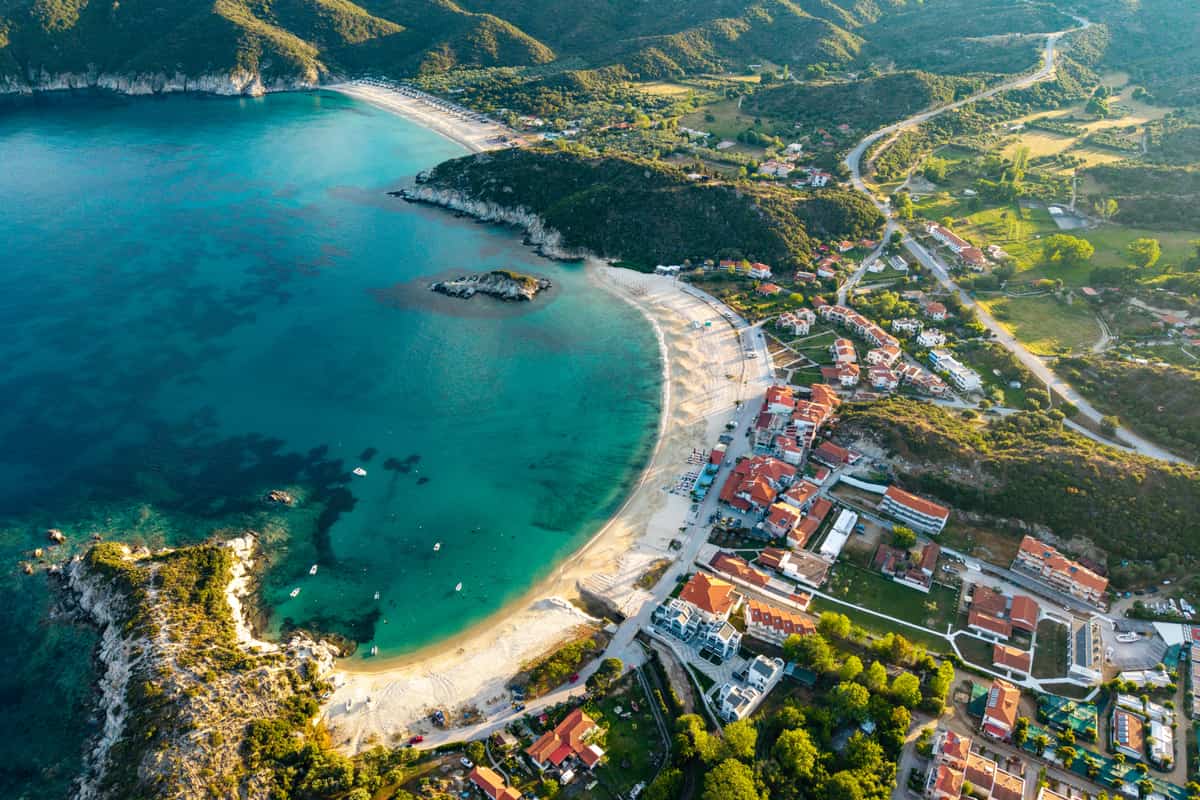
A Halkidiki day trip from Thessaloniki spends one day on the road to the beaches and stone villages of the peninsula south-east of the city. The main page of tours in Greece lists more routes across the country.
This page explains what the trip is, how long it lasts, where it starts, which route it follows, which beaches and villages it reaches, what travellers do, when it runs, who it suits and what travellers ask.
What is a Halkidiki day trip from Thessaloniki?
Operators use the name Halkidiki day trip from Thessaloniki for a drive to the peninsula and back in one day. One operator’s route has a village walk, a swim, a tavern lunch, a shopping stop and the drive home.
Wikipedia calls Chalkidiki, also spelled Halkidiki, both a peninsula and a regional unit of Greece, set in coastal Macedonia. The peninsula ends in three fingers. Kassandra is the western finger, Sithonia the central one and Athos the eastern one. Polygyros is the capital, and Wikipedia gives Nea Moudania as the largest town.
Athos governs itself as a monastic region, and Wikivoyage says its cruises leave from Ouranoupoli. That makes it a different outing from a beach day. Thessaloniki, the starting city, is Greece’s second-largest city. Wikipedia also calls it the largest city of Northern Greece. Slightly over one million people live in its metropolitan area.
Travellers pick a Halkidiki day trip from Thessaloniki for its beaches. Greece’s national tourism site lists crystal-clear waters and pine forests as highlights. A travel blog calls Halkidiki a classic choice for a Thessaloniki day trip. Wikipedia says people from Thessaloniki began spending summer holidays in its coastal villages in the late nineteen fifties.
The Halkidiki day trip from Thessaloniki takes different forms. One operator names its Kassandra outing a group trip but files it under private day trips. Its page says the programme can change with passenger requests. The same operator lists a private round tour, and another operator lists a private day trip to Sithonia.
A third listing is titled a Halkidiki and Sithonia swim, sunset and olive tour. One private-tour operator describes door-to-door pick-up, a driver who knows the region and a flexible pace. A travel blog adds that a hire car is worthwhile for day trips from the city.
How long is a Halkidiki day trip from Thessaloniki?
About 10 hours is the length one operator lists for its group Halkidiki day trip from Thessaloniki. The page gives a morning pick-up between half past 8 and 9 and an evening return. It marks every time as approximate.
In order, the stop sheet on that page shows how the Halkidiki day trip from Thessaloniki runs. After the hotel pick-up and the drive, the group walks the village of Afitos at about 10 in the morning. The swim at Pefkohori starts at about noon and runs for 2 hours.
The swim is the longest stop on the sheet. A water-park stop of one hour follows at about half past 2. Lunch comes at a tavern after that. The last stop, Kallithea, starts at about 4 in the afternoon. The sheet has the group leave at half past 4 and reach Thessaloniki at about half past 5.
The same operator’s private round tour of Kassandra, a Halkidiki day trip from Thessaloniki too, states about 10 hours. It lists lunch at about half past 2 in the afternoon, with village visits at Nea Fokea, Afytos and Kallithea. The group page and the private page differ in stops, not in stated length.
Its page says one day is not enough for every sight on Kassandra. So the operator presents the sights first, and the traveller picks. How far down the fingers the day goes shapes its length. A travel blog says a number of beaches lie within 60 to 90 minutes of the city.
A private-tour operator calls Kassandra the closest of the three peninsulas. A Greece travel site calls Kassandra the first finger and goes deeper into Halkidiki for Sithonia. Its road-trip itinerary spends two days in each of Kassandra and Sithonia. Each operator picks a slice of the peninsula, which sets the length of its Halkidiki day trip from Thessaloniki.
Where does a Halkidiki day trip from Thessaloniki start?
Operators start every Halkidiki day trip from Thessaloniki inside the city. They list a pick-up at a hotel or apartment, or at a set meeting point. The day ends back at the same place.
Wikipedia counts Thessaloniki as the second-largest Greek city. The city lies on the Thermaic Gulf, which belongs to the Aegean Sea. The article calls Thessaloniki a major transport hub, notably through its port. The Thermaic Gulf article puts the Chalkidiki peninsula on the gulf’s eastern side, with Thessaloniki at the north-eastern tip.
For its Halkidiki day trip from Thessaloniki, one operator names set meeting points for the group version. The same page offers pick-up at the traveller’s own accommodation in the city. It says the operator contacts the traveller after the order to agree the place. The same operator’s private trips collect travellers from a hotel in Thessaloniki.
Wikipedia places Nea Moudania 60 kilometres south of Thessaloniki and Afytos 73 kilometres south-east. It puts Pefkochori 92 kilometres south-east, while one operator’s page says 80 kilometres. One road-trip itinerary lists 118 kilometres to Glarokavos, near the south-western tip of Kassandra.
A Thessaloniki day-trips blog says beaches can be reached within 60 to 90 minutes. It calls a Halkidiki day trip from Thessaloniki especially easy for that reason. Wikivoyage lists the airport 15 kilometres away, to the south of the centre. It adds that buses for Chalkidiki leave from a separate station in the eastern district of Pylaia.
One cruise-excursion page writes for passengers off a ship and offers a private outing to Sithonia. It says its ship-return cover applies when the trip ends at least two hours before the ship departs.
Which route does a Halkidiki day trip from Thessaloniki follow?
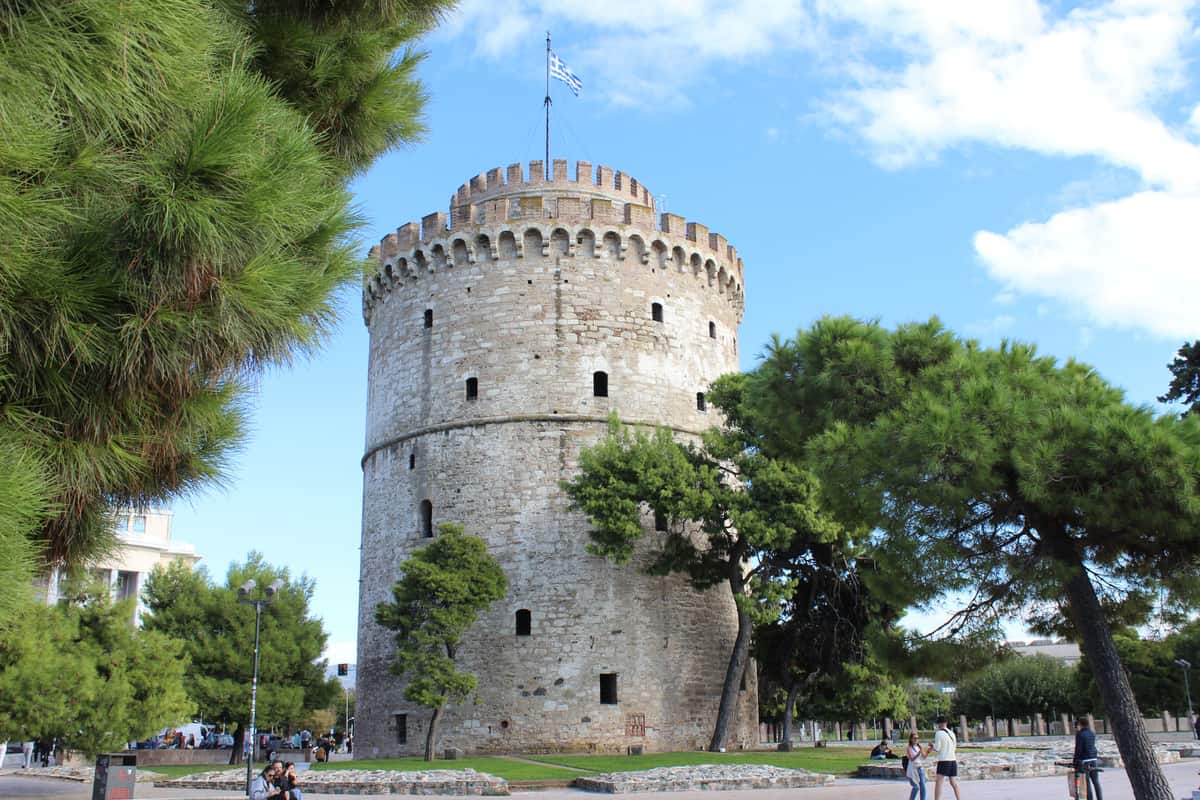
Wikivoyage names the A24 motorway to Nea Moudania as the preferred road to Kassandra and Sithonia. Past Nea Moudania, this Halkidiki day trip from Thessaloniki enters Kassandra or Sithonia. Operators describe the stops by village and beach.
Wikipedia says the A24 motorway links Thessaloniki with Nea Moudania and almost encircles the eastern part of the Thermaic Gulf. Chalkidiki’s largest town, it says, is Nea Moudania. Wikivoyage adds that the A24 gets congested on summer weekends, when crowds leave Thessaloniki for the beaches.
Entering Kassandra on this Halkidiki day trip from Thessaloniki means crossing the Potidea canal. One operator’s private Kassandra tour says a bridge at Nea Potidea links Kassandra with the mainland of Halkidiki. It lists Nea Fokea, Afytos, Kallithea and Fourka as stops. The group page lists Afytos, Pefkochori and Kallithea, all on the eastern side.
Sithonia sits further down the peninsula on this Halkidiki day trip from Thessaloniki. Wikipedia gives 100 kilometres to Nikiti and 125 kilometres to Neos Marmaras. Mount Itamos, 817 metres high, rises in the middle of the peninsula. One operator’s private Sithonia tour lists coffee stops at Geroplatanos and Arnaia. It adds swim stops at Trani Ammouda and Kavourotripes.
Kassandra is the closer finger. Wikipedia says the Toronean Gulf separates it from Sithonia. Wikivoyage says buses serve Kassandra better than the rest of the peninsula. It gives Toroni as an example: three hours by bus, 90 minutes to two hours by car. One operator says a day does not cover every sight, so it presents the options first.
Operators close the Halkidiki day trip from Thessaloniki where the pick-up began. The group page closes with Kallithea and a return to the original pick-up point. The private tours list a drop-off at the hotel. A Thessaloniki blog adds that operators offer boat trips towards Halkidiki in summer.
Which beaches and villages does a Halkidiki day trip from Thessaloniki reach?
A Halkidiki day trip from Thessaloniki reaches stone villages, sandy beaches and ancient sites along two coasts, Kassandra and Sithonia. The source pages name Afytos, Pefkochori and Kallithea on Kassandra, and Nikiti, Neos Marmaras, Sarti, Vourvourou and Toroni on Sithonia.
One operator’s Halkidiki day trip from Thessaloniki opens at Afytos on Kassandra. The page says the stone village stands on a rock of 75 metres. Wikipedia lists its elevation as 50 metres. The local stone, made of sand and shells, is the building material. Wikipedia adds narrow streets and viewpoints over the Toroneos Gulf.
Pefkochori follows on that route. Wikipedia says the name means pine village. The operator’s page lists calm, clear water at its beach. Wikipedia places Hanioti, written Chaniotis there, 3 kilometres north-west of Pefkochori. Kallithea ends the village stops. Wikipedia derives its name from kallos, beauty, and thea, view. The page adds a pine forest and a fine-sand beach.
Sithonia, the middle finger, holds the next villages. Another operator lists a private Halkidiki day trip from Thessaloniki to Sithonia. Nikiti has an old town of cobbled streets and stone houses, says Wikipedia. Beaches south of Nikiti include Kalogria and Lagomandra. Neos Marmaras was founded by refugees from Marmara Island and lives on tourism, olives, wine, honey and fishing.
Sarti lies on Sithonia’s north-eastern coast. Wikipedia says Mount Athos is visible from its beaches, and hikers start there for Mount Itamos. Vourvourou lies between Sarti and Ormos Panagia. Wikipedia counts sandy shores, rock islets and caves there. Toroni is an ancient city on the south-west tip. Its curved beach of thick yellow sand is 2.5 kilometres long.
Inland, the region behind every Halkidiki day trip from Thessaloniki holds Polygyros, the capital, and older sights. Stagira, the birthplace of Aristotle, has town walls and house remains near Olympiada. Olynthus keeps well-preserved houses and a grid of streets. One operator lists Petralona Cave as a half-day outing, and Wikipedia says it stays near 17 degrees all year.
What do travellers do on a Halkidiki day trip from Thessaloniki?
Strolling a stone village, swimming, snorkelling and a tavern lunch make up a Halkidiki day trip from Thessaloniki. Travellers also spend their own time in a seaside village. One operator says the programme can be adjusted to what the passengers ask for.
In Afytos the page labels the stop as a walk. Guests stroll the lanes and enjoy a meal or meze at the taverns. They look for small shops with folk art, jars of honey and soaps made with olive oil. Wikipedia names a folklore museum in Afytos. Another operator calls the village a clifftop one.
Swimming at Pefkochori gets two hours on the operator’s Halkidiki day trip from Thessaloniki. Besides sunbathing and swimming, the page says the beach offers snorkelling sites. An eight-day itinerary adds snorkelling at Kavourotripes, a run of beaches among smooth rocks. It also names kayaks at Vourvourou and a boat to the islets of Diaporos.
One page adds a one-hour stop at a water park on Glarokavos beach in Pefkochori. It calls the park a marine playground with inflatables in the sea, watched by lifeguards on the ground. The page also lists lunch at a traditional tavern that the operator selects.
On the same route, the Halkidiki day trip from Thessaloniki closes at Kallithea with own time. The page pairs it with shopping. Another operator sets Afytos beside Kallithea and Sani, where golden beaches leave hours to swim and relax. No listing promises a sighting under water, so a snorkel is simply a look at the shallows.
When does a Halkidiki day trip from Thessaloniki run?
Each operator sets the days on every Halkidiki day trip from Thessaloniki. One group trip carries the words Every Sunday in its title. Wikivoyage says the peninsula draws visitors all year, with its beaches popular in summer.
That Sunday group trip lists a meeting-point departure between half past eight and nine in the morning. A small-group beach trip starts earlier on weekends in high season, says its listing. The clock moves with the operator and with the time of year.
Wikipedia gives Halkidiki a mainly Mediterranean climate: winters are cool and wet, summers hot and fairly dry. Snow can fall in winter but does not last. Wikivoyage agrees in plainer words, with mild winters and long, dry summers. Wikipedia puts Neos Marmaras, on Sithonia, in a hot semi-arid class.
One hotel blog on city day trips picks April through June, then September and October. It lists pleasant temperatures and fewer crowds for those months. It warns that July and August run hot, with a higher risk of wildfires. A tourism itinerary page says the months either side of peak summer are quieter, with swimming still great.
Summer crowds meet every Halkidiki day trip from Thessaloniki, starting on the road. Wikivoyage says the motorway gets congested on summer weekends, as people from the city head for the beaches. It calls Sithonia less crowded than Kassandra, yet still busy in high season. Wikipedia calls Sarti, Nikiti and Neos Marmaras especially busy on the waterfront in summer.
Weather rules for each Halkidiki day trip from Thessaloniki differ by operator. The group page says weather does not affect its tours. If a trip is cancelled for unfavourable weather, it offers the traveller another date. A small-group listing says the tour leaders confirm the weather twenty-four hours ahead. They can reschedule or cancel when conditions are unsuitable.
Who is a Halkidiki day trip from Thessaloniki for?
For one hotel blog, the Halkidiki day trip from Thessaloniki suits beach lovers, families and groups of friends. A private-tour page calls the Kassandra coast outing family-friendly and easy underfoot, with hours built in to swim and relax.
Parents ask about children first. A private-tour page calls its Halkidiki day trip from Thessaloniki easy and family-friendly. It says it provides child seats and keeps the pace flexible for younger travellers. A small-group listing says its tour can be tailored for families. The group page names children over six for its sea play park.
Vehicles and group sizes differ. The group page lists a minivan for up to six passengers and a car for up to three. A small-group listing names a car or a van and groups of four to eight travellers. Read the vehicle line of any Halkidiki day trip from Thessaloniki before choosing.
The first stop on the group route is a village on a rock with steep slopes, a walking stop. A small-group listing asks travellers for sunglasses, a hat against the sun, swimwear, a towel and sunscreen. The group page encourages a camera.
With any Halkidiki day trip from Thessaloniki, visitors without a car face another question. Wikipedia says Halkidiki has no railways or airports, and buses serve the major towns. Wikivoyage puts a bus trip to Toroni at three hours, against one and a half to two by car. A private-tour page says self-driving brings tolls, parking and unfamiliar roads.
What else do travellers ask about a Halkidiki day trip from Thessaloniki?
Which gulfs and islands frame a Halkidiki day trip from Thessaloniki?
Water lies on the western and eastern sides of the peninsula. Wikipedia names the Thermaic Gulf on the west. On the east it names two gulfs, Strymonian and Ierissos. The Brostomnitsa peninsula separates those two.
The Toronean and Singitic gulfs cut in between the three fingers, Wikipedia says. It names the islands Ammouliani and Diaporos in the Singitic Gulf. It also lists the uninhabited island of Kelyfos in the Toronean Gulf.
Who was Aristotle, and what ties his birthplace to the Halkidiki day trip from Thessaloniki?
Aristotle was an ancient Greek philosopher who lived from 384 to 322 BC. Wikipedia calls him the founder of the Peripatetic school in the Lyceum in Athens. It says only around a third of his writing has survived. Medieval Muslim scholars called him The First Teacher.
He was born in Stagira, in Chalkidiki, about 55 kilometres east of modern Thessaloniki. At about eighteen he joined Plato’s Academy. Later, Philip II of Macedon asked him to teach his son, Alexander the Great. One itinerary page lists Aristotle’s birthplace among its sights. That road trip is longer than a Halkidiki day trip from Thessaloniki.
Which local foods come from the land near a Halkidiki day trip from Thessaloniki?
Wikipedia names olive oil and green olives as products of the peninsula. It adds that honey and wine are produced here too. The article on Sithonia describes a landscape of vineyards, forests, grasslands, shrubland and mountains. In the nineteen eighties, says Wikipedia, tourism became the main industry in place of agriculture.
The Mount Itamos article names goat herding and beekeeping on the mountain. It also says wine is grown in the foothills near Porto Carras. One itinerary page lists wines from a vineyard in Arnea. Another operator page lists Arnea under central Halkidiki.
How high are the mountains of Halkidiki?
For any Halkidiki day trip from Thessaloniki, the land behind the beaches rises into mountains. Wikipedia gives the highest peak of Kassandra as 350 metres. Athos, the third finger, tops out at 2,033 metres. The Cholomontas mountains in the north reach 1,165 metres near Taxiarchis.
Mount Kontari, near Stagira, reaches 921 metres. The Itamos range runs across Sithonia from north to south and holds nine named peaks. Astrapokameno reaches 808 metres and Psilos 753 metres. Conifer forests cover the range. The only higher settlement is the mountain village of Parthenonas, reached from Neos Marmaras by an asphalt road.
Where does the name Halkidiki come from?
Operator pages list a Halkidiki day trip from Thessaloniki under the modern name, but the name is ancient. Wikipedia gives three spellings: Chalkidiki, Halkidiki and Chalcidice. It says the name comes from Chalcis, a city-state of ancient Greece on the island of Euboea. Chalcis colonised the area in the eighth century BC.
Settlers from Chalcis and Eretria founded cities such as Mende and Scione. A second wave came from Andros in the sixth century BC and founded Akanthos. Wikipedia adds that Halkidiki became an important theatre of the Peloponnesian War, fought by Athens and Sparta. In Greek, it notes, the three peninsulas are also called legs.