
The Milos travel tips below explain how to reach the island, move about, stay safe and understand what you see. Our tours in Greece page lists trips to other islands.
Below you find the ferries and flights, the roads and vehicles, the climate and the wind, the beaches, the geology and the antiquities, the food, the money and the safety rules, and short answers.
Which Milos travel tips cover the ferries from Athens and the other islands?
These Milos travel tips start with the ferry, because Wikivoyage says a number of ferries serve Milos, mainly from Athens. Its Go next list names twenty-four places that have a ferry available. The official tourism page puts the island roughly midway between Piraeus and Crete.
Wikipedia defines a ferry as a passenger boat on a crossing that sometimes carries vehicles and cargo. On islands it forms part of public transport and allows direct transit between two points. Building the link by bridge or tunnel needs far more capital than a ferry does. The page on Milos tours begins where the crossing ends.
Athens has its chief sea port at Piraeus, where Milos travel tips for the ferry begin. Piraeus was a rocky island until the third millennium BC, when silt joined it to the mainland. Themistocles began its fortification in four hundred and ninety-three BC. Ten years later the fleet of Athens moved from the older harbour of Phaleron to Piraeus.
Among Greek ports Piraeus is the largest, and Wikipedia counts it among Europe’s larger ports. Piraeus entered a long decline in the late fourth century. Through the Ottoman occupation the town stayed largely deserted. Today it is also called the gateway to Europe because of its location. The page on Athens tours covers the capital that the port serves.
Winglike foils fixed below the hull make a boat a hydrofoil. As speed climbs, the foils lift the hull clear of the water and drag falls. Less drag allows greater speeds, and the craft are mainly small, fast passenger ferries. These Milos travel tips treat the hydrofoil as a type of ferry, not as a fixed service.
Wikivoyage names Syros, Mykonos, Santorini, Folegandros and Amorgos among those places. It adds Heraklion, Sitia, Rhodes, Karpathos, Kasos and Lavrio. The list is one article’s record, so it fixes no route and no sailing. The ferry timetable changes by season, so the current timetable decides. For these Milos travel tips, the list is only a map of links.
What do these Milos travel tips say about the second harbour at Pollonia?
Pollonia lies on the north-eastern side of the island and is the second harbour of Milos after Adamantas. Wikipedia and Wikivoyage both give this order of the two harbours. These Milos travel tips use the two articles for its name, its boat link and its status as a village.
Wikipedia opens its article on the island with a double name, Milos or Melos. The village of Pollonia belongs to this island, and Wikipedia calls it a seaside village. Its separate article gives the village 268 inhabitants at the census it cites. Wikipedia adds that the village keeps Eastern European Time, which runs two hours ahead of UTC.
A temple of Apollo once stood east of the settlement, and Wikipedia names the village after it. Wikipedia and Wikivoyage give the village’s name as Pollonia or Apollonia. The longer form keeps the name of the god whole, while the short form drops its first letter. Milos travel tips like these use the short form throughout.
Wikipedia defines a harbour as sheltered water where ships, boats and barges can be moored. It says a port means the facilities for loading and unloading ships. The village articles of Wikipedia and Wikivoyage both call Pollonia a harbour, not a port. So these Milos travel tips call Pollonia a harbour and keep the word port for the facilities.
A small boat links Pollonia with the neighbouring island on a regular basis, say Wikipedia and Wikivoyage. That island is Kimolos, and Milos has it on its north-eastern side. Wikipedia’s article on that island puts a channel one kilometre wide between the two islands. These Milos travel tips give the crossing as a distance only, never as a trip.
In nineteen forty, Wikipedia says, the village became part of what was then the community of Pera Triovasalos. The Kallikratis plan places the village in the Triovasalos community, which is part of the municipality of Milos. Wikipedia calls that plan a major administrative reform that followed the Kapodistrias reform. Triovasalos adjoins Pera Triovasalos on two neighbouring cliffs.
Which Milos travel tips cover the airport and the flights from Athens?
Wikipedia places the airport of Milos five kilometres from the harbour, towards the south-east. The official tourism page gives forty minutes of travel between Athens International Airport and the island. These Milos travel tips treat flight times as seasonal facts, so the current flights need a check.
Wikipedia says Milos Island National Airport opened its doors on January seventeen, nineteen seventy-three. In October of nineteen ninety-five, the article adds, a new terminal was taken into use at the airport. The article lists MLO as the IATA code and LGML as the ICAO code. It lists the elevation above sea level as ten feet, or three metres.
The apron is small, at 7,800 square metres, and the runway is short, Wikipedia says. Aircraft larger than a Dash 8 or an ATR 42 cannot use the field. The apron holds one Dash 8 sized aircraft or two light aircraft at one time. Milos travel tips for the flight therefore start with the size of the aircraft.
Wikivoyage lists up to five flights a day from Athens to Milos, all year round. That is the statement of one article, and flight schedules change with each season. The tourism page names the Athens end as Athens International Airport, also called Eleftherios Venizelos. The last rule, then, is to check the current flights before any plan.
The tourism page gives two hours and forty minutes of travel from Thessaloniki, by way of Athens International Airport. Wikipedia’s airport table lists Thessaloniki as a seasonal destination of one airline. The two pages therefore describe that route in different ways. These Milos travel tips quote both statements and settle neither, since flight schedules change by season.
A taxi joins the airport to the rest of the island, besides a car, Wikipedia says. Wikipedia adds that bus connections serve the airport as well. The same article calls Milos an island in the Cyclades, which puts the airport in that group. Milos travel tips for the arrival end on the ground with the taxi and the bus.
What do the Milos travel tips say about the island’s roads and the bus?
Roads come first in these Milos travel tips. Wikivoyage says the greater part of the popular places can be reached by every vehicle. The roads there are paved, with a number of unpaved but smooth stretches. Other places lie beyond a normal vehicle, and the next paragraph names them.
The same article singles out two of those places by name. One is the western part of the island. The other is Thiorichia Beach, where the old sulphur mines stand. A normal vehicle does not reach either place. Both names matter to anyone who plans a drive. These Milos travel tips pass them on, with no route attached.
Wikivoyage says one single bus company works on the island. Bus schedules on a small island like Milos vary with the season, it warns. The latest information, checked closer to the travel dates, is the one to trust. Tickets are issued in the bus. Milos travel tips on the bus leave out clock times and amounts.
In Wikipedia’s terms, a bus sits between the car and the train by the number of passengers it carries. Public transport is its main use, but charter work exists too. The article on the airport says bus connections link the airport to the island. A reader who flies into Athens first can turn to Athens airport transfers too.
The UK government page tells walkers beside a road to cross with care and to use a crossing where possible. Drivers do not always stop at a crossing, though they are meant to. The green signal can also let cars turn right onto the crossing. Milos travel tips for a walker on the road end with that caution.
Speed limits, the page says, are regularly ignored by local drivers, built-up areas included. The page also calls the traffic in the larger Greek cities busy, fast and chaotic. The description covers the country as a whole, with no Milos road named. These Milos travel tips pass it on as a general note for anyone on the road.
Which Milos travel tips cover cars and the road rules for a driver?
Milos travel tips for a driver begin with the licence. The UK government’s advice on Greece says to check that the licence is correct for the vehicle being hired. Wikivoyage adds that a car suits a group, although parking in a number of destinations can mean a walk.
The same page rules out a provisional licence in Greece, whether the plan is to drive or to hire. A UK photocard licence is accepted for driving there. An old paper licence can need to be updated to a photocard. The other option is the nineteen sixty-eight version of the international driving permit, held beside the paper licence.
The page adds that hire companies can set stricter conditions for customers. An international driving permit is one example. The others are a year of experience at the wheel and a raised minimum age. A driver reads the hire terms before the journey. These Milos travel tips pass on the conditions as listed and name no company.
The page ties a hired moped to category A1 or above on a valid driving licence. It calls category A1 the light motorcycle class. Category P, the UK class for driving mopeds up to 50cc, does not apply in Greece. The page tells a driver to choose a category that matches both the licence and the age.
A helmet is required for the driver and any passenger of a quad bike or moped, the page says. Skipping it can void the insurance. Police can fine a rider without a helmet and can also take the licence away. Milos travel tips for a rider therefore start with the helmet and the state of the vehicle.
Drink-driving is a serious offence, the page says. A driver tested above two-thirds of the English limit can face a fine and imprisonment. For a parked vehicle, the page asks for valuables out of sight and a locked vehicle. These Milos travel tips pass on the page’s choice of a secure car park or a well-lit area.
What do the Milos travel tips say about quad bikes and motor scooters as vehicles?
These Milos travel tips use Wikipedia for the plain definition. A quad bike, also called a quad, travels on low-pressure tyres. Its seat is straddled by the rider, and it has handlebars as on a motorcycle. The design suits more kinds of ground than a normal vehicle can handle.
Wikipedia adds that, by the American National Standards Institute definition, an all-terrain vehicle is meant for a single operator. Tandem models carry the driver and one passenger. Wikivoyage says quad bikes on Milos come in different sizes and power. A number of them are slow and limited, yet the island is small, so a rider still covers ground fast.
Wikipedia calls a scooter a motorcycle with a step-through frame. The rider sits on a seat, with the feet resting on a platform. Its design aims at easy operation. Wikivoyage names the motorcycle scooter an option for two people and says it is easier to park. Milos travel tips on two-wheelers leave brands and rates out.
Wikivoyage warns that a scooter, like a car, is not an all-terrain vehicle. A rider can therefore miss the places that stay out of reach, the western part of the island among them. Buggies are less popular, the article notes. A number of options for hire exist, and a buggy gives the chance to go off the road.
On the licence, the two sources do not say the same thing. Wikivoyage says a quad bike can be ridden with a car driving licence. The UK government page tells a driver to check that the licence fits the vehicle in question. These Milos travel tips therefore say that the rule must be checked before a ride.
Quad bike accidents cause serious injury and even death every year, the UK government page says. It asks riders for full instructions and training, and for care among larger and faster vehicles. The page defines quad biking as an extreme sport, so a number of travel insurance policies exclude it. These Milos travel tips end on the policy wording.
Which Milos travel tips cover taxis and the other ways to move about?
Wikipedia defines a taxi as a hired vehicle whose passengers ride straight from one place to another. The ride is normally exclusive and not shared with other passengers. These Milos travel tips on taxis then turn to licensed cabs, phone signal, offline maps and strikes in Greece.
Milos travel tips on the taxi start with a plain contrast. Wikipedia sets the taxi against public transport, where the operator fixes the points of boarding and leaving. Demand-responsive transport and share taxis are hybrids that sit between the bus and the taxi. The article adds that vehicle types, regulation, dispatching and payment differ from country to country.
Wikipedia names the main forms of the taxi. Hackney carriages, also called hailed or street taxis, are licensed for hailing anywhere in a community. Private hire vehicles are licensed only for journeys arranged in advance. Limousines are specialised vehicles that also need a trip arranged in advance. A passenger plans those two forms before the ride starts.
These Milos travel tips quote the UK government page on Greece for personal safety at night. For the way home after a night out, the page names pre-arranged transport. Where they are available, taxi-hailing apps that supply licensed cabs are the other choice. App-based ridesharing offers a similar trip but tends to be regulated separately from taxis, Wikipedia adds.
Wikivoyage says that 4G coverage on Milos is mainly good, but a number of places lie without coverage. It therefore advises offline maps. Any map built on OpenStreetMap data, it adds, has road information that is more current than the popular options. The advice stands in its section on private vehicles, next to the notes on cars and scooters.
The UK government page also warns that strikes are regular and can be announced late. They can disrupt buses, trains, ferries and air travel in Greece, as well as road networks and borders. The page files this under strikes and demonstrations. These Milos travel tips end the topic with a plain habit: check the current timetable before any trip.
What do the Milos travel tips say about the places to stay and the season?
Wikipedia’s climate article for Greece calls summer in the Csa zone sunny and dry, with hot days. The Milos article gives the island the Köppen class Csa. These Milos travel tips leave the places to stay to the page linked below and keep to the season.
Milos travel tips on the season begin with Greece. Wikipedia says Greece is mainly Mediterranean, yet its complex geography brings a wide variety of local climates. In the Köppen system it counts eleven climates, more than any other European country of its size. The national weather service of Greece, in its climate atlas, names Csa as the predominant class.
Wikipedia says summer days are mainly bright and dry. The only rain it lists comes from cumulus cloud, as showers or thunderstorms. Daytime air is hot, and the night air is warm. The Cyclades and their surroundings have a number of very windy days. Wikipedia gives average annual temperatures of about 4 to 22 degrees Celsius across Greece.
These Milos travel tips note that a heatwave on the coast stays mild. Wikipedia credits a breeze from the water and the relatively cool sea for the mildness. In the plant hardiness list, the Cyclades fall into zone 11a. That is the top of the range, 6a to 11a, that it gives for Greece. Zones rest on lowest temperatures.
Wikipedia says winters in this climate are wet and that winter rain tends to persist. Snow is short-lived, and slopes that face south hold it for the shortest time. Precipitation runs relatively higher in the west of the zone. The page on places to stay on Milos covers the lodging, so this page keeps to the weather.
Wikipedia says that Santorini and Mykonos draw bigger crowds of visitors than Milos does. Even so, Milos has grown more popular in recent decades, the article says. Milos travel tips on the season add the draw: traditional Greek architecture, a varied coastline and beaches. The article adds that Milos is popular with tourists in the summer season.
Which Milos travel tips cover water on a dry island?
Milos is a dry island: Wikipedia says it is too dry for any profusion of vegetation. These Milos travel tips on water start from that fact. They continue with the definition of drinking water, the needs of the body in heat and the hot springs.
Milos travel tips on water begin with Wikipedia’s climate article. Across the greater part of the Cyclades, it finds the hot semi-arid class that Köppen codes BSh. It names Schoinoussa as the driest area in Greece. Semi-arid climates rank second in the country by spread, after the Mediterranean one. Anavyssos is the driest area of the mainland.
The same article gives the lowest average annual precipitation in Greece as 219 millimetres, at Xerokampos on Crete. The highest, 2,529 millimetres, falls at Theodoriana in Epirus. Among mainland cities with over 50,000 residents, Ioannina is the wettest, at just under 1,100 millimetres a year. South Crete, it adds, gets over 3,250 hours of sunshine in a year.
These Milos travel tips use Wikipedia’s definition of drinking water. It is water safe to swallow, whether drunk directly or taken in food. In modern societies it reaches households through a distribution system that ends in taps. The article lists springs, aquifers, rainwater harvesting, surface water and desalinated seawater as sources. Tap water is water piped to a home.
Wikipedia says the need for drinking water depends on activity, age, health and surroundings. The need can reach 16 litres a day for people who work in a hot climate. The European Food Safety Authority names a daily 2.0 litres of total water for women and 2.5 for men. Thirst is a better measure than a fixed amount.
These Milos travel tips end the water topic with the hot springs. The Milos article records sulphurous hot springs along the eastern side of the harbour. In antiquity the island’s hot springs were already noticed, says the official tourism page, and Hippocrates refers to them. Wikipedia adds that spring water frequently holds large amounts of dissolved minerals.
What do the Milos travel tips say about the meltemi and the sea wind?
Milos lies in the Aegean Sea, where a northerly wind called the meltemi blows hard and dry. Wikipedia says the windy periods begin in late spring and last until the middle of September. These Milos travel tips therefore treat the wind as the first weather fact of a summer visit.
Wind affects the sea route to Milos. Wikipedia warns sailors that the winds rise in clear weather, at times to Beaufort force seven or eight. In such winds the greater part of the ferries that run between islands cannot sail. These Milos travel tips repeat one line for ferries: sailing times shift with the season, so check them.
Wikipedia says people already described these winds long ago, in the ancient world. It tells of Philip II of Macedon, who planned his military operations around them. Powerful fleets from the south crawled north in these winds and were unable to reach him. The same wind still holds back the ferries of today in its strongest spells.
The name has a long past. Wikipedia says the Greek word etesiai means periodic winds. Its root is etos, which is Greek for year. Wikipedia suggests that the Turkish meltem and the Greek meltemi were borrowed from Italian. Mal tempo is the Italian phrase for bad weather. These Milos travel tips use the Greek form meltemi.
Wikipedia calls the meltemi dry, and adds that it is sometimes named a monsoon wind. In winter, no wind blows the other way. A low-pressure trough above the Eastern Mediterranean helps push the winds in summer. Wikipedia adds that the weather is ordinarily clear and fine. These Milos travel tips read a meltemi day as a clear, windy day.
Wikipedia says the wind direction follows local topography, from north-east to north-west. For the Cretan sea and the southern Aegean the article gives northwesterlies. Wikipedia sets the Sea of Crete directly south of Milos. Wikivoyage lists windsurfing at certain beaches among the island’s activities. These Milos travel tips send every beach plan to the forecast on the day.
Which Milos travel tips cover the beach kinds of tuff, pumice and volcanic rock?
Volcanic ash that a vent throws out and that then hardens becomes the rock called tuff. Wikipedia lists it among the ordinary rocks of Milos, an island that is volcanic in origin. These Milos travel tips use tuff, pumice and volcanic rock as plain names for the ground along the shore.
Wikipedia says that rock with more than 75 per cent ash in it counts as tuff. Since ancient times tuff has served in construction, and Wikipedia ties that to the rock being relatively soft. Tuff made of sandy volcanic material is also named volcanic sandstone. These Milos travel tips use the short name tuff throughout the page.
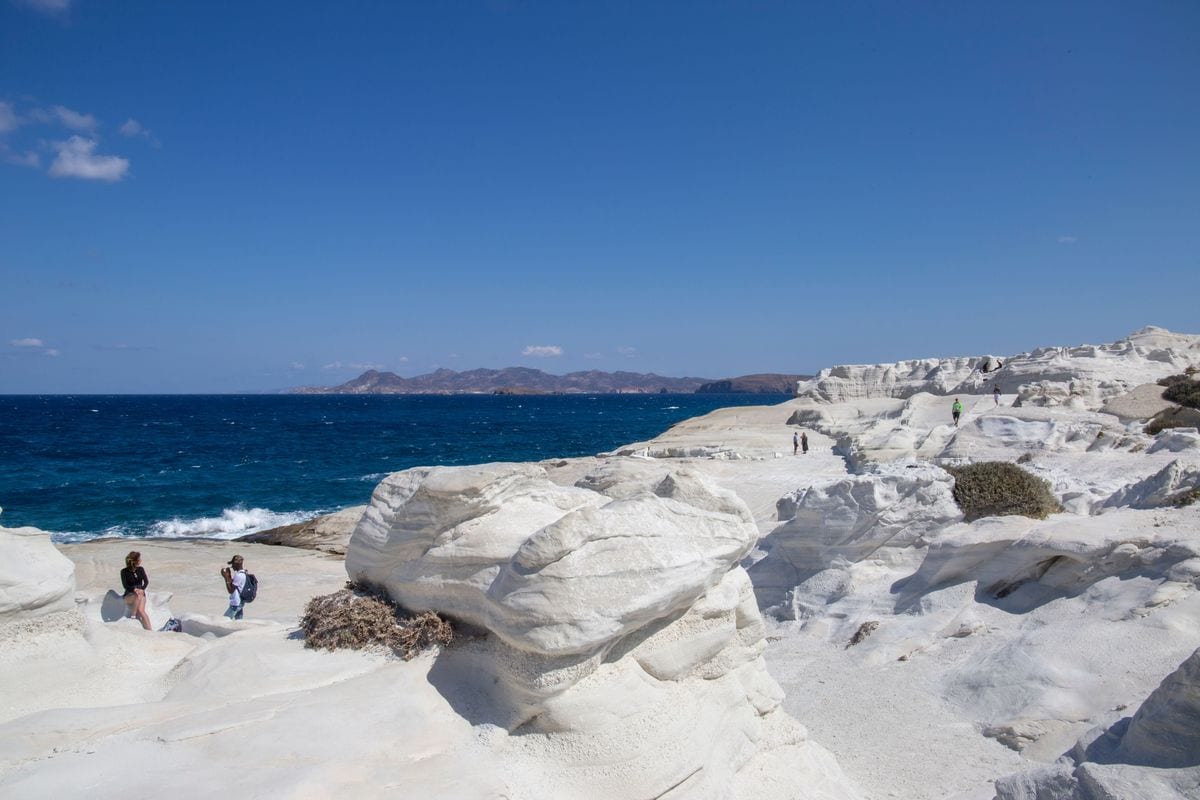
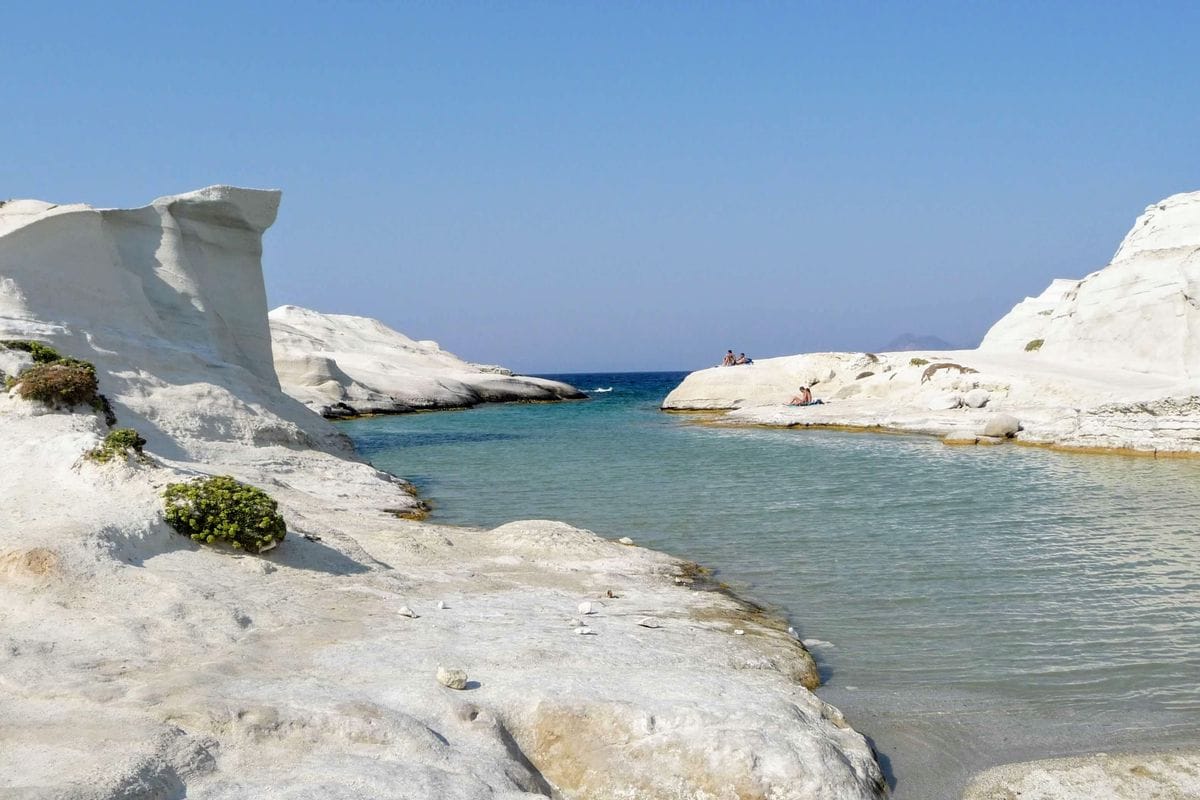
The Wikipedia article on Milos names tuff, trachyte and obsidian as the ordinary rocks of this volcanic island. It calls the island a dormant volcano. The volcano article adds that dormant volcanoes count as seismically active in technical terms. Wikivoyage lists Sarakiniko as a coast of smooth white volcanic rock, worn into the shapes of waves.
Wikivoyage describes Kleftiko by its rock: white sea caves and tall arches. It says a visitor reaches the place mainly by boat. Caves of that kind are seen from the water. The trip by sea has its own page, the Kleftiko bay sailboat cruise. These Milos travel tips leave the trip to that page and keep the rock.
Wikivoyage describes Paliochori as a long stretch of sand mixed with fine pebbles, with colourful volcanic cliffs. It calls the main beach at Pollonia sandy, too. So the ground changes from bay to bay on Milos, from smooth white rock to fine sand. These Milos travel tips read the surface first and the beach name second.
Pumice is a different volcanic rock. Wikipedia calls it extremely vesicular volcanic glass, commonly pale in colour. It forms when hot rock leaves a volcano under pressure and cools as it loses that pressure. Its porosity runs from 64 to 85 per cent by volume. A lump floats at first and sinks once it is waterlogged.
What do the Milos travel tips say about the rules of swimming?
Wikivoyage calls Milos a very safe island for tourists. Even so, the government page of the United Kingdom reports drownings in Greek waters and pools every year. These Milos travel tips for swimming therefore start with care, and the rules below come from that page.
The government page wants children watched at every moment in the sea. For small children it sets the distance at one arm’s reach. In pools the rule holds even for a child who can swim, with a lifeguard on duty. Among these Milos travel tips, the rule for families is plain: an adult within reach of every small child.
The page warns of serious injury or death from rocks out of sight and from shallow water. It adds the rule never to dive into unknown water. Wikivoyage lists cliff jumping among the things people do at Sarakiniko. These Milos travel tips set the two facts side by side: a jump needs water that is known first.
In Greece, a number of organised beaches carry a flag system, the government page says. A visitor learns what the flags mean and follows every warning that they show. A red flag means that swimmers must not enter the water. Where a beach has such flags, these Milos travel tips put them before any plan to swim.
Where a beach has no lifeguard, flag or sign, the government page asks swimmers to take extra care. It also asks swimmers to get local knowledge. It adds that a swimmer follows local advice if jellyfish are present. These Milos travel tips repeat both lines in the terms of the page. They add no rule of their own.
For water sports the government page starts with one rule: take part only in a centre licensed for water sports. Before the start, it says, the paperwork is complete. The centre gives a safety demonstration. Everyone knows how to call for help. The page points to a Greek non-profit group whose aim is to prevent accidents in water sports.
Which Milos travel tips cover the walk up to Plaka and its castle path?
These Milos travel tips for walkers begin with the castle path of Plaka. Wikivoyage says the village sits high on the mountain. It adds that a path leads up to the Venetian castle at the top. The same text names two churches, one at the top and one on the way.
Milos travel tips place Plaka close to the north of the harbour town of Adamantas. Wikivoyage describes it as a small village, while the Milos article calls it the chief town. Wikivoyage gives its views as the reason it is known, since it is settled higher on the mountain. A village on a slope overlooks the land below.
Wikivoyage gives the village a second name, Chora. It says the village is perched on a rocky outcrop above the main port of Adamantas. Wikipedia lists Chora as the principal town of Mykonos and of Patmos. It also lists Chora as the capital of Ios. On each island the name belongs to the main town, as it does here.
From Adamantas the Milos article describes an ascent to a plateau above the harbour. Plaka stands on that plateau, and Kastro rises on a hill higher still. Wikivoyage adds that the Venetian castle at the top also holds the Church of Panagia Skiniotissa. Readers who want to see the island first can open the Milos photo gallery.
On the way up, Wikivoyage says, a walker passes the Church of Panagia Thalassitra. Wikipedia explains that Panagia is a title of Mary, Mother of God, used in Orthodox Christianity. These Milos travel tips note one more point. The same title begins the names of the church at the castle and of the church with the sea balcony.
Wikivoyage points to the castle as a place to watch the sunset. It names a second place for the view, a balcony overlooking the sea at the Church of Panagia Korfiatissa. Milos travel tips for the end of a walk therefore list two places. One is at the castle, and the other is at that church.
What do the Milos travel tips say about Trypiti and the windmills?
Trypiti is a traditional settlement with white houses and windmills. Wikivoyage names it as a place for a quiet afternoon stroll. These Milos travel tips add the origin of the name, which Wikipedia ties to the caves. They also place the Dorian city of the island just south-west of the village.
Wikipedia calls Trypiti a small town of Milos. It names the catacombs and the Roman theatre as its close neighbours. The municipality of Milos includes it. The latest census it lists gives 766 residents. Wikivoyage prints two spellings of the name, Trypiti and Tripiti. These Milos travel tips use the first spelling.
Wikipedia’s general article defines a windmill as a machine driven by the wind. The force of the wind acts on vanes or sails to mill grain. The same article adds that the earliest mills were used to grind cereals. The windmills that Wikivoyage lists at Trypiti belong to this family of machines, with the white houses as their setting.
Wikipedia explains the village name in its article on the catacombs of Milos. The Greek word for a hole gives the village its name. Caves fill the whole area around the settlement. They are cut into porous volcanic rock. These Milos travel tips read the name as a short description of the landscape of the village.
Wikipedia adds that the inhabitants still use these caves as storerooms and stables. In these Milos travel tips the caves are working spaces of the present day, not ruins. A walker in Trypiti is therefore close to rooms for goods and animals. Wikivoyage names the white houses and the windmills as the other marks of the same village.
These Milos travel tips date the first Dorian settlement, as Wikipedia does, to no earlier than the first millennium BC. The Dorians were the ethnic group to which the Spartans belonged. Wikipedia says the Dorian settlers of Milos made themselves independent. They founded a city whose site lies along the bay’s eastern shore, just south-west of Trypiti.
Which Milos travel tips cover the syrmata of the fishing villages?
These Milos travel tips describe syrmata as the traditional fishermen’s houses. Wikivoyage says the lowest level of such a house is hollowed out of soft rock. That level acts as a mooring site for the boat in winter. The main part of the house sits above it, at ground-floor level.
Wikivoyage names Klima as the place where a visitor sees samples of syrmata. Wikipedia calls Klima a seaside village of Milos and says it is known for these fishermen’s houses. The same article places the village near the site of ancient Milos and its theatre. These Milos travel tips follow that order, with Klima first and other villages after.
Wikipedia’s article on Klima describes the houses as two-store buildings. The first floor holds the home of the fisherman’s family, and the ground floor stores the boat during the winter. Wikivoyage calls the boat room a basement, so the two sources number the levels in different ways. Both give the boat its winter place in the lowest room.
Wikipedia prints the word syrmata with the gloss wires. The article adds that the doors and windows of these houses tend to be colourfully painted. These Milos travel tips pass on both details as the article gives them. The paint is a mark a visitor can see from outside, while the word is the name to look for.
Wikivoyage adds that other villages still have syrmata, and it names Schinopi, Areti and Fourkovouni. The list shows that the houses do not belong to one village alone. A walker who knows the word syrmata can look for the same houses in these three villages. These Milos travel tips list four villages in all, Klima and these three.
Wikipedia defines a mooring as a permanent structure to which a boat or ship can be secured. It gives quays, jetties, piers and buoys as examples. Wikivoyage uses the term mooring site for the lowest level of a syrma. That level is cut out of the rock, so it is a mooring unlike a quay or a jetty.
What do the Milos travel tips say about the volcanic origin of the island?
The Pliocene saw the first volcanic activity on Milos, between three and two million years ago. The last eruption came ninety thousand years ago. Milos travel tips on the geology of the island start with that timeline. Wikipedia calls the volcano dormant and says it can erupt again.
Milos travel tips for a closer look at the ground begin with colour. The official tourism page lists white, red, yellow and black rocks among the island’s volcanic formations. Wikipedia gives the cause in one line: Milos is of volcanic origin, like the rest of the Cyclades. The island sits in the far south-west of that group.
A volcano is a vent in the crust where hot lava, ash and gases escape from a magma chamber. Wikipedia sorts volcanoes into active, dormant and extinct. Active ones have a history of eruptions and stand a fair chance of erupting again. Extinct ones have no magma source. Dormant ones have been quiet for a long time.
Wikipedia calls a volcano dormant when it has not erupted since the start of the Holocene, about 12,000 years ago. The last eruption on Milos came long before that start, so the island also fits the rule. Milos travel tips can add one note from the same article: the classes are not entirely uniform and can overlap.
Inside the principal crater, in its hollow, lies the natural harbour of Milos. Wikipedia gives its depth as falling from 130 metres to 55 metres. The bay cuts into the island from the north-west and divides it in two. A narrow isthmus joins the two parts. The article puts its width at no more than 2.2 kilometres.
Milos travel tips on the heat below start with a definition. A hot spring is groundwater that the Earth heats before it emerges. Wikipedia names two sources of that heat: shallow bodies of magma, or deep faults that reach hot rock. The Milos article adds a cave on the south coast where the volcano’s heat is still great.
Which Milos travel tips cover bentonite, kaolin and the other minerals?
The volcanic ground of Milos yields bentonite, perlite and pozzolana, with kaolin in small quantities. Open-pit and strip mines collect them, and the minerals are sold all over the world. Milos travel tips on the minerals begin with bentonite. Wikipedia lists the bentonite deposit of the island among the finds in Greece.
Wikipedia defines bentonite as an absorbent clay that swells, made largely of the mineral montmorillonite. Sodium bentonite swells far more than the calcium type, which is the commoner of the two. These Milos travel tips keep the chemistry short. The clay has microscopic platy grains, and together they give it a very large total surface area.
Ash from a volcano can weather underwater in the sea and become bentonite. Hot water circulating through the pores of an ash bed does the same. Both routes change the volcanic glass in the ash into clay minerals. Fresh beds look white, pale blue or pale green. Weathering then shifts the colour to cream, yellow, red or brown.
Milos travel tips on bentonite include its behaviour in water. The clay takes in water and can multiply its volume by up to eight, Wikipedia says. For building and for road construction, the beds are unsuitable. The same swelling helps in drilling mud and in sealants for groundwater. Wet plates stick together, so the clay works as a binder.
Wikipedia calls kaolin a soft, earthy clay mineral that comes from the weathering of aluminium silicate minerals such as feldspar. Kaolin, also called china clay, is the name for rocks rich in kaolinite. Iron oxide colours kaolin pink, orange or red in a number of regions. Where iron is low, the kaolin is white, yellow or light orange.
Milos travel tips on the minerals close with a pigment and a name. Ancient artists used the Melian earth of Milos as a pigment, Wikipedia says. The word kaolin has a Chinese source. Wikipedia traces it to Gaoling, a village whose name means High Ridge. The English name was borrowed from French reports of seventeen twelve on Jingdezhen porcelain.
What do the Milos travel tips say about sulphur and the mining history?
Pliny the Elder noted that no other place in the ancient world supplied sulphur as abundantly as Milos, Wikipedia says. Milos travel tips on the mining history of the island start with that record. The island also yielded baryte, millstones and gypsum in the past, the same article says.
Milos travel tips on sulphur begin with the element itself. Sulphur has the symbol S and the atomic number sixteen, and Wikipedia also gives the spelling sulfur. At room temperature, elemental sulphur is a bright yellow, crystalline solid. The gas hydrogen sulphide gives rotten eggs their characteristic smell. Wikipedia calls the element abundant, multivalent and nonmetallic.
Sulphur sometimes occurs in pure, native form, so people knew it in ancient times. Wikipedia names ancient Greece among the places where its uses are mentioned. The Milos article adds a second ancient product. The alum of Milos ranked next to that of Egypt in the ancient world. The article cites Pliny the Elder for it.
Wikipedia says sulphur has an older name, brimstone, which means burning stone. Its greatest commercial use is making sulphuric acid for sulphate and phosphate fertilisers. Milos travel tips can add the smaller uses that Wikipedia lists: matches, insecticides and fungicides. Today almost all elemental sulphur is produced as a byproduct of cleaning natural gas and petroleum.
Wikivoyage places a sulphur mine at the bay of Paliorema, in Theiafes. A local mining company used the bay until nineteen fifty-seven. Today a visitor sees the ruins of the quarry’s installations there. The beach in the bay is made of yellow pebbles. Milos travel tips can use that beach as a marker of the old workings.
Near Adamantas, one travel article says, the Mining Museum presents an eleven-thousand-year history of mining. The same article lists ore samples, maps and tools. The official tourism page picks out the Milos Mining Museum as a highlight of the island’s long mining history. Opening details change, so Milos travel tips point to the current page of the museum.
Which Milos travel tips cover the obsidian trade of the Neolithic?
These Milos travel tips start with obsidian, which is natural volcanic glass. Wikipedia puts the earliest trade in Milos obsidian fifteen thousand years in the past. The glass travelled over long distances, and toolmakers turned it into stone tools of extreme sharpness, well before farming began.
Milos travel tips on the Neolithic need one definition first. Wikipedia explains that obsidian forms when lava pushed out of a volcano cools quickly, with very little growth of crystals. The result is a hard, brittle glass that fractures with very sharp edges. In the past, the article adds, people made cutting and piercing tools from it.
Stone Age cultures valued obsidian because, as with flint, workers fractured it into sharp blades or arrowheads. The process is called knapping. People also polished the glass to make early mirrors. Archaeologists now date obsidian artefacts with a relative method called obsidian hydration dating. As a glass, the article adds, obsidian is not a true mineral.
Milos travel tips on the quarries start with what did not happen. Wikipedia says the quarrying led to no permanent homes or manufacturing on Milos. Visitors came by sea. They beached a boat in a cove that suited them and cut glass from the quarries. The article quotes a remark that no early Near Eastern farming village lacked obsidian.
Wikipedia’s article on the rock names Milos and Gyali as the ancient sources of obsidian in the Aegean Sea. It says the cultures living in and around Greece took their obsidian from the island of Milos. Wikipedia adds that tests with X-ray fluorescence trace Greek obsidian to three islands of the Aegean: Milos, Nisyros and Gyali.
These Milos travel tips end the Neolithic story with the Milos article. It says the island supplied obsidian during the Neolithic to the Aegean and the Mediterranean. Lying between mainland Greece and Crete, and holding obsidian, Milos became a leading centre of early Aegean civilisation. Its arms-making role faded when bronze became the favoured material for weapons.
What do the Milos travel tips say about Phylakopi and the Bronze Age settlement?
These Milos travel tips place Phylakopi on Milos, along the northern shore. Wikipedia ranks it among the key Bronze Age settlements of the Aegean. Settlement there ran without a break from about twenty-five hundred BC to the twelfth century BC. Wikivoyage puts its ruins beside the road to Pollonia.
Obsidian quarrying was fading when Phylakopi began, says the Milos article. Tuna fishermen were its first settlers. The Phylakopi article adds that the earliest village, a small one, stood directly on bedrock. The village made pottery in the style of the Grotta-Pelos culture, an early Bronze Age culture. Excavators of the eighteen-nineties later found a town wall.
Milos travel tips on dating lean on Phylakopi. Wikipedia calls it the type-site for a number of Bronze Age periods. Phylakopi I, the first phase with buildings, runs from about twenty-three hundred to two thousand BC. Phylakopi II follows to about fifteen hundred and fifty BC, with houses along straight streets. Phylakopi III lasts until about eleven hundred BC.
Phylakopi shows how far Minoan goods travelled. Wikipedia says Minoan pottery spread through the Cyclades in the Middle Bronze Age, as Minoan Crete expanded. It came in above all at Akrotiri on Thera, though a good deal of it reached Phylakopi. Thera is the island now called Santorini, which has a page of Santorini tours on this site.
These Milos travel tips reach the third city of Phylakopi next. Wikipedia says an earthquake probably destroyed the second city, and builders raised the third in its place. The Pillar Room of that city had pillars and ashlar blocks. The so-called Mansion held a fragment of a Linear A tablet, so the article calls it a probable administrative centre.
Milos travel tips on the dig name the British School at Athens first. It ran the first excavation, from eighteen ninety-six to eighteen ninety-nine, and every later project. Duncan MacKenzie recorded the layers in detail. Later work led by Colin Renfrew uncovered a sanctuary. Wikipedia says the community used it as its main place for worship, sacrifice and offerings.
Which Milos travel tips cover the Cycladic culture of the Bronze Age?
Milos travel tips on the Bronze Age use the name Cycladic culture. It was a culture of the Cyclades, an archipelago lying southeast of mainland Greece. Wikipedia dates it from about thirty-one hundred to about one thousand BC. Its dating is relative, roughly matching mainland Helladic and Cretan Minoan dating.
Wikipedia’s chronology has three stages: Early, Middle and Late. The early stage unfolded in three phases, between about thirty-one hundred and twenty-three hundred BC. Middle Cycladic is dated from about two thousand BC, and archaeologists find it harder to read. When Late Cycladic closed, about one thousand BC, the Cycladic and Minoan cultures had essentially converged.
Milos travel tips on the research begin in the eighteen-eighties. Wikipedia says antiquaries such as Theodore Bent made the first digs. The British School at Athens then took up systematic fieldwork. Then Christos Tsountas studied burial sites on a number of islands in eighteen ninety-eight and eighteen ninety-nine. He also coined the term Cycladic civilization, the article says.
Pottery is a large part of the finds, and its changing style marks the periods. Wikipedia says boats carried pottery overseas, especially in the Early Cycladic period. No boat survives. Cycladic frying pans, whose purpose is unknown, show a ship. The article infers two kinds of ship, a small boat and a longboat for at least twenty-five people.
Milos travel tips on the Middle Bronze Age follow the pottery and the graves. Wikipedia says they show Cycladic influence spreading to the mainland and to Crete. Then the palace culture of Crete arose, and the islands became relatively less significant. Cycladic culture was increasingly overshadowed by the rising influence of Minoan Crete, the article says.
These Milos travel tips end with a later chapter of island history. The Milos article says the island struck its own coins from the sixth century BC, on the Milesian weight standard. Milos was the only island in the Aegean Sea to use it, the article adds. The base coin, the stater, weighed just over fourteen grams.
What do the Milos travel tips say about the Venus de Milo and her marble?
These Milos travel tips treat the Venus de Milo as a work of stone. Wikipedia describes a statue of Parian marble, larger than life and over two metres high, with both arms missing. It dates to the Hellenistic period, and the Louvre in Paris has displayed it since eighteen twenty-one.
Wikipedia says the stone was quarried on Paros, an island in the Aegean Sea. Its article describes Parian marble as pure white, semi-translucent and fine in grain. Wikipedia names the Medici Venus and the Venus de Milo among the statues cut from this marble. These Milos travel tips add the quarry names: Chorodaki, Marathi and Agios Minas.
The figure stands on the right leg with the left leg raised. Wikipedia lists the missing parts as both arms, the left foot and the earlobes. A filled hole below the right breast held a metal tenon for the arm. Only the nose tip, the lower lip, a big toe and a section of the drapery were restored.
Wikipedia says the flesh is polished smooth, while chisel marks remain on the other surfaces. The right side of the drapery has more carved detail than the left. The back is less finished than the front. These Milos travel tips keep to the article’s reading: the front was originally the only view intended for the work.
Wikipedia says the date was disputed from the day of the discovery. The modern consensus places the work in the second century BC, within a span from 160 to 110 BC. Nineteenth-century scholars had held the fourth century BC. In eighteen ninety-three Adolf Furtwängler argued for a late Hellenistic date, and that view is still widely accepted.
Wikivoyage places a reproduction of the Venus at the entrance of the island’s archaeological museum. The original stays in Paris. Wikipedia dates the neoclassical museum building to eighteen seventy and puts it on the main square of Plaka. These Milos travel tips name Ernst Ziller as its architect, a German-born man who became a Greek national.
Which Milos travel tips cover the ancient theatre and the Roman town?
Wikivoyage says little survives of the ancient city of Milos apart from a Roman-era theatre, which is under conservation. These Milos travel tips start with that theatre. Wikipedia adds that the old town also held town walls, other buildings and a floor mosaic from the same period.
According to Wikipedia, the old town of Milos lay closer to the harbour mouth than Adamas does. Its slope ran from the village of Trypiti down to a landing place at Klima. Remains of the town walls and of other buildings stand there, with the theatre. Milos travel tips on the old town point to one hillside.
Wikipedia dates the start of the Roman era to one hundred and ninety-seven BC. In that year the Romans forced Philip V to withdraw from Greece, and Milos came under Roman influence. A second Wikipedia article covers the history of the Cyclades. It adds that Milos had a large Jewish population as the first century BC ended.
Wikipedia says Roman theatres were generally built on their own foundations, not on earth banks or a hillside. The auditorium formed a half circle, and awnings known as velarium gave cover from rain or sun. It names the cavea as the seating section. These Milos travel tips give this general frame, not a plan of the island’s theatre.
Wikipedia says the British School at Athens uncovered a building holding a mosaic in eighteen ninety-six. The article on mosaics says the craft covers a surface with small pieces cut from coloured stone, glass or ceramic. Plaster or mortar fixes the pieces in place. It adds that Roman floor mosaics were widespread, from Britain to Dura-Europos.
The old town gave up statues that now stand in three capitals. Wikipedia names the Venus in Paris, an Asclepius in London, and a Poseidon and an archaic Apollo in Athens. These Milos travel tips add that the British School at Athens opened in eighteen eighty-six. Wikipedia states its aim as the study of Greece in all its aspects.
What do the Milos travel tips say about the catacombs near Trypiti?
Wikipedia calls the catacombs of Milos an ancient underground Christian cemetery in the Cyclades. It dates their use from the first through the fifth century AD, the early Christian age. These Milos travel tips place the site near the modern settlement of Trypiti, next to the old agora.
Wikipedia gives one distance for the site. Measured from the ancient theatre, the catacombs lie 200 metres to the east. That theatre is the Roman-era building of the previous section. The agora of the ancient city lies next to them. Milos travel tips on the catacombs therefore name the agora and the theatre as the two neighbours.
The galleries are not uniform. Wikipedia reports that their width ranges from one to five metres, while their height runs from 1.6 to 2.5 metres. No single figure fits the whole site, so these Milos travel tips quote the range. In ancient times, the article adds, the caves of the area served as family burial chambers.
Wikipedia describes two kinds of burial place at the site. The first kind is the tomb cut into the wall of a gallery. The second is the grave cut into the ground and covered with unworked stones of irregular sizes. Unworked means that the stones were left as found, not shaped. The article adds that the site lies underground.
Wikivoyage lists the catacombs among the largest in Greece. It places their cutting in the early Christian period. Wikipedia’s history of the Cyclades calls them the only ones of their kind in the Aegean and Greece. Their workmanship is very simple. With baptismal fonts close by, they confirm a Christian community from at least the third or fourth century.
Wikipedia defines catacombs as man-made underground passages, mainly for burial. The word comes from Late Latin catacumbae and first named the Roman site on the Appian Way. Burial inside Rome was illegal, so the Roman catacombs lay outside the walls. The first of them were carved from soft tufa. Milos travel tips on the cemetery rest on that background.
Which Milos travel tips cover the Greek food of the island as plain facts?
These Milos travel tips cover the Greek food of the island as plain facts. Three foods carry Greek cuisine, Wikipedia explains: wheat, olive oil and wine. That cuisine continues ancient Greek and Byzantine traditions. Wikipedia also names Middle Eastern, Balkan and Italian influences on the cooking of today.
On the islands and along the coasts, fish dishes are common, according to Wikipedia. Beef dishes are uncommon in Greece, because the climate and terrain favour goats and sheep over cattle. The same article lists pork, poultry, lamb, rabbit and goat. These Milos travel tips pass that general rule on as background for an island table.
Wikivoyage names three places on the island where a number of restaurants serve fresh seafood, Greek cuisine and local delicacies. Those places are Adamantas, the harbour town, Trypiti and Pollonia. The same line names two of the delicacies, pitarakia and karpouzopita. Wikipedia gives both names in its article on Greek cuisine, and the next two paragraphs follow it.
Wikipedia describes pitarakia as mini half-moon-shaped pies with a mizithra cheese filling and places them on the island of Milos. It lists them among the appetizers of Greek cuisine. A Wikivoyage listing glosses the same word as small fried cheese pies. These Milos travel tips give both: one source names the cheese and shape, the other the frying.
Wikipedia lists karpouzopita among the desserts and pastries of Greek cuisine. It gives the English words watermelon pie and watermelon cake, and it places the dish on the island of Milos. The same list holds walnut pie, pumpkin pie and sesame pie. Filo pastries, nuts, honey, fruits and sesame are named as common dessert ingredients by the article.
Wikipedia names lathera as a home-cooked dish type: seasonal vegetables stewed in olive oil with herbs and a tomato sauce. Wikipedia names leeks, spinach, okra, peas and green beans among them. Another passage lists tomatoes, aubergine, potato and onions as important vegetables. These Milos travel tips close the food facts with lathera, a dish of the home table.
What do the Milos travel tips say about the grapes and the wines?
Grapes are one of the three main crops of Milos, along with cotton and barley, says Wikipedia. These Milos travel tips cover the grapes and the wines as plain facts. The grape facts below come from Wikipedia’s articles on Milos, on the Assyrtiko grape and on Greek cuisine.
Wikipedia calls Assyrtiko a Greek grape for white wine, native to Santorini. The soil there is arid and rich in volcanic ash. A number of the Santorini vineyards are old and ungrafted. Paros is another Aegean island where the grape grows, and Chalkidiki is another region. Another page of this site, titled Paros tours, names that island.
Wikipedia says Santorini growers coil the vines into low baskets called kouloura. The shape helps protect the grapes from strong winds and sun exposure. During long, dry summers the roots can extend deep through ash-rich volcanic soil, looking for moisture. One study there found that the kouloura shelter the grapes from heatwaves and strong winds.
Even a very ripe Assyrtiko grape keeps its acidity, according to Wikipedia. Its mineral profile suits blending, and the article names Malagousia, Sémillon and Sauvignon blanc as partners. The article adds that across Greece the grape makes dry and sweet wines, including syrup-sweet dessert wines. These Milos travel tips note that range of wines made from Assyrtiko.
Wikipedia counts approximately two hundred vine varieties in Greece, Assyrtiko among them. Wikipedia traces retsina back to ancient Greece; the wine is white or rosé and flavoured with pine resin. A blend with the less acidic Savatiano grape appears in retsina, says the Assyrtiko article. These Milos travel tips keep these facts as background for the glass.
Wikipedia names wine and olive oil as foods that were always central to Greek cooking. Wikipedia connects Greek colonization with the early spread of grapes and of olive trees across the Mediterranean. The Wikipedia article on Milos names no wine of the island. These Milos travel tips stay with the grape facts above and add no label.
Which Milos travel tips cover the capers and the cheeses of the island?
Wikivoyage lists a local cheese called manoura, preserved in olive oil, among the foods to buy on Milos. These Milos travel tips cover the capers and the cheeses as kinds of product. Wikipedia adds the wider list of Greek cheeses, so the cheese of the island sits in a long line.
Wikipedia says a great variety of cheese types is used in Greek cuisine. The list includes Feta, Kasseri, Kefalotyri, Graviera, Anthotyros and Metsovone. It also holds Ladotyri, which the article glosses as cheese with olive oil, and Kalathaki, a specialty of Limnos. These Milos travel tips do not equate that name with the manoura of Wikivoyage.
The Buy section of Wikivoyage names capers among the local foods of Milos, next to a sun-dried tomato paste. Wikipedia lists kaparosalata, a caper salad, among the salads of Greek cuisine. It says that in Greek cuisine appetizers are also salads. These Milos travel tips cite the caper as an island food and the salad as a plain dish.
Two Wikivoyage listings in Adamantas name sun-dried tomatoes kept in olive oil and a local sun-dried tomato paste. Wikipedia calls olive oil an element of Greek cuisine that is both characteristic and ancient. The olives themselves are also widely eaten, the article adds. Wikipedia’s Milos article says orange, olive and juniper trees grow throughout the island.
Wikivoyage lists glyko koufeto, spoon sweets of white pumpkin, next to other fruit preserves. Wikipedia lists koufeto of Milos as a spoon sweet from the island. Wikipedia lists other island spoon sweets too, such as a plum sweet from Skopelos. These Milos travel tips note that both pages name the sweet, so two sources tie it to Milos.
One Wikivoyage listing adds kritamo, which it glosses as sea fennel, preserved grape hyacinth bulbs and homemade sesame snaps. Wikivoyage places the listing in Adamantas, the harbour town. Wikipedia says Greek cuisine uses seeds and nuts in everything from pastry to main dishes. These Milos travel tips treat these foods as product kinds, with no shop and no label.
What do the Milos travel tips say about money, cash machines and tipping?
These Milos travel tips begin with the currency. Out of the 27 states in the European Union, 21 have made the euro their official money. Wikipedia lists Greece among those 21. One euro equals 100 cents. Milos is a Greek island, so it uses the same currency.
The Eurosystem and the European Central Bank look after the euro. The central banks of the eurozone states form the Eurosystem. It also takes part in printing and minting the notes and coins. An Austrian designer, Robert Kalina, created the notes. Each note has its own colour and honours one artistic period in the architecture of Europe.
Euro coins carry a common side with the value and a map. The other side is national and shows an image picked by the issuing country. These Milos travel tips add that a euro coin from any member state works in any euro country. A Greek commemorative coin marks the Summer Olympics of two thousand and four.
For cash, these Milos travel tips point to the automated teller machine. It lets customers withdraw cash and check a balance without bank staff. Wikipedia adds that a machine can pay out cash in a foreign country. A different currency is converted at the institution’s exchange rate. A second Wikipedia article calls Adamas the commercial centre of Milos.
On tipping, these Milos travel tips draw on Wikipedia. It defines a tip as a sum given by a customer to service workers. The sum comes on top of the basic charge. The practice differs between countries and settings alike. In a number of countries, bar and restaurant servers get tips, and so do taxi drivers.
In other places a tip is not expected, and it can be discouraged or seen as an insult. Restaurants sometimes add a service charge to the bill. A tip is not expected when a fee is charged openly for the service. Wikipedia notes that American travellers keep the tipping habit even where it is less of a norm.
Which Milos travel tips cover the Greek language and the English spoken on the island?
These Milos travel tips cover the Greek language first and the spoken English after it. Wikipedia says that no other Indo-European language has a longer documented history. Its written records reach back at least 3,400 years. Milos lies in Greece, so Greek is the official language on the island as well.
Greeks have written with their alphabet for roughly 2,800 years. Earlier, Greek was set down in the Cypriot syllabary and in Linear B. A clay tablet in Linear B, found in Messenia, is the oldest written evidence. It dates to between fourteen fifty and thirteen fifty BC. Wikipedia calls Greek the oldest recorded living language in the world.
Cyprus gives Greek the same official status as Greece does. The European Union counts it among its 24 official languages. Wikipedia gives at least 13.5 million speakers of Greek today. It is native to the lands where Greeks have lived since antiquity. Among them are Greece, Cyprus, Egypt, Turkey, southern Albania, and Calabria and Salento in Italy.
Wikivoyage says that, aside from Greek, Milos has a number of English-, French- and Italian-speakers. The article says that Spanish- or German-speakers turn up in smaller numbers too. These Milos travel tips pass this on as the statement of one travel article. Wikipedia adds that the English language owes a strong influence to Greek and Latin.
The official tourist publication of Milos of two thousand and eight came in six language versions. These Milos travel tips list them: Greek, English, French, Italian, Spanish and German. Wikivoyage names the same six languages in its list of speakers on the island. The statement is dated, so it describes that edition only, not the current one.
In the early nineteenth century a purified form called Katharevousa was developed. The newly formed Greek state used it for literary and official purposes. The spoken form, Dimotiki, became the official language of Greece in nineteen seventy-six. These Milos travel tips add that Standard Modern Greek is today the form the state and the schools use.
What do the Milos travel tips say about name days and church feasts?
A name day celebrates a day linked to a person’s baptismal name. The name is normally taken from a biblical character or another saint. These Milos travel tips look at it as it is kept in Greece. In Greece and Cyprus it is celebrated much like a birthday, without the cake.
The custom began with the Christian calendar of saints. Anyone named after a saint marked that saint’s feast day. Wikipedia says name days carry more weight where Catholicism, Lutheranism and Orthodoxy predominate. The church favoured saints’ feast days over birthdays, which it saw as pagan. Catholic and Eastern Orthodox countries have kept the tradition since the Middle Ages.
The Greek Orthodox calendar gives every day of the year a saint or martyr to remember. Anyone named after a saint has a big celebration that day. Names that Greeks took from pagan antiquity have no saint of the same name. These Milos travel tips add that the bearer of such a name counts as having no name day.
Since antiquity Greeks have named a newborn child after a grandparent, which keeps names running down the family line. Name days can also fall on major feasts of the church year. Wikipedia places Christos and Christine on Christmas Day. New Year’s Day is the name day of those called Basil. Easter Sunday belongs to Anastasios and Anastasia.
In Greece a name day is traditionally marked with an open house, and well-wishers are welcome. These Milos travel tips add that guests are expected to bring gifts. A celebration can fall as late as 40 days after the nominal date. Where the custom is popular, a person marks both a name day and a birthday each year.
The older text of this site says that name days on Milos count for more than birthdays. It adds that a feast, called a panigiri, takes place at the saint’s church on the day before. These Milos travel tips add, from Wikipedia, that the majority of the island’s population is Greek Orthodox. The Venetians brought Catholicism to the island.
Which Milos travel tips cover the sun and the heat of the summer?
UK government advice for Greece lists three items for a walk: a hat, sunscreen and a good supply of water. It also asks walkers to skip the trails when the sun is at its peak. These Milos travel tips start there, since sun and heat come first on a summer walk.
Wikipedia says a summer climate of hot days and warm nights is found in a number of the Cyclades. Any rain in that summer falls as showers or thunderstorms. Coastal heatwaves stay generally mild, Wikipedia adds, because water cooler than the land and its breeze temper the heat. These Milos travel tips use that picture of the climate.
The government page asks walkers to take extra care in temperatures higher than they are used to. It says trails frequently lack shade and route markings vary in quality. It lists footwear for uneven ground, a map and a fully charged phone. It also says to avoid hiking alone if possible and to tell someone the route.
Wikipedia treats sunscreen as protection for the skin: it guards against sunburn and helps prevent skin cancer. It comes as lotion, spray, gel, foam, stick or powder. It supplements clothing such as sunglasses and sunhats. The World Health Organization lists it among its Essential Medicines. These Milos travel tips treat it as one part of sun care.
The article sorts sunscreens by their active ingredients. Mineral kinds use zinc oxide or titanium dioxide, chemical kinds use organic molecules, and hybrid kinds combine both. A broad-spectrum product covers UVA and UVB radiation. Wikipedia says cutting UV damage matters especially for children and light-skinned people. Olive oil served as sun protection in ancient Greece, the article adds.
Wikipedia gives fewer than 1,600 sunshine hours a year for the Epirus mountains and more than 3,250 for south Crete. It lists forty-eight degrees Celsius as the highest temperature ever recorded anywhere in Greece. The government page names extreme heat among the natural phenomena of the country. These Milos travel tips use the figures to set the scale.
What do the Milos travel tips say about rip currents and lifeguards?
Wikipedia defines a rip current as a strong, narrow current of water that moves directly away from the shore. It cuts through the lines of breaking waves like a river flowing out to sea. These Milos travel tips use that plain definition of the danger.
Wikipedia calls rip currents hazardous to people in the water. A swimmer who does not understand what is happening can panic. Another swimmer can exhaust themselves by swimming straight against the flow. The article names rips as the cause of eighty per cent of rescues by beach lifeguards. Milos travel tips on the sea start with the current.
Wind and breaking waves drive the surface water landward, and a rip begins. That lifts the water level slightly along the shore. The extra water flows back by the easiest route, such as a gap in an offshore sandbar or reef. Wikipedia says rips form on coasts of oceans, seas and large lakes wherever waves carry enough energy.
Wikipedia lists signs that show a rip from the shore. The water looks flat where the waves break, and a river of foam can run out to sea. The article warns that the smooth surface of a rip can look like a suitable place to enter. These Milos travel tips ask a swimmer to read the water first.
Wikipedia says the lifeguard’s job is the safety and rescue of people who swim, surf or play other water sports. Each lifeguard learns swimming, first aid and water rescue. The article advises entering the water only where lifeguards are on duty. Boat trips on open water have their own page, the Milos and Polyaigos sailboat tour.
Wikipedia says a rip can move faster than any human can swim. The advice is to swim parallel to the shoreline until out of the flow. A swimmer then returns to shore at an angle, or floats and signals for help. The article says a rip cannot pull a person under. Milos travel tips pass the advice on.
Which Milos travel tips cover sea urchins and the cuts from the rocks?
Wikipedia says about 950 species of sea urchin live on the seabed. The body is globular and covered by spiny shells, as a rule three to ten centimetres across. These Milos travel tips place sea urchins on the rocky shores of the Aegean too.
Wikipedia says sea urchins move slowly. They crawl on tiny tube feet and sometimes push themselves with their spines. They feed mainly on algae and on slow-moving animals such as sponges. The article places urchins from rocky shores to the deep sea. Milos travel tips for a swimmer on a rocky shore picture a slow animal of the seabed.
The spines serve for defence and movement, and they come in a variety of forms. Wikipedia calls the spines long and sharp in a number of species. It says they are venomous in certain tropical families. Among the spines sit pedicellariae, which are moveable stalked structures with jaws. Wikipedia adds that the spines protect adults well against predators.
These Milos travel tips take the sea urchin injury from Wikipedia: a painful puncture wound made by the brittle spines. The article calls these a common source of injury to ocean swimmers. Wikipedia says a spine wound can bring venom or infection. Trouble with breathing can point to a serious reaction to the toxins in the animal.
The spines are not dangerous in themselves if they are fully removed promptly, Wikipedia says. Spines left in the skin can cause further problems. The Greek word ekhinos means spine, and the word urchin is an old word for hedgehog. Its chewing organ, built of five teeth, is called Aristotle’s lantern, after Aristotle’s History of Animals.
Rocks injure swimmers too. The government page lists hidden rocks among the causes of serious injury in the sea. Wikivoyage calls the rock of Sarakiniko smooth, white and volcanic. Wikipedia adds that one urchin species, Paracentrotus lividus, uses its jaws to burrow into soft rocks. These Milos travel tips set the three facts side by side.
What do the Milos travel tips say about wildfire and the rules of fire?
These Milos travel tips take the fire rules from the UK government’s safety page on Greece. For wildfires, the page names April to October as the summer season of high risk. It calls lighting a fire dangerous and illegal, so a visitor starts from one plain rule: no fires.
These Milos travel tips start with Wikipedia’s definition: a wildfire is a blaze that nobody planned and nobody controls. It burns vegetation that can catch fire. A spark can come from nature or from people, on purpose or by accident. Even a burn set under control becomes a wildfire when it slips past the lines meant to hold it.
Wikipedia says wildfire severity depends on factors such as the fuel, the setting and the weather. A wet period that grows plenty of plant matter, followed by drought and heat, frequently comes before severe fires. Grasses and leaves hold less water than branches and trunks, so they catch fire more easily. A drought leaves plants drier and more flammable.
In Greece, starting a wildfire counts as a criminal offence, the UK government’s page says. That holds even when the act is entirely unintentional. The page calls wildfires highly dangerous and unpredictable, and says the situation can change quickly. These Milos travel tips quote the fire ban from the page’s section on hiking and exploring nature.
Two habits keep a visitor from starting a fire, according to the page. The first is to leave no litter, especially glass, since glass is known to start fires. The second is to make sure every cigarette is properly extinguished. Wikipedia adds that campfires and the use of equipment are among the human sources of ignition.
The UK government’s page tells a visitor who sees a fire to call the emergency services on 112. These Milos travel tips add the emergency alerts: a phone that allows them warns its owner of wildfires nearby. The sender is the Emergency Communication Service. The Greek Ministry of Climate Change and Civil Protection has an English website.
Which Milos travel tips cover camping and the beaches as places to sleep?
These Milos travel tips start with the law. Greece has introduced regulations that ban tent camping on beaches, on seashores and at archaeological sites. A UK government page on safety in Greece gives the rule. The page names one option for a night outdoors: a licensed campsite.
Milos travel tips on camping begin with a plain definition from Wikipedia. It calls camping outdoor recreation that involves staying overnight in a basic, temporary shelter. The article lists a tent, a tarp, a hammock and a recreational vehicle as shelters. The Greek rule on beaches covers two of these shelters, the tent and the vehicle.
The same regulations also bar motorhomes, camper vans, trailers and semi-trailers from parking there. Wikipedia describes a motorhome as a self-propelled recreational vehicle, a home on wheels. It has sleeping space for two to eight people, the article says, with a kitchenette and a small bathroom. The kitchenette holds a stovetop, an oven, a refrigerator and a sink.
These Milos travel tips list the places where the ban applies. They are archaeological sites, seashores, beaches, the edges of public forests and public areas in general. Wikipedia says an archaeological site keeps evidence of past activity, whether prehistoric or historic. A beach on Milos falls under the same ban as any other beach in Greece.
The page tells visitors to use licensed campsites to avoid fines. Wikipedia describes a campsite as an area that is set apart for people to camp. In British usage a campsite splits into pitches, where campers stay in tents, campervans or caravans. Wikipedia adds that a campsite can be a patch of dirt or a paved pad with electricity.
Wikipedia notes that camping on open land is legal in a small number of countries. Scotland is one, allowing camping on much unenclosed land, state-owned or private, under an access code. The Greek rule for beaches differs, as the UK government page states it. Milos travel tips on camping therefore end with a check of the current rule.
What do the Milos travel tips say about accessible tourism on the island?
These Milos travel tips borrow the idea from Wikipedia. Accessible tourism is the ongoing effort to make destinations, products and services open to all. That holds whatever a person’s physical or intellectual limits, disabilities or age. The goal covers people with disabilities, travellers with children and seniors.
Wikipedia says the idea reaches publicly owned places and privately owned ones alike. It also aims to let people with access needs act independently, using universal design. Wikipedia gives about fifteen per cent of the world’s population as living with a disability. These Milos travel tips use the scope to frame the page, not to promise anything about Milos.
According to the European Network for Accessible Tourism, the field includes destinations without barriers, with their infrastructure and facilities. The same list holds transport by air, land and sea that suits all users, and services delivered by trained staff. It ends with activities, exhibits and attractions open to everyone, and with marketing and websites that inform all.
Milos travel tips on access also draw a little history from Wikipedia. The concept of accessible tourism grew from a shift from the medical model of disability to the social model. In nineteen ninety-seven, a set of seven principles of universal design was developed. Three of the seven are equitable use, flexibility in use and tolerance for error.
Wikipedia says a pedestrian zone is closed to ordinary motor traffic and left to walkers and bicycles. The aim, Wikipedia says, is better accessibility and mobility for people walking. The UK government’s page tells walkers to use a pedestrian crossing where possible. Drivers sometimes pass a crossing without stopping, the page warns, although the rule says they stop.
Wikipedia treats Article 9 of the United Nations disability convention as the nearest thing to an international standard. Adopted in two thousand and six, it has 164 signatories, and no other human rights treaty was enacted faster. For Milos itself the sources give no accessible routes, so these Milos travel tips point to the island’s own page.
What else do visitors ask about Milos travel tips?
What do these Milos travel tips say about the size of the island?
These Milos travel tips take the size from Wikipedia. The lead gives one total of 160.147 square kilometres, or 61.833 square miles, for the municipality. That total adds Antimilos and Akradies, two offshore islands without residents, to the main island. It is therefore larger than the area of the island alone.
The geography section of the article measures the island by itself. Wikipedia gives two lengths, 23 kilometres on the east-west line and 13 kilometres on the north-south line. It converts them to 14 miles and 8.1 miles. The area is estimated at 151 square kilometres in all, or 58 square miles.
Wikipedia calls the greater part of the land rugged and hilly. It names Mount Profitis Elias, at 748 metres or 2,454 feet, as the summit at its western end. A figure for the island and a figure for the municipality differ. So these Milos travel tips label each size, island or municipality.
What is the number of residents of Milos in these Milos travel tips?
Wikipedia’s lead counts 5,193 inhabitants at the latest census it cites. That count belongs to the whole municipality. Antimilos and Akradies, the offshore islands of that municipality, have no residents, so the inhabitants all live on Milos. The section on the modern period gives an older figure of 4,977 for two thousand and eleven.
The same section says the population peaked in nineteen twenty-eight at 6,562 people. The history section puts it above 6,000 in the early eighteenth century. At that time it was almost entirely Greek and Christian. These Milos travel tips set both highs beside the later counts, so a reader sees the swings.
The population then fell. By seventeen ninety-eight it was below 500 people. Visitors of that period put the share of ruined buildings at no more than two thirds. It began to grow again in the early nineteenth century and reached 5,000 by eighteen twenty-one. Reliable figures are hard to find, since no Ottoman census ran before eighteen eighty-one.
What do these Milos travel tips say about the police and the coast guard?
The Hellenic Coast Guard is the national coast guard of Greece. Wikipedia says the corps dates from nineteen nineteen and that its legal framework was reformed in nineteen twenty-seven. Upholding Greek, European and international law across the maritime areas is its primary mission. The Military Penal Code classes both its officers and its enlisted ranks as military personnel.
Wikipedia names a wide range of tasks for the corps. They include general policing, traffic policing, port operations and protection of the marine environment. Law enforcement covers the sea, the ports and the coastal areas. The corps answers to the Ministry of Shipping and Island Policy, and it runs a rescue coordination centre in Piraeus.
On land, the UK government’s page on safety in Greece says to carry a passport at all times. The police can ask for identification and can refuse a copy. It adds that the police arrest anyone whose behaviour they judge rowdy or indecent, above all with heavy drinking. These Milos travel tips relay both rules.
What do these Milos travel tips say about the emergency number and the alerts?
The UK government’s advice for travellers to Greece names 112 as the number of the emergency services. It tells a walker who is hurt or lost to call it. The same number is for anyone in immediate danger during an earthquake. These Milos travel tips repeat that one number and no other.
Every visitor is asked to switch on emergency alerts in the phone’s settings. The Greek government’s Emergency Communication Service sends the alerts. The setting sits in the notification menu, and the page lists the steps for three kinds of phone. Which alerts arrive depends on where the phone is, so the owner keeps it close.
Flash floods, extreme heat, wildfires and earthquakes all appear on the page’s list of extreme natural events in Greece. Adverse weather and floods can develop quickly, it warns. It points to the official 112 Greece account on social media for updates. It closes with a grab bag of phones, chargers, insurance papers, essential medicine and prescription details.
What do these Milos travel tips say about the name of the island and the apple coin?
Wikipedia opens with two spellings of the name. Mílos is the Modern Greek one, and an ancient Greek spelling stands beside it. The apple on the island’s coins is a pun on the name, the article says. The Greek word mêlon meant apple and sounded close to the old name of the island.
The greater part of the coins carried an apple, Wikipedia says. The coins also bore the name of the people, Malion, meaning of the Melians. By the sixth century BC the Melians wrote in an archaic variant of the Greek script. These Milos travel tips note both marks, the apple and the name.
Wikipedia says the coinage switched to the Rhodian weight standard after the siege of 416 BC. Its tetradrachms weighed 15.3 grams. They no longer carried the word Malion. The archaic script was discarded too. The island also stopped making the terracotta reliefs that it had exported from at least 470 BC.