
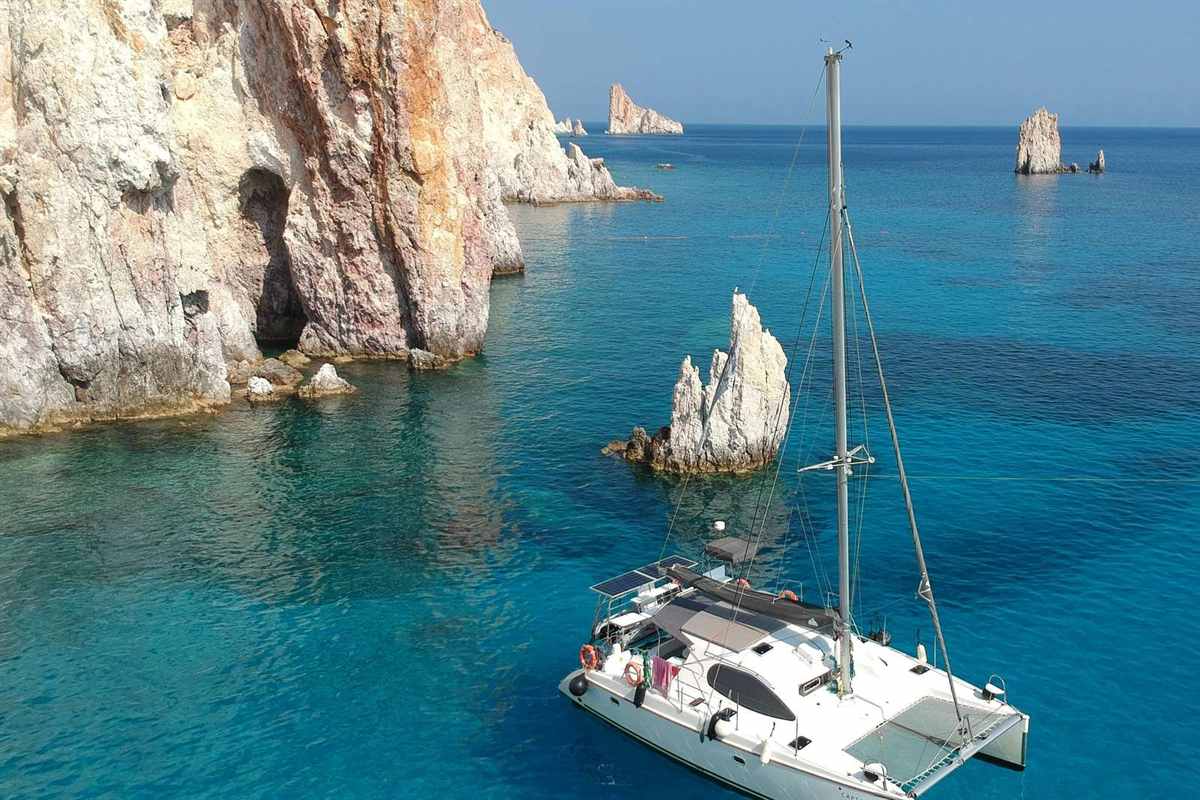
A Milos and Polyaigos sailboat tour is a full day on the water that leaves the port of Adamas, passes the white rock coast and reaches an island without a single village. Other sea days across the islands are gathered on the home page of tours in Greece.
This page covers what the trip is, how long it lasts, where it starts, the island of Polyaigos, the stops at Kleftiko, the weather and the questions travellers ask.
What is a Milos and Polyaigos sailboat tour?
A Milos and Polyaigos sailboat tour is a full-day trip around Milos and out to Polyaigos. Operators list swim stops and a lunch on board. One operator starts the day at the port of Adamas and brings the boat back there in the evening.
Wikipedia describes Milos as an island of volcanic origin. It lies in the Aegean Sea, with the Sea of Crete just to its south. Milos is the island furthest south-west in the Cyclades. Polyaigos is the second island of the trip. Wikipedia calls Polyaigos uninhabited and links it to the island of Kimolos.
Operators describe a Milos and Polyaigos sailboat tour in their own words. One operator calls its route the round of Milos and Polyaigos. The boat circles Milos and visits Polyaigos, which this operator places north-east of Milos. It adds that the swim stops are reachable by sea only.
Operators run these days with small groups. One operator caps its round of Milos and Polyaigos at 22 passengers. Another offers private and semi-private sailing cruises to Kleftiko and Polyaigos. A listing of Milos tours shows a full-day cruise to the west of Milos for up to 10 passengers.
A listing of Milos tours describes a full-day sailboat tour with lunch. It lists an extended tour around Milos and a look at the waters of Polyaigos. The tour also has a swim and snorkel session near the caves of Kleftiko. Operators spell the island’s name in different ways, such as Poliegos or Polyegos.
How long is a Milos and Polyaigos sailboat tour?
A Milos and Polyaigos sailboat tour fills one full day. One operator lists a departure from Adamas at 9 in the morning and a return around 6 in the evening. That is a day of about nine hours.
The hours above belong to one operator. Other sources describe a Milos and Polyaigos sailboat tour in words, not in hours. Another operator gives a choice between a half day and a full day. The page of one more operator, for its round of Milos and Polyaigos, gives no clock times.
On that schedule, the boat casts off from the port and sails north-east around Milos. It passes Klima and Arkoudes, then heads for Polyaigos. Galazia Nera on Polyaigos is the first swim stop, and a light breakfast is served on board afterwards.
On this operator’s Milos and Polyaigos sailboat tour, the boat follows the south coast past the abandoned sulfur mines. It stops at Gerakas Beach for about 40 minutes. At Kleftiko the operator plans about one hour for swimming and snorkeling. A barbecue lunch is served on board after that.
After Kleftiko, the boat follows the west coast to the Sykia sea cave for a photo stop. The last swim stop is the bay of Kalogries, for about 30 minutes, and dessert is served on board. The boat returns past Cape Vani and reaches Adamas at about 6 in the evening.
Weather can change the plan of a Milos and Polyaigos sailboat tour. This operator says its itineraries are subject to weather and to the captain’s discretion. When strong north winds rule out the north side, this operator begins at Palaiochori Bay, on the south coast.
With strong south winds, the same operator heads out of Adamas to the north of Milos and on to Polyaigos. It lists the cruise as available daily from late spring to October.
Where does a Milos and Polyaigos sailboat tour start?
A Milos and Polyaigos sailboat tour starts at Adamas, the harbour town of Milos. One operator lists the meeting point as Adamas port, 30 minutes before departure. In Wikipedia’s words, Adamas is the island’s centre for trade and culture.
The town carries the name Adamas, which is Greek for diamond. Adamas keeps a French cemetery that was in use during the Crimean war, plus the Milos Mining Museum. One operator’s round of Milos and Polyaigos leaves from Adamas port and returns there. Another operator lists a private tour to Kleftiko or Polyaigos from Provatas Beach.
The harbour is where a Milos and Polyaigos sailboat tour begins. Wikipedia calls the natural harbour of Milos the hollow of the main volcanic crater. The bay reaches inland from the north-west, which splits the island into two nearly equal halves. The strip of land joining the halves is 2.2 kilometres broad or less.
Among the Cyclades, Milos sits farthest to the south-west. The group fills part of the Aegean Sea, off the south-east coast of mainland Greece. From the Laconian coast, Milos is 120 kilometres to the east. The Sea of Crete lies just to its south. It spans about 23 kilometres east to west and 13 kilometres north to south.
Wikipedia puts Milos 6.2 kilometres west of Polyaigos, and one operator says Polyaigos lies north-east of Milos. That gap separates the two islands that give a Milos and Polyaigos sailboat tour its name. Wikipedia says only two Cycladic islands are volcanic: Milos and Santorini.
What is Polyaigos, the island on a Milos and Polyaigos sailboat tour?
Polyaigos is an uninhabited island in the Cyclades, close to Milos and Kimolos. It is the second island of a Milos and Polyaigos sailboat tour. Only goats live there, Wikipedia says, and the island forms part of the Kimolos community.
Wikipedia gives Polyaigos a surface area of about 18 square kilometres and a coast of 22 to 27 kilometres. It stretches 6 kilometres along its longest axis. Its higher mountain, Psilo Vouno, reaches 370 metres. Operators spell the name Poliegos, Polyegos or Poliaigos.
The Greek name means goats in great number. Wikipedia says the goats keep the island barren. Three ancient writers named it: Pomponius Mela, Ptolemy and Pliny the Elder. So a Milos and Polyaigos sailboat tour reaches a place with a long written record.
Kimolos is the neighbour, 2 kilometres north-west of Polyaigos. It covers 36 square kilometres. Wikipedia ranks Polyaigos as the largest island in the Aegean without residents. Milos and Kimolos argued over who owned it, and the Argives decided that Kimolos did. A large share of the land is private property of the Greek Orthodox church, which rents parts to herdsmen.
Mediterranean monk seals take refuge in caves at the sea surface on Polyaigos, and Wikipedia says their numbers are dwindling. The seals live in the same seas as a Milos and Polyaigos sailboat tour. Wikipedia calls them shy and says they avoid people. Greece holds 250 to 300 of them, and the Aegean Sea is a key site.
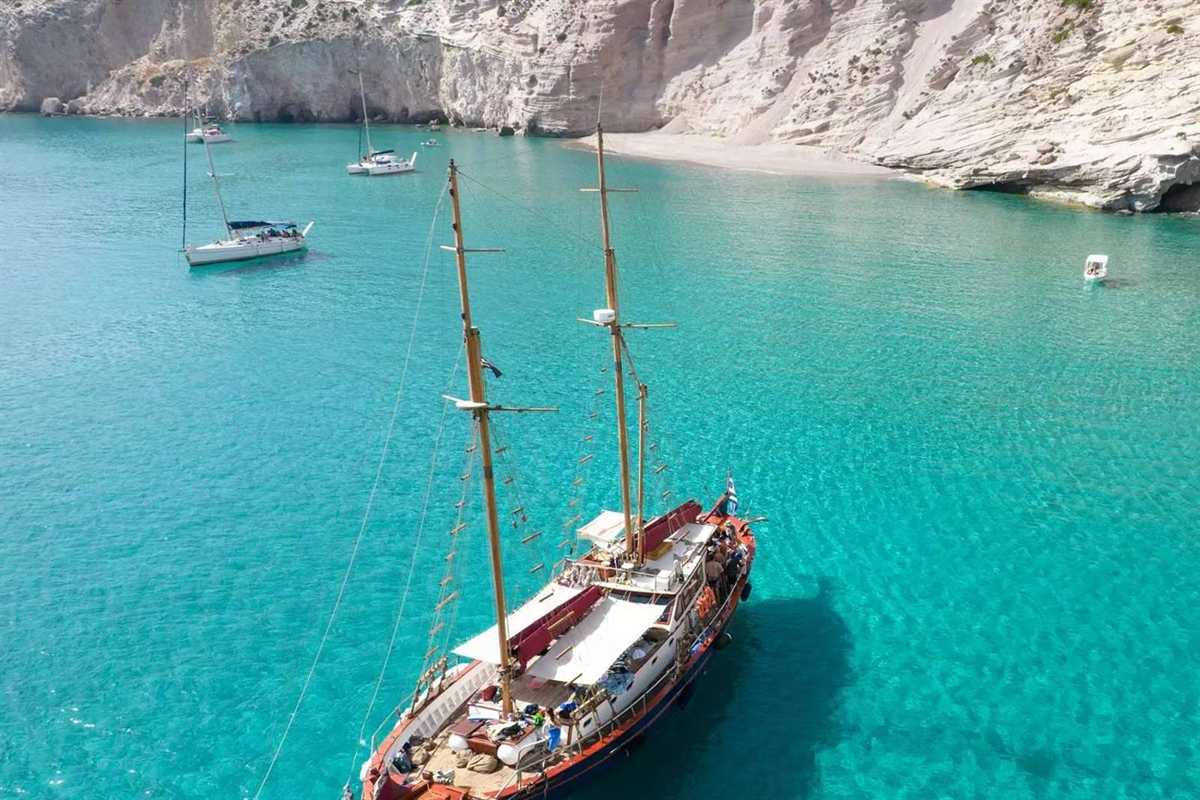
What does a Milos and Polyaigos sailboat tour show at Kleftiko?
Kleftiko is a stretch of white sea caves and tall rock arches that Wikivoyage says people reach mainly by boat. One listing says a Milos and Polyaigos sailboat tour includes swimming and snorkeling near the caves.
One operator says the name Kleftiko comes from the Greek word kleftis, meaning thief. A second operator dates the pirate hideout from the fifteenth century to the end of the seventeenth.
The first operator describes grey and white rocks in unusual shapes. It says wind and sea have carved caves and pits into them over the centuries. A third operator lists about one hour at Kleftiko for a swim and a snorkel among the caves.
Wikipedia explains that waves form a sea cave by wearing away weak zones in the rock. A cave chamber can later collapse and leave a sinkhole.
A Milos and Polyaigos sailboat tour sails along the coast of a volcanic island. Wikipedia says the volcanic activity of Milos started in the Pliocene, between two and three million years back. It lists Milos among the volcanoes of the South Aegean Volcanic Arc.
Stops beyond Kleftiko differ by operator, so each Milos and Polyaigos sailboat tour has its own list. The second operator says Sykia, in the south-west, is a cave reachable only by boat. Its roof has collapsed, so daylight enters. The third operator calls it the largest sea cave on the island.
The second operator also names Gerakas beach, reachable only by boat. It names Arkoudes, rocks at the gulf entrance that take animal shapes. It lists the Glaronisia, three rocky islets where hexagonal lava columns formed. Wikipedia shows dacite lava columns there, and says wind and water shaped the white rock of Sarakiniko.
What is the weather like for a Milos and Polyaigos sailboat tour?
The Aegean has hot, dry summers, and Wikipedia calls the Meltemi, a strong north wind, a dominant weather influence there. Sun and wind together set the conditions for a Milos and Polyaigos sailboat tour in summer.
Wikipedia classes the bulk of the Aegean as a hot-summer Mediterranean climate, where winters are mild and wet. It puts the surface water between 19 and 24 degrees Celsius when summer comes.
The Meltemi is dry and strong. Wikipedia dates its season from late spring through mid-September. It puts the strongest gusts in the afternoon, with a drop after dark. A spell can last for days.
Wikipedia warns that it can build in fine weather with no warning, up to force 7 or 8. Not every yacht or inter-island ferry can sail then. Leisure sailors, it adds, like the steady push of this wind.
Sails take power from the wind and produce lift and drag, Wikipedia explains. A sailing boat can sail upwind and downwind, but not straight into the wind. The wind therefore matters to every Milos and Polyaigos sailboat tour.
One operator calls its route open to change, depending on the weather and the call of the captain. When north winds are strong, it begins on the south coast at Palaiochori bay. When south winds are strong, it leaves Adamas and heads for the northern coast of Milos and Polyaigos.
At the Kleftiko swim stop of a Milos and Polyaigos sailboat tour, Wikipedia describes snorkeling as swimming face-down. The swimmer breathes through a tube and wears goggles or a mask and fins.
What else do travellers ask about a Milos and Polyaigos sailboat tour?
Is lunch served on board a Milos and Polyaigos sailboat tour, and what is there to drink?
One operator lists a barbecue lunch on its Milos and Polyaigos cruise, served on board after the Kleftiko swim. The same operator lists vegetarian, vegan and other food restriction options. It asks guests to mention them ahead of time.
That operator adds a light breakfast after the first dip, and dessert once the final swim stop is done. Drinks and snacks run through the cruise. Its page names an open bar, plus refreshments and ice-cold beers after the swim at Gerakas. Another operator lists a meal on board its private sailing tour from the port of Adamas to Kleftiko.
Can children join, and from which age?
One operator lists ages 2 and over and infants under 2 in the quick details of its cruise. Another listing calls a full-day cruise family friendly. It runs on a 55-foot sailing yacht to the caves of Sykia and Kleftiko in west Milos.
The exact age rule sits on the page of the chosen operator. A family planning a Milos and Polyaigos sailboat tour reads that page first.
Is swimming and snorkeling part of a Milos and Polyaigos sailboat tour, and is gear provided?
One operator lists four swim stops on its cruise around Milos and Polyaigos: Galazia Nera, Gerakas, Kleftiko and Kalogries. The operator states that its boats carry snorkeling gear for guests. Guests with a personal mask and flippers can bring them too. At Kleftiko, the same operator lists a stand-up paddleboard to try.
Wikipedia explains that a snorkel is a bent tube that lets the wearer breathe surface air, head down. A snorkel for breathing and a mask or goggles for sight make up the essential kit. The activity needs so little effort that it suits every age.
What do travellers bring and wear on the day?
For a Milos and Polyaigos sailboat tour, one operator says guests only need personal belongings. The list starts with a swimsuit and a towel, then sunscreen and a hat. It adds glasses against the strong Greek sun and a cellphone or camera.
The same operator suggests a light windproof jacket early or late in the season, when the sun starts dropping. Wikipedia notes that certain waterproof sunscreen lotions are environmentally damaging.
What happens when the wind is too strong on a Milos and Polyaigos sailboat tour?
One operator says its itineraries change with the weather conditions and at the discretion of the captain. In strong north winds the north side cannot be sailed. The operator then starts from the south side and the bay of Palaiochori. It also lists a transfer to and from Adamas port in this case.
In strong south winds, the same operator leaves Adamas and heads to the north side of Milos and Polyaigos. The captain decides the final route on the day, so a Milos and Polyaigos sailboat tour follows the weather.