
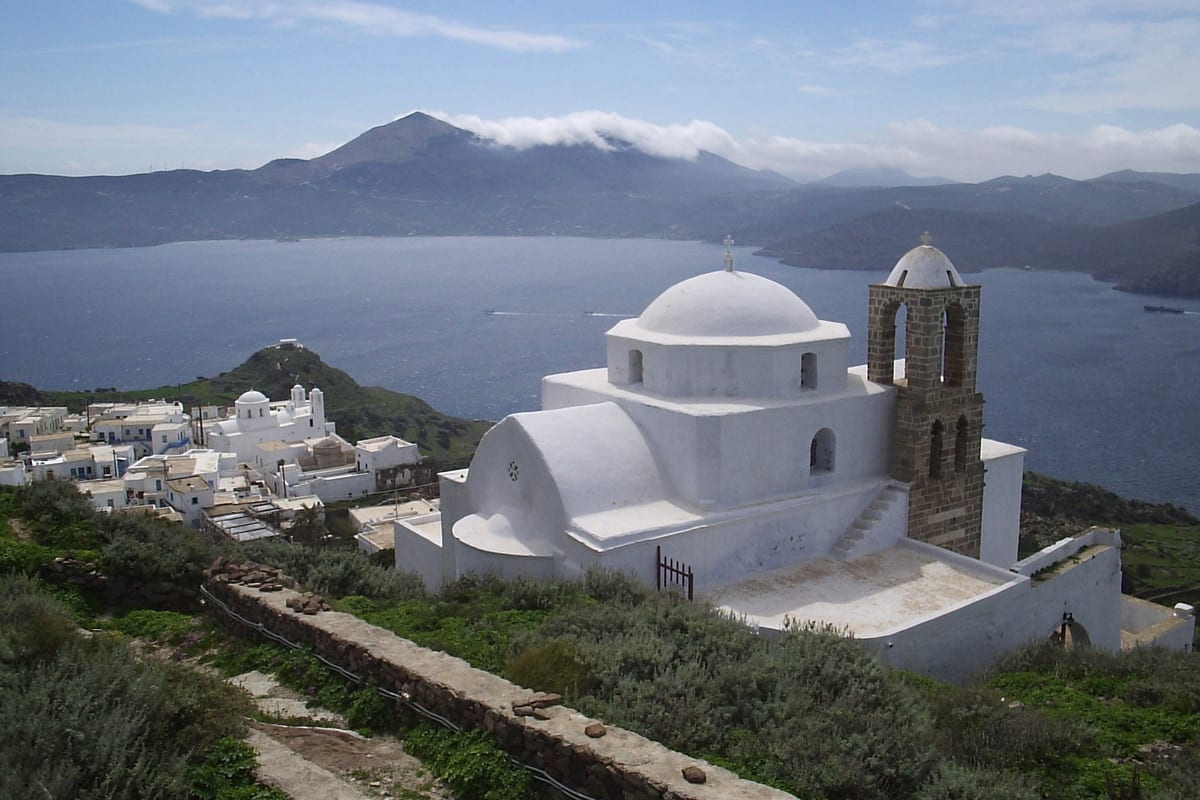
The Milos hotels stand on an island in the southwestern Cyclades, and this page explains how lodging there is arranged. Our tours in Greece page lists trips to other islands.
Below you find the places where lodging stands, the kinds of lodging, the star classes, the wind and the water, breakfast, access, pools, longer stays and short answers.
What do the Milos hotels stand on, and how large is the island?
The Milos hotels rest on a Greek island of volcanic origin, set in the Aegean Sea. Wikipedia calls Milos the southwesternmost of the Cyclades. For a visitor, that position is the first fact about any place to stay on Milos. The lodging belongs to the far southwestern end of the island group.
The official tourism site of Greece adds a second fix on the map. It places the island roughly halfway from Piraeus to Crete. That is the position every visitor to the Milos hotels shares, whichever kind of room the visitor takes. Readers who want day programmes on the island can open the Milos tours page of this site.
Wikipedia opens its article with two spellings, Milos and Melos. The article then names the Sea of Crete as the water that lies immediately south of the island. This page keeps to the spelling Milos from top to bottom. The Milos hotels therefore carry a single name in every section of this page, as the article’s own title does.
The combined land area of the municipality, says Wikipedia, comes to just over one hundred sixty square kilometres. That figure answers the second half of the question. The Milos hotels share a small stretch of land with the island’s towns and villages. The offshore islands count inside the figure, so the main island itself covers a little less.
At the latest census, says Wikipedia, the municipality of Milos counted five thousand one hundred ninety-three inhabitants. The Milos hotels thus stand in a community of about five thousand people. The article gives that figure for the municipality as a whole, not one town. Later sections of this page give the smaller counts of the towns and villages.
Wikipedia adds that the municipality takes in offshore islands as well, and it calls them uninhabited. The five thousand residents counted above therefore all live on Milos itself. That puts every town and village named on this page on the main island of the municipality. The Milos hotels of the next sections belong to those places as well.
Which kinds of Milos hotels does a visitor find on the island?
A hotel is, in Wikipedia’s wording, an establishment where a guest pays for lodging during a short stay. That plain definition is the starting point for the Milos hotels. The sections ahead take the other kinds one by one. The kind of lodging then comes down to the room, the services and the length of stay.
According to Wikipedia, every hotel gives a private room to a single guest or to a party travelling together. The article describes that room as a sleeping accommodation for guests. The article adds that hotels give their rooms numbers, and that smaller hotels and B&Bs sometimes use names. A guest of the Milos hotels finds the room by that number or name.
The article lists the facilities of a room on a scale. At one end sits a modest mattress in a small room. The large suites add bigger beds, a dresser, a refrigerator, upholstered chairs, a television and en-suite bathrooms. For a guest who starts in the capital, our Athens airport transfers page is the companion read.
Wikipedia says small hotels at the simple end of the scale offer only the plainest guest services. Larger hotels add a swimming pool, a business centre, childcare, conference space, restaurants and a day spa. The size of a property tells a reader of the Milos hotels what to ask about. It says nothing about what any one place offers.
Boutique hotels, in Wikipedia’s account, are small-capacity hotels with service tailored more closely to the guest than in other hotels. The article describes them as hotels with fewer than a hundred rooms. The label names a size and a style, not a place. The boutique kind joins the Milos hotels only as a definition, never as a named property.
The article defines an apartment hotel as serviced apartments in one complex, managed with a hotel-style booking system. No fixed contract binds the guest, so the stay resembles the rental of an apartment. This kind sits beside the Milos hotels as a separate category. A later section of this page returns to this kind in more detail.
How do the star classes of the Milos hotels work in Greece?
Before a visitor compares the Milos hotels, the word class needs a plain meaning. On Wikipedia, a hotel rating means a sorting of hotels by their quality. A star class is therefore a label that sorts one property from another by what it offers a guest. A number of schemes mark the classes with stars.
Three words name the same idea in the Wikipedia article: grading, rating and classification. A page about the Milos hotels can therefore use any one of them without changing the topic. A reader who meets another word elsewhere still sees the same sorting of hotels. Only the scheme behind the label differs from one organisation to the next.
A rating first gave plain notice of the basic facilities guests can expect. Wikipedia says the focus has since widened to the hotel experience as a whole. Points such as the size of a room, the ease of access and the location can enter a rating too. For the Milos hotels, a class therefore speaks about the whole stay.
The Hotelstars Union criteria page for Greece calls a classification a structured system with a wide range of criteria. It judges services, room features, the food and beverage offer, and leisure and event facilities. The page carries the name of the Hellenic Chamber of Hotels. A reader weighing the Milos hotels can use those four headings as questions.
Wikipedia dates the American Forbes star scheme to nineteen fifty-eight, when it first launched under an earlier name. In a scheme that uses stars, a higher grade of property carries more of them, the article adds. The article reports one criticism: a missing elevator or spa can bar a small hotel from a higher class.
The European Hotelstars system counts Greece among the countries that took it up, according to Wikipedia. It dates the step to two thousand and thirteen. Standards come from law in a number of member countries, Greece among them, according to Wikipedia. Where a page lists a star class for the Milos hotels, the standard behind it is set by law.
What do the Hellenic Chamber of Hotels criteria say about the rooms of the Milos hotels?
The criteria excerpt of the Hellenic Chamber of Hotels opens with WLAN internet access in public areas and the rooms. That line stands at the top of the general list, ahead of every other item. A reader who checks the Milos hotels against the excerpt can start with that line.
The excerpt presents its room lines as minimum criteria for rooms and bathrooms, listed apart from the general ones. The first of them lists all rooms with a shower and WC, or a bathtub and WC, and a mirror. Whoever compares the Milos hotels can put one plain question to each: which of the two does the room hold?
The room list also names a monitor with a television programme, sized to suit the room, and a remote control. The general list adds an international socket adapter and chargers with a cable or an adapter. Both lines concern the devices a traveller carries, and a reader can match them against what a room offers.
Other lines of the room list name wash lotion or shower gel, shampoo and a bath towel for the guest. Two further lines name hygiene articles on demand and an additional baby cot on demand. Readers who plan a stay among the Milos hotels can open the practical tips for Milos page of this site.
The general list also holds the housekeeping lines: daily room cleaning, with a cancellation option. The towels are changed on demand, while the bed linen is changed at least once a week. One line sets a daily rhythm, and the other splits the work between a request and a fixed minimum. Both lines describe a service, not a fitting.
There is an edge to what a reader can take from the excerpt. The criteria excerpt lists the items in groups, with no star level beside each line. The page adds a warning: its graphic of minimum criteria supports no claims. The excerpt therefore says nothing about any single one of the Milos hotels or their rooms.
How do holiday homes and villas sit beside the Milos hotels?
Holiday homes and villas sit beside the Milos hotels as another kind of lodging. Wikipedia defines a holiday home as a place used for holidays, corporate travel and temporary housing. Its definition names a length of stay of under thirty days. The same article also calls the kind a holiday cottage, as its opening line shows.
Wikipedia sets a holiday home against a hotel, and the contrast holds beside the Milos hotels too. The home is rented as a private residential unit and commonly includes a kitchen and a living area. The article describes the properties as small homes, such as cottages. A traveller enjoys it as if it were his or her own.
Wikipedia names two ways to hold a holiday property, both in one sentence. In the first, the owners use the property for a vacation themselves, and the term second home applies. In the second, an agency lets the property to holidaymakers for a stay. Only the second way matches the word rented in the definition that opens this section.
The names change from country to country, and the article lists three. In the United Kingdom the kind goes by the name holiday home or holiday cottage. Australia says holiday house, holiday home or weekender, and New Zealand says bach or crib. All of these words name one kind of lodging, which stands apart from the Milos hotels.
The villa is a kind of house, and Wikipedia traces it to ancient Rome. The earliest villa served the upper class as a retreat from city life, and it stood in the country. Once the Roman Republic had fallen, villas turned into small farming compounds. Since its Roman origins, the idea of a villa has changed a great deal.
In modern speech, says Wikipedia, the word villa covers a wide range of residences. The range runs from the semi-detached double villa of a suburb to a country house larger than average. That larger sense is found especially around the Mediterranean. Next to the Milos hotels, a villa is therefore a house of its own, not a hotel.
What do bed and breakfast houses and guest houses mean for the Milos hotels?
In the Wikipedia article, the bed and breakfast is a small place to stay. It gives the guests a bed for the night and a breakfast. A guest house is also a kind of lodging, says the same article. Both stand beside the Milos hotels as lodging in a house that has a host or an owner.
Beside the Milos hotels, one stated feature of the B&B concerns the hosts. Wikipedia says they generally live in the same house, so the hosts and the guests share one building. The article shortens the name of the kind to B&B or BnB. It adds that the Israeli name for a B&B is zimmer, the German word for room.
The label has a second use. Wikipedia says bed and breakfast also describes a level of catering. It is the level that comes with a hotel room, set against the room-only, half-board and full-board levels. So one label names a house and a meal level. This site keeps its photographs of the island in the Milos photo gallery.
Wikipedia calls the guest house a kind of lodging and gives it two meanings. One is a hotel-like lodging, as it is in the Caribbean. The other is a private home that was converted into lodging for the use of visitors only. Beside the Milos hotels, the second meaning is the one that describes a house, not a hotel.
In a guest house of that kind, says Wikipedia, the owner lives in a wholly separate part of the property. The article also adds that a guest house of this kind can work as a lodging business of its own. The result is one property with two parts: a part for the owner and a part for the visitors.
Wikipedia names one feature that marks a guest house off from a hotel: it has no full-time staff. The article adds that hotels keep a staff presence all day and all night. A guest house keeps a more limited staff presence. Beside the Milos hotels, that staff contrast is one line between a hotel and a guest house.
How are the Milos hotels in the syrmata houses of Klima built?
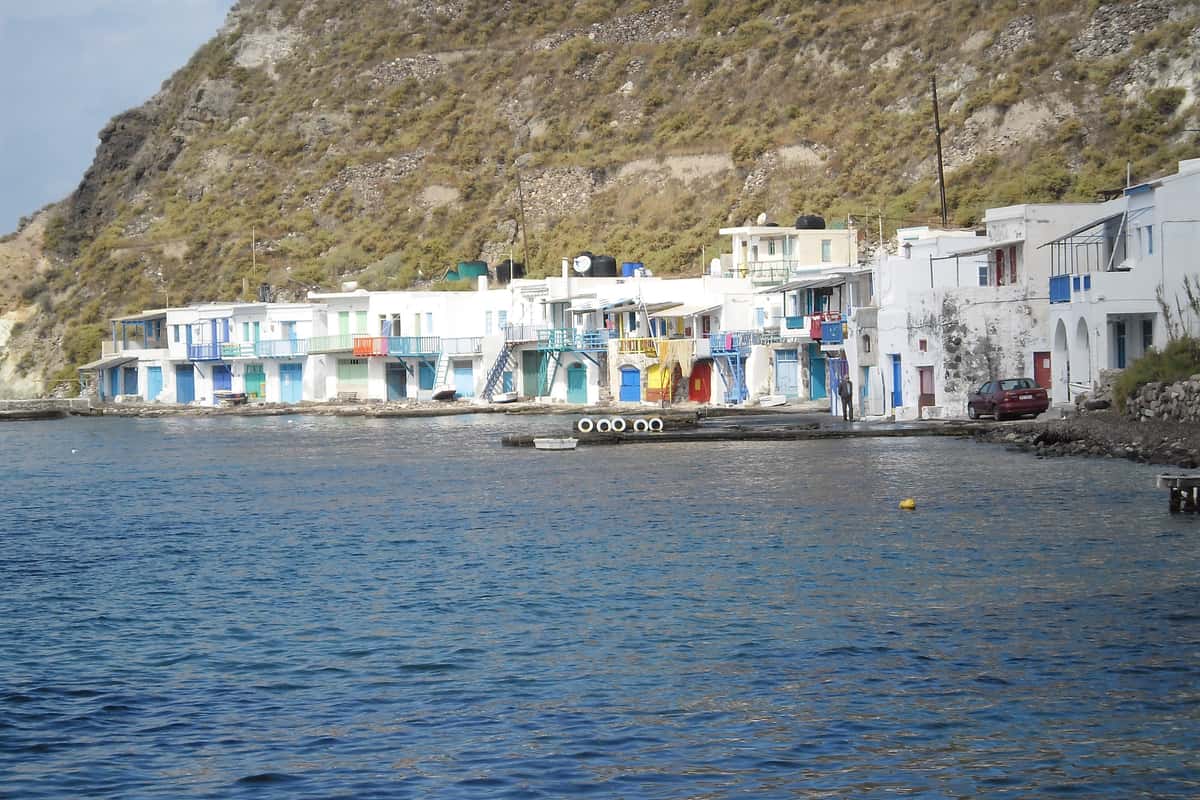
The Milos hotels in the syrmata of Klima follow the plan of an old fisherman’s house. It has two storeys, with the family living on the first floor and the boat kept below. Wikipedia adds that a group of these houses in the seaside village now serve visitors as tourist accommodation.
Wikipedia describes Klima as a seaside village of Milos in the Cyclades of Greece. It adds that the village is known for the old houses of its fishermen. They carry the name syrmata, and the article translates that word as wires. The Milos hotels of this village therefore start from a house type that has its own Greek name.
Wikipedia says the first floor of each house was the living space of the fisherman’s family. The article calls the houses two-storey, so a second level lay below that family floor. A guest can ask the host which floor holds the room and how steep the stairs are. The answer matters to a guest with heavy luggage or children.
The same article says the ground floor stored the fisherman’s boat during the winter. So in the cold season the boat stayed under the same roof as the family. For the Milos hotels in these houses, the ground floor is a fair question. A guest can ask what it holds today. The answer shows what the lower level became.
Wikipedia describes the doors and windows of the houses as colourfully painted. That detail belongs to the outside of the building, so a visitor sees it from the lane or the shore. The paint says nothing about the inside of a room. A room can face the sea or the lane, and only the host knows which one.
The word nowadays in Wikipedia marks a change of use. The houses were first homes and boat stores for the fishermen. A group of them now take visitors as tourist accommodation, which is a wider term than hotel. For the Milos hotels of Klima, one question helps: is it a hotel, a guest house or a holiday home?
Which Milos hotels in Plaka, the chief town, suit guests who arrive on foot?
For the Milos hotels in Plaka, the chief town, one rule decides the arrival. Wikipedia says no car can enter Plaka, because the spaces between the walls and the buildings are narrow. A guest therefore meets the town on foot, from the point where the road ends and the lanes begin.
Wikipedia names Plaka as the chief town of Milos, the Cyclades island, and gives its official name as Milos too. For the Milos hotels in Plaka, the shared name has a plain effect. An address that says Milos can point to the island or to the town of Plaka. A visitor can ask which of the two is meant.
Wikipedia says that motorbikes, mopeds and the like are the only usable vehicles in the town of Plaka. The words and the like leave the list open, so a guest can ask which vehicle serves a given lane. For a day trip like the Kleftiko bay sailboat cruise, the same question covers the whole walk to a vehicle.
Wikipedia lists nine hundred two residents for Plaka at the latest census. That is under one thousand, a modest size for a chief town of an island. The Milos hotels in Plaka therefore belong to a small place whose lanes the guest learns on foot. A guest can ask the host how long the lane to the door runs.
Because no car can enter Plaka, the last stretch to a door is a walk, with the bag in hand. That is a plain result of the rule, not a claim about any room. For the Milos hotels in Plaka, a fair question is where the last vehicle stops. The walk from that point to the door comes next.
Wikipedia says Plaka overlooks the gulf of Milos, so the town stands above the water. For the Milos hotels in Plaka, a view of the gulf is a question for the host. The entry gives the position of the town, and not the position of a room. A room on a lane shows another side of the town.
Which Milos hotels stand in Adamas, the harbour town and commercial centre?
Wikipedia names Adamas as the harbour town of the island of Milos and as its cultural and commercial centre. The entry names no hotel there, and this page follows it and names none either. So the answer about Milos hotels in Adamas is about the place: its role, its size and its highlights.
The Wikipedia entry gives Adamas a plain label: it is the harbour town of the island. For a visitor who studies Milos hotels, that label puts the town at the water. That is where the port of the island lies. The entry gives no street plan, no distance and no lodging fact, so the label is the whole claim.
At the latest census Wikipedia counts one thousand two hundred sixty-eight people living in Adamas. Against the population of the whole island, that is close to one islander in four. A town this size has its own residents, so any lodging there shares the streets with local life. This page gives no bed count, because its sources state none.
The entry also gives Adamas a role beyond the port, that of a cultural and commercial centre. The word commercial points to trade, so a visitor can read Adamas as the place for shops and services. A traveller who wants Milos hotels near such services can ask a host for the distance to the centre. No shop is named.
Wikipedia lists a French cemetery among the highlights and ties it to the Crimean War years. That war set Russia against an alliance of the Ottoman Empire, France, the United Kingdom and Sardinia. Britain and France both entered it in March of eighteen fifty-four. A reader who weighs Milos hotels in Adamas finds that past in the same town.
Another highlight is the church of the Holy Trinity, and Wikipedia gives it an age of six hundred years. The same list also holds two museums. Adamas is also one of the communities of the municipality of Milos, beside Plaka, Triovasalos, Trypiti and Pera Triovasalos. So a search for Milos hotels in Adamas is a search inside one community.
What do the Milos hotels in the inner village of Zefyria mean for a stay?
Zefyria is a village of Milos that lies in the interior of the island. Wikipedia ties it to farming and to an older rank as chief town. No hotel appears in the entry for the village, and none appears here. For a stay, the point about Milos hotels here is the setting of an inland village.
Wikipedia places Zefyria in the interior of the whole island, a position that sets it apart from the harbour town. A traveller who looks at Milos hotels there looks inland, away from the quay and the open water. The entry gives no road and no distance, so how far the sea lies stays a question for the host.
Wikipedia adds that Zefyria once held the rank of chief town on Milos, until Plaka took the title. That rank gives the village a past as the main town. The entry gives no date and no reason for that change of title. The past is a fact about the village, and it carries no claim about any room there.
Wikipedia says Zefyria sits in the community of Trypiti, which lies in the municipality of Milos. A traveller who compares Milos hotels meets three levels of one map: the village, the community and the municipality. A reader can check which of the three names a listing of a stay uses. This page adds nothing more about Trypiti itself.
At the latest census Wikipedia counts one hundred ninety inhabitants in Zefyria. The harbour town of Adamas counts more than six times the number. That gap is the plainest fact that separates the two places. A reader can use it to picture the scale of each place. The entry for Zefyria gives no count of beds, rooms or lodgings.
The entry closes by describing Zefyria as a largely agricultural settlement. That points to farming as the main work here, while Adamas stands for trade. A reader who weighs Milos hotels in an inner village can start from that same setting. Every other detail of a stay, from the room to the road, stays a question for the host.
How do the Milos hotels cope with the meltemi on a dry, wind-swept island?
Milos lies in the Aegean, and the Milos hotels share the weather of that sea. The Aegean has a summer wind of its own. In the Wikipedia article, north winds that are strong and dry carry the name meltemi. A visitor to Milos meets that wind as part of the setting, indoors and out.
Wikipedia dates the windy season from the halfway point of late spring to the halfway point of September. In the Aegean Basin, where Milos lies, the same article calls the winds a dominant influence on the weather. A visitor reading about the Milos hotels for those dates can count on the wind as part of the days.
The Greece Hotels page and the Cyclades Islands page give more facts. Another trip is the Milos and Polyaigos Sailboat Tour.
The wind keeps a daily schedule, Wikipedia says: its peak falls in the afternoon, and by night it settles. For the Milos hotels, that puts the windiest hours in the afternoon and the calmest hours after dark. The same terrace or window meets a different wind at three in the afternoon than at midnight.
Wikipedia notes one more habit: the wind can blow for days on end without a pause. During such a spell the wind keeps going through the night as well, and the usual calm does not come. A stay of a week can fall inside one spell. The daily rhythm is a pattern to expect, never a timetable to rely on.
Under a clear sky the wind can still rise with no notice, Wikipedia says. On the Beaufort scale, its top range sits at force seven or eight. A bright blue morning therefore says little about the afternoon wind. A visitor weighing the Milos hotels can read the forecast on the day for wind as well as sun.
Wikipedia says the wind blows from the north. Local topography shapes its exact bearing, which swings between the north-east and the north-west. The side a room faces is therefore a fair thing to ask about. A visitor can put that question to the host for any window or terrace of the Milos hotels. Only the host knows the answer.
What does the air conditioning of the Milos hotels do for a room in summer?
Wikipedia defines air conditioning as the removal of heat from an enclosed space, which makes the interior more comfortable. For a room in summer, removing that heat is the whole job of the system. A visitor reading about the Milos hotels treats the feature as a question for the host, room by room.
Wikipedia adds a second duty that applies in certain cases: control of the humidity in the indoor air. The definition therefore holds two jobs, taking heat out of a room and managing the humidity inside it. For the Milos hotels, a visitor can ask which of the two jobs the system in a room does.
Wikipedia names the mechanical air conditioner as one method of reaching this result. The article lists it first and gives the other methods after it in one sentence. A visitor who asks about air conditioning learns first whether a room has a machine of this kind. The answer separates a room with a unit from a room without one.
The article names two more methods, passive cooling and ventilative cooling. It therefore allows cooling by other means than a unit. A visitor reading about the Milos hotels meets the phrase with a wider meaning than a wall unit. A host can say whether a room relies on a unit, on one of these two methods, or on none.
In its room items, the criteria excerpt from the Hellenic Chamber of Hotels names a desk or a similar workstation. It lists a monitor with a television programme and a remote control. Air conditioning is not among the room lines of the excerpt text. For the Milos hotels, it stays a plain question for the visitor to ask the host.
A visitor reading about the Milos hotels can put three questions about air conditioning to the host. Does it have a mechanical unit? Does the system control humidity as well as heat? Does the room rely on passive or ventilative cooling? In summer, with the afternoon wind outside, the answers tell more about a room than a feature’s name.
How do the Milos hotels get their water on an island with little rain?
Wikipedia says water supply systems draw on three kinds of source. These are groundwater, which the article links to aquifers, surface water in lakes and rivers, and the sea through desalination. The article names no Milos system, so the Milos hotels appear here only against the general facts of water supply.
Wikipedia defines water supply as the provision of water by public utilities, commercial organisations, community endeavours or individuals. In the ordinary case a system of pumps and pipes carries it. The article adds that the arrangement differs by country and region, and between urban and rural areas. The Milos hotels sit inside whatever arrangement the island uses.
In its entry about tourism, Wikipedia places a Mediterranean climate over the Greek islands and coasts. It calls the summers hot and dry and the winters generally mild and wet. Southern Greece and the islands see winters considerably milder than the north does. That is a national picture for the coasts and islands, not a measure of Milos.
Wikipedia says desalination technology is especially prevalent in coastal areas and in dry countries such as Australia. Milos is an island, so it has a coast all around. The article names no Greek example, so it does not say that the Milos hotels use desalination. It shows where the method is common and gives no figure for Greece.
Wikipedia lists purification and disinfection through chlorination among the treatment steps, and sometimes fluoridation. Treated water then flows by gravity or is pumped to reservoirs. The reservoirs can be elevated, such as water towers, or stand on the ground. A guest at the Milos hotels sees none of this work directly, because it all happens before the tap.
Wikipedia says an urban system can keep its pressure with a pressurised tank, a water tower or pumps. It names continuity, water quality and water pressure among the aspects of service quality. A guest can ask a host whether the water runs all day. The question fits the Milos hotels as it fits any lodging by the sea.
What have the tourism of Greece and the Greek National Tourism Organisation done for the Milos hotels?
The Greek National Tourism Organisation is the governmental board for the promotion of tourism in Greece, says Wikipedia. The Ministry of Tourism oversees its work. A second Wikipedia article says tourism in Greece is run by this organisation. The article names no Milos project, so the Milos hotels appear here only inside the national picture.
Wikipedia traces tourism in Greece to ancient times, when Roman visitors came to Athens, Corinth and Thebes. In the nineteen sixties and seventies, says the article, tourism in the modern country started to flourish. That period became known as mass tourism, and large-scale construction projects for hotels and other facilities were undertaken. The article names no island there.
The article adds that the country saw more international tourists over the years. It says the Summer Olympic Games in Athens, held in two thousand four, boosted tourism. A large cultural project, the New Acropolis Museum, also drew visitors to the country. None of this names an island, so the Milos hotels sit in the national picture only.
Wikipedia says the Greek National Tourism Organisation was founded in nineteen twenty-nine and re-established in nineteen fifty. The article calls it a Public Entity, abbreviated PE. The body is older than the mass tourism of the nineteen sixties. Our Athens tours page covers the capital for travellers who pass through it before the island.
Wikipedia gives the mission of the organisation as developing and promoting the Greek tourism product. It does so through promotional campaigns in Greece and abroad, using a network of overseas offices. The article lists no campaign for one island, so the Milos hotels stay inside the national frame. The body also belongs to the UNWTO and the ETC.
The article lists past campaign slogans, among them “Live your myth in Greece” and “You in Greece”. Wikipedia says the advertisements on the organisation’s website still focus on sea, sun and sand. The campaign is changing, adds the article, with city breaks and conferences promoted too. The Milos hotels stand in the sea part of that national picture.
How accessible are the Milos hotels for guests with limited mobility?
Accessible tourism, Wikipedia says, aims at destinations, products and services that every person can use. Physical or intellectual limits, disabilities and age make no difference to that aim. This page claims no access feature for any of the Milos hotels. A guest with limited mobility asks each lodging directly what the access is like on arrival.
Wikipedia names three groups in the goal of accessible tourism: travellers with children, people with disabilities and seniors. The goal is inclusion of everyone. A family, a guest who walks with difficulty and an older traveller all fall inside it. For the Milos hotels, access is therefore a question for a wide circle of guests, not for one group.
Wikipedia ties the idea to the independent living movement. That movement created a demand for equal access to cities for everyone. The aim is that each person acts independently, using services and environments built on the universal design principle. A visitor can carry the same aim to the Milos hotels as one plain question: what does a lodging offer?
Article 9 of the UN disability rights convention comes closest to an international standard for accessible tourism. Its full name is the Convention on the Rights of Persons with Disabilities, adopted in two thousand and six. Wikipedia counts 164 signatories and calls it the fastest human rights treaty enacted. Article 9 covers access to every part of society.
The accommodations that follow benefit disabled citizens of the states that belong to the convention. They also improve the experience of disabled travellers and tourists, Wikipedia says. The article adds that its examples of solutions form no exhaustive list. A traveller with limited mobility who studies the Milos hotels stands inside a frame wider than one country’s rules.
The Hotelstars criteria excerpt lists general items a guest with limited mobility can ask about. One is availability for 24 hours, digitally or by telephone. Another is eight hours of physical presence at the hotel, or 24-hour self check-in and check-out. The excerpt gives no star level for these items, so each of the Milos hotels answers for itself.
What does the breakfast of the Milos hotels mean for the first meal of the day?
Wikipedia places breakfast at the head of the meals of a day, taken in the morning. The English word refers to breaking the fasting period of the previous night. The breakfast of the Milos hotels is a question for each lodging. This page claims no menu, no hour and no dish.
Wikipedia says the Old English name for a regular morning meal was morgenmete. The word dinner comes from the Gallo-Romance desjunare, meaning to break a fast, and first named a meal after fasting. That sense of dinner faded around the middle of the thirteenth century. Around the fifteenth century breakfast entered written English for the morning meal.
Menus differ by region and tradition, and Wikipedia gives examples. French breakfast pastries include brioche, croissant and pain au chocolat. A Dutch breakfast is bread with cold cuts, cheeses and sweet toppings. In Japan, miso soup and rice porridge are common. A guest at the Milos hotels who wants a local morning table asks what each lodging serves.
Wikipedia says French breakfasts resemble the continental breakfast. The Hotelstars criteria excerpt lists a continental breakfast with allergen-friendly products among the general items of a hotel. It names no star level for this item, so no class is implied. A guest with an allergy can ask the Milos hotels which products on the morning table suit a diet.
The excerpt also names a morning buffet, or an equivalent breakfast menu. One line adds a staffed buffet, and another a buffet with waiter service, each with an equivalent menu. A breakfast menu in room service is listed as well. This page ties none of these lines to a star level or to the Milos hotels.
Wikipedia says classical Greek writers knew pancakes called tagenias, a word that comes from the frying pan. The earliest references are in the works of the poets Cratinus and Magnes, from the fifth century BC. Athenaeus mentions staititas topped with honey, sesame and cheese. Whatever the Milos hotels serve in the morning joins that long Greek line.
Where do the Milos hotels stand among the islands of the Cyclades?
The Cyclades lie in the Aegean Sea’s centre, and the Milos hotels stand on the southwestern edge of that group. Wikipedia calls Milos the southwesternmost island among them. The article describes the group as large but dense. The island therefore marks one far corner of the whole archipelago on the map.
A visitor who studies the Milos hotels meets a large archipelago before any single island. Wikipedia counts around 220 islands and islets in the entire Cyclades. The article adds that no one lives on the greater part of the smaller islands. Milos appears in the article’s list of the major islands, and that list names twenty islands in all.
Wikipedia lists Santorini among the major islands and gives Thira as its other name. Two islands of the group are volcanic, Milos and Santorini. The article describes the others as summits of a mountainous terrain under the sea. A reader who wants to compare the two islands can open the page about Santorini tours on this site.
The official tourism site of Greece places Milos roughly midway between Piraeus and Crete. In Wikipedia’s ranking, Crete is first among the Greek islands for area and for population. On the south, the Cyclades end at the Sea of Crete, says Wikipedia’s article on the group. So the Milos hotels stand near that southern limit of the group.
Greek islands fall into traditional clusters, says Wikipedia. Athens has the Saronic Islands close by, in the gulf of that name. A loose group of North Aegean islands lies off the Turkish west coast. The Dodecanese, another loose collection, lie between Crete and Turkey in the southeast. The Milos hotels belong to none of these but to the Cyclades.
The Sporades form a small tight group off the coast of Euboea. In the Ionian Sea, chiefly off the western mainland, sit the Ionian Islands. Estimates of the number of Greek islands run from around 1,200 to 6,000. The count depends on the minimum size, so the Milos hotels sit on one island in a long national list.
What is a swimming pool at the Milos hotels, and how is it built?
Anyone who reads a plain description of the Milos hotels meets the word pool. Wikipedia defines it as a structure designed to hold water for swimming and for related activities. The article also gives swimming bath, wading pool and paddling pool as other names for the same kind of structure.
Wikipedia says a pool can be built into the ground, as an in-ground pool, or stand above ground. An above-ground pool can be a separate construction or part of a larger structure. The article adds that a pool can sit aboard a ship. A visitor who asks about a pool at the Milos hotels can name the kind meant.
The article lists fiberglass, composite, plastic, metal, natural stone and concrete as materials for in-ground pools. A pool can follow a standardized size, and the largest of those sizes is the Olympic-size pool. The other path is a custom shape. A plunge pool, the article says, is a smaller swimming pool that is installed permanently in one place.
A number of hotels have a pool for the use of their guests, says the Wikipedia article. The article adds that hotel pools are found more frequently in tourist areas and near convention centres. That line names no island, no country and no town. It states a general pattern and says nothing about any one of the Milos hotels.
Wikipedia says chlorinated water and salt water are the common choices for a pool. The water can be heated or unheated. Levels of bacteria and viruses must be kept low to prevent the spread of diseases. Pumps, mechanical sand filters and disinfectants sanitise the water. Chlorine and bromine are the two chemical disinfectants the article names as examples.
Wikipedia warns that pools pose a risk of drowning, higher for young children. It says a number of jurisdictions require fencing around a residential pool. The article places diving in the deepest point of a pool. A family that weighs the Milos hotels can ask each lodging how its pool is fenced. Another question is who watches the water.
How do apartment hotels and hostels fit the Milos hotels for long and short stays?
The stay in an apartment hotel, Wikipedia says, runs from days up to months or even years. That span is wide enough to cover both a short visit and a long one. For the Milos hotels, that range is the first fact a traveller needs to learn about this kind of lodging.
Wikipedia gives this kind of lodging four names: apartment hotel, aparthotel, residential hotel and extended-stay hotel. A traveller who reads about the Milos hotels by kind meets all four names, and they all mean one thing. Serviced apartments sit together in one complex, and a booking system of the hotel type serves the whole complex.
Wikipedia says the arrangement resembles a rented flat, but the guest signs no fixed contract. The occupants can check out whenever they wish. The one limit is the minimum length of stay, set by the company that runs the complex. A short stay and a long stay therefore sit in the same lodging, and only that minimum separates them.
Wikipedia says an apartment hotel offers a complete apartment that is fully fitted for the guest. Custom building is the norm for these complexes. The article likens them to a hotel complex that holds a varied number of apartments. The extended-stay form has kitchens with a stovetop, a microwave oven, a refrigerator and a sink at the least.
Apartment hotels began in holiday destinations, the article says, as lodging for families. These families needed an apartment to live in, not a hotel room to stay in. The apartments served as a holiday home, and the complex generally serviced them. For readers of the Milos hotels, the family origin shows what the kind was first made for.
Later the apartments grew into complete homes, Wikipedia says, where occupants clean, wash and cook as they do at home. The people who stay there use the complexes as long-term accommodation. The buildings are therefore fitted with the things that an average home needs. For the Milos hotels, this makes the apartment hotel the long-stay kind of lodging.
What does a hostel mean for the Milos hotels for guests on a budget?
Wikipedia defines a hostel as a form of low-cost, short-term shared lodging. A guest rents a bed there, for example a bunk in a dormitory that sleeps four to twenty people. Among the Milos hotels, this is the kind built on shared space and open to a traveller on a budget.
Guests of a hostel share more than the dormitory. The article names a lounge and a kitchen that guests use in common. It lists board games, books, computers and internet access beside the sofas, chairs and coffee tables of a lounge. For the Milos hotels, the hostel is a lodging built around common rooms. Guests meet in the lounge.
A hostel offers private or shared rooms, and a shared room can be mixed or single-sex. The bathrooms can be private or shared too. The article adds that a hostel gives less privacy than a hotel. A guest who needs more privacy can find shared sleeping areas uncomfortable. The sharing also makes it easier to meet new people.
A hostel can also store luggage, run a laundry service and supply lockers, food and drink, the source says. Nearly all of them hold a shared kitchen and a storage area with refrigerators. A label system marks the owner of each item of food. These shared extras matter to guests who weigh the Milos hotels on a budget.
Wikipedia calls the hostel a sociable lodging, popular with backpackers and youth travel. A greater part of the hostels do not impose age limits. The article lists the benefit of meeting people from other places and of finding partners to travel with. A reader who sorts the Milos hotels by company finds the hostel at the shared end.
The typical guest, the source says, is between sixteen and thirty-four years old, although the figure can vary by country. For the Milos hotels, that number is a general figure from Wikipedia, not a count of the island’s guests. A hostel can also keep a curfew and a daytime lockout, and it can leave out the bed linen.
What else do visitors ask about the Milos hotels?
What do the criteria of the Hellenic Chamber of Hotels say about the reception and the check-in at the Milos hotels?
The criteria excerpt of the Hotelstars Union, shown for the Hellenic Chamber of Hotels, opens with the general hotel items. One item asks for availability around the clock, digitally or by telephone. A reader who studies the Milos hotels takes that line as a rule about contact. It does not promise a person at a desk all night.
The next item gives a choice. A hotel offers eight hours of physical presence on the premises. The other route is self check-in and check-out around the clock. The excerpt joins the two with the word OR in capital letters. A later category lists ten hours of physical presence, or eight hours together with the round-the-clock self service.
One category lists a reception service of fourteen hours that stays physically available all day and night. The category with the ten-hour rule adds bilingual front-line staff and a central safe, for example at reception. The excerpt names no star level beside each line, so a guest asks the host which line applies.
The block with the fourteen-hour reception lists a lobby with seating and beverage service. On the same line stands the alternative of a hotel bar or lounge area. A bar or lounge area with service on at least five days a week follows. For the Milos hotels, such lines describe the space around the front desk.
What do the crater, the goats and the old stories of Antimilos tell a reader of the Milos hotels?
Wikipedia places Antimilos thirteen miles north-west of Milos, the island that gives the Milos hotels their setting. The Milos article calls its island volcanic, and the Antimilos article gives the same description. The crater of Antimilos is still obvious, that article says. It also gives the height of Antimilos as 671 metres.
A rare variety of the common goat lives on Antimilos, according to Wikipedia, on an island with no residents. Its Latin name is Capra aegagrus pictus. The article calls the animal similar to the Cretan goat known as kri-kri, but not the same. The Cretan goat carries the Latin name Capra aegagrus creticus.
An interpretation of the Odyssey links Antimilos to Helios, the sun god. In that story the companions of Odysseus slaughtered his sacred cattle there. Wikipedia adds two older names, Ephyra and Ephora. The second name means watchtower, because a watcher on the highest point can look at the sea over long distances.
The picture at the head of the Antimilos article shows the island as seen from Milos. The article also lists the name Erimomilos, with the English meaning Desert Milos. It names trachyte as the rock that forms the island and counts Antimilos in the Cyclades group. It gives the Modern Greek pronunciation of the name too.
What are Antimilos and Akradies in the municipality of the Milos hotels?
A reader of the Milos hotels meets the names Antimilos and Akradies in the opening of Wikipedia’s article on Milos. The article calls them the uninhabited offshore islands of the municipality of Milos, which holds the main island as well. The separate article on Antimilos repeats that the island is, administratively, part of that municipality.
Nobody lives on Antimilos now, yet Wikipedia reads signs of earlier settlement there. Walls and arrowheads made of obsidian were found on the island. The article therefore says that settlement in prehistoric times can be assumed. Prehistoric means that the finds belong to the time before written records existed, long before the Roman period.
The crater of Antimilos also shows how people handled rain. Wikipedia says that ancient inhabitants transformed the crater into an open rain tank. The article adds remains of a cistern, a closed store for water. It places the origin in the Roman or early Christian period, with a measure of doubt.
The information box of the Antimilos article names the South Aegean as its region and Milos as its regional unit. It lists a population of zero at the census of two thousand and one. The article ends with a link to the municipality’s official website. The island of the Milos hotels names that regional unit.
What does the air conditioning and the humidity of a room mean for the Milos hotels in summer?
Summer is the season when tourists favour Milos, Wikipedia says. A reader of the Milos hotels meets the heat of a room in that season. The article on the process explains the aim of air conditioning. It is a more comfortable interior, gained by removing heat from the room. Humidity control is a further task in certain cases.
The same article lists heat stroke among the dangers that cooling prevents in hot weather. Heavy sweating can lead to dehydration, and electrolyte imbalance and kidney failure also appear on its list. Indoors, the temperature stays fairly constant, whatever the weather outside does. Wikipedia says this lets people live comfortably in hot regions.
Wikipedia traces air conditioning back to prehistory. Double-walled living quarters with a gap for air flow were found in the ancient city of Hamoukar, in modern Syria. Ancient Egyptian buildings also used a wide variety of passive techniques. For the Milos hotels, passive cooling therefore means an old idea, not a new machine.
A heat pump is similar to an air conditioner but has a reversing valve, so it heats and cools. The United Nations has asked for more sustainable cooling. It also names alternatives: evaporative cooling, selective shading, windcatchers and thermal insulation. A guest who plans a stay among the Milos hotels asks which of these a room uses.
What do the criteria of the Hellenic Chamber of Hotels say about bathrobes, slippers and the ironing at the Milos hotels?
One category of the criteria excerpt lists a bathrobe and slippers on demand. It also names a choice of pillows, comfortable seating with a side table and generous storage space in the bathroom. It adds an additional change of bed linen on demand. A visitor who compares the Milos hotels can turn that list into questions.
Another category of the excerpt places the bathrobe and the slippers in the room itself. It lists an iron or a steamer with an ironing board on demand, or else an ironing room. It sets a mattress width of at least ninety centimetres for a single bed. For a double bed the width is one hundred eighty centimetres.
A service block of the excerpt lists ironing, a shoe shine and a sewing service. Another category names washing and ironing of guest laundry and a wake-up service. These lines describe what a hotel provides, not what a guest does. The excerpt itself adds that its graphic gives no basis for claims.
The same service block lists a valet parking service, a concierge and a luggage service. It names a shuttle service or a limousine service as well. A restaurant open seven days a week appears in the same block. The block also pairs a minibar with food and drinks in room service around the clock.