
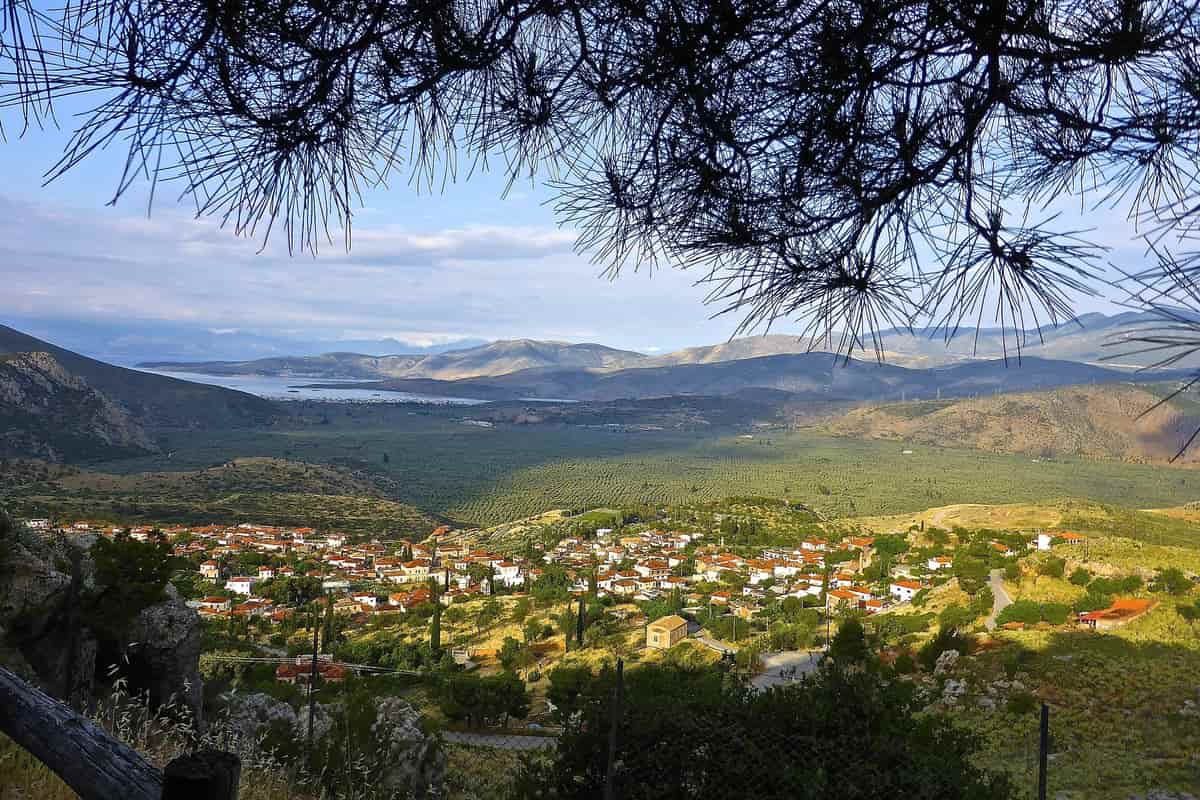
Delphi hotels stand around the sanctuary town in Phocis, on slopes above a wide olive valley. For tours and day trips from Athens, see our tours in Greece page.
Below you find the kinds of lodgings, how Greece grades them, where they sit, the views, the way from Athens, the season, and short answers to common questions.
What kinds of Delphi hotels are there today?
The Delphi hotels are town lodgings for visitors to the archaeological site. Wikivoyage says the hotels of the town cater mainly to package tours. Two Wikipedia terms, mountain resort and guest house, name other kinds of lodging in a hill area.
According to the same travel page, the lodgings of the town earn their living chiefly from package tourists. Anyone planning a day around the ruins can read about Delphi tours on another page of this website. The sections below stay with the lodging itself: its kinds, its grades, its places and the road to it.
Wikivoyage also says that the greater part of the guests stay a single night before they visit the archaeological sites. In that account, one night is the usual stay at the Delphi hotels. A traveller who wants two days at the ruins can ask a hotel about a second night. Can the same room stay for both nights?
The same page adds that the hotels of the town fill up during weekends and public holidays. It names Easter as one example of those days. A visitor with fixed dates can ask a hotel which days of the season are busy. A short break leaves little room to move the dates, so this question comes first.
Wikipedia defines a mountain resort as a place to holiday in an elevated and at least relatively isolated area. It adds that hill and mountain resorts in hot climates are visited for the cooler temperatures found at height. Delphi stands on the south-west flank of Mount Parnassus, so height is a fair question for the Delphi hotels.
Wikipedia describes a guest house as a kind of lodging. In one region it resembles a hotel; in another it is a private home converted for visitors. Wikipedia says a hotel keeps staff present all day; ask about the front desk. The old entry groups its lodgings by class; the next section covers how Delphi hotels are graded.
How are Delphi hotels graded in Greece?
Wikipedia says that Greece sets standards for hotel classes by law. The year Wikipedia gives for Greece taking up the Hotelstars scheme is two thousand and thirteen. A visitor can ask any of the Delphi hotels which class it holds and which criteria its rooms meet.
Wikipedia explains that European hotel associations drafted a shared classification system in order to harmonise their national standards. A number of the countries in that scheme set those standards by law, and Greece is one of them. For the Delphi hotels, a grade therefore rests on Greek rules, not on the wish or label of a hotel.
The Hotelstars system began when hotel associations of seven countries created a union. Wikipedia lists the countries that joined later, with Belgium, Denmark and Greece all given for two thousand and thirteen. A traveller who stops in the capital first can read about Athens accommodation on a page of this site. The grading question comes up there too.
The Hotelstars criteria catalogue says that a classification judges a property on a wide range of points. These cover services, room features, the food and drink offer, leisure and event facilities, and online or quality activities. The text speaks to hoteliers who want a class, so a visitor who compares Delphi hotels sees only the result.
The catalogue shows a graphic of the minimum criteria for rooms and bathrooms in each class. It adds that no claims can be derived from that illustration. The picture gives a first impression of the standards, not a promise about one room. A class is a starting point for a visitor, not a verdict on the whole stay.
Three plain questions help a visitor read the class of any of the Delphi hotels. Which criteria do its rooms meet? When was the class last checked? Which entry stands today in the Greek register for the hotel? A hotel can answer all three from its own papers. The answers belong in the visitor’s notes before the stay.
Where are Delphi hotels placed around the town and the road?
Delphi hotels stand in the small modern town beside the ancient sacred precinct. Two more bases of the area lie within reach by car along the same national road. They are Arachova, higher up the mountain, and the seaside town of Galaxidi.
Wikivoyage describes the modern town of Delphi as compact enough that a visitor needs no transport but walking. A walk from the town reaches both the museum and the ruins, and taxis are readily available there. So Delphi hotels in the town keep the museum and the site within a short walk.
Wikipedia explains that the modern town arose once the precinct had been emptied of buildings for excavation. It places the two Delphis, old and new, on Greek National Road 48. That road links Amfissa, to the west, with Livadeia, the capital of Boeotia, to the east. Ask the hotel how far its door stands from that road.
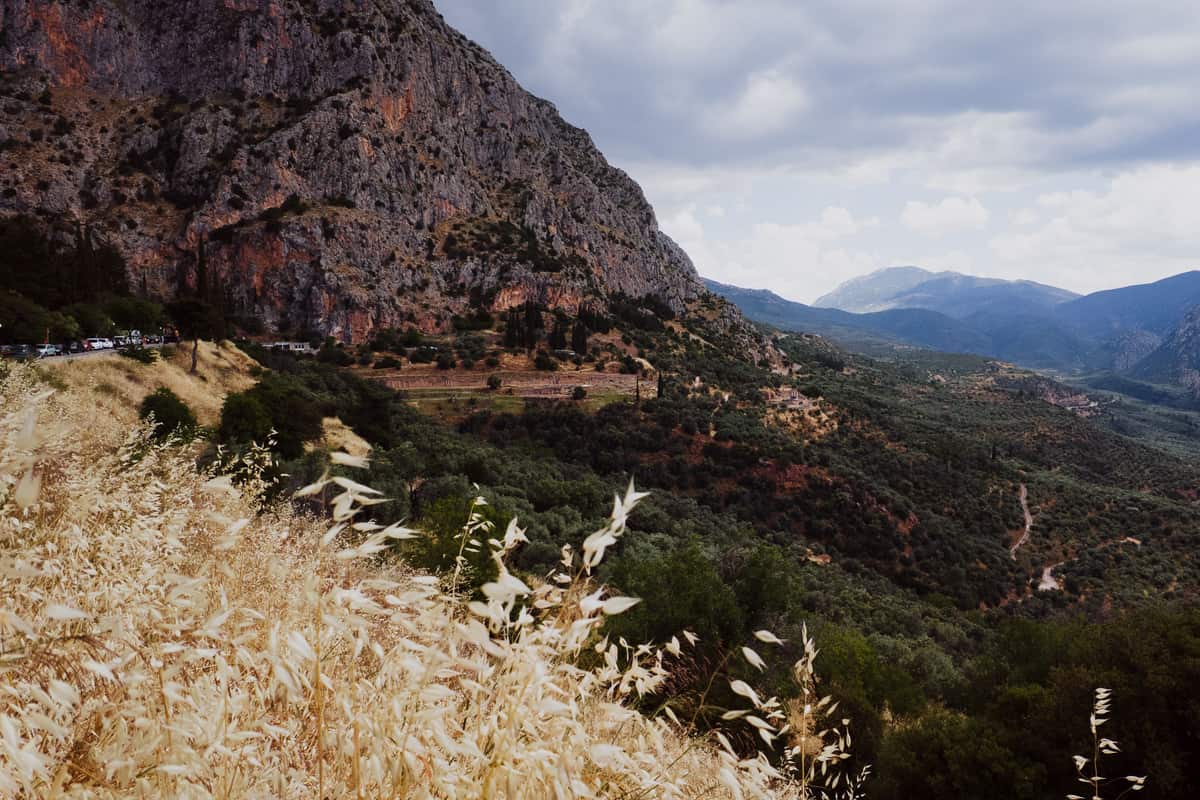
Wikipedia has the road keep to the north side of the Pleistos pass, where the river flows east to west. The river drains the valley named after it, a relatively recent rift valley north of the Corinthian Gulf. Anyone weighing Delphi hotels along that road can ask each hotel about steps and gradients at its entrance.
Wikipedia places Arachova 8 km to the east of Delphi. The town sits at an elevation of about 970 metres, on the south-facing side of Mount Parnassus. The same article places it in western Boeotia, just outside the Phocis region. Anyone choosing a room in Arachova can ask how long the drive to the site takes by car.
One Wikivoyage page on Galaxidi says Delphi is about 30 minutes away by car. The same page adds that frequent strikes make a car the better choice than the bus. Wikipedia says Greek National Road 48 connects Galaxidi with Nafpaktos, Itea and Delphi. Delphi hotels and the Galaxidi coast are therefore two bases linked by one road.
What do the views from Delphi hotels take in?
Wikivoyage says that certain rooms in the town look out over the Corinthian Gulf and the olive groves of Itea. The views from Delphi hotels can therefore take in the gulf, the olive groves and the slope of Mount Parnassus.
Wikivoyage says the foothills of Mount Parnassus are covered with an estimated nine million olive trees. Wikipedia adds that the olive groves of the Pleistos valley carry the nickname the sea of olives. The article says they reach back to prehistoric times. A visitor weighing Delphi hotels can ask whether a window looks onto the groves.
Readers can also open the Greece Destinations page or the Greece Hotels page. For a change, read the Greek Islands Cruises page, then the Greece Travel Information page.
Wikipedia treats the Gulf of Corinth as a branch of the Ionian Sea, set between two land masses: the Peloponnese and western mainland Greece. On travel pages the same gulf appears as the Corinthian Gulf, the water that certain rooms overlook. Wikipedia lists Galaxidi, Itea and Kirra as the Phocis towns that lie beside the gulf on its northern side.
Wikipedia gives Mount Parnassus, a range in Central Greece, an altitude of 2,457 metres, with Liakoura as its highest peak. The article ranks the range among the largest mountainous regions of mainland Greece and among the highest Greek mountains. Wikivoyage places Delphi on its southwestern slope, so a visitor weighing Delphi hotels can ask which windows face uphill.
Wikipedia calls Arachova a mountain town and says it has a panoramic view. Its small houses stand uphill, and its streets are cobbled. The same article says the town centre includes a huge and steep cliff. A stay there means a slope, so a visitor can ask how steep the way to the room is.
Wikipedia notes the spacious houses of the traditional settlement of Galaxidi. It says that the preservation of this traditional architecture has helped tourism to grow in recent decades. Wikivoyage adds that the streets there are narrow. A visitor who compares Delphi hotels with Galaxidi can ask whether a room faces the old houses or the sea.
How do travellers reach Delphi hotels from Athens?
A traveller reaches Delphi hotels from Athens by intercity bus in about three hours, according to Wikivoyage. The same page names the bus terminal in Athens and warns drivers of hairpin turns. Travellers from Meteora change buses at Lamia and Itea.
A guest of Delphi hotels on the intercity bus starts at Bus Terminal B. Wikivoyage calls it tricky to find, because it stands off a main road and local buses skip it. A city bus to Liosion Street drops a traveller around number 260. From there the walk goes to the parallel street, Agiou Dimitriou Oplon.
Wikivoyage advises buying the return ticket one day ahead. That avoids a sold-out bus and leaves time to find the terminal. It lists departures from the morning into the evening and warns that times change, so check the current schedule. A traveller who lands at the airport first can read about Athens airport transfers elsewhere on this site.
A traveller from Meteora or Kalambaka changes buses at Lamia and again at Itea. Wikivoyage says Lamia has one, two or no buses a day to Delphi, so a traveller plans ahead. A guest can ask the Delphi hotels how a late arrival works. Another page joins both places in one trip: Delphi and Meteora two day tour.
Wikivoyage says a driver can reach Delphi, but the hairpin turns pull attention from the scenery. Finding a parking space is hard, and traffic jams the narrow roads. Its advice is to let someone else do the driving. A traveller weighing a car can start with car hire on a separate page, then ask the hotel about parking.
In the town, Wikivoyage describes taxis as readily available, so a guest with bags can ride the last stretch. A guest of Delphi hotels can ask which stop is nearest and how far the door is on foot. One visitor page gives 180 km as the distance from Athens to Arachova, the mountain town nearby.
When is the season for Delphi hotels, and what lies near?
Wikivoyage calls the country around Delphi hotels nice for hiking and cycling, above all in spring and autumn. The museum has a summer season and a winter season. North of Delphi, a walker finds the Corycian Cave in the mountain range of Parnassus.
The region around Delphi hotels is mountainous, with narrow roads, according to Wikivoyage. The page gives the heat of summer as the reason that hiking and cycling suit spring and autumn better. Wikivoyage adds that a number of hostels rent bicycles. One question for the hotel is which walking routes begin near the front door.
Wikivoyage adds that the archaeological site lies in the open air, so summer brings hot sun and tourist crowds. One information site for the museum names two times that avoid the crowds. They are the early morning, before ten, and the late afternoon, after four. The same site says organised tour groups are rare at weekends.
One museum information site lists a summer season that runs from April the first to October the thirtieth. Winter starts on the first of November and ends on the thirty-first of March. Summer days run into the evening and winter days end in the afternoon. A guest of the Delphi hotels checks the current times before the visit.
The Corycian Cave lies within Parnassus National Park, north of Delphi, on the slope of Mount Parnassus. Wikipedia says people have held the cave sacred since the Neolithic era. Its name comes from the Corycian nymphs, nature spirits of myth who were said to live in the cave. The cave sits 1,250 metres above sea level.
Wikipedia adds that tourists hike past the cave on the ancient trails that lead up Mount Parnassus. The climb gives walkers a wider outlook across the Livadi Valley below. A guest of the Delphi hotels can ask which trail heads lie near the town. For the capital before the drive, a separate page covers Athens tours.
What else do travellers ask about Delphi hotels?
What does a guest of Delphi hotels learn about the Pythian Games?
A guest of Delphi hotels stays beside the place where the Pythian Games were held. Wikipedia lists them among the four Panhellenic Games, held once in four years, midway between two Olympic Games.
A hymn to Apollo was the first contest held at Delphi, Wikipedia says. Athletic events came later, and women were admitted as competitors in sport and in the arts. Olympia held a separate festival for women.
A winner received a wreath of bay laurel as the only reward, Wikipedia says. Thessaly’s Vale of Tempe supplied the laurel, which was sacred to Apollo. Records from Aristotle give six to eight days for the whole festival.
Can a guest of Delphi hotels go skiing on Mount Parnassus in winter?
In winter, Wikipedia says, skiing is possible across the entire Parnassus range, especially around the resorts of Arachova. A guest of Delphi hotels therefore finds the town and the slopes on one mountain.
The ski centre’s own information page gives the layout. Two skiing areas, Kellaria and Fterolakas, hold 34 km of trails in total. The page counts 21 pistes, 7 ski routes and four mini pistes with baby lifts. The descents run between 2,260 metres and 1,640 metres.
From a number of points the page lists the Euboean Gulf and the Gulf of Corinth as views. The same page puts the centre 196 km from Athens, about two hours by car. A guest checks the current status of the slopes before any trip.
How far is the Osios Loukas monastery from Delphi hotels?
Wikivoyage places the Osios Loukas monastery about 20 km southeast of Delphi, near the town of Distomo. A guest of Delphi hotels plans it as a separate outing and asks about the drive time.
Wikipedia describes Osios Loukas, spelled Hosios Loukas there, as a walled monastery near Distomo in Boeotia. It dates the founding to the middle of the tenth century. UNESCO has listed it since nineteen ninety, with Nea Moni and Daphnion.
Wikipedia names the hermit Luke of Steiris as its founder and says his relics remain there. Among those three monasteries, only this one honours a single military saint. Pilgrims hoping for healing once slept beside the tomb.
What did the ancient sources call the Gulf of Corinth near Delphi hotels?
Wikipedia says the ancient sources point to an earlier name for the Gulf of Corinth, the Krisaean Gulf. Krisa was an ancient town on a spur of Parnassus, and it once ruled the whole valley system.
Krisa and Corinth were both Dorian states, Wikipedia notes. It calls the gulf a kind of Dorian lake. The Dorians had been moving into the Peloponnese since about one thousand BC. In Mycenaean times Krisa was a major power on land and at sea.
States of southern Greece broke the power of Krisa in a dispute over access to Delphi, Wikipedia says. The Amphictyonic League, an association of states with a stake in Delphi, then took control. The gulf was then given the name of Corinth.
What does the name Delphi mean for a guest of Delphi hotels?
Wikipedia says the name Delphi shares its root with delphys, the Greek word for womb. The article adds that this link can point to an early worship of Gaia at the place.
Wikipedia reports a tale from the Suda: the she-serpent Delphyne lived at the site and gave Delphi its name. Another version puts a male serpent, Python, in her place. Wikipedia adds that Pytho was the earlier name of the site in legend.
Wikipedia calls Delphi a municipality of Greece and a modern town. An address that says Delphi therefore leaves a question open. A guest of Delphi hotels asks whether the hotel stands in the town or elsewhere in the municipality.