Delphi tours take a traveller from Athens up into the mountains of Central Greece to the sanctuary of Apollo, where the oracle once spoke. For other routes, see our tours in Greece page.
This page covers what Delphi tours include, how long they take from Athens, the Sanctuary of Apollo, the Delphi museum, the villages near Mount Parnassus, the combined tours with Meteora and the questions travellers ask.
What do Delphi tours include?
Delphi tours take visitors out of Athens to the ancient sanctuary of Apollo with a licensed tour guide. The group rides a coach or a car. The trip centres on the archaeological site and the Delphi museum.
On Delphi tours the group walks in the footsteps of pilgrims on the Sacred Way. It stands before the Temple of Apollo. Pilgrims came here to hear the prophecies of the oracle. The commentary covers the history and the myths of the sanctuary, so the ruins come with a story.
The museum is the second stop. It holds statues, reliefs and everyday objects found at Delphi. Visitors link what they see inside with the ruins outside. Whether entry tickets are included depends on the option chosen.
Delphi tours bring sound to the day. The tour guide talks live during the drive, and one trip hands out headsets for clear commentary. Another offers commentary in 10 languages. A ticket-only option replaces the live tour guide with an audio guide for the site and the museum.
One coach trip adds a stop in Arachova. The village has narrow streets, cafes and local shops. Guests explore it on their own before the drive back to Athens.
Food is an add-on. One trip lists an optional lunch at a Greek restaurant. The coaches on these trips are air-conditioned, and one trip also offers onboard Wi-Fi.
The way the day is run changes from trip to trip. A coach leaves from central Athens, and one trip picks guests up at four central stops. Another caps the group at 15 guests and uses a minivan with hotel pick-up. A private car or van is also offered. Browse them among our tours and cruises.
How long do Delphi tours take from Athens?
The drive from Athens to Delphi lasts roughly two and a half hours in each direction. Delphi tours that run as day trips fill a whole day. Longer trips add a night away from the capital.
The archaeological site sits in the prefecture of Fokida, 180 km west of Athens. The sanctuary climbs the southern slope of Mount Parnassus, so the trip ends in the mountains of central Greece. Day trips are round-trip, and the coach brings the group back to Athens the same day.
The Athens visitors bureau calls Delphi an easy two and a half hour road trip. Intercity buses from Athens need about the same time. The drive back takes time too, and one operator lists about three hours for the ride from Delphi to Athens.
That is why a day trip is long. Delphi tours of one day mix road time and walking time. The group spends hours on the road, then walks the site and visits the museum. The paths at the site run over uneven surfaces, so comfortable shoes help. Guests also need a hat and sunscreen in the sun.
One operator lists ten hours for its one-day trip. For a single day, look at the Delphi day tour.
Operators also sell trips of two days, with a hotel night and a tour guide for both days. Anyone who wants more than one day can read about the two-day Delphi tour. A tour guide stays with the group for both days.
Delphi tours differ in length and in theme. Anyone who prefers a classical theme can see the Delphi classical tour.
What do Delphi tours show at the Sanctuary of Apollo?
Delphi tours walk the Sacred Way up through the Sanctuary of Apollo. There the Pythia answered questions before wars and the founding of colonies. The precinct clings to the south-west side of Mount Parnassus.
One estimate places the first oracle in the Mycenaean age. By the eighth century B.C. the Pythia held her post, and visitors sought her words for centuries after that. Priests turned her words into verse. The emperor Theodosius I ended it when he destroyed the Temple of Apollo.
Delphi tours reach a site that the French School at Athens uncovered in the eighteen-nineties. Before that, the village of Kastri stood on the ruins. An earthquake damaged the village, and the villagers took a new one in exchange. UNESCO counts the precinct among its World Heritage Sites.
The path begins near the Castalian Spring, where pilgrims washed before they entered. Along the Sacred Way stand treasuries that Greek city-states built to thank the oracle. The restored Athenian Treasury, made of Parian marble, marks the victory at the Battle of Marathon.
No religious building before the Siphnian Treasury was made wholly of marble. The people of Siphnos paid for it with a tithe of their silver-mine income. The Temple of Apollo rises above these treasuries. Its ruins belong to a Doric temple raised in the fourth century B.C.
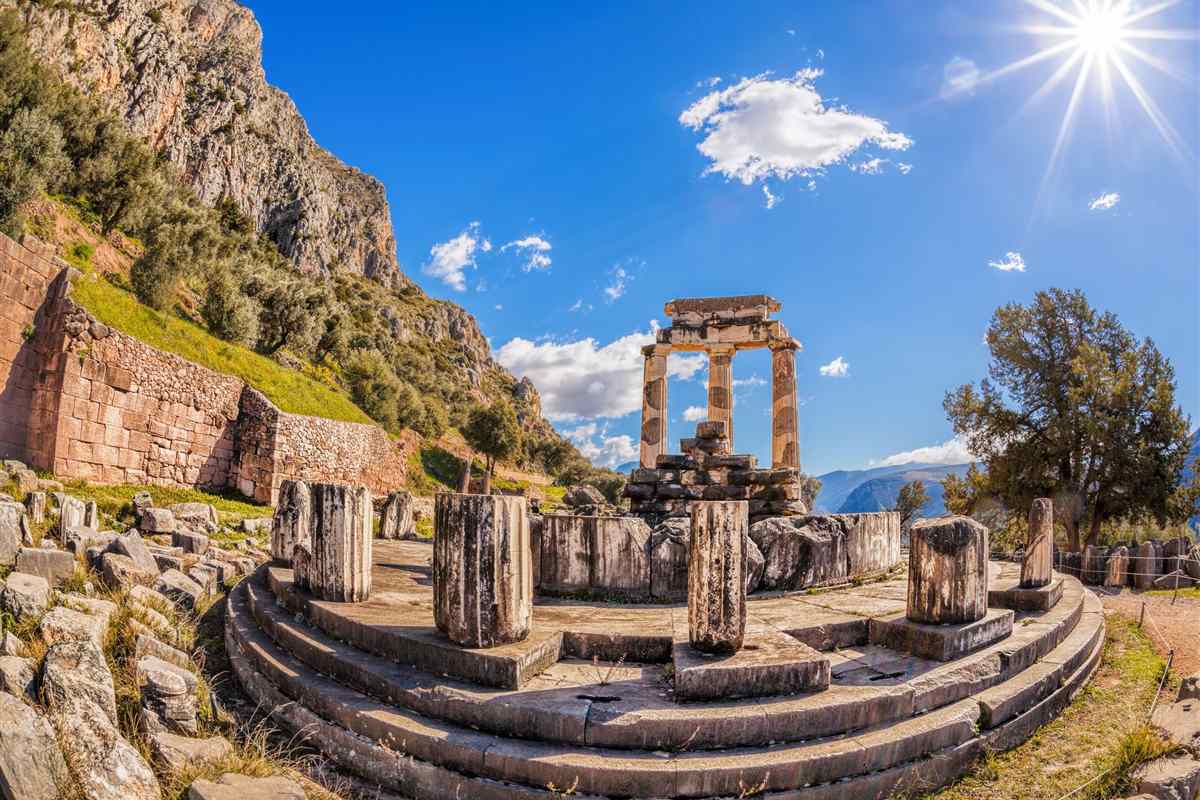
On Delphi tours the group climbs on to the theatre, which seated around 4,500 people. The stadium sits highest, and Greece has no ancient stadium in better shape. The round Tholos sits in the precinct of Athena Pronaia. It stands about 800 meters from the main ruins, and three of its Doric columns are restored.
Travellers who want the stories behind the stones can read about the Delphi mythology tour.

What do Delphi tours show in the Delphi museum?
Delphi tours visit the Archaeological Museum of Delphi, which keeps the finds from the sanctuary. Across two floors it displays a bronze Charioteer, a marble Sphinx from Naxos and the Omphalos stone.
A first small museum opened in the early years of the twentieth century. The present building grew in the nineteen-fifties and was later renovated. It has fourteen rooms. Here Delphi tours also meet the true metopes of the Athenian building, since the carvings at the site are reproductions.
The Charioteer of Delphi is a bronze statue from around 470 B.C. and stands 1.8 meters tall. Polyzalus of Gela gave it to Apollo to mark a victory in the games held at Delphi for Pythian Apollo. Excavators found it in the eighteen-nineties. Its eyes are inlaid glass. The left forearm is lost. Room 13 holds it.
The Sphinx of Naxos stood next to the Temple of Apollo as an offering from the island of Naxos. It dates to around 560 B.C. and is carved from Naxian marble. The statue is 2.22 meters tall, and with its column the monument topped 12.5 meters. Room 5 shows it beside the Siphnian Treasury friezes.
On Delphi tours the Omphalos is the stone to look for. Omphalos means navel, and the ancient Greeks held Delphi to be the center of the world. The carved stone has a knotted net across its surface and a hollow center. Room 11 displays it with the Dancers of Delphi.
Which places near Delphi do Delphi tours pass?
Day-trip Delphi tours from Athens stop in Arachova, a mountain town 8 km away, east of the sanctuary. Itea, Galaxidi, Amfissa and Kirra all lie within 20 km of Delphi, so each sits close to the site.
Day-trip operators describe a free stop in Arachova, with narrow streets, cafés and local shops. The town sits at about 970 m on the south side of the mountain, above the Pleistos valley. Its Formaela cheese holds a protected designation of origin. On Delphi tours with this stop, the group explores the town on its own.
Parnassus reaches an altitude of 2,457 meters, and the ancient Greeks held it sacred to Apollo and the Muses. In winter the range opens to skiing. Greece’s biggest ski center joins two sections, Kellaria and Fterolakka. The town of Delphi lies very close to the ruins and holds small houses, tavernas and hotels near Delphi.
Itea sits 8 km from Delphi, on the northern shore of its own gulf. Kirra is 2 km east of Itea, and ancient Kirrha was Delphi’s port. Its ruins stand on a hill near the modern village. Galaxidi is 7 km southwest of Itea and stands on a natural double harbor. It was busy in the age of sail.
Amfissa has a history of about 3,000 years. It lies at the northern edge of the Crissaean olive forest, between Mount Giona and Mount Parnassus. Livadeia, the capital of Boeotia and 26 km east of Arachova, grew important through its oracle of Trophonius. National Road 48 links Livadeia, Delphi, Itea and Galaxidi. Drivers can compare car hire.
How do Delphi tours combine with Meteora and the Peloponnese?
Combined Delphi tours join the ancient sanctuary with the Meteora monasteries over two or three days. Operators build them around hotel nights near Meteora. A transfer by coach, minibus or car then reaches Delphi, with free time at the ruins.
One operator’s two-day itinerary visits the Delphi site and two monasteries, with a hotel stay and meals. Delphi tours of this shape split the trip over two days instead of one. The operator offers three-star or four-star hotels, an air-conditioned bus and headsets. For that length, read about the two-day Delphi and Meteora tour.
Another operator’s three-day route runs from Athens to Kalambaka on day one, with a Meteora sunset tour. On day two, guests choose a Meteora hike or a half-day tour of four hours. On day three, Delphi tours of this kind move the group from Meteora and stop at Thermopylae. For a slower pace, see the three-day Delphi and Meteora tour.
Thermopylae is a narrow pass whose name means hot gates, from its sulphur springs. A battle was fought there in 480 BC. The rock pillars of Meteora rise in Thessaly. Twenty-four monasteries were built on them from the fourteenth century. Kalambaka, also spelled Kalabaka, is the town beside it. For only the rock monasteries, use the Meteora day trip.
UNESCO lists the Meteora complex. It also lists Hosios Loukas, a monastery close to Distomo. Hermit Luke of Steiris founded it in the early tenth century. It lies on the road before Arachova. One operator says its private Delphi tours can add a stop there. Routes that add the Peloponnese sit under classical tours of Greece.
What else do travellers ask about Delphi tours?
What were the Pythian Games at Delphi?
The Pythian Games honoured Apollo and took place at his sanctuary. The festival ran every fourth year, two years after each Olympic Games. Music, athletics and horse racing made up the programme, and the last day went to the equestrian races. The athletic events included the pentathlon, boxing and wrestling.
Winners took home a crown of bay leaves, a plant sacred to Apollo. The games carried on until the fourth century A.D. Delphi tours walk through the sanctuary where they were held.
What are the Delphic maxims?
The Delphic maxims are moral sayings that were carved into the Temple of Apollo. “Know thyself” and “Nothing in excess” are the two people quote today. A third warns that a pledge brings trouble close behind.
A fifth-century A.D. collection by Stobaeus lists 147 more. Nobody knows exactly where the words stood on the temple. The forecourt, a column, a doorpost and the front wall have all been suggested. Delphi tours stop at the temple where they were once displayed.
What is the Serpent Column?
The Serpent Column is a piece of an ancient bronze tripod that once stood at Delphi. The Greeks built it to remember their victory over the Persians at the Battle of Plataea in 479 B.C. Three snakes coil together to form the shaft, which stands about 8 meters high.
Constantine moved it to the Hippodrome in Istanbul, where it still stands. Only its base has been found at Delphi, so travellers on Delphi tours cannot see the column there.
Where is the Corycian Cave on Mount Parnassus?
The cave opens on the southern side of Mount Parnassus, north of Delphi. It is the largest cave in the Delphi area, at an altitude of 1,250 meters. The first chamber runs about 90 meters by 60 and rises about 50 meters.
People worshipped Pan in this cave, and it has been a sacred place since the Neolithic era. When the Persians invaded, the people of Delphi hid inside. To add the cave to Delphi tours, use the contact page to design your own tour.
What was the gymnasium at Delphi?
The gymnasium was a group of buildings for the young men of Delphi. It stood about 800 meters from the main sanctuary and had two levels. An open stoa ran along the top, and a palaestra, a pool and baths filled the lower floor.
People said the pools and baths held magical powers that let a bather speak directly to Apollo. The gymnasium lies apart from the main ruins that Delphi tours walk through.