
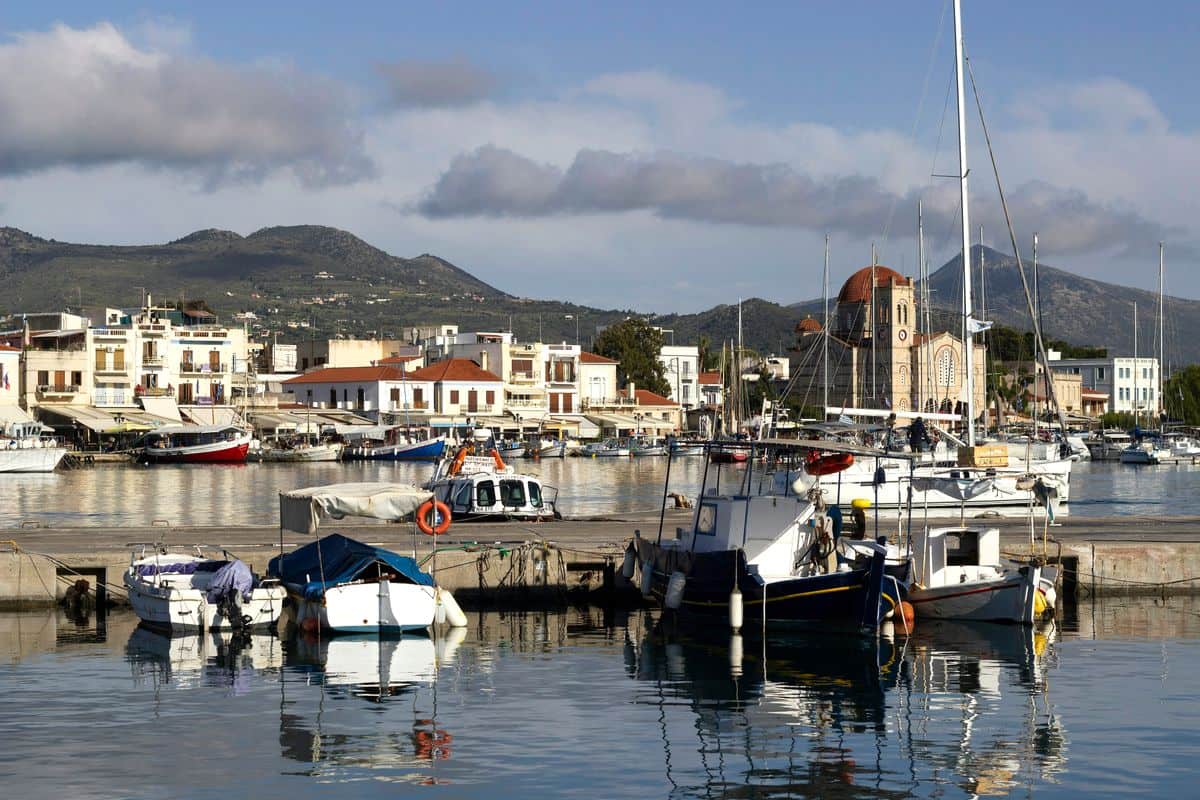
Aegina travel tips start with the crossing: the island lies one short sea trip from Athens, and the plan for the day follows the boat, the bus and the sights. For other trips, see our tours in Greece page.
This page covers the crossing from Piraeus, the island buses and taxis, the temple and the monastery, the beaches, food, weather, a day plan and the islands next door.
What are the first Aegina travel tips for a new visitor?
The first Aegina travel tips are about the island itself. Wikivoyage calls it a triangle with sides of 11 km and the closest island to Athens. Its port town carries the same name, and three smaller places, Souvala, Agia Marina and Perdika, serve as bases.
These Aegina travel tips begin with numbers, because size shapes every plan. Wikivoyage gives the population as 13,056 for two thousand and eleven. Athens lies 27 km away, according to Wikipedia. The Saronic Gulf around the island touches two peninsulas, Attica and Argolis. A visitor deals with a small place that sits close to a large city.
Aegina is also the name of the main town and ferry port. To avoid confusion, Wikivoyage calls it Aegina town, and these notes use the same name. Wikipedia calls this town the regional capital and puts it on the island’s north-western tip. It adds that the island’s buildings are neoclassical, built in the nineteenth century.
Wikivoyage lists three places beside the town, and the Aegina travel tips below come back to each. The shore on the island’s northern side holds a row of beach and resort places, and Souvala is the main village among them. Agia Marina, a small harbour, stands on the east coast by the Temple of Aphaea. Perdika, a resort village, lies close to the southern tip.
Wikivoyage notes that the greater part of the visitors come from the city. It adds that the island feels more like a beach suburb than a Greek island. One travel forum post adds that Athenians treat it as a quick getaway, so weekends are busier and weekdays quieter. This site has a page on Aegina tours for outings.
The simplest of all Aegina travel tips is to pick a reason and plan around it. Wikivoyage names two main reasons. One is to escape the city heat in an old port. The other is to see the temple of Aphaea. One travel essay says Athenians pick Aegina for a short break rather than a main summer holiday.
How long does a visit to Aegina take?
Wikivoyage says the main town is mainly geared for day-trippers, so a day trip works. One travel page calls a day trip feasible but suggests one or two nights. These Aegina travel tips show how the sights fit into half a day, a whole day or one night.
Size is the reason a short stay works. Wikipedia measures the island along two lines: about 15 km east-west and 10 km north-south. It covers 87.41 square kilometres, the same article says. Wikivoyage describes a triangle of 11 km on each side instead. The two sources differ on the shape, but both describe a small island.
Wikivoyage puts the Temple of Apollo 500 m from the harbour, towards the north, on the Kolona headland. It places the Temple of Aphaea 13 km east of Aegina town. The temple lies much farther out than the Kolona headland. Among these Aegina travel tips, the two figures decide how a day splits between the town and the temple.
For Aegina travel tips on time, one page says the small museum at Kolona took its writers about four minutes. It adds that a reader with a deeper interest in antiquities can spend longer on the ancient pottery. One travel forum post lists a day trip as the port town, the temple, a major church and beaches.
The plainest of these Aegina travel tips is to choose a short plan or a long one. The short plan fits the town and Kolona. It holds the harbour front, the stroll to the headland and a meal at the port. The long plan adds the Temple of Aphaea. Wikivoyage notes cafes near the pier.
A night on the island changes the pace. One travel essay describes the harbour tables emptying as the ferries leave, and a calm settling over the port. A visitor who stays sees that hour after the day-trippers have gone. A separate page about Aegina hotels lists the lodging areas, so these Aegina travel tips stay with timing.
How do travellers plan the crossing from Piraeus?
Aegina travel tips start at Piraeus, which Wikipedia calls the largest port in Greece. Wikivoyage tells passengers to follow the signs marked Aegina and Gate E8. It advises a check of the electronic screens to be sure of the gate.
Wikivoyage adds that the gate can shift, and it gives E7 as one example. For that reason the electronic screens inside the port count for more than a number noted at home. A passenger reads the screens on arrival and again before walking to the quay. That habit catches a change early and keeps the plan on time.
Wikipedia says the metro station of Piraeus stands beside the port. The station joins Line 1 and Line 3, and Line 1 ends there in the south. Travellers who follow these Aegina travel tips can reach the quay by train. Readers who add days in the capital can see the Athens tours of this site.
Wikipedia’s Port of Piraeus article names an airport express bus, route X96. It runs around the clock and links Athens International Airport with the port. A reader who lands late and follows these Aegina travel tips can still reach the quay without the metro. Another page of this site covers Athens transfers for readers who prefer a road ride.
These Aegina travel tips quote two pages on the metro ride. One travel page says it takes less than 30 minutes from the centre of Athens. A travel forum post gives 30 minutes from Monastiraki station and warns of pickpockets on a crowded train. It names a taxi, arranged by the hotel, as another way to the port.
The forum post advises arriving at least 30 minutes before sailing, which leaves time to find the gate and board. Another travel page describes a pedestrian bridge between the metro station and the ferry boats. Early arrival is the plainest of the Aegina travel tips for this stretch. The walk to the gate is part of the crossing.
How do the ferry and the hydrofoil differ?
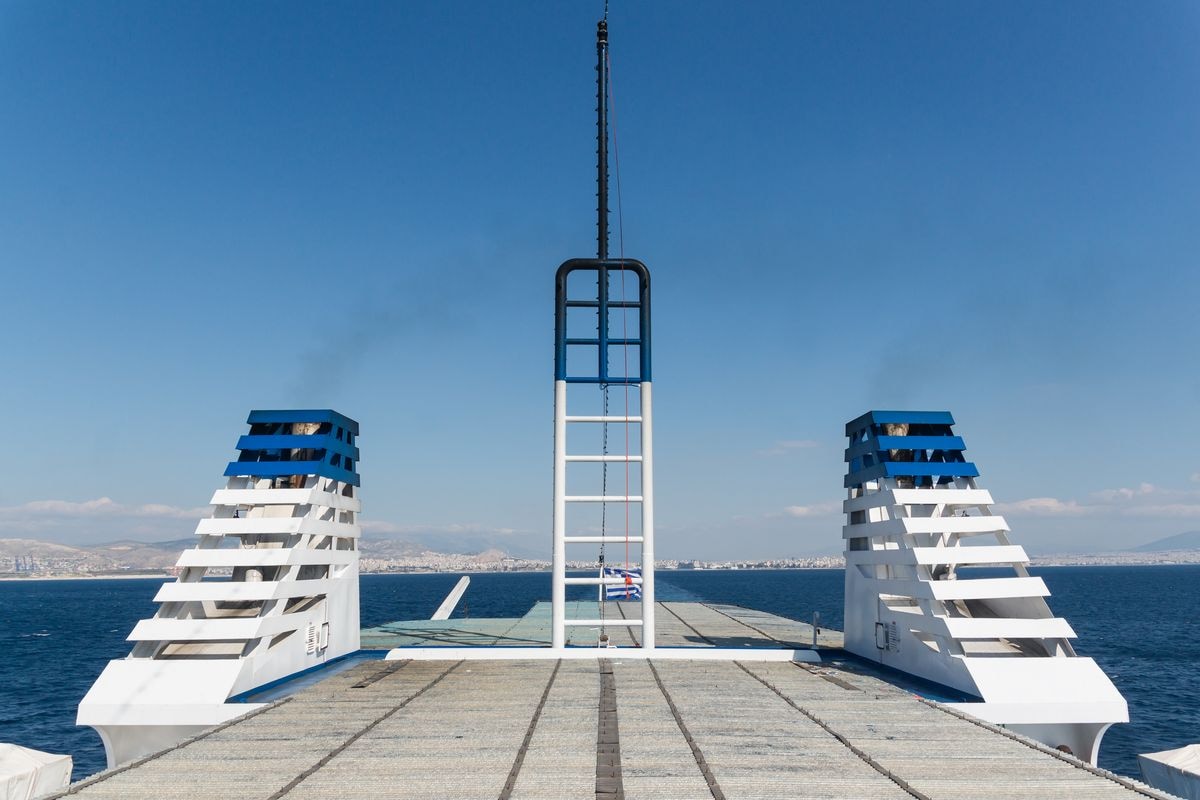
Wikivoyage says a hydrofoil carries foot passengers, while a conventional vessel carries cars and motorbikes. Aegina travel tips add the sailing time as the second difference. Wikivoyage lists 40 minutes by hydrofoil and 70 minutes by conventional vessel.
Aegina travel tips need one fact about the technology. Wikipedia describes a hydrofoil as a boat with winglike foils mounted beneath the hull. At speed these foils raise the hull clear of the surface, and drag falls. A second Wikipedia article says a hydrofoil company active in the Argo-Saronic Gulf and the Sporades began in nineteen eighty-four.
On the conventional vessel, says one travel forum post, a passenger can sit on an open deck. The deck gives a view of freighters and cruise ships. On a hydrofoil, it says, passengers stay inside behind salt-marked windows with little to see. The post suggests an open-deck ferry one way and a hydrofoil the other, if the schedule suits.
Sources differ slightly on the crossing time. One travel page gives about an hour and fifteen minutes by regular ferry, and half of that by hydrofoil. Wikivoyage gives 70 minutes for the ferry and 40 for the hydrofoil. Neither page replaces the current timetable, so check it on the day before turning Aegina travel tips into a plan.
Wikivoyage describes hourly hydrofoil sailings in normal times. It ties that pattern to a first sailing at 7 in the morning and a last one at 5 in the afternoon. Another travel page says departures run about every hour on either craft, even in low season. These Aegina travel tips repeat both statements as pictures of a normal day, not as a promise.
The last of these Aegina travel tips concerns the island end. Wikivoyage places the ferry berths at the west pier of Aegina port, in the town centre. Cruise ships use the east pier, and the inner harbour is for small craft. Wikivoyage names Agistri, Poros and Methana as stops where sailings continue, and seasonal ferries serve them too.
How do visitors get around Aegina without a car?
These Aegina travel tips for a visit without a car begin at the harbour. Wikivoyage says the bus stand there serves all three island routes, and no ride lasts longer than 30 minutes. Walking covers the town.
Wikivoyage describes the island buses as a limited service for villagers. Residents ride it to town for essentials and back home. It adds that the buses are not designed for sightseeing, though a trip is possible with boundless patience. Among the Aegina travel tips, this one comes first: the bus is a village service, not a sightseeing aid.
Wikivoyage names three routes and gives each a colour: yellow, blue and orange. Wikipedia says regular buses run out of Aegina town to villages across the island, and Agia Marina is one of the stops. Destinations show only in Greek, so Wikivoyage tells a traveller in doubt to get on and ask the driver. The ticket is paid in cash on boarding.
Route 1 is yellow and follows the north coast through Kipseli, Vathi, Souvala and Agii to Vagia. Route 3 is orange and runs south through Faros, Marathonas and Aeginitissa to Perdika. Each has three services on weekdays, Wikivoyage says, and two on Saturday and Sunday. These Aegina travel tips add the advice to ask for the current timetable.
Blue route 2 heads east, calling at Agios Nektarios and the Temple of Aphaia and ending at Agia Marina. Anyone who plans around the temple needs these Aegina travel tips: three outbound buses pass it. Two others skip the temple, taking a lane via Alones, but return the same way. On weekdays Wikivoyage counts five return services.
One travel page calls Aegina town the island’s centre, with banks, a post office, shops and beaches within walking distance. Another page describes a line of horse-drawn carriages near the port. A forum post mentions e-bikes with pedal assist for rent there. These Aegina travel tips come from visitors’ reports, so check what is still offered.
When does a taxi, a scooter or a hire car make sense?
These Aegina travel tips weigh three choices. Wikivoyage points to a taxi on a day out. The driver knows the roads, where to park and how long the return to the ferry pier takes. Scooters and hire cars come from rental agencies near the harbour.
One of the Aegina travel tips on taxis comes with an example. A travel page describes a taxi that takes visitors to the temple, waits 30 minutes and drives them back. The same page mentions drivers waiting around the harbour area. A forum post lists a bus plus a taxi as another way to cover the island.
Wikivoyage counts five car rental agencies there, and they also rent motorbikes and scooters. It advises reserving ahead to be sure of a vehicle. A number of the offerings are worn out, it adds. One travel page tells of scooters that came without a speedometer or indicator lights. The writer advises a closer look before renting.
A hire car brings its own paperwork. Wikivoyage’s Greece page says drivers without an EU licence must carry an international driving permit from their home country. It warns that an insurance policy can be void without that permit. These Aegina travel tips for drivers end with a question for the rental desk: which documents does the vehicle need?
The same page lists driving on the right. It notes that roads in towns and villages can be surprisingly narrow. It asks drivers to go slowly in villages because pedestrians walk in the road. It adds that finding parking can be very difficult. Beyond these Aegina travel tips, a separate page of this site is about car hire.
Two more Aegina travel tips close the comparison. About 90 percent of rental cars in Greece are manual, Wikivoyage says, so an automatic is reserved in advance. Wikipedia notes that a number of countries require motorcycle riders to wear a helmet and that the laws vary. A scooter renter therefore asks the agency which rule applies here.
What are the tips for visiting the Temple of Aphaia?
Plan the temple first, because it lies far out. The first of the Aegina travel tips is the distance. Wikivoyage puts the temple 13 km east of Aegina town, and Wikipedia adds a peak of about 160 metres.
The Aegina travel tips for the road stay short. Wikivoyage names the blue route 2 bus. One travel page adds that a car or a taxi reaches the temple. Wikivoyage lists daily visiting hours that open at 10 in the morning and shut at 5 in the afternoon. Check the current hours. A ticket is paid separately.
The standing temple was built about 500 BC. An earlier temple on the same spot, put up about 570 BC, burned down about 510 BC, Wikipedia says. In the Aegina travel tips of Wikivoyage, the ruin is a Doric shell on a ridge of pine trees. Among its admirers was the painter J. M. W. Turner, Wikipedia says.
Aphaia was a local goddess, and Wikipedia says she was worshipped only at this sanctuary. Wikivoyage says her worship began in the 14th century BC. By the 2nd century BC, it adds, she had merged into Athena and Artemis. The greater part of the temple’s sculptures now stand in the Glyptothek in Munich, according to Wikivoyage.
Walk the whole sanctuary, which Wikipedia measures at about 80 by 80 metres. The temple has six by twelve columns, and all but three outer ones were single blocks of stone. The on-site museum holds a rebuilt part of the older temple. Ask at the entrance whether it is open, a simple step among the Aegina travel tips.
Agios Minas is a small convent 300 m southwest of the temple, and Wikivoyage says visitors are welcome. Wikivoyage’s safety note for the island fits this site: take care with sun protection and keep hydrated. The cooling sea breeze hides how fast the sun burns. Add that to your Aegina travel tips for a day outside.
What are the tips for the monastery of Saint Nectarios and Paliochora?
Treat the monastery of Saint Nectarios and Paliochora as one outing. Wikivoyage places the church along the road to Agia Marina. A path leads uphill from it to Paliochora, the island’s earlier capital. The pairing is one of the practical Aegina travel tips here.
Wikivoyage describes Nectarios as a monk who ministered in Cairo, Libya and Athens before retiring to Aegina. Born in eighteen forty-six, he died in nineteen twenty, and Wikipedia calls him a renowned Greek saint. In nineteen sixty-one, Patriarch Athenagoras I proclaimed him a saint in Istanbul. The Church celebrates his memory on 9 November each year.
At the request of nuns, Nectarios set up the Holy Trinity Monastery in nineteen hundred and four. Aged 62, he withdrew there in nineteen hundred and eight, Wikipedia says. He helped build it with his own funds. Wikivoyage calls today’s church large and modern, so one of the Aegina travel tips is to expect a big building.
One travel page puts the monastery 6 km from the centre of Aegina town. Another says two small chapels inside hold the saint’s tomb and relics. A third page asks visitors to wear long clothes with the shoulders covered. It rules out short skirts, bermuda shorts and open blouses, a dress point for Aegina travel tips.
Wikipedia calls Paliachora the medieval capital of Aegina, the island’s chief settlement under Byzantine and Venetian rule. Its people left in the early nineteenth century as piracy declined. The Aegina article counts over 35 surviving churches, while the article on Paliachora counts 38. Spelling differs among Aegina travel tips: Wikivoyage writes Paleochora, and Wikipedia writes Paliachora.
One travel page calls the climb mild, the path rough, and advises sturdy shoes. Among the Aegina travel tips, a lane winding south from the church reaches the Chrysoleontissa convent. Wikivoyage gives two opening slots. The first runs from 7 in the morning until 2, and the second from 4 until half past 6. Check the current hours.
What are the tips for the town of Aegina and the Kolona hill?
These Aegina travel tips for the town begin at the harbour, where a whitewashed chapel stands on the west pier. The Kolona headland, marked by a single standing column, lies 500 metres north of the harbour. Wikivoyage says visitors come mainly for the view.
The first of these Aegina travel tips is to look up as the boat comes in. Wikivoyage names the church of Isodia Theotokou, which looms over the harbour and shows even earlier from the water. It also names the whitewashed chapel of Saint Nicholas on the west pier, just as passengers step off the ferry.
Wikivoyage lists two more churches in the town. The cathedral stands on Mitropoleos street. The church of Fanomeri lies 1 km inland and underground. Wikivoyage says it is closed at times, so ask on the spot. Wikipedia adds that the island’s buildings of the nineteenth century are Neoclassical in style with a heavy folk influence.
Good Aegina travel tips for Kolona begin with the distance. Wikivoyage puts the temple of Apollo 500 metres north of the harbour. An official heritage page gives about 15 minutes on foot from the main port. The name Kolona refers to the column, which still stands and was once a daymark for ships on their approach.
Aegina travel tips about the hill’s past start with the temple. The heritage page places the building of the Doric temple of Apollo in the closing years of the sixth century BC. Venetian sailors named the hill and steered by its columns, according to Wikipedia. Digs found prehistoric buildings beneath the acropolis, raised in ten phases or more.
The museum on the headland is the Archaeological Museum of Aegina. Its three rooms display ancient vessels, statuettes, weapons, coins and inscriptions. Wikipedia places a mosaic from a fourth-century synagogue in its courtyard. One of the Aegina travel tips is to check the current days. Wikivoyage lists Wednesday and Friday to Monday; another page says Tuesday is closed.
What are the tips for the beaches and for swimming?
Aegina travel tips for the beaches start with the four that Wikivoyage lists by name. They are Marathonas, 5 km south of the town, Perdika, Souvala and Agia Marina. For swimming, bring sun protection, water and shoes for the rocks.
These Aegina travel tips circle the coast. Souvala is the chief village of the north coast’s strip of beaches and resorts, Wikivoyage says. A beach-listing page describes its sandy shore and clear water. Close to the Temple of Aphaea, the east coast holds Agia Marina, a small harbour. Another page names its beach the longest on Aegina.
Marathonas lies 5 km south of the town on the Wikivoyage list. A beach-listing page calls it a seashore with shallow water and facilities on the beach. One travel page found a beach taverna with sunbeds there. It also found a sandbank that made for a long wade, and rocks here and there, so swimming shoes help.
Among the Aegina travel tips for the south is Perdika. At the south-west tip, Wikivoyage finds this fishing village on the northern prong of a peninsula. It adds a cafe strip by the harbour. The southern prong is scrub grazed by goats and donkeys, and officially off-limits. A listing page names a shore of sand and pebbles.
Wikivoyage advises sun protection and keeping hydrated, because the cooling breeze hides the sun’s heat. Other Aegina travel tips come from one page on the beaches by the town. Avra beach lies beside the road out of town. Kolona beach is further along, with dry seaweed and stones, so swim shoes help. The page says to bring shade.
One of the Aegina travel tips is the climb up Oros, the highest peak. Wikivoyage gives 532 metres, Wikipedia 531. The peak stands 5 km to the south-east, reached by the Lefkis road towards Anitseo. A marked path passes the ruins of a Zeus temple and takes 45 minutes. The top offers a panorama of the Saronic Gulf.
What are the tips for eating and shopping on Aegina?
These Aegina travel tips for eating and shopping begin at the harbour. Wikivoyage places the waterfront cafes and the fish market by the port. The Aegina pistachio carries a protected designation of origin. Wayside kiosks across the island sell the nuts.
Pistachios came to the island’s farms in the nineteenth century, Wikipedia says. Since nineteen ninety-six, the name Aegina Pistachios has held protected status for its origin. The article credits the dry climate and the volcanic soil, and it puts the yearly harvest at about 2,700 tons. Any list of Aegina travel tips for shoppers opens with the nut.
Wikivoyage describes the nut plainly. The shell is paler and a little more closed than that of American varieties. Its kernel is red-green and intensely sweet. Wikivoyage’s advice is salt plus a squeeze of lemon, which offsets the sweetness. One travel page notes vendors near the ferry landing offering samples with different levels of salt, and pistachio butter.
One listing page names a shop on Irioti Street, by the harbour, that sells fresh-roasted pistachios, chocolates and marzipan. Another travel page describes departing visitors heading for the ferries with bags of fistikata, a pistachio marzipan. Among the Aegina travel tips for sweets, Wikipedia adds a warning for nut allergies: pistachios are a priority allergen.
Wikivoyage says cafes line the town waterfront, one of them open every day from 10 in the morning to midnight. Another is open from half past 7 in the morning until 3 the next morning. Check the hours there. One travel page finds the cafes by the pier crowded, with an international menu, and simpler bars further on.
A pungent alley by the harbour holds the fish market. Wikivoyage says the market opens at 6 every morning and closes at 9 every evening. One travel page lists grilled octopus, fried squid, Greek salad and small fried fish as the usual order. Aegina travel tips from Wikivoyage add a row of tavernas at Perdika.
What are the tips for the weather and the winds?
These Aegina travel tips for the weather start with the climate. Wikipedia puts the average yearly temperature on Aegina at about 20 degrees Celsius. Rainfall stays below 340 millimetres across a whole year. In summer the Meltemi wind blows.
Greece’s climate entry on Wikipedia files Aegina and Hydra as hot semi-arid islands of the Argo-Saronic Gulf. That type also covers Piraeus and the bulk of the Cyclades. The same article says Ioannina in Epirus receives just short of 1,100 millimetres of rain a year. That is more than three times the figure Wikipedia gives for Aegina.
Athens lies close, so Wikipedia describes Aegina as a favourite holiday spot in summer. Wikivoyage lists escape from the city heat among the main reasons to visit. It adds that a cool breeze off the sea hides the strain of the sun. Aegina travel tips for summer start with sun protection and water, as Wikivoyage advises.
Dry and forceful, the Meltemi sweeps the Aegean from the north each summer. Per Wikipedia, swimmers and holiday visitors have the shore from late spring until the middle of September. The Greek climate article extends the season to October and puts the peak frequency in July and August. Aegina travel tips for the wind therefore look to July and August first.
Wikipedia notes afternoons bring the strongest Meltemi, while night tends to calm it. It can build up in clear weather with no sign beforehand, reaching force 7 or 8 on the wind scale. At that strength a number of yachts stay in port, and the larger part of the island-to-island ferry fleet is held back. Aegina travel tips add a question for the ticket office: which departures run today?
One travel page about an early April day reports a chill, cold sea water and the need for a hat. Another page, about a stay in October, found the water clear for swimming but the Agia Marina restaurants closed. Aegina travel tips for spring and autumn follow: bring a hat and ask what is open.
What are the tips for a day trip from Athens, hour by hour?
A day trip from Athens fits in five steps. Sail early, see the town, visit the temple, eat at the harbour and head back with time to spare. These Aegina travel tips follow that order hour by hour.
The first hour of the day is the crossing. Wikivoyage lists a hydrofoil every hour in normal times, with the first at 7 in the morning and the last at 5 in the afternoon. Of all Aegina travel tips, the simplest is an early start. The fish market, an alley by the harbour, is open daily from 6 in the morning, says Wikivoyage.
The next hour or two belong to the town. Wikivoyage places the Kolona headland, with its single standing column, 500 m north of the harbour. One travel page says to head left from the harbour, facing inland. The small museum there keeps set opening days. Among Aegina travel tips for the town, checking the current days comes first.
Late morning is for the temple, 13 km east of the town, says Wikivoyage. Daily hours start at 10 in the morning and finish at 5 in the afternoon. Among Aegina travel tips for getting there, one travel page mentions a taxi that waits 30 minutes. Pictures of the island sit in the Aegina photo gallery.
Lunch belongs at the harbour. Wikivoyage describes the port as the centre of the town, with cafes nearby, so the ferry is close. It adds that a taxi driver knows how much time to allow for the return to the pier. Among Aegina travel tips, a fair question for the driver is how much time the return needs.
The last step is the return sailing. Wikivoyage names hourly hydrofoils for normal times only, so check the last return for the exact day before leaving Athens. One travel page describes the harbour at sunset, where the tables empty as the evening ferries leave and calm follows. These Aegina travel tips for the evening start with that check.
What are the tips for the islands next to Aegina?
Moni and Nisida are two small islets right beside Aegina. Agistri is a ten-minute boat ride away, and Poros, Hydra and Spetses lie further along the gulf. These Aegina travel tips give each island one plain fact from Wikipedia or Wikivoyage.
Moni lies west of Perdika and is 1 km long. Wikivoyage lists a 10-minute water taxi and a beach bar at the landing. Nobody lives there, and the deer come looking for handouts. Nisida, off the north-east tip, is a wooded islet that Wikivoyage calls seldom visited. A page here covers the Agistri, Moni and Aegina cruise.
Agistri, in Wikipedia’s words, is covered in pine, and boats from Aegina cross in ten minutes. Wikivoyage adds that seasonal ferries continue from Aegina town to Agistri, Poros and Methana. Among Aegina travel tips for onward trips, check that the ferry runs in season. Longer sea routes through the gulf are on the page for Greek islands cruises.
Poros is a pair of islands with a bridge between them. Wikipedia puts it about 58 km from Piraeus, in a southerly direction. A strait only 200 m across divides it from the Peloponnese. The article adds that Athenian travellers like it for a weekend away. Poros tours are one click away on this site.
Wikipedia says no wheeled vehicles are allowed on Hydra, a ban that reaches bicycles and e-bikes as well. From the crescent-shaped harbour of Hydra port, streets of steep stone lead uphill, so visitors walk. These Aegina travel tips for the next island come down to one thing, walking. For Hydra tours, this site keeps a separate page.
Spetses comes last on the route. The Wikipedia article on Hydra has the fast boats leaving Piraeus for Poros first and Spetses afterwards. Together the trails on Spetses run for about 25 to 30 km. Among Aegina travel tips, a shorter day stays closer. The Hydra, Poros and Aegina day cruise has its own page here.
What else do travellers ask about Aegina travel tips?
What is the legend of the nymph Aegina?
Wikivoyage opens the history part of its Aegina travel tips with this legend. In it, Aegina is a nymph whom Zeus carried off to the island, and the island took her name. Their son Aeacus became king. Wikipedia gives her father as Asopus, a river god, and her mother as Metope, a nymph.
The two sources tell the next part differently. Wikivoyage says Hera wiped out the islanders with a plague. Aeacus then asked Zeus to turn ants into people, the Myrmidons. In Wikipedia’s version, Zeus makes the ants into soldiers who wear black armour and have six hands. It adds that Achilles later commanded the Myrmidons.
Why do Aegina travel tips link the island to the first government of modern Greece?
Ioannis Kapodistrias became the first governor of newly freed Greece. His Wikipedia article says he arrived on Aegina on 8 January in eighteen twenty-eight. The Aegina article calls the island an administrative centre of the revolutionary authorities. The principal square carries a statue in his honour.
Wikivoyage names the buildings of that time. The Government House is a modest two-storey building beside the cathedral. That building housed the newly independent government during the final years of the eighteen twenties. The Eynardio, a building of eighteen thirty, stands next to it. The Tower of Markellos is a pink watchtower on Thomaidou.
Wikipedia says the Tower of Markellos held the temporary government in eighteen twenty-six to eighteen twenty-eight. Wikivoyage says the Kapodistrian Orphanage, on the south side, looks like a prison. Wikipedia says it served as one from about eighteen eighty.
Where do Aegina travel tips place the Kapralos museum and the Kazantzakis house?
Wikivoyage lists the Christos Kapralos Museum 3 km north of Aegina town, close to the island’s north-west tip. Kapralos lived from nineteen oh nine to nineteen ninety-three and was a Greek artist who worked on Aegina in summer.
The writer Nikos Kazantzakis wrote Zorba the Greek and lived from eighteen eighty-three to nineteen fifty-seven. He stayed on Aegina on and off from nineteen thirty-three. Aegina travel tips from Wikivoyage put his house on the north-west tip, 200 m north of the museum. It is a private home now, so visitors cannot tour inside.
How did ancient Aegina trade, and what were its coins?
Wikivoyage’s Aegina travel tips call the island a maritime trading state of the seventh to fifth centuries BC. Its coins carried a sea turtle and later a land tortoise. They circulated widely in the Hellenistic world. Wikipedia says the land tortoise had replaced the turtle by 456 BC.
Trade also set Aegina against Athens. Wikipedia dates the start of the Athenian challenge to the island’s sea power to the early sixth century BC. Wikivoyage says the rivalry grew into war, and the island suffered a massacre in 424 BC.
Which villages beyond the three bases appear in Aegina travel tips?
Wikipedia says the municipality has five communities. For two thousand and twenty-one it gives Aegina town (6,976), Kypseli (2,166), Mesagros (1,473), Vathy (1,449) and Perdika (847). Wikivoyage spells Kypseli and Vathy as Kipseli and Vathi, and lists both as stops on the north-coast bus route.
Aegina travel tips name smaller places too. Portes, on the east coast, is a fishing village in Wikipedia’s words. Wikipedia’s landmark list adds Pachia Rachi, a village with a Byzantine church that dates to the thirteenth century. Wikivoyage ends the north-coast bus route at Vagia and places Vagia beach just west of its marina.