
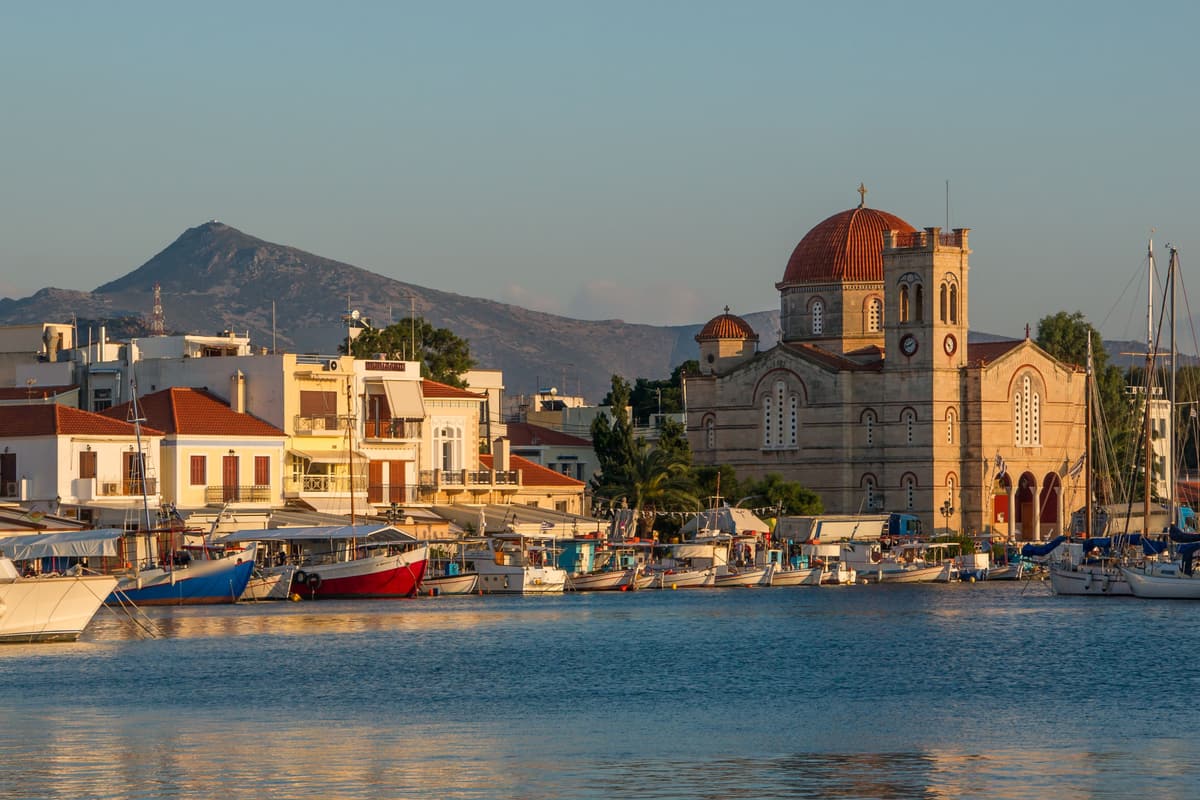
Aegina hotels cluster around the island’s harbour town and two coastal villages, so the first choice for a stay is the area, not the building. For other trips, see our tours in Greece page.
This page covers the kinds of lodging, the areas, the star classes, the sea link from Athens, the sights, beaches and food nearby, the season and the questions to ask before booking.
What kinds of Aegina hotels does the island have?
Aegina hotels fall into three groups in this listing. B class means three stars, C class means two stars, and the third group holds apartments and maisonettes. All of them sit on a Saronic island that lies close to Athens.
Aegina hotels follow the plain meaning of the word. Wikipedia describes a hotel as a business that rents out rooms for short stays. Bigger hotels add extras, such as a pool or a restaurant. Smaller ones offer only the basic services. That difference is the first thing to check when you compare two places.
An apartment hotel works in a different way. Wikipedia calls it a serviced apartment complex that takes bookings the way a hotel does. Each unit is a complete, fully fitted apartment. Such complexes are custom built and look like a hotel made of apartments. In this listing, apartments form one of the three groups.
Aegina hotels share this listing with holiday rentals. According to Wikipedia, a vacation rental is a furnished apartment or house that tourists take for a set period. It is an alternative to a hotel. A studio, a villa or a maisonette fits that idea. For days out on the island, open the Aegina tours page.
Aegina suits a short stay because it is close and compact. Aegina sits in the Saronic Gulf, and Wikipedia gives its distance from Athens as 27 km. On a map it measures about 15 km wide and 10 km tall. Its area is 87.41 square kilometres. The Aegina photo gallery shows what that size looks like.
Aegina hotels therefore work as a base for a short trip, not as a resort city. Wikipedia lists the community of Aegina with 6,976 residents, which fits the picture of a small island town. Travellers who plan a longer route can compare hotels across Greece, then come back here for the island itself.
Where do Aegina hotels sit on the island?
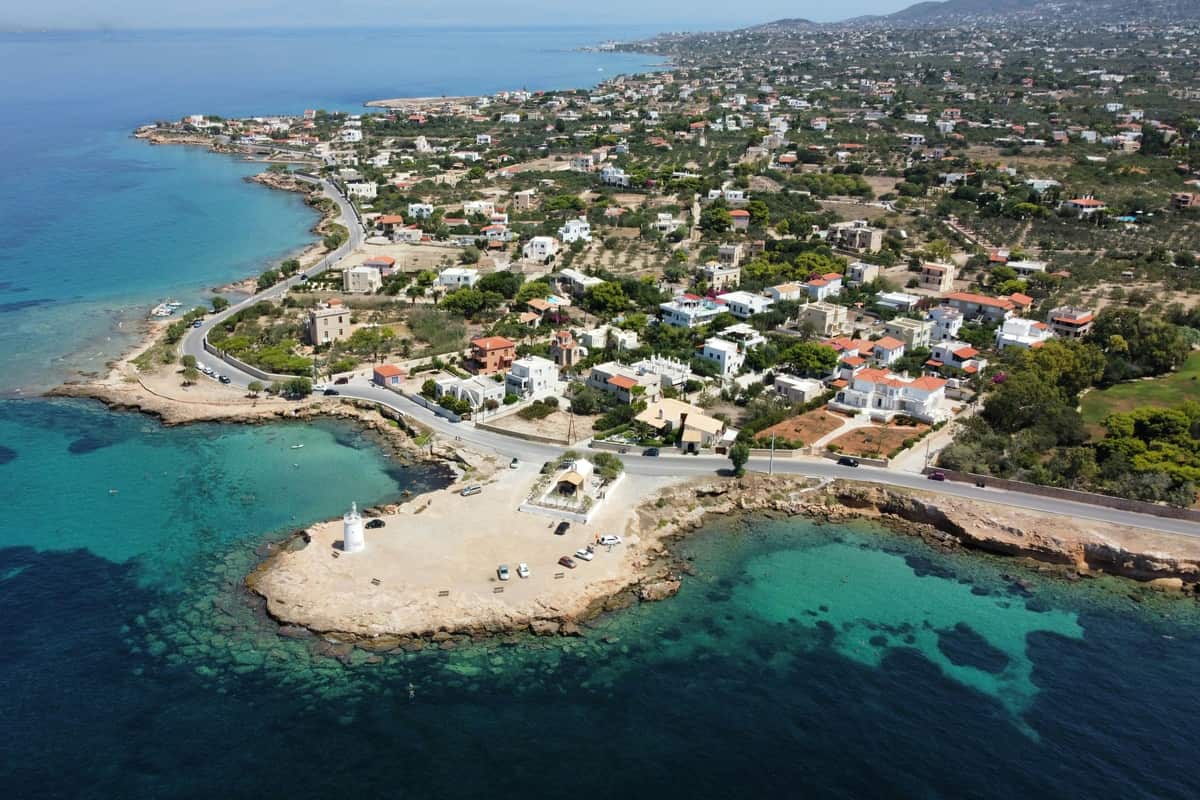
Aegina hotels cluster in three places. Aegina Town sits on the north-west coast. Agia Marina is on the eastern side, and Perdika is near the south-west tip. Smaller coastal places, such as Souvala and Vagia, lie on the north shore.
Aegina hotels sit on a roughly triangular island. Wikipedia says that two-thirds of the island is an extinct volcano. The north and the west are plains of stony yet fertile land. The south is rugged, mountainous and largely barren. Keep that shape in mind as you read the place names below, because every cluster sits by the shore.
Start with Aegina Town. Wikipedia says the regional capital stands at the north-western end of Aegina itself. Wikivoyage adds that the main strip of lodging begins just north of the town. Wikipedia splits the municipality into five communities: Aegina, Vathy, Kypseli, Mesagros and Perdika. Aegina and Perdika are both on that list. Agia Marina is not.
Aegina hotels also gather at Agia Marina, which belongs to the island’s east coast. Wikivoyage describes Agia Marina as a small harbour on the same shore. It lists the place among the other clusters of lodging, beside the north-coast strip. Wikipedia names Portes, a fishing village, as another place on that shore.
Perdika is the third cluster. Wikivoyage calls it a fishing village on a peninsula in the island’s south-west corner. Wikivoyage lists it as a cluster of lodging too. Wikipedia gives its community 847 residents, the lowest figure among the five. The next sections follow the same order: the town, the east coast, then Perdika.
Aegina hotels turn up in smaller places as well. Along the north coast runs a strip of beaches and resorts, and Wikivoyage names Souvala as its main village. The same strip ends at Vagia. Marathonas lies 5 km south of Aegina Town, says Wikivoyage. For the wider picture, read the general information about Aegina.
Which Aegina hotels are in Aegina Town?
The Aegina hotels in Aegina Town stand in the port and capital of the island. Wikipedia calls the town the regional capital, at the northwestern end of Aegina. Wikivoyage names it the main town and ferry port, mainly aimed at day-trippers.
Aegina hotels in the town stand in a place with a part in the Greek revolution. Wikipedia says the island served the revolutionary authorities as an administrative centre. Its article on Ioannis Kapodistrias says he reached Aegina on the eighth of January, eighteen twenty-eight. He governed Greece until eighteen thirty-one, as the same article notes.
Wikivoyage adds that Government House, next to the cathedral, housed the newly independent Greek government. That was in the years eighteen twenty-eight and eighteen twenty-nine, until the government set up in Athens. The list below holds the pages of the hotels in Aegina Town, one page for each hotel in the town.
- The page for Danae Hotel Aegina covers a B class entry in Aegina Town, and its photos sit in the Danae Hotel photo gallery.
- Klonos Anna Hotel Aegina is the C class entry of the listing, also set in Aegina Town.
Anyone choosing among Aegina hotels in the town finds the hill of Kolona to the north. Wikipedia calls it an acropolis with the sanctuary of Apollo. Wikivoyage puts the temple remains 500 m north of the harbour. Wikipedia adds that the rear building keeps its foundations and a single column.
Wikipedia says Venetian sailors gave the hill the name Colona. They used the columns of the Doric temple as a sign to steer by. It dates the temple to the end of the sixth century B.C. Digs from the nineteenth century onward found prehistoric structures below the later ruins, with at least ten phases of building.
The Archaeological Museum of Aegina is another stop for guests of Aegina hotels. Kapodistrias founded it on the twenty-first of October, eighteen twenty-eight. Wikipedia lists ancient vessels, pottery, coins, weapons and statuettes among the exhibits, shown in three rooms. A carnelian bead of Harappan type hints at trade links with Mesopotamia and the Indus Valley.
Which Aegina hotels are in Agia Marina?
The Aegina hotels in Agia Marina stand along Aegina’s east coast. Greeka calls Agia Marina a tourist resort on the island’s eastern side. Wikivoyage describes it as a small harbour on that coast, near the Temple of Aphaea.
Aegina hotels in Agia Marina lie across the island from the capital and its main port. Wikipedia locates the capital at Aegina’s northwestern end. Greeka places Agia Marina 12 km east of Aegina Town. The Greek Travel Pages port database lists Agia Marina as a village of Aegina with its own port.
One travel site says Agia Marina was once a major name in international tourism. The same site says hotels and waterfront tavernas are still found there, and local visitors still come. Below are the pages of the hotels in Agia Marina, one for each hotel of the resort.
- Apollo Hotel Aegina belongs to the Agia Marina group, and the Apollo Hotel photo gallery shows its photos.
- Open Katerina Hotel Aegina for another B class entry at Agia Marina, with the Katerina Hotel photo gallery beside it.
- The apartment entry here is Esperides Maisonettes and Apartments, which has its own Esperides photo gallery.
The Greek Travel Pages port database says the harbour is open to the southeast and links ferries with Piraeus. One travel site calls it a second, less used ferry port, with daily boats to other Saronic islands. Aegina hotels in Agia Marina therefore sit on a coast with a second sea link to Piraeus.
Another travel site calls Agia Marina the island’s classic beach resort, with a strip of bars, tavernas and shops. Wikipedia names Portes as a fishing village on the same east coast. A ferry-booking site adds that a monastery dedicated to Agios Minas lies not far from the town. Greeka says the resort gets very popular in summer.
Aegina hotels in the resort and in the capital give two different bases. The capital lies at the northwestern end, with the main port and the Kolona hill. Agia Marina lies 12 km east, with a harbour of its own. Both areas have a sea link to Piraeus, so the choice is about the setting, not the crossing.
Which Aegina hotels are near Perdika?
Aegina hotels near Perdika lie at the southwest tip of the island. Wikivoyage calls Perdika a fishing village on the north prong of a peninsula. It also lists Perdika as a resort village near the south tip of the island.
Wikivoyage names Perdika as one of the clusters of lodging on Aegina, beside the cluster around Agia Marina. The main accommodation strip lies along the north coast instead, starting just north of Aegina Town. One travel page puts Perdika about five miles south of Aegina Town. Both clusters lie outside the port town.
Wikipedia counts Perdika as one of five communities of the Aegina municipality, with 847 residents. It also records that Albanians settled in Perdika when the island was repopulated in fifteen seventy-nine. Next come the pages of the Aegina hotels in the Perdika area. Each link opens the page of one hotel.
- Moondy Bay Hotel Aegina is the B class entry for the Perdika side of the island, and the Moondy Bay photo gallery holds its photos.
Wikivoyage mentions a cafe strip by the Perdika harbour and a lane round the headland with views towards Epidaurus. Goats and donkeys graze the scrub of the peninsula’s south prong, which is officially off limits. Another travel page says the village has a small number of hotels and little else in the way of shops.
Across the water from Perdika lies the islet of Moni, close to the Aegina hotels in the village. Wikivoyage describes Moni as a wooded island one kilometre long, reached by a ten-minute water taxi. It has a beach bar at the landing point and no residents. Wikivoyage adds that the deer come looking for handouts.
Other lodging also sits in smaller villages on the north coast. A travel page names Vagia and Souvala as examples. Wikivoyage calls Souvala the main village of the beach and resort strip there. It says the accommodation strip ends at Vagia. Marathonas lies on the coast five kilometres south of Aegina Town.
How are Aegina hotels grouped by class?
This listing groups Aegina hotels into B class, C class and apartments. Wikipedia says hotel ratings sort hotels by quality and first told travellers which basic facilities to expect. In schemes that use stars, more stars stand for more luxury.
Rating schemes differ from one organisation to the next. Wikipedia notes that there is no global standard. Amenities at a given rating level vary from one market to another. The same idea goes by three names: grading, rating and classification. A class given to Aegina hotels therefore reads as a local label, not as a promise.
Wikipedia says traditional systems look at the goods and services offered. Its examples are food, entertainment, the view and spas. The size of the room, the ease of getting there and the hotel’s position can count too. A single missing item, such as a spa, can hold a small hotel in a lower class, Wikipedia adds.
This listing sorts its pages into three groups: B class hotels, C class hotels and apartments. Wikipedia says every hotel offers a private room for the guest, so Aegina hotels of both classes share that base. The apartment group follows a different idea: a fully fitted apartment in place of a single room.
Four plain questions help a traveller compare the classes before choosing one. Is the bathroom private, or shared between rooms? Does the room have air conditioning? Is there a pool? Do the nights include meals, and which ones? Wikipedia notes that rooms can share one bathroom, and that a hotel can include meals with the room.
Wikipedia says a small or medium-sized hotel offers only a limited set of facilities on site. It describes a boutique hotel as a smaller independent hotel without a brand. An apartment complex is generally custom built and holds a varied number of apartments. Size is a second question, apart from the class, when a traveller compares Aegina hotels.
How do travellers reach Aegina hotels from Athens?
Travellers reach Aegina hotels by boat from Piraeus, the port of Athens. Wikipedia gives forty minutes for a hydrofoil from Piraeus to the island, while the ordinary ferry needs roughly an hour. Wikivoyage names Aegina Town as the arrival port.
Athens relies on Piraeus as its chief port, and the sea route to Aegina hotels begins there. Wikipedia ranks it as Greece’s largest port and lists a metro station next to the quay. Visitors who stay in Athens first can ride the metro there. A direct X96 bus joins the airport and the port around the clock.
A hydrofoil is a boat with winglike foils under its hull. Once the craft speeds up, its foils lift the hull out of the sea, so drag falls, Wikipedia explains. Such craft work chiefly as fast passenger ferries. Wikivoyage states that hydrofoils for foot passengers take forty minutes. Conventional vessels for cars and motorbikes take seventy minutes, it adds.
Anyone sailing to Aegina hotels crosses the Saronic Gulf. Wikipedia says the peninsulas of Attica and Argolis shape the gulf, which is part of the Aegean Sea. The article lists Aegina, Salamis and Poros among its islands, and puts the Athens urban area on its north coast. It adds that short-beaked common dolphins gather in these waters.
Guests at Aegina hotels have three ways to travel around the island: bus, taxi or a rented car. Wikivoyage says three bus routes begin at the harbour stand, and none runs longer than thirty minutes. Wikipedia notes regular bus services linking Aegina Town with Agia Marina and other destinations. Wikivoyage calls the service limited.
Wikivoyage suggests a taxi for a day trip. A taxi driver knows the roads and parking, and judges the time needed to return to the ferry pier. For more freedom, travellers can arrange car hire. The same page counts five car rental agencies near the harbour, and they also have motorbikes and scooters.
What sights lie close to Aegina hotels?
Three sights lie within reach of Aegina hotels: Aphaia’s temple, the monastery of Saint Nectarios and medieval Palaiochora. Wikipedia places the temple on a hilltop about 13 km east of the island’s main port by road.
Wikipedia calls the Temple of Aphaia a Doric building in a sacred precinct for the goddess Aphaia. Guests at Aegina hotels will find it on the eastern side, on a rise of roughly 160 metres. Wikivoyage describes a Doric ruin on a pine ridge. The article adds that Turner and other Romantic artists admired it.
The temple seen today dates to around 500 B.C., Wikipedia states. It rose above the remains of an earlier temple, dated around 570 B.C., which fire destroyed around 510 B.C. The later temple had marble roof tiles. All but three of its outer columns were monolithic, meaning each stood in one piece.
Wikipedia says the goddess Aphaia received worship at this sanctuary alone. It places the marbles from both pediments in Munich’s Glyptothek. Anyone staying at Aegina hotels will find a number of fragments in the island’s museums and in the sanctuary. Each pediment centred on Athena, and the scenes honoured Aegina’s local heroes in the Trojan wars.
Wikipedia counts the pilgrimage site of Saint Nectarios among Aegina’s known sights. The saint lived from eighteen forty-six to nineteen twenty. In nineteen hundred and four he founded a monastery for nuns on Aegina. Wikivoyage places the church dedicated to him on the road to Agia Marina. The bus line there also passes the temple.
Palaiochora is an abandoned medieval settlement, says Wikipedia. Pirate raids drove people to this inland stronghold, and it stayed the island’s chief settlement until the early nineteenth century. The article counts 38 surviving Byzantine and post-Byzantine churches. A path leads uphill from the monastery, Wikivoyage says, so guests at Aegina hotels can pair the two sights.
Which beaches lie close to Aegina hotels?
Aegina hotels stand near sandy, rocky and pebbled shores, and Visit Greece says the beaches are generally organised. Agia Marina holds the island’s largest sandy beach. Perdika, Aeginitissa, Marathonas and Klima add more places to swim along the coast.
Travellers who choose Aegina hotels in Agia Marina swim from a shallow, sandy shore. Visit Greece, the national tourism site, places the beach on the east side. A Greek islands travel site calls it organised, offering water sports, sunbeds and umbrellas. Wikivoyage lists the village among four beach areas it recommends, together with Souvala, Marathonas and Perdika.
Marathonas has two sandy beaches, which Visit Greece places five minutes by road from Aegina Town. Wikivoyage gives the distance as five kilometres south of the town. That suits a traveller who stays in the port town and swims here by day. The same travel site describes the water there as shallow.
Aeginitissa sits halfway along the road from Marathon to Perdika, in a large sandy cove with eucalyptus shade. Perdika has a partly organised beach next to the village, with clear water and a shore of sand and pebbles. For Aegina hotels in the south, Visit Greece adds a sandy beach on Moni islet, beside a pine forest.
At Souvala on the north coast, Visit Greece adds thermal springs. It says a small stretch of sand and a rocky area make swimming pleasant. At Vagia, the Greek islands travel site finds an organised beach for anyone who wants peace and quiet.
Klima lies on the road to Sfentouri, in a cove where bright white sand gives the water a deep-blue colour. The Greek islands travel site calls the beach ideal for families and snorkelling, with a beach bar. Wikipedia lists the beaches as a popular tourist attraction, so the shore is a fair test when comparing Aegina hotels.
What do travellers eat near Aegina hotels?
Travellers near Aegina hotels eat fish from the harbour market, taverna dishes, local cheeses and pistachio sweets. Wikipedia lists the pistachio as the signature crop of Aegina today. Wikivoyage adds that Aegina pistachios carry a protected designation of origin, known as PDO.
The Attica tourism site says Aegina’s pistachio was classified as PDO in nineteen ninety-four. It entered the Official Journal of the European Union in nineteen ninety-six. The same page counts 120,000 trees over 3.5 square kilometres on the island today. Anyone staying at Aegina hotels can ask for the cultivar by its name, Aegina or Aeginitiki.
Wikivoyage says the shell is paler and a bit more closed than on US cultivars. The kernel is red-green with an intense sweet taste. Wikipedia adds that a ripe pistachio shell cracks open with a pop you can hear. Wikivoyage suggests buying the nuts at a wayside kiosk and adding salt and lemon juice to balance the sweetness.
A Greek travel portal says pistachio dominates the island’s sweets in the form of spoon sweet. It lists pasteli, a honey and sesame bar, among them. The Attica tourism site adds that the nut is eaten fresh or roasted. The same site places the yearly FistikiFest in September, so a stay at Aegina hotels then meets it.
Aegina’s lively fish market has run for more than seventy years, says the Greek travel portal. Wikivoyage places the market in a pungent alley by the harbour. The portal also names katsoula, a fish that almost vanished from the Argosaronic Gulf because of pollution. Cooks traditionally fry it in butter and then cook it in tomato sauce.
Wikivoyage says the waterfront of Aegina Town is lined with cafes. Perdika, at the south-western end of the island, has a whole row of good tavernas. It adds that the rest of the island has no free-standing bars, so waterfront tavernas serve drinks. These notes help when weighing Aegina hotels in town against a village.
How does the season change a stay at Aegina hotels?
Climate on Aegina is hot and semi-arid, so the season changes heat, wind and visitor numbers. Wikipedia gives an average annual temperature near 20 degrees Celsius for the island. A stay at Aegina hotels therefore feels different in July than in January.
Wikipedia adds that its average annual rainfall stays below 340 millimetres. The Climate of Greece article lists Aegina and Hydra among the Argo-Saronic islands with this dry type. It draws on the Hellenic National Meteorological Service atlas. A summer stay at Aegina hotels means strong sun and dry air, not showers.
Wikipedia presents Aegina as a vacation island for the summer months and says Athenians own second houses there. Wikivoyage describes the island as a long-time holiday retreat for Athenians. It also warns that the cooling sea breeze hides how much sun a visitor takes in. Shade and water matter on long walks.
The meltemi is a north wind, strong and dry, over the Aegean. The Etesian winds article says it starts in late spring and ends mid-September. The peak comes in the afternoon, calm comes at night, and a spell can go on for days. A stay at Aegina hotels in July or August falls inside this wind season.
The Beaufort number can climb to seven or eight, the article says. The winds come up without warning under a clear sky. At that strength the sea can stop ferries between islands, while leisure sailors like the steady wind. So a boat day on the Saronic Gulf depends on the sea, not only the sky.
Per the Climate of Greece article, July and August see the winds at their highest frequency. It adds that Aegean temperatures stay lower than those on the mainland or in the Ionian Sea. A traveller who wants calmer water can check when the wind season ends before fixing dates at Aegina hotels.
Which day trips start from Aegina hotels?
Moni and Agistri are the closest day trips, and both are short boat hops from the coast near Aegina hotels. Hydra, Poros and Spetses lie farther along the Saronic Gulf, and each island has its own way of getting around.
Moni is the small islet off Perdika. Wikipedia says boats from Aegina reach Agistri in ten minutes. It calls the island pine-covered and says the name means fishing hook. A set route is the Agistri, Moni and Aegina cruise.
Poros lies about 58 kilometres south of Piraeus, Wikipedia says, and a 200-metre channel divides it from the Peloponnese. Poros is a pair of islands joined by a bridge. Wikipedia adds that Poros draws weekend visitors from Athens. Guests of Aegina hotels who add it to a trip can read about Poros tours first.
Wikipedia reports that Hydra bans cars, motorcycles and bicycles, so people walk or ride donkeys and water taxis. Its crescent-shaped harbour holds the restaurants, shops and galleries that serve visitors and locals. Hydrofoils from Piraeus cover 37 nautical miles to reach it, stopping first at Poros. More on that island sits under Hydra tours.
Wikivoyage adds that certain hydrofoil sailings from Aegina Town carry on to Agistri, Poros or Methana. Seasonal ferries continue to Agistri, Poros and Methana as well. A traveller at Aegina hotels can therefore hop onward from the port. Another option is a day cruise from Athens, such as Hydra, Poros and Aegina day cruise.
Private cars stay out of Spetses town, Wikipedia says. People go on foot, by horse-drawn carriage, or by bicycle or moped. Ferries and hydrofoils reach it from Piraeus. Trails also circle the island, about 25 to 30 kilometres in all. Readers who keep Aegina hotels as a base and want wider routes can look at Greek islands cruises.
What else do travellers ask about Aegina hotels?
Where does the name of the island come from?
Wikipedia says tradition derives the island’s name from Aegina, the mother of the hero Aeacus. Aeacus was born there and later ruled the island as king. In Greek myth, Aegina was a daughter of the river god Asopus and the nymph Metope. Guests at Aegina hotels sleep on an island named after her.
The myth explains how Oenone became Aegina. Zeus abducted Aegina and took her to Oenone, an island close to Attica. There she gave birth to Aeacus, who later became king of Oenone. From then on, Wikipedia says, the island carried her name.
How large is the population where Aegina hotels stand?
Wikipedia gives the municipality of Aegina 12,911 residents for twenty twenty-one. The municipality is the island together with its offshore islets. Wikivoyage names 13,056 as the island’s population in twenty eleven. The two numbers come from different years, so they show only the rough size of the place.
The same article lists the municipality under the Attica region, in the regional unit named Islands. It adds that a province of Aegina was created in eighteen thirty-three and abolished in two thousand six. Those details place Aegina hotels inside the Attica region, on an island with its own municipality.
Is there a hill walk on the island?
Wikivoyage lists a climb up Oros, the highest peak on Aegina. The name is the Greek word for mountain. The peak lies 5 km southeast of town, along the Lefkis road towards Anitseo. The marked path passes the ruin of a Zeus temple.
Wikivoyage puts the walk at 45 minutes and says the top has a panorama over the Saronic Gulf. A traveller at Aegina hotels who plans this climb can ask how long the stay needs to be. Nothing on this page sets a number of nights, so the plan for each day sets the answer.
Which bus lines serve the coast near Aegina hotels?
Wikivoyage describes route 1, the yellow line, as the bus that follows the north coast. Its stops are Aegina Town, Kipseli, Vathi, Souvala, Agii and Vagia. Souvala and Vagia both appear on the list, so the line links both villages with the town.
Route 3, the orange line, runs south: Aegina Town, Faros, Marathonas, Aeginitissa and Perdika. Wikivoyage says villagers use the buses to reach the town for essentials and get home again. It calls them badly suited to sightseeing, though possible with boundless patience. Perdika, in the south-west, is the last name on the list.
What does the reception desk at Aegina hotels do?
Wikipedia names the reception desk as the place where guests check in and check out. Guests also ask questions there and request extra services. This page states no check-in or checkout time for Aegina hotels. Ask the hotel for both times before the trip.
Wikipedia adds that a hotel provides bedding and towels. Staff wash them between guests. During a stay, the hotel swaps them by itself or when a guest asks. Rooms carry numbers or names so guests can identify them, and the room key is physical or electronic. Where a hotel has room service, food can come to the room.