
Klonos Anna Hotel Aegina stands in the Kolona area at the northern edge of Aegina town, on the west side of the island. For other trips, see our tours in Greece page.
This page covers the rooms, the facilities on site, the setting by the sea, the sights nearby, the way from Athens and the questions travellers ask.
What is Klonos Anna Hotel Aegina?
Klonos Anna Hotel Aegina is a family-run hotel in the Kolona area of Aegina town. It overlooks the Saronic Gulf and keeps 19 or 20 rooms, depending on the source. A beach lies just below the hotel, and green gardens surround the building.
Klonos Anna Hotel Aegina presents itself on its own website within a pleasant, family environment. The text calls the surroundings calm and relaxing and mentions landscaped areas in the gardens. One booking page calls the hotel family run and measures 800 metres to the middle of town. This site’s older summer two thousand seven listing says the same.
The room count differs by source. The facilities page of the hotel speaks of 19 renovated rooms. One booking page and that older listing give 20 rooms. An earlier version of the facilities page gave a capacity of 35 beds instead. Ask the hotel which figure is current.
Klonos Anna Hotel Aegina carries no star class on the hotel’s own pages. This site’s older summer two thousand seven listing calls it CLASS C, or two stars. Wikipedia says that rating schemes differ between organisations around the world. A star label therefore tells little without the scheme behind it.
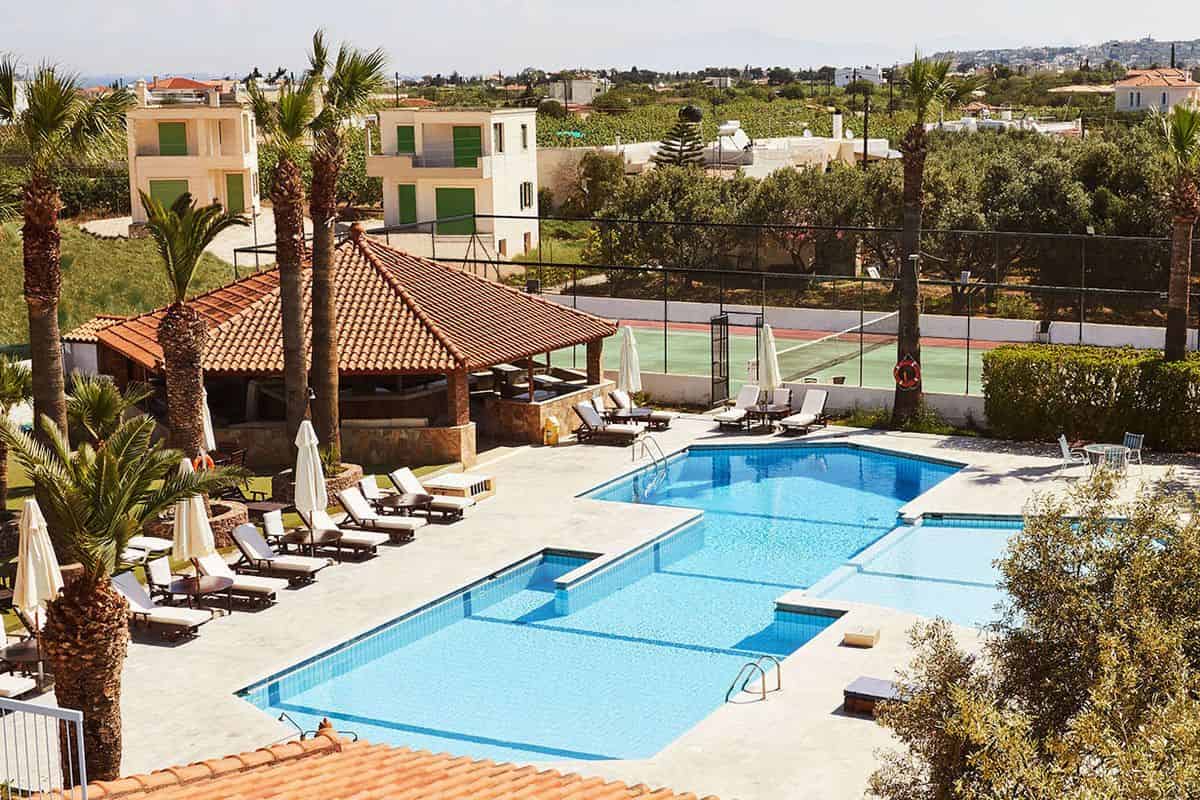
The website of the hotel names a large swimming pool with a pool bar among its on-site features. A restaurant, a bar and a tennis court are named as well. The section on services later on this page gives the details. The website addresses wedding and baptism parties and keeps a pool area for children.
Klonos Anna Hotel Aegina keeps rooms for guests with special needs. Its own home page and its accommodation page both say so. Travellers who want to compare other stays across the island can open the Aegina hotels page. Ask the hotel which rooms and services exist today. The facts above rest on pages written at different times.
What are the rooms like at Klonos Anna Hotel Aegina?
The rooms at Klonos Anna Hotel Aegina come as single, double, triple and family rooms. The hotel’s own pages describe light colours and wood. They list independent air conditioning, a TV, a minibar fridge and a private balcony with a view.
Klonos Anna Hotel Aegina lists single, triple and family rooms on the accommodation page of its own website. It calls the single rooms neat and homey. The triple rooms are meant for a restful stay. The family rooms take up to 4 people in comfort. The booking rules page adds double rooms.
The booking rules of the hotel set the sleeping numbers. A double room takes up to 3 people, and a family room takes up to 4. A double room holds one baby cot or one extra bed, and no more. Babies up to 3 years of age sleep in a cot in the room, the rules say.
The facilities page of the hotel names the fittings of each room at Klonos Anna Hotel Aegina. The list holds beds of modern specification, a TV, independent air conditioning and a minibar fridge. The air conditioning has a remote control. A safe is kept at the reception. Wireless internet is included in all areas.
The facilities page lists a private balcony with a view. The hotel’s text speaks of the Saronic Gulf and the sunsets as the view. Non-smoking rooms are available on request, and so are baby cots. Extra beds and the daily towel change are paid separately. The extra beds depend on availability, so ask the hotel in advance.
The accommodation page says the rooms for guests with special needs carry a specially designed bathroom and equipment. Other fittings appear in this site’s older summer two thousand seven listing of Klonos Anna Hotel Aegina. They are a satellite TV, music channels, a direct-dial telephone and a safe box. Ask the hotel which of these exist today.
What does Klonos Anna Hotel Aegina offer on site?
Klonos Anna Hotel Aegina lists a large pool, a pool bar, a restaurant, a bar and a tennis court. The hotel’s own website also names green gardens with landscaped areas, a lobby, verandas and a cafeteria.
The facilities page of Klonos Anna Hotel Aegina names a large swimming pool. It lists separate areas for adults and for children. Pool service opens at 11 in the morning and stops at 8 at night. The page also refers readers to the pool’s terms of use. A guest can ask the reception for them.
Klonos Anna Hotel Aegina lists a pool bar and a separate bar. The pool bar serves snacks and soft drinks during the same hours as the pool service. A snack bar appears only in the site’s own older listing, dated to summer two thousand seven. The cafeteria gives all-day service.
The restaurant works daily and serves a la carte meals. Its listed hours begin at 11 in the morning and end at 9 at night. The buffet breakfast runs 8 to 10 in the morning. An early breakfast is available on request. Guests who want to be sure of today’s hours can ask the hotel.
Room service is listed for the whole day, starting at 8 in the morning and ending at 9 at night. Breakfast can also be brought to the room, starting at 8 and ending at 10. A tennis court and green gardens with landscaped areas complete the grounds. The older listing adds a TV lounge and a children’s pool.
Klonos Anna Hotel Aegina includes wireless internet in all areas of the hotel. The use of a fax, a copier and a printer is included too. The reception is open 16 hours, and the page invites guests to rest in the lobby. The page does not say which 16 hours those are, so ask the hotel.
Where is Klonos Anna Hotel Aegina in Aegina town?
Klonos Anna Hotel Aegina stands in the Kolona area, on the coast at the northern edge of Aegina town. One booking page and the older listing on this site both give 800 metres to the town centre.
Wikivoyage lists a citadel in ruins and a small museum on the Kolona headland. It puts them 500 metres north of the harbour. According to Wikipedia, the Colona site lies north of Aegina town. The site’s own older listing, dated to summer two thousand seven, names the Kolona area as well.
Both the Aegina Travel Tips page and the Greece Destinations page are open to read. Visit the Moondy Bay Hotel Aegina page, or jump to the Esperides Maisonettes Aegina page. Open the Apollo Hotel Aegina page and the Katerina Hotel Aegina page for more choices.
Klonos Anna Hotel Aegina has a beach just below it, and the sources give two distances. On its own website the hotel gives 70 metres to the nearest beach. One booking page and the older listing on this site both give 50 metres. The two figures are close, and the hotel can tell a guest which is current.
The website of Klonos Anna Hotel Aegina adds a second beach fact. It says a long beach stretches between the hotel and the ancient finds of Kolona. The page gives no length for that beach and no walking time to the site. A guest who wants those details can ask the hotel before arrival.
The same booking page lists two museums under landmarks. It gives 0.3 miles to the Archaeological Museum of Aegina, which is about 500 metres. For the Christos Kapralos Museum it gives 0.7 miles, close to 1.1 kilometres. Wikivoyage places that museum 3 kilometres north of the town, near the island’s north-west tip.
Klonos Anna Hotel Aegina overlooks the Saronic Gulf, according to its own website. The same site invites guests to enjoy the view of the gulf and the island’s sunsets. It describes the setting as calm, among green gardens. Another page of this site, Danae Hotel Aegina, covers a hotel on the same coastal stretch near Kolona.
What lies close to Klonos Anna Hotel Aegina?
Near Klonos Anna Hotel Aegina lie the Colona hill and two museums, the Archaeological Museum and the Kapralos Museum. A hotel-booking page lists the Archaeological Museum at 0.3 miles and the Kapralos Museum at 0.7 miles.
North of Aegina town, Wikipedia says, lies Colona, an ancient acropolis with a shrine of Apollo. The name goes back to Venetian sailors, who navigated by the Doric temple of Apollo, six columns by eleven. Today a single column of its rear building stands, together with the foundations.
The Archaeological Museum of Aegina is the nearer of the two to Klonos Anna Hotel Aegina, about 500 metres away. Wikipedia says Ioannis Kapodistrias founded it in eighteen twenty-eight, and three rooms hold vessels, coins and weapons. Wikivoyage puts the Christos Kapralos Museum 3 kilometres north of town, which does not match the booking page.
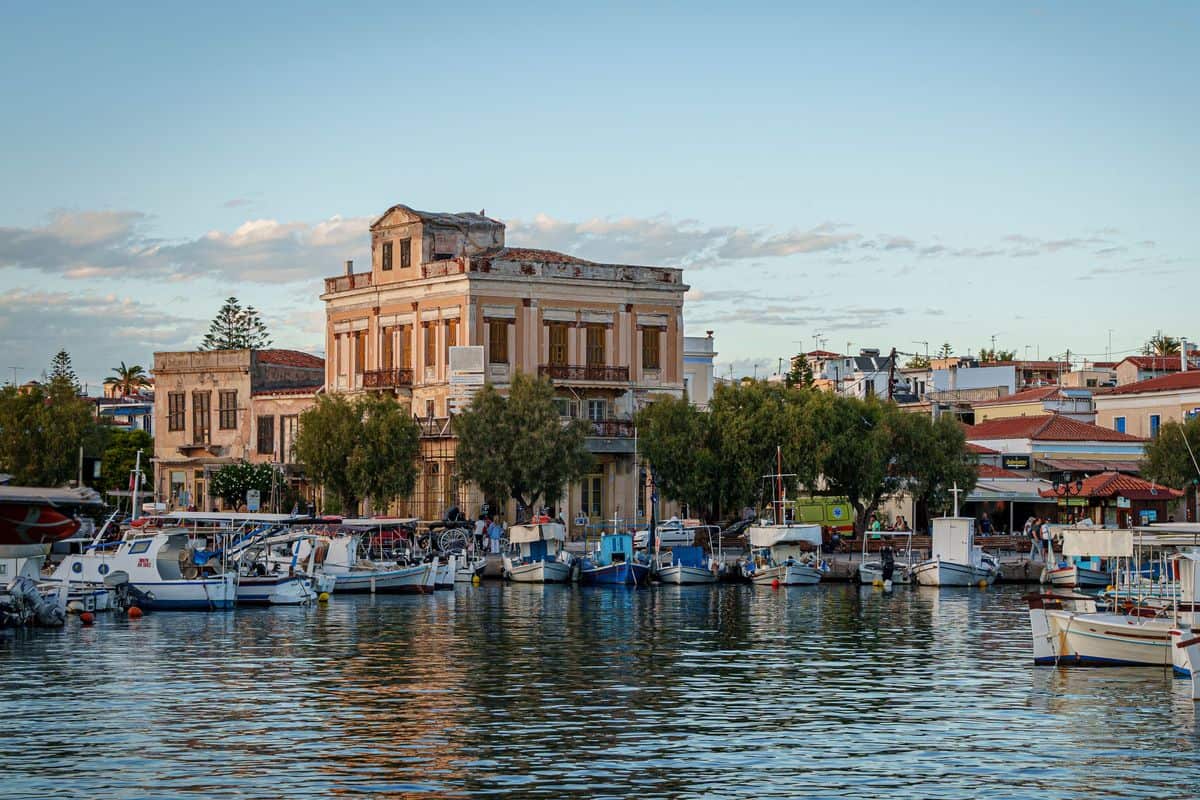
On the west pier, Wikivoyage points to St Nicholas Chapel, a whitewashed building, and notes that cafes line the waterfront. The hotel’s own Aegina page adds fish taverns and traditional shops. In an alley by the quay, Wikivoyage says, a fish market trades daily until 9 in the evening.
The website of Klonos Anna Hotel Aegina calls Moni an uninhabited, protected ecosystem with deer, kri-kri goats and peacocks. Wikivoyage places the wooded island 1 kilometre long, west of Perdika, with a beach bar at its landing. Perdika is a fishing village at the southwest tip, and the water taxi takes 10 minutes.
Wikivoyage puts the Temple of Aphaia 13 kilometres east of Aegina town. Its listed daily hours begin at 10 in the morning and end at 5 in the afternoon. Wikipedia says the temple dates to about 500 BC and sits on a hilltop about 160 metres high. Travellers who prefer a group can read about Aegina tours.
Wikivoyage places the monastery of Saint Nectarios along the road to Agia Marina. Wikipedia records the saint’s life as spanning eighteen forty-six to nineteen twenty. The website of Klonos Anna Hotel Aegina calls the monastery the place where the twentieth-century saint lived. Wikipedia gives his feast day as 9 November.
How do travellers reach Klonos Anna Hotel Aegina from Athens?
Reaching Klonos Anna Hotel Aegina means a sea crossing to Aegina town, on sailings that leave the harbour of Piraeus. The hotel’s own pages say ships and ferries reach the port daily. Both Wikipedia and Wikivoyage list a fast hydrofoil and a slower ferry.
Wikipedia gives forty minutes for the hydrofoil crossing and puts the ordinary ferry near the one-hour mark. Wikivoyage also lists forty minutes for hydrofoils with foot passengers, and 70 minutes for the slower vessels that take vehicles. It adds hourly hydrofoils in normal times, 7 in the morning up to 5 in the afternoon.
The crossing to Klonos Anna Hotel Aegina begins at Piraeus. Wikipedia says the Themistoclean Walls were finished in 479 BC. Together with the new ship sheds, the walls made Piraeus both a naval base and a trading port. The Athenian fleet had fought at Salamis in 480 BC.
The cruise port has 11 berths shared by three terminals, Wikipedia says. Terminal A is the main one, open 24 hours and a short walk to the centre of Piraeus. Terminal B can park 120 tour buses. The passenger quay measures 2.8 kilometres in length.
The hotel’s pages call the small church of Agios Nikolaos one of the first sights on arrival by ferry. Two listings give 800 metres as the distance between Klonos Anna Hotel Aegina and the town centre. Ask the hotel how to cover that distance.
Wikivoyage calls the island buses a limited service. Three routes start at the harbour bus stand, with destinations shown only in Greek. It judges a taxi the better pick for a day out, since the driver knows the roads. Five agencies near the harbour, it adds, rent out cars, motorbikes and scooters, which makes car hire possible.
What else do travellers ask about Klonos Anna Hotel Aegina?
What hours apply to arrival and departure at Klonos Anna Hotel Aegina?
One hotel-booking page gives the hours of a stay. Arrival opens after 3 in the afternoon, and departure falls before 11 in the morning.
Times change, and a page that repeats them can be out of date. A traveller on a late ferry or an early boat can ask Klonos Anna Hotel Aegina what is possible. One question is whether a bag can wait at the reception.
Does Klonos Anna Hotel Aegina arrange wedding and baptism receptions?
The events page of the hotel’s own website says the hotel undertakes wedding and baptism receptions. It names a space beside the swimming pool, and the couple chooses the menu.
The same page says the hotel management of Klonos Anna Hotel Aegina organises the whole reception. It also lists a wedding stay, with the view, the balcony and room service.
Before any plan, ask about the date, the guest numbers, the menu choices and the plan for rain. Only the hotel can answer.
Does the hotel take pets, babies and guests with special needs?
One hotel-booking page says pets are allowed on request at Klonos Anna Hotel Aegina. It adds that a charge can apply, paid separately. The hotel’s own website gives no rule on pets, so ask first.
For babies, the facilities page of the website lists baby cots on request. Its booking-rules page says babies up to 3 years sleep in a cot in the room. A double room holds up to 3 people, a family room up to 4.
The accommodation page lists specific rooms for guests with special needs, with a specially designed bathroom. One booking page also lists accessible rooms. Ask Klonos Anna Hotel Aegina which rooms these are.
What is the ancient coinage of Aegina?
Wikipedia credits Aegina with the earliest coins of Europe. Citing Ephorus, it says Pheidon of Argos founded the island’s mint. Its coin was the Aeginetic stater.
The article shows an electrum coin that carries a turtle, which it calls sacred to Aphrodite. It dates that strike to about 700 BC.
Aegina also gave the Greek world a system of weights and measures. The article calls it one of the two in general use. The Euboic-Attic standard was the other. On the coins, the article says, the sea turtle gave way to a land tortoise. It puts that change at 456 BC, in the First Peloponnesian War.
What are the Tower of Markellos and the Orphanage of Kapodistrias?
Both buildings belong to the island town where Klonos Anna Hotel Aegina stands. Wikipedia suggests the Tower of Markellos was a Venetian watch tower. The Venetians held the island again between sixteen eighty-seven and seventeen fourteen. The aim was defence against a Turkish siege.
After seventeen fourteen the tower was left empty. Around eighteen hundred and two, Spyros Markellos, a leader of the revolution, bought it to live in. Between eighteen twenty-six and eighteen twenty-eight the interim government of the new Greek state met in it. Police and other state offices used it later, until it was abandoned again.
Wikipedia says Ioannis Kapodistrias had the Orphanage built over eighteen twenty-eight and the year after. He meant it as a home for war orphans of the Greek struggle for independence. Locals call the building The Prison, since it later became a jail that held political prisoners under the Greek Junta.