
An Acropolis guided tour with Acropolis Museum joins a walk across the ancient rock with a visit to the gallery that holds its original sculptures. For more days in the country, browse our tours in Greece.
This page covers what the tour includes, its length and meeting point, what the tour guide shows at the Parthenon, the other temples and gates on the hill, the galleries of the Acropolis Museum, the Parthenon marbles split between Athens and London, the quietest time to visit with what to wear, and the questions visitors ask.
What does an Acropolis guided tour with Acropolis Museum include?
Booking an Acropolis guided tour with Acropolis Museum puts the hill and the museum into a single booking. One ticket seller lists entry to the Acropolis, the Parthenon and the museum, plus an English-speaking tour guide.
The same listing gives each part its own walk. You get a 2-hour guided walk on the Acropolis and a 1.5-hour guided walk in the museum. The seller also names a travel book and a detailed city map. You choose between an English-speaking and a Spanish-speaking tour guide.
Another operator builds an Acropolis guided tour with Acropolis Museum in two steps. The base tour is a 2-hour walk with a licensed tour guide. The museum is an optional upgrade, and the operator describes it as a 2-hour guided visit. You pick up your tickets from the tour guide at the start of the walk.
Read what is left out before you book. That operator lists the Acropolis entry tickets as not included. You book them online, or you pay in cash straight to the tour guide on the day.
The first seller bundles the entry tickets into its tour. Both ways exist, so the list for your exact Acropolis guided tour with Acropolis Museum matters. Check the entry line before you compare two tours side by side.
Languages differ by tour. A sunset tour from the first seller lists a licensed tour guide in English, Spanish or French.
Sound matters on a busy hill. A different tour from that seller, an early-entry walk, gives every guest a headset. That way everyone hears the licensed tour guide clearly. Look for the same detail in the listing of your own tour.
How long is the tour, and where does the group meet?
On one seller’s listing, an Acropolis guided tour with Acropolis Museum runs 2 hours on the hill. The museum part runs 1.5 hours. Another operator’s morning walk starts at 9 in the morning, at its office close to the Acropolis.
That operator asks you to meet your licensed tour guide at its office by the Acropolis. The group then walks a short distance to the monuments. The hill walk lasts about 2 hours. The rock itself rises 150 metres above sea level.
The walk ends at the Acropolis exit at Mars Hill, by the Plaka area. The operator’s longer upgrade, which adds the Ancient Agora, ends by Monastiraki square. If you picked the museum upgrade, the Acropolis guided tour with Acropolis Museum carries on from that exit.
The Acropolis Museum sits at the southeastern slope of the hill, 400 metres away on foot from the Parthenon. Its entrance is on Dionysiou Areopagitou Street, next to Akropoli metro station on the red line. That short link is why the Acropolis guided tour with Acropolis Museum fits both stops into one tour.
Group sizes depend on the seller. A separate, longer tour from the first seller, which adds the Ancient Agora, runs in a small group of 20. The seller lists a private upgrade for that tour. The museum itself accepts group bookings of 16 to 40 people.
Inside the building, every visitor, groups included, goes past the machines that validate tickets on the ground floor.
Evening visits run longer. One operator runs a museum-only tour of 3 hours, from 7 to 10 in the evening on Fridays. It tailors the focus to the interests of the group.
Ask the seller for the length and the group size of your Acropolis guided tour with Acropolis Museum. Listings differ.
What does the tour guide show you at the Parthenon?
A tour guide at the Parthenon points out what the eye misses: the temple has almost no straight lines. One ticket seller promises you will hear how the Parthenon was designed with optical tricks. An Acropolis guided tour with Acropolis Museum puts that explanation in front of the columns.
Careful measuring in the 19th century showed that the temple bends the rules. The stone floor step bulges upward in the middle, rising 10.3 centimetres across a span of 70 metres. The columns swell slightly, and the columns and walls lean a little inward. The corner columns also sit slightly out of place.
The main theory says the builders curved the lines to cancel a trick of the eye. Straight edges against the sky can look hollow, so the curves make them look straight. Other scholars point to drainage or to looks alone. On an Acropolis guided tour with Acropolis Museum, the tour guide lays out each idea at the corner.
Next come the carved stories above the columns. On the east side, the gods battle the Giants. The west side has Athenians fighting the Amazons. On the south side are Lapiths against Centaurs, and the north side seems to show the sack of Troy. Christian iconoclasts later cut away figures on three sides.
Only two corners of the east pediment survive, and they show a full day passing. The horses of the sun god Helios rise eagerly on the left. The horses of the moon goddess Selene tire on the right. A tour guide on an Acropolis guided tour with Acropolis Museum reads them like a clock.
On the west pediment, even the backs of the statues are finished. The largest figure, Poseidon, broke when Francesco Morosini tried to remove it in the late 17th century. The back of its torso is now in London. The front is in Athens, and an Acropolis guided tour with Acropolis Museum leads you to it.
Which other temples and gates stand on the Acropolis hill?
Four more stops wait by the Parthenon: the Propylaea, the Erechtheion, Athena Nike’s temple and the Odeon of Herodes Atticus. One operator’s walking route names all four. An Acropolis guided tour with Acropolis Museum links each stop to the sculptures you see later.
The Propylaea is the gate you walk through first, since it was the entrance to the hill. Pericles ordered it to rebuild the Acropolis after the Persian wars, and it was wide enough for chariots. Its roof beams were marble girders held up by iron bars. Berlin’s Brandenburg Gate took its idea from this gateway.
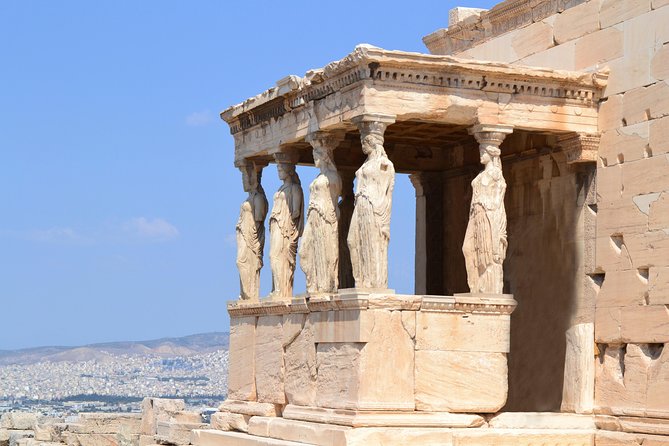
The Erechtheion breaks the Greek rules. Temples are balanced, but this Ionic one is lopsided. Scholars blame the uneven ground or the cults inside. One ticket seller says the tour guide explains why the temple honoured Athena’s olive tree. In later centuries it served as a palace and then as a home for the Ottoman commander’s harem.
Its porch once rested on Caryatids, and the originals are now kept in the museum. The same ticket seller says an Acropolis guided tour with Acropolis Museum lets you see them.
Athena Nike’s temple is a small one on a bastion, to the right as you enter. It has four Ionic columns of white marble. It measures 8 metres by 5.5 metres and stands 7 metres tall.
Workers took it apart to replace its crumbling concrete floor, and its frieze went to the new museum. Copies stand in place, and the originals wait for you on an Acropolis guided tour with Acropolis Museum.
The walk finishes with the theatres on the slope. One operator calls the Theatre of Dionysus the first theatre of humanity. Another lists the Odeon of Herodes Atticus among the stops of its two-hour morning walk. Both sit on the route of an Acropolis guided tour with Acropolis Museum.
What will you see inside the Acropolis Museum?
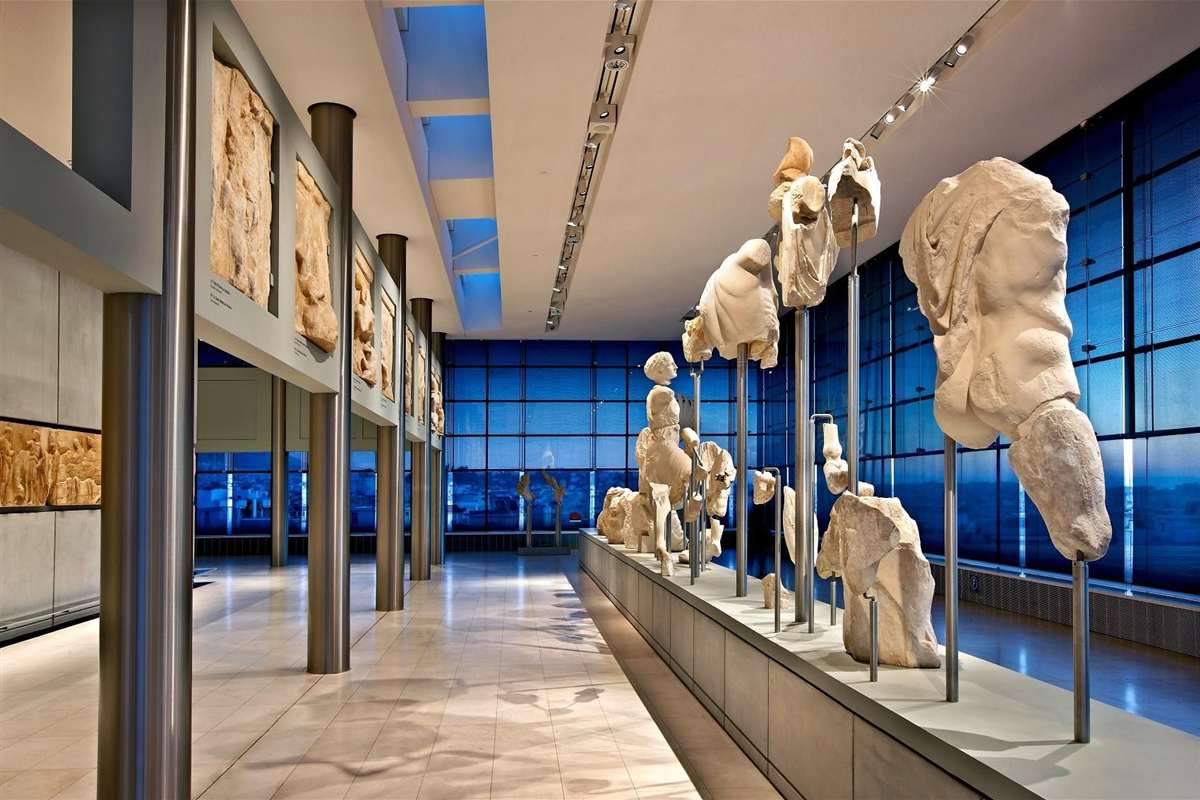
An Acropolis guided tour with Acropolis Museum takes you through galleries of every find from the rock or its slopes. You then climb to a glass-walled hall that holds the Parthenon sculptures.
The museum was designed to hold objects dating from the Greek Bronze Age through Roman and Byzantine times. On an Acropolis guided tour with Acropolis Museum, the first level shows objects found on the hill’s slopes. Its long hall has a sloping floor, like the climb up to the rock.
A large trapezoidal hall follows, with the Archaic finds. The same level holds sculptures from other Acropolis buildings, such as the Erechtheion. The city’s visitor bureau dates the Archaic statues from the 7th century BC to the end of the Persian Wars.
The top level is set at a skew to the floors below. It faces the same compass points as the Parthenon. Daylight enters through glass on all four sides. A row of 48 columns marks the outline of the ancient temple. Visitors on an Acropolis guided tour with Acropolis Museum get a direct view of the Parthenon from here.
Here the pediments, metopes and frieze are placed facing out, just like on the temple. The frieze runs behind the metopes in one continuous band. You can walk all the way around it. Part of it is original marble, and part is made of cast replicas.
The Caryatids are the six sculpted women who held up the porch of the Erechtheion. One of them ended up in the British Museum. The original figures in Athens won the museum a conservation award. Visitors on an Acropolis guided tour with Acropolis Museum can see them. The visitor bureau notes an empty circle left for the missing one.
Why are the Parthenon marbles split between Athens and London?
Agents of Lord Elgin took about half of the Parthenon sculptures that survive, in the early 19th century. They now stand in the British Museum. An Acropolis guided tour with Acropolis Museum shows you the part that stayed in Athens.
Elgin’s agents also took pieces from the Erechtheion, the Propylaia and Athena Nike’s temple. All three stand on the hill you visit on an Acropolis guided tour with Acropolis Museum. Elgin said the Ottoman rulers of Athens gave permission. People have disputed whether his actions were legal. Lord Byron likened them to vandalism or looting.
London holds 21 figures from the pediments, 15 of the 92 metope panels, and 75 metres of the frieze. Seven museums around the world hold parts of the Parthenon marbles. The two main holders are the Acropolis Museum and the British Museum. This split is why an Acropolis guided tour with Acropolis Museum tells only part of the story.
Two views explain the split behind your Acropolis guided tour with Acropolis Museum. Greece argues that the marbles were taken illegally or unethically. It says they are of great cultural value and belong in one display beside the other Parthenon finds.
The British Museum says it acquired them legally. A British inquiry agreed with that view, and Parliament backed the purchase by 82 votes to 30. The museum also says its collection shows them next to other ancient cultures.
Greece formally asked for the marbles back and listed the dispute with UNESCO. Britain declined UNESCO’s offer of mediation. UNESCO later asked the British government to settle the matter between governments. British and Greek officials are still talking.
A hall for the Parthenon marbles was central to every recent plan for the new museum. Officials once suggested that Greece had no suitable place to show them.


Which hours are calmest on the hill, and what do you wear?
The quietest slots sit at the two edges of the day. One seller sells an early-access walk that starts before the crowds, and a sunset walk timed near last entry. Book your Acropolis guided tour with Acropolis Museum at one of those edges.
The crowds are real. Athens Walks says the Acropolis draws more visitors than any other sight in the city. It starts its morning walk early to avoid them. A ticket seller adds that a tour guide helps you move through the uneven paths and the crowded entrance.
The same seller sells a premium sunset tour with a licensed tour guide. Its listing says the tour is timed for fewer crowds. It runs close to last entry, for a calmer pace with more room. The listing also promises golden-hour photo stops. That slot suits an Acropolis guided tour with Acropolis Museum if mornings are too early for you.
The season matters as well. Wikivoyage names spring and late autumn as the top times for Athens. Winter is low season, with the occasional rainy or snowy day and fewer tourists. Summer can be extremely hot and dry during heatwaves.
That heat explains the dress code at Athens Walks. It lists a hat, especially in June, July and August. Pack one for the hill part of an Acropolis guided tour with Acropolis Museum. Check the weather before you set out.
What other questions come up about an Acropolis guided tour with Acropolis Museum?
What are the museum’s opening hours?
The regular schedules on the museum’s official page start at 9 am. On days that close at 5 pm, last entry is 4:30 pm. Clearance of the galleries begins 15 minutes before closing. Plan the museum part of your Acropolis guided tour with Acropolis Museum around that.
On 24 and 31 December the museum closes at 3 pm. On August full-moon evenings and the Night of Museums across Europe, it stays open until midnight.
Can children join the museum visit?
Yes. The museum gives free admission to children up to the age of 5 from non-EU countries, shown with a passport. Visitors aged under 25 from EU countries get in free on showing an ID card or passport. Under-25s from non-EU countries get reduced admission.
Athens Walks asks that an adult accompany children on its morning walk. Put the same question to the seller of your Acropolis guided tour with Acropolis Museum before booking.
Can you see the dig under the museum?
Yes. The museum ticket covers the archaeological excavation beneath the building. You reach it from the entrance courtyard. The museum stands on pillars above the site. The dig revealed two layers of modest roadside houses and workshops, one early Byzantine and one classical. Ask your tour guide whether your Acropolis guided tour with Acropolis Museum visits it.
Is there a restaurant at the museum?
Yes. Every Friday and Saturday the restaurant on the second floor is open until midnight. The café and shop on the ground floor need no ticket. For the second-floor restaurant and shop, you collect a free admission ticket at the Ticket Desk. A night-tour review adds that a live jazz band plays there on Fridays.
Is the museum accessible for people with mobility needs?
The museum keeps elevators for priority use by visitors with mobility difficulties. A person with a disability of 67 percent and one escort enter free with a disability certificate. Tours differ, though. Athens Walks lists its morning walk as not wheelchair accessible. Read the access line of your own Acropolis guided tour with Acropolis Museum.