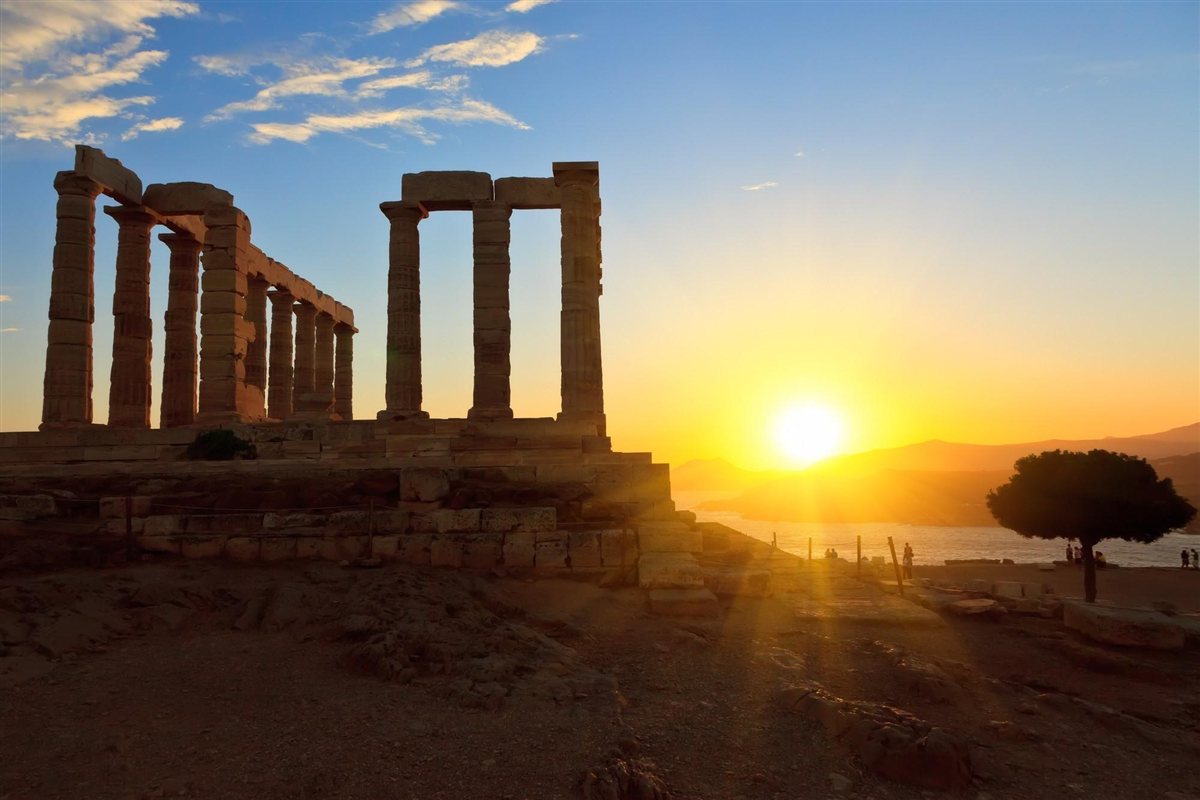
A Cape Sounion sunset tour from Athens leaves in the afternoon, follows the Athenian Riviera south and ends at the Temple of Poseidon while the sun drops towards the Aegean. For other trips from the capital, open our hub of tours in Greece.
This page covers what the trip includes, how long it runs, where the cape lies, why the light suits the late hours, the Temple of Poseidon and its builders, Poseidon, King Aegeus, Lord Byron, the Temple of Athena Sounias, the walls and the triremes, the Riviera suburbs, Lake Vouliagmeni, Lavrion, the Saronic Gulf, the islands you see, the Aegean, Attica and the questions travellers ask.
What does a Cape Sounion sunset tour from Athens include?
A Cape Sounion sunset tour from Athens includes a coach ride, time at the Temple of Poseidon, and the sunset. Each operator adds its own extras, such as a tour guide or the entry ticket.
One operator offers a bus with air conditioning and the entry ticket to the Temple of Poseidon. A tour guide leads a tour inside the archaeological site, and the group gets one hour of free time there. An escort travels along and tells the legends of the region.
Part of the drive during a Cape Sounion sunset tour from Athens follows the sea. One operator’s route runs along the old Olympic site at Hellinikon, then on to Glyfada, Vouliagmeni and Varkiza. Another operator sends a round-trip coach from a central meeting point in Athens. It offers a multilingual audio guide, or an English-speaking archaeologist as tour guide.
A third operator sends an archaeologist along as trip attendant. Its list also holds basic travel insurance and an audio guide app. Its entrance fee and a guided tour inside the site are not included. Before you book, read what your chosen Cape Sounion sunset tour from Athens lists.
Meeting points differ too. One operator’s tour guide meets guests right outside Halandri metro station, which is on the Blue Line. The third operator meets guests at Platia Karaiskaki, and a trip attendant holds a sign there.
The plan differs in the private version of the Cape Sounion sunset tour from Athens. One private-tour operator adds the Stavros Niarchos Foundation Cultural Center and Lake Vouliagmeni, then a walk by the sea. It uses a private air-conditioned vehicle and a professional English-speaking tour guide. Lunch is not included.
How long is a Cape Sounion sunset tour from Athens?
According to operators, a Cape Sounion sunset tour from Athens takes about 4 to 5 hours in total. The start time follows the season and the sunset time, so the group reaches the cape before sunset.
One operator of a Cape Sounion sunset tour from Athens states that its departure time depends on the season. A travel portal’s listing for an operator gives half past 6 in the evening from late spring to 20 August. It gives half past 5 from 21 August to 15 September. From 16 to 30 September, it is 5 o’clock.
One private-tour operator says that standard Sounion tours last around 4 hours. Much of that time goes on driving, with only about 1 hour at the Temple of Poseidon. Another operator lists a 5-hour tour of the temple and the cape. It uses a round-trip coach from central locations in Athens.
A third operator sets out the steps of one Cape Sounion sunset tour from Athens. The bus ride takes approximately 1.5 hours along the coast. The group then gets free time at Cape Sounion and the temple, listed as 1.5 hours. Another 1.5 hours on the bus brings everyone back to the centre of Athens.
The private operator states that its own trip lasts approximately 5 hours. A swimming stop can be added, and it extends the trip by approximately 1 hour. Because the trip is private, it can also start in the morning. For coach tours, one listing asks guests to be at the meeting point 10 to 15 minutes ahead of departure.
Where is Cape Sounion, and how far is it from Athens?
Cape Sounion is the headland that closes the Attica peninsula in the south. Athens lies about 70 kilometres (43 miles) to the northwest. Our Cape Sounion sunset tour from Athens ends on that headland.
For any Cape Sounion sunset tour from Athens, Wikipedia gives the exact distance: 69.5 kilometres, or 43.1 miles. It adds that the town of Lavrio lies 8 kilometres to the north. One operator rounds the figure to 70 kilometres, so the two sources agree.
The Athens Riviera ends at the cape. In local government, the cape falls under Lavreotiki, a municipality of East Attica. Two villages flank it, Kato Sounio and Legrena.
Any Cape Sounion sunset tour from Athens ends at ruins on a headland. The Aegean Sea wraps around the ruins on three sides. Wikipedia calls the cape a popular day excursion for visitors from Athens. It adds that the Sounio national park began in the nineteen seventies. Its core area covers 750 hectares.
Travel time depends on the traffic. One operator’s FAQ gives a drive of 1 hour to 1.5 hours by car. Public bus takes around 2 hours. Another operator lists a coach ride that lasts roughly 1.5 hours in each direction. Our Cape Sounion sunset tour from Athens takes the coastal road, which that operator calls a scenic route.
Wikipedia classes the climate at the cape as hot semi-arid. The summer months bring heat and dry weather, and winters are mild and wetter. That climate is one reason the hour of the visit matters. The next section explains the choice.
Why do tours reach Cape Sounion in the late afternoon?
Tours reach Cape Sounion in the late afternoon because the sunset is the main sight. One operator names the hour just before sunset as the ideal time, with the temple bathed in golden light. That is why the Cape Sounion sunset tour from Athens runs in the evening.
The habit is old. Wikipedia says visitors have come for the sun going down over the Aegean since modern tourism began. That was in the early nineteenth century. Any Cape Sounion sunset tour from Athens follows that tradition.
The second reason is comfort. The operator’s FAQ says late afternoon brings cooler temperatures than the midday heat, especially from late spring to September. Summer days are hot and dry. A cooler hour makes the walk among the columns easier on the Cape Sounion sunset tour from Athens.
Calm is the third reason. The same FAQ says visitors tend to leave after exploring the site. Staying until sunset gives a quieter and more tranquil atmosphere. The evening hour suits the Cape Sounion sunset tour from Athens for that reason.
The Cape Sounion sunset tour from Athens ends with its reward, the sunset itself. One operator describes the sun slowly dipping into the sea. A private-tour operator says guests catch the last rays over the water from the site of the temple itself. That operator also says its tour can start in the morning on request, because the tour is private.
The FAQ gives a rule for planning a visit on your own. Check the sunset time for the day and arrive at least an hour before it. That leaves time to walk around the temple before the sun reaches the horizon. It also warns that darkness comes quickly after sunset.
What is the Temple of Poseidon at Cape Sounion?
The Temple of Poseidon is an ancient Greek temple on the southern tip of Attica, dedicated to the sea god. The Cape Sounion sunset tour from Athens takes visitors to its standing columns on the headland above the Aegean Sea.
The remains rest on a headland, and the sea surrounds them on three sides. The temple belongs to the Golden Age of Athens, as one of its major monuments. The cliff rises almost 60 metres above the water, which makes the temple visible to ships nearing Attica. One operator describes it as a structure of the fifth century BC.
Archaeologists tie the choice of this cape to ship paths into and out of Piraeus, the harbour of Athens. Ships heading for Attica had to pass the headland, and sailors saw the temple from far away. Visitors on any Cape Sounion sunset tour from Athens stand where archaeologists also see a lookout.
In Greek belief, Poseidon was the master of the sea. Trade by sea mattered to Athens. So did its navy, which helped the city rise and survive in the fifth century BC. The god therefore held special value for Athenians. One operator’s listing for the Cape Sounion sunset tour from Athens says the temple’s size reflects the god’s importance.
Worship on the cape is older than the temple. Sanctuaries existed here from the eleventh century BC, long before the Classical temple. Two cult centres, one for Athena and one for Poseidon, go back to about 700 BC. Travellers taking the Cape Sounion sunset tour from Athens walk among ruins with a very long past.
Who built the Temple of Poseidon, and when?
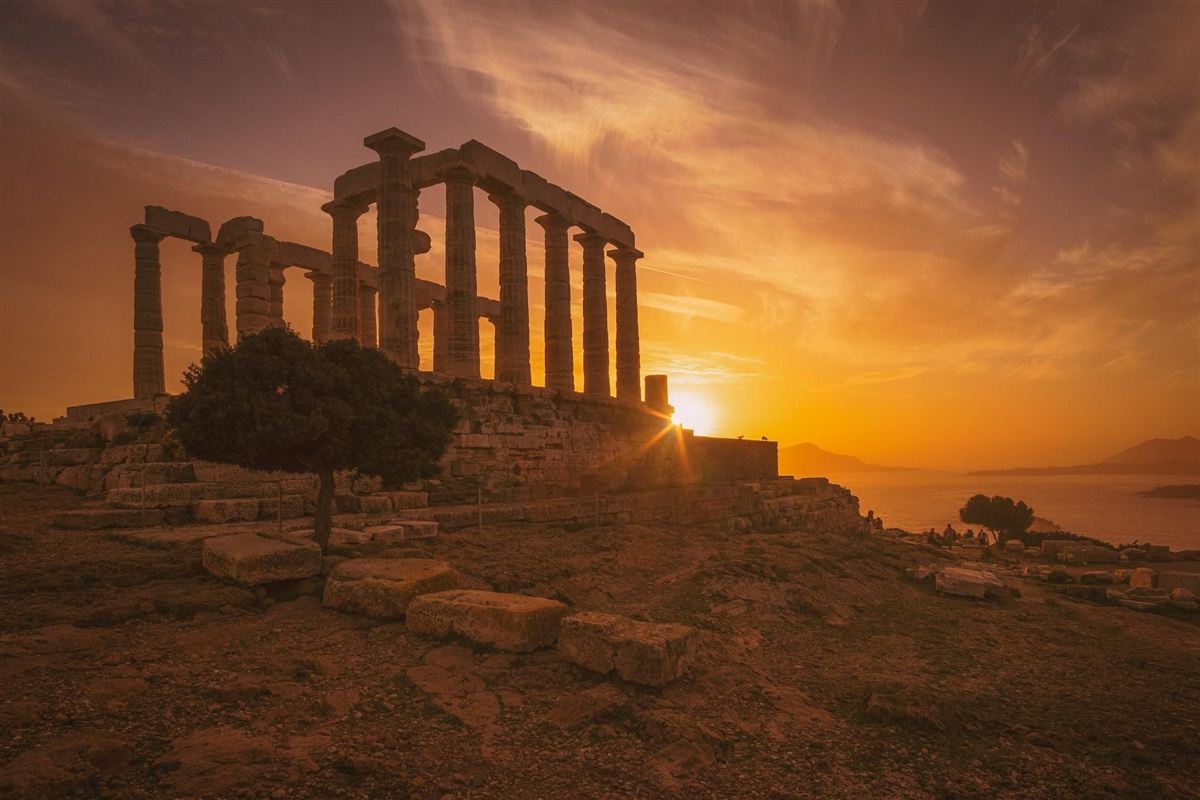
The Athenians built the temple between 444 and 440 BC, in the time of the Athenian statesman Pericles. It replaced an older Archaic temple, so the Cape Sounion sunset tour from Athens visits a rebuilt monument.
Pericles also rebuilt the Parthenon in Athens. When whole, the Sounion temple looked very much like the Temple of Hephaestus beneath the Acropolis. One source names a shared architect for both temples as a possibility. Builders raised the new temple over the remains of the old one, on the same cliff.
In the late nineteenth century, the archaeologist Wilhelm Dorpfeld dug around the site. He uncovered the remains of an Archaic limestone temple beneath the later one. It dates to around 500 BC and measured about 13 by 30 metres, close to the new temple. The Cape Sounion sunset tour from Athens brings you to that spot.
The older temple was not finished when it was destroyed. Dorpfeld argued that Persian troops destroyed it in 480 BC. Valerios Stais, another excavator, suggested that high winds or an earthquake caused its collapse. Later builders laid new marble over the old limestone steps. So the ruins seen during the Cape Sounion sunset tour from Athens hold two building phases.
Stais led the fullest excavations here, which ended in the early twentieth century. His inscriptions, found at the site, showed that the temple belonged to Poseidon, not Athena. That disproved a claim by the ancient writer Pausanias. The finding matters during the Cape Sounion sunset tour from Athens. It confirms the sea god as the owner of the temple.
How is the Temple of Poseidon built?
The Temple of Poseidon is a Doric temple built of white marble, with columns on all four sides. A Cape Sounion sunset tour from Athens ends at this temple, perched almost 60 metres above the sea.
The plan is the classic one for a Greek temple. Anyone taking a Cape Sounion sunset tour from Athens reads it from the ground. Columns ran along all four sides, six across the front and 13 along each side. That makes 34 columns in all.
The columns follow the Doric order. It is the oldest Greek style, and the plainest in its basics. Look up during a Cape Sounion sunset tour from Athens, and the details are easy to spot.
A Doric column is fluted and has no base. It stands straight on the stone platform, under a plain round capital. At Sounion each column is 6.10 metres high. It is 1 metre wide at the base and 79 centimetres wide at the top.
Inside the ring of columns stood the naos, the hall of worship. It was a windowless rectangular room. It is thought to have held a colossal bronze statue of Poseidon, as high as the 6-metre ceiling. Stand at the temple during a Cape Sounion sunset tour from Athens and picture that room.
The white marble was quarried locally. The builders laid it over the limestone steps of the earlier temple, so it wrapped around them. One historian notes that marble ceilings on the flanks are rare in Greek temples.
The temple sits on a cape at the far south of Attica, ringed on three sides by the Aegean Sea. That headland is where a Cape Sounion sunset tour from Athens watches the sun go down.
Which parts of the Temple of Poseidon still stand?
Fifteen of the 34 original columns of the Temple of Poseidon still stand. Travellers choosing a Cape Sounion sunset tour from Athens find a ruin: Doric columns against the evening sky.
The other 19 columns are gone. The Venetians called the cape Capo Colonne, which means Cape of Columns. The name is reported from the seventeenth century. Columns of the temple had remained standing since antiquity, unusually. Visitors have sought out the sunset here since the early nineteenth century. Today a Cape Sounion sunset tour from Athens follows that habit.
Not every column survived the eighteen twenties. Two columns collapsed then. An Austrian naval commander ordered one of them, the fifth from the northeast corner, taken down and shipped to Venice. Five of its eight drums and the capital now stand in a palazzo garden there. No Cape Sounion sunset tour from Athens goes there.
Other pieces went to England. Five known drums of the temple are there. Four sit in the Chatsworth House garden, holding up a bust. The British Museum keeps another, probably the seventh drum of the same column. A Cape Sounion sunset tour from Athens shows the columns that stayed. These drums are the ones that left.
To picture the whole building, look at the Temple of Hephaestus in Athens, which is well preserved. When complete, the Sounion temple closely resembled it. The European Union and the Greek culture and sports ministry co-financed a project to arrange the site. It covers the ruin that a Cape Sounion sunset tour from Athens visits.
Who was Poseidon, the god of the sea?
Poseidon was one of the twelve Olympian gods of ancient Greece. He ruled the sea, storms, earthquakes and horses. The Cape Sounion sunset tour from Athens ends at his temple, which stands on a cliff above his waters.
Homer says the three sons of Cronus divided the world by lot. Zeus won the sky, Hades won the underworld, and Poseidon won the sea. During the Cape Sounion sunset tour from Athens, that sea fills the view from the temple.
His symbol is the trident, a weapon with three prongs. Myths say one strike of it made springs flow from the ground.
The Greeks asked him for safe travel on the water. Sailors prayed to Poseidon before a voyage, and he was the protector of seafarers. In his kind mood he gave calm seas. When angered, the myths say, he sent earthquakes, drownings and shipwrecks.
Cape Sounion suits a sea god well. The Odyssey is the earliest writing that names the cape. Tour operators add that it was the last safe landing before Poseidon scattered the returning Greek navy. The writer Aristophanes records that people worshipped Poseidon at Sounion. So the Cape Sounion sunset tour from Athens stops where his cult once lived.
Poseidon also lost a contest for Athens. Athena offered an olive tree. Poseidon drove his trident into the ground, and a salty spring rose. The Athenians chose Athena. In anger, Poseidon sent a flood across the Attic plain.
What is the myth of King Aegeus and the Aegean Sea?
Aegeus was an Athenian king in Greek myth, and the Aegean Sea carries his name. When he believed his son Theseus had died, he leapt into the sea. The Cape Sounion sunset tour from Athens offers a view over that same water.
Theseus was the son of Aegeus. Every nine years, King Minos of Crete made Athens send seven young women and seven young men. They were fed to the Minotaur, a vicious monster. Theseus sailed to Crete to end this duty, and he killed the beast.
Before the voyage, Aegeus asked his son to hang a white sail if he lived. Theseus forgot. Aegeus saw the ship come home without one and feared the worst. Overcome by grief, he leapt into the sea, and the sea took his name. An operator’s escort on the Cape Sounion sunset tour from Athens tells the legends of the region.
Poseidon appears in this story as well. Greek tales say Aegeus and Poseidon both slept with Aethra, the mother of Theseus, on the very same night. So Theseus had a human father and a divine one. So the Cape Sounion sunset tour from Athens visits a god who is part of this tale.
King Minos doubted that claim. He threw a ring into the sea and told Theseus to fetch it. Dolphins led Theseus to the palace of Poseidon, and he came back with the ring.
Authors of old also traced the sea’s name to places called Aigai, closely tied to Poseidon. The god himself carried the title Aigaios. In the Iliad, his golden palace stands deep in the water at Aegae. The Cape Sounion sunset tour from Athens shows that realm from the cliff top.
One operator asks visitors at the temple to think of old King Aegeus. In death, he gave his name to the whole sea. The headland has that water on three sides, so the tale is easy to picture. The Cape Sounion sunset tour from Athens ends as the sun sets over it, seen from the ruins.
Why did Lord Byron write his name at Sounion?
One column of the Temple of Poseidon carries a name carved low on its base, credited to Lord Byron. Travellers on the Cape Sounion sunset tour from Athens search for it among the columns. No direct evidence proves Byron cut the letters.
Why does the name matter at the cape? Byron, a Romantic poet from Britain, wrote Don Juan and Childe Harold’s Pilgrimage. In his youth he took the Grand Tour, a customary stage in the schooling of young noblemen. He spent months in Athens, and records document two trips he made to Sounion.
One account links the inscription to his first visit to Greece, before he acquired fame. One operator lists the graffiti among the highlights of the Cape Sounion sunset tour from Athens it sells. A second operator calls it nineteenth-century vandalism. One more operator says the name is on one of the temple’s remaining Doric columns.
His poem Isles of Greece names Sounion, and so the Cape Sounion sunset tour from Athens touches verse. Later he backed the Greek cause against the Ottomans, and Greeks revere him as a folk hero. Travel books by George Wheler and Edward Dodwell describe the cape too. An Athens suburb, Vyronas, was named in his honour.
The graffiti belongs to a long habit of visiting the cape for the view. Tourists have sought out the Aegean sunset at these ruins ever since tourism took shape in the early nineteenth century. That old custom lives on in the Cape Sounion sunset tour from Athens, built around the sunset.
What is the Temple of Athena Sounias at the cape?
The Temple of Athena Sounias stood on a low hill near the Temple of Poseidon, 300 metres to its northeast. It was built in 470 BC, replacing a sixth-century BC shrine. The larger temple is the goal of the Cape Sounion sunset tour from Athens, yet Athena shared the headland.
Its plan was unusual. Colonnades ran along the southern and eastern sides only, with none on the west or north. Vitruvius remarks on it. Beside the temple lay a walled precinct, identified as the burial mound and shrine of Phrontis, helmsman to King Menelaus. Finds on the site date from as early as 700 BC.
The Odyssey says Phrontis died at his post as the ship rounded the cape. Menelaus then buried him at Sounion. A smaller Doric temple next door is thought to honour Phrontis or Artemis. This earliest written mention of the place travels with the Cape Sounion sunset tour from Athens.
Offerings wrecked in the Persian invasion filled a deep pit nearby. The temple of Athena was pulled down in the first century AD. Pieces of its columns went to Athens, for the South-East temple of the Agora. The group takes the opposite road out of the city on the Cape Sounion sunset tour from Athens.
Sounion was especially sacred to Athena, and Aristophanes tells us Poseidon was worshipped there as well. Both cults are believed to have begun by that time. Valerios Stais, who dug both sites, found inscriptions proving the cliff-top temple was Poseidon’s. Pausanias had named Athena instead. The Cape Sounion sunset tour from Athens thus reaches the home of two cults.
Why did Athens put walls around Cape Sounion?
During the Peloponnesian War against the Spartans, in 413 BC, the Athenians fortified Cape Sounion with a wall and towers. They wanted to keep the headland out of Spartan hands. That old fortress stood where the Cape Sounion sunset tour from Athens stops.
Athens had a food problem. The Spartans had fortified Dekeleia, north of Attica, and cut the city’s land supply lines. The supply situation had become critical. That left the seaborne grain route from Euboea, and a Spartan hold on Sounion threatened it. The wall guarded the passage of the grain ships to Athens.
The headland that the Cape Sounion sunset tour from Athens visits was once a fortress. The Temple of Poseidon stood in its south-eastern corner. Garrison quarters stood beside a main stream on the hill’s western slope. In the north-western corner lay a small naval base, with a shipshed built for two warships.
On the Cape Sounion sunset tour from Athens, walkers can still trace the line of the walls. Square towers stood along them, and they enclosed an area just over half a mile around. Where the rocks fell steeply, they gave natural defence instead.
The fortress did not hold forever. A force of slaves from the silver mines at Laurium seized it from the Athenians. Even so, it was maintained well into the Hellenistic period. The Chremonidean War, from 266 to 261 BC, brought repairs and additions. Sounion ranked among the principal fortresses of Attica.
A working fortress, not only a temple, lies behind the Cape Sounion sunset tour from Athens.
What were triremes, the warships that sailed past Sounion?
The trireme, an ancient warship, took its name from its three rows of oars, with one man to each oar. At Sounion, the victors of the naval Battle of Salamis left a trophy for Poseidon. It was one whole enemy warship, a trireme. Guests on the Cape Sounion sunset tour from Athens arrive at that same headland.
Triremes were the dominant warship of the Mediterranean from the seventh to the fourth century BC. Athens built its power on these ships. In 483 or 482 BC, the statesman Themistocles persuaded the assembly to build 200 triremes. He paid for them with income from the new silver mines at Laurion.
The fleet grew to over 200 triremes and secured control of the Aegean Sea. That is the water the Cape Sounion sunset tour from Athens overlooks. Each ship carried 170 oars in three rows, two masts with square sails, and two steering oars at the stern. Sustained speed was around 6 knots.
The whole crew was about 200. That meant 170 rowers, a deck crew led by the trierarch, and a detachment of marines. The rowers were free men, not galley slaves. Rich and poor rowed side by side. Of the 170, 108 sat in the lower two rows and had no view of the water.
Rams were fitted to the prow and ruptured the hull of an enemy ship. The Athenians became masters of ramming with light triremes. Such ships were built for day-long journeys and had no capacity to stay at sea overnight. On the Cape Sounion sunset tour from Athens, picture them crossing the sea below the cliffs.
Builders in Piraeus launched a reconstruction, Olympias, in the late nineteen eighties, crewed by 170 volunteer oarsmen. It reached 9 knots with an inexperienced crew. The Cape Sounion sunset tour from Athens looks over the Aegean Sea where the Athenian fleet once held control.
What is the Athenian Riviera on the way to Cape Sounion?
The Athenian Riviera is the seaside belt below Athens that starts at Piraeus and ends at Sounio and Lavrio. One operator says its Cape Sounion sunset tour from Athens starts with a drive along this coast.
The Riviera lies about 16 kilometres from downtown Athens and ends in the far south of Attica. The temple at Sounio marks its far end, where a Cape Sounion sunset tour from Athens arrives.
The Greek National Tourism Organisation names ten main areas. Four are Elliniko, Glyfada, Voula and Vouliagmeni. The rest are the Bay of Zea, Aenaon Park, Lagonisi, Varkiza, Anavyssos and Sounio.
One operator says the drive goes by Hellinikon, Glyfada, Vouliagmeni and Varkiza, with views of the Saronic Gulf. Another operator mentions golden beaches and seaside resorts. Both describe the road as part of the day on a Cape Sounion sunset tour from Athens.
In the nineteen fifties a plan to develop the Riviera began. Greek cinema helped make the coast popular with Athenians.
The coast has a mild climate all year. The mean annual temperature reaches up to 19.4 degrees Celsius locally. Continental Europe’s warmest area is said to lie here. A Cape Sounion sunset tour from Athens is one way to see it. The T6 tram runs from Syntagma, and the T7 runs from Piraeus to Voula.
What do you pass at Faliro, Alimos and Elliniko?
Faliro, Alimos and Elliniko are the first Riviera suburbs south of central Athens. One operator lists the Hellinikon Olympic complex among the places on its Cape Sounion sunset tour from Athens.
Phalerum, today called Faliro, was a port of ancient Athens, 5 kilometres southwest of the Acropolis. It was the major port until Themistocles developed the natural harbours of Piraeus from 491 BC. Four towns now cover the old bay: Neo Faliro, Moschato, Kallithea and Palaio Faliro.
This old port lies near the start of the coast on a Cape Sounion sunset tour from Athens. The Park of Maritime Tradition stands there.
The park’s preserved ships include an armoured cruiser that is now a floating museum, a destroyer and a cable ship. It also holds a modern reconstruction of an ancient trireme. Aenaon Park, a waterfront park, is planned on the Faliro Delta.
Alimos lies 8 kilometres south of the city centre. It sits on the Saronic Gulf coast that a Cape Sounion sunset tour from Athens follows. Its big marina and its beaches sit on that shore, beside Poseidonos Avenue. In ancient times Halimous was a fishing town, and the historian Thucydides was born there.
Elliniko lies 10 kilometres south of the city centre. A US Air Force base operated at its former airport until the early nineteen nineties. The Hellinikon Olympic Complex, with five venues, was built on the airport grounds for a Summer Olympics.
The northern part of the airport became a sports complex, and plans exist to turn the rest into a park. Elliniko has its own metro station, and the tram serves its coast. A Cape Sounion sunset tour from Athens heads on south from here.
A large project called the Ellinikon Metropolitan Park is changing the site. It brings homes, hotels, a casino and a marina. It also includes the Riviera Tower, planned at 200 metres as the tallest building in Greece. A Cape Sounion sunset tour from Athens passes this site on the way south.
What is Glyfada, the first big resort on the coast road?
Glyfada sits on the Saronic Gulf in southern Athens and has been called the headpoint of the Athens Riviera. The route of a Cape Sounion sunset tour from Athens follows that Riviera shore.
One operator calls Glyfada, Vouliagmeni and Varkiza upscale seaside suburbs with beaches and cafes. Its bus passes through all three before the temple stop of this Cape Sounion sunset tour from Athens. That listing also names the Hellinikon Olympic complex.
The ancient name of the district was Aixone, a deme. The town took the name Glyfada by the start of the twentieth century, because of its salt-water wells. It spreads between the Hymettus mountain and the gulf.
Glyfada has a modern marina, and Metaxa Avenue is one of its shopping streets. Two big roads, Poseidonos Avenue and Vouliagmenis Avenue, join the town to central Athens. A tram also runs beside the sea. Glyfada is the opening stretch of the Riviera for any Cape Sounion sunset tour from Athens that follows the shore.
An American air base stood beside the town until the early nineteen nineties. Its community shaped the local mix of Greek and American cooking and atmosphere. Dimitris Pikionis planned an artist colony here, and only one small building rose: the Chapel of the Akathist Hymn.
The climate here is Mediterranean, with hot summers and mild winters, and the driest months fall in summer. A Cape Sounion sunset tour from Athens passes a town with that climate.
What are Voula and Vouliagmeni?
Voula and Vouliagmeni are two seaside suburbs south of Glyfada, 16 and 18 kilometres from central Athens. Both lie on the route that a Cape Sounion sunset tour from Athens takes to the cape.
Voula looks out over the Saronic Gulf, with Glyfada to the northwest and Vouliagmeni to the south. National Road 91 to Sounio crosses the suburb, so Voula lies on the road to the cape. A Cape Sounion sunset tour from Athens ends at that cape.
The Asklipieio, one of the largest hospitals in the Athens area, stands in the north of Voula. The end stop of tram line T7 is beside it. Voula is the seat of the joint municipality Vari-Voula-Vouliagmeni, which it joined in the local government reform.
Vouliagmeni means “sunken” in Greek, and the suburb is named after the nearby lake. One private-tour operator includes a guided visit of that lake. Its listing covers a Cape Sounion sunset tour from Athens.
West of Athinas Avenue, pine trees cover the land down to the sea. Two peninsulas there, Megalo Kavouri and Mikro Kavouri, are named Big Crab and Little Crab. Sandy and pebble beaches sit between rocky shores. The beaches have been awarded EU blue flags consistently. Off the coast sits Fleves, a rocky islet.
A Cape Sounion sunset tour from Athens runs along a coast with old traces. The Temple of Apollo Zoster has been excavated, and its ruins can be viewed inside the public Astir hotel beach.
Legend tells how Leto, in labour with Apollo and Artemis, fled to Delos and lost her girdle on Mikro Kavouri. Apollo later wore it and earned the name Zoster, which means girt.
The Athenians called the area Aixonides Halai, “Saltfields of Aixone”, and Aixone is today’s Glyfada. In the summer of nineteen sixty-four, Bob Dylan stayed in Vouliagmeni and wrote ballads there. They were recorded later for the album Another Side of Bob Dylan.
What is Lake Vouliagmeni, the thermal lake?
Lake Vouliagmeni is a small brackish lake just south of Vouliagmeni, and its temperature never falls under 18 °C. One operator includes a guided visit here on its five-hour Cape Sounion sunset tour from Athens.
That five-hour Cape Sounion sunset tour from Athens includes a lake that shows two kinds of water in one place. Warm seawater of 28 to 35 °C flows in along an underground channel across flooded caves. Fresh spring water cuts the salt, so the lake is brackish.
The lagoon formed about two thousand years ago. It was once a large cavern, and its roof fell in after an earthquake. From a distance you can still see the outline of the fallen roof. The cave runs deep inside Mount Hymettus, and its end is impossible to trace, even with sonar.
The operator says the underwater tunnels run so far under the mountain that nobody has fully mapped them. Another operator calls the lake a natural thermal spa on its half-day Cape Sounion sunset tour from Athens. Wikipedia dates its use as a spa to the late nineteenth century.
The water stays warm and holds hydrogen sulphide. The private operator adds that doctor fish, Garra rufa, live here and nibble at your toes. The operator says a longer Cape Sounion sunset tour from Athens goes beyond one monument. The lake is the second guided visit in its itinerary.
The lake is also protected. The Greek State declared it a natural monument. It holds the only existing population of a sea anemone, Paranemonia vouliagmeniensis. The Greek name means “sunken lake”, and the lake gave the nearby suburb of Vouliagmeni its modern name. Another operator lists the lake among the highlights along the route to the cape.
What is Varkiza, and what is the coast like there?
Varkiza is a seaside suburb of Athens, 22 km from the centre, lying north-west of Cape Sounion. One operator names it on its coach-based Cape Sounion sunset tour from Athens.
Formerly, the town carried the name Alianthos. Its local authority is Vari-Voula-Vouliagmeni, in southern Attica, and the town of Vari sits 2 km to the north. Its main street is Poseidonos, and its streets take their names from Greek mythology. To the north-west stand the Hymettus mountains, and forests cover part of the area.
Varkiza has a widely known beach. According to Wikipedia, tennis courts, parkland and fields sit around it, with restaurants and taverns. On a coach-based Cape Sounion sunset tour from Athens, passengers watch the Saronic Gulf from their seats. Along the way come Hellinikon, Glyfada, Vouliagmeni and Varkiza.
Just after the Second World War, Varkiza was a small fishing village. The population stayed rural until the nineteen sixties. Suburban housing then spread until the nineteen nineties, and the town joined the Athens urban area.
In the nineteen sixties the connecting highway gained two lanes. A late-afternoon Cape Sounion sunset tour from Athens now drives past a suburb that was once a fishing village.
The resort lies beside top summer clubs on the Glyfada strip, so Wikipedia says the summer population triples. The Treaty of Varkiza, signed in nineteen forty-five, was an attempt to stop the Greek Civil War. The coach-based Cape Sounion sunset tour from Athens lists Varkiza on its drive.
What do you pass at Lagonisi, Saronida and Anavyssos?
Lagonisi, Saronida and Anavyssos are seaside towns of the Athens Riviera, roughly 30 to 34 kilometres southeast of Athens. They line the road between Athens and Sounio, where any Cape Sounion sunset tour from Athens heads.
Lagonisi is the first town. The Greek name stands for “island of the rabbit”, because the peninsula has a rabbit shape. It lies about 30 kilometres southeast of Athens and 35 kilometres northwest of Cape Sounio. Galazia Akti, Agios Nikolas and Pefko are its sandy beaches. This coast is the setting for any Cape Sounion sunset tour from Athens.
Saronida comes next, a resort village on the western foot of Olympos hill. It is 31 kilometres southeast of the city centre. Greek National Road 91 links Athens with Sounio and goes right through it. Anavyssos follows close by, along the same coast as any Cape Sounion sunset tour from Athens.
Anavyssos is a major coastal resort of Attica, known for water sports. Its population triples in the summer months. Lavrio is 10 kilometres to the east. The district of Anaphlystos stood here in antiquity. Today the National Archaeological Museum in Athens displays the Kroisos Kouros, a statue found in that district.
The dry hills beside the road explain themselves. Lagonisi and Anavyssos are the driest places in mainland Greece. Anavyssos gets around 290 millimetres of rain a year. That dry climate belongs to the coast that any Cape Sounion sunset tour from Athens follows.
Legrena is a village west of Sounion on the same road, with an extensive beach and bay of its own. Cape Sounion itself sits between the two villages of Legrena and Kato Sounio. Any Cape Sounion sunset tour from Athens centres on that spot.
What is Lavrion, the old silver mining town near Sounion?
Lavrion, also spelled Lavrio, lies in the southeast corner of Attica, about 60 kilometres from the centre of Athens. The cape that any Cape Sounion sunset tour from Athens visits stands 8 kilometres to the south of the town.
The Greeks of antiquity called it Laurium, and its silver mines made it known. The Athenian state drew a chief share of its income from them, and the silver was mainly turned into coins. Ancient Thoricus occupied the same spot as the modern town, which took its name from the entire mining region.
Mining here began as early as the Bronze Age. Under Peisistratus, systematic work seems to have started in the 500s BC. The ancient district of Sounion held parts of the Mines of Laurion. That ties any Cape Sounion sunset tour from Athens to the silver story.
Around 483 BC a major silver vein was struck. Once Marathon was won, Themistocles convinced the Athenians to put the new income into 200 triremes. That choice built the base of Athenian sea power. Output dropped late in the fifth century BC, partly owing to the Spartan occupation of Decelea.
Old shafts and galleries, dug to reach the ore, still show in places. So do the washing tables that concentrated it. Late in the nineteenth century, French and Greek companies worked the mines again, digging for lead, manganese and cadmium.
Two museums tell the story now. The Archaeological Museum of Lavrion shows much of the history of the mines. The Mineralogical Museum of Lavrion holds mineral samples from the region. Together they place any Cape Sounion sunset tour from Athens in its mining background.
What is the Saronic Gulf, seen from the coast road?
The Saronic Gulf is a branch of the Aegean Sea, with Attica on one side and Argolis on the other. Along the Riviera, one operator promises its guests views of that water during the Cape Sounion sunset tour from Athens.
Its second name is the Gulf of Aegina. Athens itself sits on the northern shore, and the port of Piraeus marks the northeastern edge. From Piraeus down to Anavyssos, beaches line much of the shore.
The same operator names the suburbs it passes, starting at Hellinikon and ending at Varkiza. Before the cape, the Cape Sounion sunset tour from Athens rolls through these towns. The former Ellinikon airport stood in the northeast corner of the gulf.
Aegina, Salamis and Poros are the main islands, and Patroklos and Fleves are smaller ones. Salamis is the largest. The Saronic Islands have played a pivotal role in the history of Greece. They are a separate story from the Cape Sounion sunset tour from Athens, which keeps to the coast.
Days like the Cape Sounion sunset tour from Athens begin beside busy water. Ships sail to Piraeus, to the refineries on the northern shore and to the Corinth Canal. Mainland Attica takes the edge off the summer Meltemi wind. Further east, among the Aegean islands, that wind climbs to Force 7 and above.
The name comes from a myth. King Saron drowned at the Psiphaea lake, which is now called Psifta. The old stories also counted six entrances to the Underworld along the gulf, each watched by a thief-like guardian. Sea surrounds the cape itself on three sides.
Which islands can you see from Cape Sounion?
On a clear day you can spot up to seven islands from the Temple of Poseidon, one operator says. For island spotting on the Cape Sounion sunset tour from Athens, watch for Kea first, 20 kilometres from the cape.
Kea is the island of the Cyclades that lies closest to Attica. It is 60 kilometres southeast of Athens, and the ferry from Lavrio takes about 1 hour. Its highest point stands 560 metres above the sea. These distances help you judge the view on the Cape Sounion sunset tour from Athens.
Next, a second operator writes that the view across the Aegean reaches Kea and the Peloponnese on a clear day. Athenians have rediscovered Kea as an easy weekend and yachting trip. That listing sells the Cape Sounion sunset tour from Athens, and Kea is the nearest island in its view.
Makronisos lies close to the coast of Attica and faces the port of Lavrio. Lavrio sits 8 kilometres north of the headland. Makronisos measures 13 kilometres from north to south, and its widest point is 2.5 kilometres across. It is the largest uninhabited Greek island.
Helene was its name in ancient times. It sheltered the harbours of Thorikos and Sounion. In the twentieth century it served as a political prison, from the nineteen twenties to the nineteen seventies. Today its original structures are protected as a monument of the civil war era.
No operator’s listing for the Cape Sounion sunset tour from Athens names Kythnos. The island shares a regional unit with Kea. It lies in the Western Cyclades between Kea and Serifos, 104 kilometres by sea from Piraeus. Mount Kakovolo is its highest peak at 365 metres. The Middle Ages called the island Thermia, for its hot springs.
What is the Aegean Sea at Cape Sounion?
The Aegean Sea is the arm of the Mediterranean between Greece and Turkey, and it spreads out below the temple. Visitors on the Cape Sounion sunset tour from Athens see a corner of a sea covering about 214,000 square kilometres.
The sea fills the space between the Balkans and Anatolia. To the north it joins the Sea of Marmara. Two straits, the Dardanelles and the Bosphorus, lead on from there to the Black Sea.
From north to south the sea measures about 670 kilometres, and from west to east about 390. It is at its deepest, 2,639 metres, in the water west of Karpathos. Geographers sort the Aegean Islands into seven groups, among them the Cyclades, the Dodecanese and the Saronic Islands.
One operator says a view from the temple takes in up to seven islands when the weather is clear. Such a view comes with the Cape Sounion sunset tour from Athens, which stops at the cape.
The sea beside the Cape Sounion sunset tour from Athens carries a name with three old explanations. Goats rising from the waves gave the first, the islands being the goats. “Because the land is always in sight” gives the second. Violent squalls give the third. The Romans called it Mare Aegaeum.
Across much of the Aegean the climate is hot-summer Mediterranean. Summers run hotter and drier, and winters run milder and wetter. The Etesian winds are a dominant weather influence.
Athens has always looked to this sea. In ancient times, sailing across it was easier than crossing the rough ground of the mainland. The port of Athens, Piraeus, serves as the chief port of Greece. Ferries leave it for the Cyclades, the Dodecanese and Crete. The Cape Sounion sunset tour from Athens runs along the shore of the same sea.


What is Attica, the region around Athens and Sounion?
Attica is the historical region around the whole Athens metropolitan area. The Cape Sounion sunset tour from Athens runs from its centre to its southeastern tip. The region is a triangular peninsula pushing out into the Aegean Sea.
Boeotia lies north of Attica and Megaris lies west of it. The Cithaeron and Parnes ranges separate Attica from Boeotia. Aigaleo, Parnitha, Penteli and Hymettus ring the hilly plain under Athens. Parnitha tops them as the highest peak in Attica. The Cape Sounion sunset tour from Athens begins on that plain.
Mesogeia, another plain, lies east of Mount Hymettus. The mountains of Lavrio close it in to the south. Where the Lavrio region ends, Cape Sounion closes the Attic peninsula at its southeastern end. There the Cape Sounion sunset tour from Athens ends at the temple.
According to Pausanias, a Roman geographer, the land first carried the name Actaea. Later it took a new name in honour of Atthis, the daughter of King Cranaus. In ancient times the region and the city-state of Athens were one and the same.
Cleisthenes reorganised Attica into local units called demes. He sorted them into three zones: city, coast and inland. The coast zone took in the land from Eleusis as far as Cape Sounion. In our day the Cape Sounion sunset tour from Athens stops at the far end of that coast zone.
The capital moved from Nafplio to Athens in the eighteen thirties. People from all over Greece then settled in Attica, and the city now covers the whole Athenian plain. The modern region is larger than the old one. It adds the Saronic Islands and the island of Kythira.
What else do travellers ask about a Cape Sounion sunset tour from Athens?
What is the Battle of Salamis, and where is Salamis Island?
The Battle of Salamis was a naval battle fought in 480 BC. Greek city-states under Themistocles faced the Persian Empire under King Xerxes. The outnumbered Greeks won. The fighting happened in the straits that separate Salamis Island from the mainland, close to Athens.
In the Saronic Gulf, no Greek island is larger than Salamis. It lies about two kilometres from the port of Piraeus and about 16 kilometres west of central Athens. On the coast road, one operator promises views of the Saronic Gulf during its Cape Sounion sunset tour from Athens.
What is Marathon in Attica?
Marathon is part of East Attica, on the edge of Athens. A much smaller Athenian army beat the Persians there in 490 BC. Legend says the herald Pheidippides was sent running to Athens to announce the win.
That legend is how the marathon running race was conceived in modern times. The town’s name comes from the herb fennel, and the Athens Classic Marathon starts there every year.
What is the golden hour, and does it matter on a Cape Sounion sunset tour from Athens?
Photographers use the term golden hour for the stretch of daylight just before sunset and just after sunrise. The light looks redder and softer than it does with the sun high overhead. A Cape Sounion sunset tour from Athens departs at a time set by the sunset, as one operator says.
Nobody defines its length exactly; it varies with latitude and time of year. Contrast is lower, so shadows are less dark. After sunset comes the blue hour, when leftover light looks blue and shadows are not sharp.
What did the Delian League have to do with the Athenian navy?
Founded in 478 BC under Athens, the Delian League grouped between 150 and 330 Greek city-states. The members wanted to carry on the war against Persia. It is named after Delos, where its congresses met.
Athens turned to the seas and became the dominant naval power of the Greek world. Members chose between giving ships and paying a tax. Athens spent the money on strengthening its own fleet. The League was based largely around the Aegean Sea. From the cape, the same sea fills the view on a Cape Sounion sunset tour from Athens.
Which clothes and gear suit a Cape Sounion sunset tour from Athens?
A first operator lists sunglasses, a hat and a water bottle. It adds comfortable shoes, because the trip involves a fair amount of walking. Another operator lists a hat, sunglasses, comfortable clothes and a bottle of water.
A third operator strongly recommends comfortable walking shoes, sunglasses, a hat and loose clothing. All three lists agree on shoes, a hat and sunglasses for a Cape Sounion sunset tour from Athens.