Naxos tours cover the Cyclades island of Naxos by road, on foot and by boat, from the town at the port to the mountain villages and the beaches. For more Greek island routes, see our tours in Greece page.
This page covers what Naxos tours include, how the island is reached from Piraeus, the Portara and the Kastro, the mountain villages, the beaches, the ancient sites, the history, and how Naxos tours combine Paros, Santorini and Ios.
What do Naxos tours include?
Naxos tours are trips run from the island itself: bus rides round the villages, boat days, walks and private excursions. Local operators work from Naxos Town, and no other Cyclades island is bigger.
Wikipedia counts 20,578 residents at its latest census, on an island that spans 430 square kilometres. Of those, 8,897 live in Naxos Town, the island capital, also called Chora. Wikipedia lists beaches, villages and old ruins as the island’s places of interest. Greeka’s sight list counts more than 40 places to visit.
Naxos tours by road include a bus circle of the island. One local operator’s page lists a daily bus tour that stops at Halki, Filoti, Apeiranthos and Apollonas. The same page offers a private tour, where guests choose the stops themselves. Greeka points to a day bus tour, or a hire car, for the sights that lie farther from town.
A Greek business directory lists a tour office in Naxos Town. Its profile names cruises and road trips. It adds day trips by boat or bus, private island tours and afternoon walks.
A Greek activity page for the island lists more. It has a guided bus ride with a lunch break, a hike with a picnic and sea kayaking. It also lists snorkelling from a boat, horse riding on a beach and a farm cooking class.
Go-karting on a 900-metre track and a sunset trip on a traditional fishing boat appear too. The page sorts these Naxos tours under themes such as farm life, children, food and drink, and history.
Boat days reach beyond the coast. That activity page lists an all-day cruise from Naxos with a barbecue meal. It names the Rina sea cave and the Small Cyclades as stops. Greeka says the cave can be reached on a day cruise from the port of Naxos. Boat-based Naxos tours can therefore start in town.
The Naxos photo gallery on this site shows the villages and coasts that these trips pass.
How do Naxos tours reach the island from Piraeus?
Travellers start Naxos tours in Naxos Town. A ferry links this town with Piraeus, the chief harbour of Athens. The sea route measures about 100 nautical miles, or roughly 180 kilometres, according to Wikipedia. The island airport also has daily flights from Athens.
Anyone planning Naxos tours from Athens starts at Piraeus. Wikipedia describes Piraeus as the main harbour of Athens and the largest in Greece. It also names the port as the largest for passengers in Europe. The article adds that Athens has used this harbour since antiquity.
Wikipedia lists the Dodecanese, Crete, the northern Aegean, the Saronic islands and the Cyclades as ferry destinations. A metro station stands beside the port, Wikipedia says, where Line 1 ends and Line 3 joins it.
Wikipedia lists Route X96 as a direct express bus linking Athens International Airport with the harbour, running day and night. A traveller can therefore land in Athens and still reach the ferry without a car.
Naxos is part of the Cyclades. This Aegean group lies southeast of mainland Greece. The group has about 220 islands, according to Wikipedia, and Naxos is named as the biggest. Syros has the largest population. VisitGreece calls Naxos a crossroads of the Aegean. Our page on the Cyclades islands covers the wider group.
Flying is the other route. Wikipedia places the island airport near Agios Prokopios, about 3 kilometres from Naxos Town. VisitGreece lists a flight of 45 minutes from Athens International Airport and 1 hour 15 minutes from Thessaloniki. Wikipedia adds that airlines run both scheduled and charter flights at the airport.
Wikipedia also says ferries from the town reach all the neighbouring islands. Either route ends in or beside Naxos Town, which Wikipedia places on the island’s west side. That town is the base for the Naxos tours listed on the operator pages. One local operator’s page shows ferry tickets and air tickets beside its excursions.
Our general information about Naxos covers the practical side of getting there, so read it before you plan Naxos tours.
What do Naxos tours show at the Portara and in the Kastro?
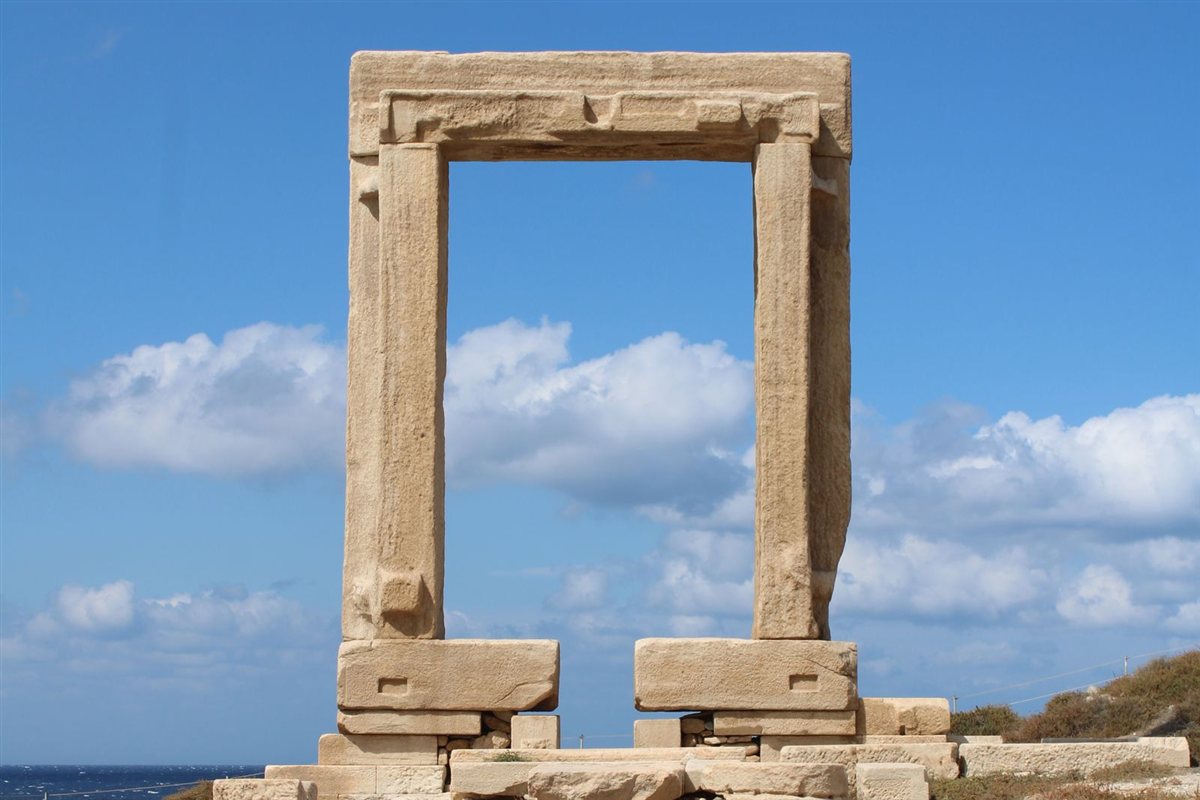
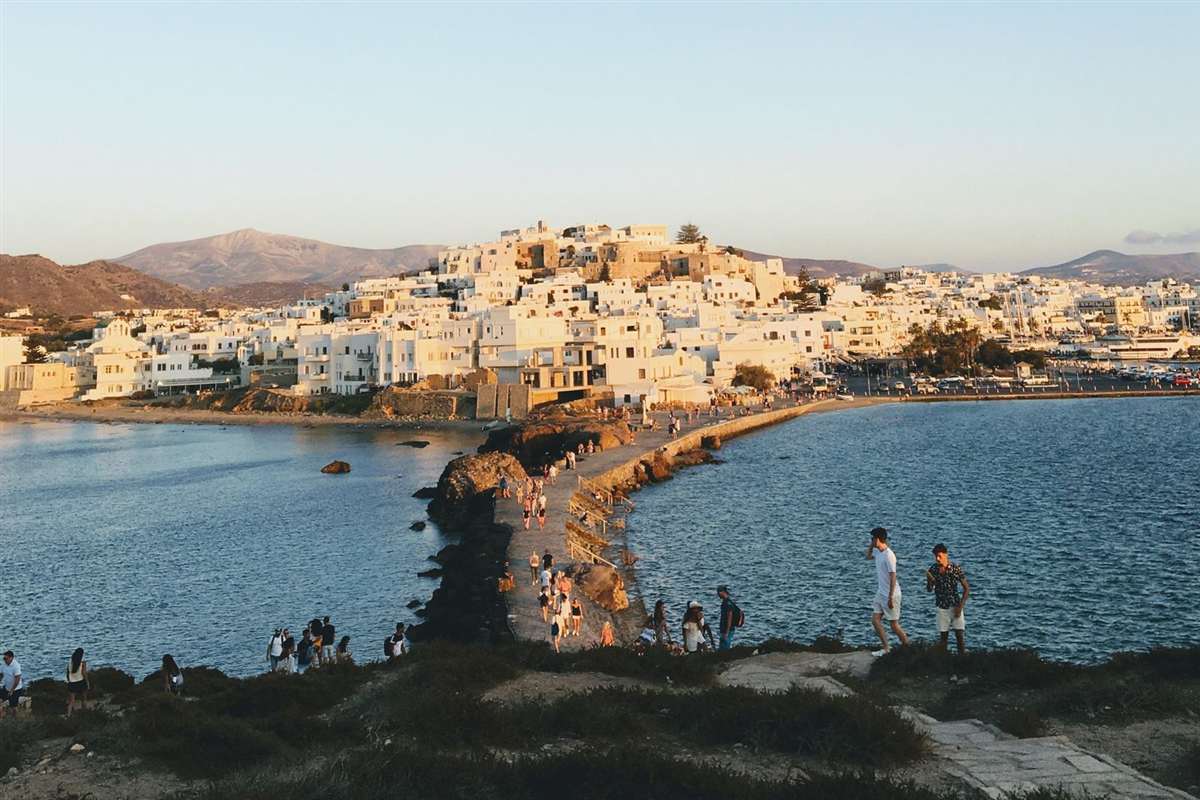
Naxos tours show two landmarks in the main town: the Portara and the Kastro. The Portara is a marble doorway on a small islet by the harbour. The Kastro is a fortified medieval quarter on a hilltop. The town is commonly called Chora.
Greeka lists two things as not to miss here: a walk through the castle and the sunset beside the Portara. Both are natural stops on Naxos tours. The same page calls the Portara the trademark of Naxos and the first sight a ferry passenger sees. Its Greek name means “large door”.
The Portara is what remains of a temple to Apollo that was never completed. Lygdamis, who ruled the island as a tyrant, started the work about 530 B.C. It stopped by 524 B.C., when the Peloponnesian League removed him from power. The plan measured 38 metres by 16 metres and pointed towards Delos.
Naxos tours reach only the door frame today. It has five marble pieces, and each weighs up to 20 tons. The stone was cut about 10 kilometres away, at the Flerio quarry. Bumps for lifting ropes are still carved into it. Builders normally removed such bumps at the end, so they show the temple was never finished.
The Portara stands alone because later builders reused the rest of the temple. Venetian builders put parts of it into the Castle of Naxos. Wikipedia says the gate pieces probably stayed because of their weight. A Christian church was raised there in the fifth century A.D. Its builders notched the threshold to fit a door, and the notch remains.
Naxos tours go on to the Kastro. The Venetian Marco Sanudo built it on the old acropolis hill in the thirteenth century. It holds an entire medieval town, still largely preserved. Large houses there carry family crests above their doors.
The district of Bourgos lies north of the castle. Its narrow, winding streets have dead ends. Wikipedia says people liken the layout to a labyrinth, believed to be planned partly to confuse pirates. The Archaeological Museum of Naxos is also a landmark of the town. For more stops, see places to visit in Naxos.
Which villages do Naxos tours visit in the mountains?
Naxos tours climb to mountain villages such as Apeiranthos, Filoti, Koronos and Halki. One local operator says its daily bus tour of the island makes stops at Halki, Filoti and Apeiranthos.
Apeiranthos is 28 kilometres from Naxos Town, towards the north-east, Wikipedia says. Houses climb the lower slope of Mount Fanari, at an altitude of 650 to 700 metres. The village runs four museums: one for archaeology, one for folk art, one for geology and one for natural history. Only Filoti is bigger. VisitGreece adds the marble-paved alleys.
Naxos tours that call at Filoti reach a semi-mountainous village about 18.2 kilometres from the town. Its altitude is 400 metres, and it sits below the mountain, on two hills. Three settlements make up the village: Rachidi, Klefaros and Lioiri. A basilica of Panagia Filotitissa from the eighteenth century stands there.
Koronos lies in the north-east, on the slopes of the Koronion Oros, the island’s second tallest mountain. Wikipedia gives its height as 630 metres above the sea, the second highest of the villages. With Apeiranthos and Keramoti, Koronos belongs to the Smiridohoria, the emery-producing villages. For the coast as well as the hills, see Naxos villages and beaches.
Greeka says Halki was once the capital of Naxos and its main administrative and trade centre. Naxos tours that stop there reach a village in central Tragea, 16 kilometres from Naxos Town. Neoclassical houses show its past wealth and power. The Gratsia Tower served as a lookout during pirate raids.
Naxos tours can also take in two old churches that Greeka names. It dates Agios Mamas to the ninth century and says the church honours Saint Mamas, patron saint of shepherds. It puts Panagia Drossiani, near Moni village, in the sixth or seventh century. The page on Chalki, Agios Mammas and Drosiani adds more.
Which beaches do Naxos tours stop at on the west coast?
Naxos tours on the west coast pass the sandy beaches of Agios Prokopios, Agia Anna, Mikri Vigla and Kastraki. Wikipedia names seven beaches in all, adding Plaka, Agios Georgios and Aliko. It places them mainly in the island’s west, close to Chora.
Agios Prokopios is a seaside village that Wikipedia counts at 182 residents. It is known for its long sandy beaches, and a small church stands in the village. The Red Lake nearby is a resting place for herons on their migratory flight to Africa. See also Agios Prokopios, Agia Anna and Mikri Vigla.
Greeka puts Agios Prokopios 6 km southwest of Chora and Agia Anna 6 km south. It calls Agia Anna a tourist resort with a sandy beach and crystal waters. Tour listings show Naxos tours from Agia Anna. One is a sunset cruise on a local fishing boat. Another is a morning fishing trip, and a third is snorkelling.
Mikri Vigla means “little lookout” in Greek. Wikipedia puts the village roughly 18 km to the south of Naxos town. Parthena, to the north, is 600 meters long. Limanaki, to the west, goes on for 3,200 meters until Kastraki village. Greeka adds that the wind at Mikri Vigla suits windsurfing and kitesurfing.
- Kastraki lies 15 km south of Chora, says Greeka, with white sand and crystal waters.
- Aliko lies 18 km south of Chora, and Greeka warns that it has no shade and no canteen.
- Among Naxos tours by boat, one listing offers a full-day cruise from the town to Aliko, Rina cave and the Small Cyclades.
- Wikipedia counts seven sports clubs on the island that offer windsurfing, kitesurfing and other water activities.
Naxos tours in summer share the island with the meltemi, a north wind that is both strong and dry. It crosses the Aegean. The season begins in late spring and ends in the middle of September, per Wikipedia’s Etesian article. Afternoons are the windiest hours, and at night the wind can ease.
Greeka tags Agios Prokopios as protected from winds. It also says the meltemi can blow hard for days in July and August. Then the long west-coast beaches like Plaka get gusty.
What do Naxos tours show at Agios Georgios, Plaka and Moutsouna?
Naxos tours link three different places here. Agios Georgios is the town beach, 2 km south of Chora. Greeka calls Plaka the longest sandy beach on the island. Moutsouna on the east coast is the old port that shipped emery.
Wikipedia’s article on Naxos town says the newer streets south of the old town reach west to Agios Georgios Beach. Greeka describes a lengthy sandy shore with crystal water and watersports facilities, and calls the sea shallow and calm. Among Naxos tours, one listing offers horse riding on this beach for beginners and experienced riders.
Greeka puts Plaka 8 km south of Chora and describes a long strip of white sand with dunes behind it. It adds that Plaka and Agios Prokopios are well organised, with sunbeds, water sports and tavernas behind the sand. See also Agios Georgios, Plaka and Moutsouna.
On the east coast, Wikipedia says, Moutsouna is a small village at the water’s edge. It lies about 39 km from the capital and 11 km from Apeiranthos. Naxos tours that reach the east coast find Moutsouna joined by road to Apeiranthos, the village it belongs to. The bay is open, and the harbor has limited facilities.
Until the early nineteen-eighties, boats loaded emery for export at Moutsouna. The rock is dug higher in the mountains. An aerial cableway brought it down to the harbor. Wikipedia says the cableway and the remains of its transfer station can still be seen.
- Emery is a dark granular rock, largely corundum, that is crushed into abrasive powder.
- Wikipedia says Naxos used to be the main source, with mining on the east side for more than two thousand years. It cites Pliny the Elder.
- VisitGreece lists the sandy beaches from Agios Prokopios and Agia Anna to Plaka, and says that further away the landscape becomes wild.
- Panormos means “sheltered harbor”; Wikipedia lists a Panormos on Naxos as a gulf and natural harbor in the Apeiranthos area.
- Greeka says boats reach the sea cave of Rina from the beach it spells Panermos, and Naxos tours can also reach it on a day cruise from Naxos port.
Which ancient sites do Naxos tours reach?
Naxos tours reach the unfinished Kouros of Apollonas, the Temple of Sangri and the cave on Mount Zas. The kouros lies in a quarry in the north, the temple at Gyroulas and the cave on a mountain slope.
Naxos tours that stop at the Kouros of Apollonas see a statue 10.7 metres tall. Wikipedia gives the block as light grey Naxian marble, around 80 tonnes in weight. Its quarry, close to Apollonas in the north, is among the oldest in Greece. An unpaved road above the village leads there.
Greeka dates the kouros from the late seventh to the early sixth century BC. It was never finished. Workers freed three sides of the block from the rock but never cut a route to carry it away. The archaeologist Gruben judged the block too heavy to move. Wikipedia calls that view undisputed in academic works.
Naxos tours that include the Temple of Sangri meet a building made entirely of Naxian marble. It stands at Gyroulas, south of Ano Sangri by about 1.5 km, and dates from around 530 BC. Wikipedia calls it one of the earliest Ionic temples. It adds that the beams held the oldest known marble roof of ancient architecture.
Greeka calls it the Temple of Demeter, goddess of agriculture, and Wikipedia says the finds probably point to her sanctuary. In the sixth century AD the temple was largely demolished. A Christian basilica rose from the same stone on the same site. A small museum was later built there. For more places, see our page on Naxos sightseeing.
Naxos tours in the hills see Mount Zas, also called Mount Zeus. At 1,001 m, it tops every other peak in the Cyclades. Around 628 m up its western slope lies Zeus’s cave. Myth says Zeus spent his childhood in that cave. Wikipedia names two main routes up, from the Agia Marina chapel and the Aria Spring.
What does the history of Naxos add to Naxos tours?
The history of Naxos adds three layers to Naxos tours. They are Bronze Age Cycladic culture, the myth of Ariadne and Dionysus, and the Venetian duchy. The tale begins in the Bronze Age and ends with the Greek War of Independence.
The Bronze Age gave the Cyclades a culture of their own. Wikipedia says it is known above all for flat female figurines of uncertain purpose, made of the islands’ white marble. Naxos is one of the excavated sites. People have lived on Naxos without a break since the fourth millennium BC at the latest.
The monuments of the island come from different eras, so Naxos tours cover more than one age. When the palace culture of Crete rose, the Cyclades became less significant. Wikipedia names Kea, Naxos and Delos as the exceptions.
In myth, Theseus leaves Ariadne asleep on Naxos after escaping the Minotaur with her help. Wikipedia’s Ariadne article says Dionysus saw her sleeping there, fell in love and married her. Festivals in her honour were held on Naxos and Cyprus. Plutarch reports a local tale of two Ariadnes: one wed Dionysus, the other was left by Theseus.
Naxos tours that follow this tradition find Dionysus in more than one place. Greeka lists an ancient temple of Dionysus close to Glinado village, in the area of Iria. In the myth, Naxos was the home of the god. On account of its beard, the Kouros of Apollonas has been read as Dionysus, not Apollo, Wikipedia says.
The Duchy of the Archipelago was the work of Marco Sanudo, a Venetian nobleman who joined the Fourth Crusade. Its other name was the Duchy of Naxos. It began in the early thirteenth century and covered the Cyclades apart from Mykonos and Tinos. Naxos tours in the countryside pass stone towers that, Visit Greece says, show the Venetian presence.
Twenty-one dukes in two dynasties ruled the duchy until the sixteenth century, when Ottoman control began. Ottoman rule lasted until the eighteen-twenties. Then Naxos brought its fleet into the Greek War of Independence. Wikipedia says it later became part of the autonomous Greek state and then of the independent one.
How do Naxos tours combine Paros, Santorini and Ios?
Naxos tours combine with Paros, Santorini and Ios because the Cyclades form a chain of islands that ferries join. A narrow channel parts Naxos from Paros, which sits 8 kilometres to the west. Santorini is the island farthest south in the Cyclades, and Ios sits halfway between it and Naxos.
Paros is the nearest neighbour for Naxos tours. Parikia, the capital, stands beside a bay in the island’s north-west. Wikipedia names Parikia harbour as a hub for ferries and catamarans, with daily sailings to Naxos, Ios and Santorini. It adds that the constant strong wind in the channel makes Paros a favoured windsurfing location. Our Paros page covers that island.
Santorini is the biggest of a small round group of islands that its caldera formed, says Wikipedia. It dates the huge eruption that made the water-filled caldera to about 3,600 years ago. One local listing shows a one-day catamaran cruise from Naxos to Santorini, so Naxos tours by boat can reach it. See Santorini for the island itself.
Ios lies between Naxos and Santorini. Wikipedia places the port of Ios on Ormos harbour. A footpath rises from the port up the hill to Chora, the main village of the island. Narrow alleys and steep stairs keep Chora largely closed to cars. Day trips there are on our Ios tours page.
Naxos tours by boat link the islands too. The same local listing starts each trip from Naxos. It shows a one-day catamaran cruise to Delos and Mykonos. It adds an all-day catamaran cruise to the south coasts of Naxos or Paros. A third trip is an all-day cruise on a traditional wooden boat to Koufonisia and the Rina cave.
Naxos tours cover one island of a long chain. The Cyclades number about 220 islands, says Wikipedia. The name refers to a circle of islands around Delos. A cruise is the other way to join islands: one ship instead of a ferry for each hop. Our Greek islands cruises page explains that option.
Where do travellers stay between Naxos tours?
Between Naxos tours, travellers stay in Naxos Town, the island capital and main port, or on the west coast. Greeka and Wikipedia describe three west-coast areas: Agios Prokopios, Agia Anna and Plaka. Each area gets one plain fact here.
Naxos Town, also called Chora, has 8,897 inhabitants, says Wikipedia. The main port is there, and Greeka adds that buses link the town to other places. Greeka also mentions a day bus tour and a day cruise from Naxos port. So Naxos tours can start in town. For rooms, see hotels on Naxos.
The Paralia promenade has a pedestrian street with shops and restaurants along it. Greeka names Agios Georgios as the closest beach to the town, within walking distance. Wikipedia says taxis can be found by the port. Intercity buses run to the villages, with more frequent buses in summer. It warns that summer traffic and parking can be hard in town.
Agios Prokopios is a seaside village with 182 residents, known for its long sandy beaches. Greeka calls it a convenient place to stay because it lies close to the town. It adds that Agios Prokopios and Plaka are easy to reach, even by bus. Wikipedia also mentions the Red Lake nearby, where herons rest on their way to Africa.
Greeka calls the sandy cove of Agia Anna a popular place on Naxos, with tourist facilities. Plaka has accommodation, fish restaurants and water sports centres along its beach, and still has room for privacy. The local listing shows boat trips from Agia Anna, including a morning fishing trip. So Naxos tours by boat start on this coast too.
Wikipedia puts the airport about 3 kilometres from Naxos Town, near Agios Prokopios. The port lies in the town itself, on its northwestern side. A base in town keeps the port close. A base on the west coast keeps a long sandy beach close. For other areas, see more Naxos hotel listings.
What else do travellers ask about Naxos tours?
What weather and water do Naxos tours meet in summer?
Wikipedia sorts Naxos into two climate types by location: Mediterranean in one area and hot semi-arid in another. The article on Greek climate says Mediterranean summers bring frequent sunshine and dry days. It adds that heatwaves at the coast tend to be mild, as cooler water and its breeze temper the heat.
In winter, the inland part of the island turns much wetter and cooler, as the land stands higher. The mountain villages on Naxos tours stand in that higher country.
Wikipedia says Naxos Town’s water supply is not pure enough to drink, so residents use filters or bottled water. Nearby dams feed it. After a long run of low rainfall, desalination plants went up near the town hall.
Which local foods can travellers try after Naxos tours?
Wikipedia ranks Naxos first among the Cyclades for fertile land and for self-sufficiency. Water is short across the region, yet Naxos keeps a sound supply. Its highest peak tends to trap the clouds, which allows more rain.
Farms grow vegetables and fruit and raise cattle. Wikipedia says Naxos is well known in Greece for four products: Arseniko Naxou cheese, potatoes, Kitron and Naxian honey. The page on Greek cuisine lists Kitron as a liqueur made on Naxos.
Farming on the island is old. Wikipedia says Naxos was celebrated for agriculture and animal husbandry in antiquity and again in Byzantine times. The geographer al-Idrisi, writing in the twelfth century, notes cattle raising on a wide scale.
How old is the marble trade behind Naxos tours?
Wikipedia dates the start of marble quarrying on Naxos to before 550 B.C. Naxian marble was used to make the roof tiles of the Acropolis in Athens and of ancient Olympia. In the eighth and seventh centuries B.C., Naxos dominated commerce in the Cyclades.
The article on Naxos Town adds that Naxos was among the first places in Greece where marble sculpture developed. Sculpture from that age turns up all over Greece. Naxians also gave works to the sanctuaries of Delos and Delphi.
What other names has the island of Naxos had?
Wikipedia says Homer mentions Dia, literally the sacred island of the Goddess. Dia means heavenly or divine, and the name went to small craggy islands that lie close to larger ones.
The same article says the name Dia was even passed on to Naxos itself. Under Venetian rule, the island carried its Italian name, Nasso.
Which local festivals can travellers meet on Naxos tours?
Wikipedia lists yearly festivals in Naxos Town. The Naxos Carnival is a three-day event with parades, costumes and torches. Religious celebrations such as Saint Nicodemus on 14 July and Panagia Chrysopolitissa on 21 November include parades and image processions.
Greeka adds that the Bazeos Tower hosts the Naxos Summer Festival every year. Travellers who want to plan Naxos tours around a festival can ask us about a trip to Naxos.