
Naxos hotels are the lodgings of the largest island of the Cyclades, from the old town to the beach villages. Boat days and island tours from Naxos are collected on our tours in Greece home page.
The sections below cover the areas, the classes, the kinds of lodging, the rooms, the wind and the season. The last part answers questions about Naxos hotels.
Where do the Naxos hotels stand in Chora, the town of Naxos?
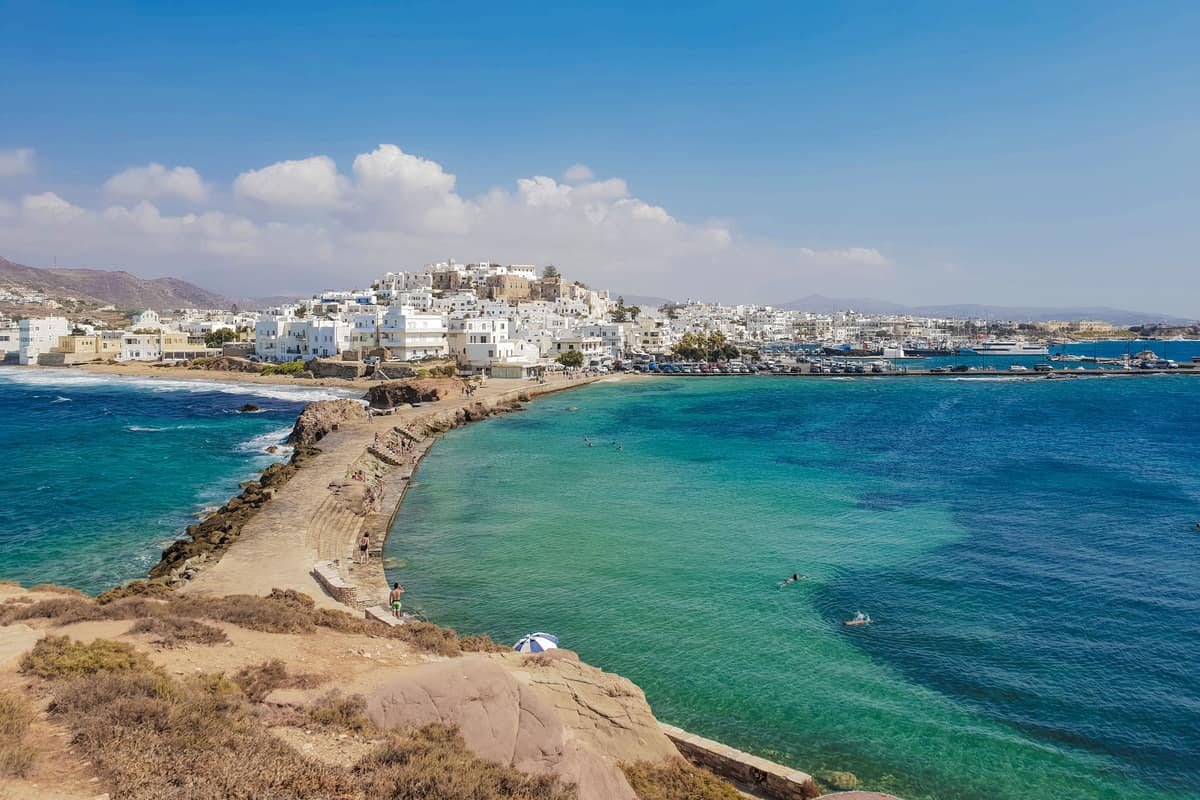
The Naxos hotels stand in two kinds of place: in Chora itself and in the beach towns close to it. The census counted 8,897 residents in Chora, the capital and the largest town, and 20,578 across the whole island. Parts of it are pedestrianised, and it faces the sea on the west.
Chora is the town where a number of the Naxos hotels stand. In the Aegean, the Cyclades group holds the island, and the town sits on its western shore. Since two thousand and eleven the town has served as administrative centre for Naxos and the Lesser Cyclades. Wikivoyage says that visitors find shops and restaurants there as well.
The town has a long past. From the year twelve hundred and seven, the city of Naxos was capital of the Duchy of the Archipelago. That lasted until fifteen hundred and sixty-six. On the old acropolis, Sanudo built the Kastro, the town’s fortress. According to the Greek tourism pages, the Venetian castle crowns the town among the newer buildings.
Nio Chorio, Kastro, Bourgos and Grotta are the named parts of the city. A visitor who reads an address meets these names. Grotta is the northern beach of the city and also the name of the area near its shore. So a listing for the Naxos hotels of Chora can name one of these four parts of town.
On foot is the natural way to move in Chora. Wikivoyage says parts of the town are pedestrianised, which makes it easy to amble from beach to cafe to shop. Places elsewhere on the island have their own page, Naxos places, for readers who plan a wider day. Ask the property which streets near it are closed to cars.
Among the sights that make Naxos a popular place to visit, Wikipedia names beaches, villages and old ruins. Chora is the main town among them. A reader who compares the Naxos hotels of Chora with the beach areas compares a town with a shore. The shore is reached by road or bus, and the next section gives the distances.
What distance and bus logic links the Naxos hotels of the beach areas to Chora?
Beach towns close to Chora hold a number of the Naxos hotels. Agios Prokopios lies five kilometres south of the town, and Naxos Airport is three kilometres from Chora. Ten bus lines serve the island. Every distance is therefore also a question of bus times, and these change with each season.
Wikivoyage says the coast south of Chora is lined with beach communities. It adds that the larger share of visitors from abroad stay in the beach towns close to the town. One of these shores has its own page, Agios Georgios Naxos, where the beach itself is told. This page keeps only to the distance and the bus.
The Greek Wikipedia article measures Agios Prokopios from Chora. It places the village where the largest bay of the island ends. The Naxos hotels of that area are reached by road, because the town is a drive away. Naxos Airport lies near the same area, according to the Wikipedia note.
Naxos Airport lies three kilometres from Naxos City, says the Wikipedia note on the airport. Wikivoyage gives the same three kilometres from Chora and adds that a visitor can reach it on foot. A bus also links the airport with the town, it says. For the exact times, ask the bus operator, because the timetable changes by season.
Wikivoyage lists the popular sandy stretches: Alyko, Kastraki, Mikri Vigla, Orkos, Plaka, Maragas, Agia Anna and Agios Prokopios. Those names are the labels a listing for the Naxos hotels of the west coast can use. Each name is a different distance from Chora. Wikivoyage says to establish the location of the lodging first, because distance can add to expense.
The island has ten bus lines, Wikivoyage says. A bus serves every village, but a village can have only three buses a day. Tickets are sold at a machine by the bus offices and at village kiosks. A ticket is needed before boarding. So the Naxos hotels of a village are as near to Chora as the next bus.
How does the Greek class system sort the Naxos hotels?
The Greek class system sorts lodgings into groups by fixed standards. Wikipedia lists Greece among the countries that set standards by law. Grading, rating and classification are three names for one idea. For the Naxos hotels, the class letter is a label to read, and the ministry’s current page is the check.
Wikipedia gives a hotel two plain traits: lodging that is paid and lodging for a short period of time. That meaning sits under every class label. The Naxos hotels follow the same base, so a stay there is short and paid for, as usual. A class letter tells how the lodging is graded, not what the room feels like.
On Wikipedia, grading, rating and classification describe one and the same system of sorting lodgings. The same article names Greece among the member countries that set the standards by law. A class is therefore a simple public label, not a sales line. To learn the class of a lodging today, ask the ministry’s current page, not an old list.
The old index of this site dates from the early two-thousands. It used three class letters: A with four stars, B with three stars and C with two stars. Those labels belong to that old entry only. The Naxos hotels of today need a fresh check. The first group also has its own page here: Naxos A class hotels.
Rooms differ widely in size and in fittings. Wikipedia describes small rooms with a plain bed and large suites. The suites hold a dresser, a refrigerator, kitchen facilities, a television and a private bathroom. That is why a listing needs a separate look at the room itself, not only at the class letter. Compare size, beds and fittings first.
Reading a class letter takes three steps. First, find the label on the listing. Second, read the ministry’s current page to see whether the label still holds. Third, compare the rooms and facilities as kinds, because the class does not describe a stay. The Naxos hotels become much easier to compare, and no old claim is taken as fact.
Which kinds of lodging besides hotels are the Naxos hotels?
Lodging comes in more kinds than hotels: apartments, studios, villas, guest houses, bed and breakfast houses, aparthotels and campsites. Each kind has its own definition. For the Naxos hotels, the old index counted five apartment, studio and villa units. Wikivoyage says rooms to let are offered to visitors arriving at the ferry.
Wikipedia treats an apartment as a home of its own inside a larger building. In a studio unit, living, sleeping and cooking all happen together in a single small room. Both are kinds of unit, and neither one is a name. A listing of either describes a space, not the name of a house, as with the Naxos hotels.
Wikipedia says the word villa first meant a rural house of wealthy Romans, an escape from city life. Among the Naxos hotels of the old index, villas shared one group with the apartments and studios. A guest house is yet another kind. It is a private home turned into visitor lodging, where the owner lives in a separate part.
Wikipedia calls the B&B a small lodging that offers a room for the night and a morning meal. The hosts of such a house tend to live in it too. The aparthotel is described as serviced flats run on a hotel-style reservation system, with no fixed contracts. For apartments and studios, see Naxos apartments studios, the page on that kind.
On a campsite, the land is divided into a number of pitches for overnight stays in tents, campervans or caravans. Wikivoyage names a campsite south of Agia Anna among the lodgings of the island. This page names no campsite. Among the Naxos hotels, a pitch is one kind of place to sleep, so ask each site about its facilities.
Rooms to let are the last kind. In both July and August, says Wikivoyage, the rooms are taken up early, so a late arrival has less choice. It also advises to establish the place first, because distance adds to the expense. For the Naxos hotels, these are plain statements of fact about the busy high season, not fixed rules.
What does the old index of Naxos hotels count in its four groups?
The old index of Naxos hotels counts twenty-two lodgings in four groups. The class A group of four stars holds five, and the class B group of three stars holds eight. The class C group of two stars holds five. Five more are apartments, studios and villas in the last group.
The old entry is an index of Naxos hotels from the early two-thousands. It gives each lodging one short paragraph, a class line, a location line and a photo link. The lodgings are sorted by class and by name within each group. This page does not copy those paragraphs or the names, because a lodging can change over time.
Naxos hotels fall into the four groups by class and kind. The class A group holds five lodgings and carries a four star label. The class B group holds eight lodgings under a three star label. The class C group holds five lodgings under a two star label. The last group holds five units of apartments, studios and villas.
The page Naxos B class hotels takes the second group on its own. That group is the biggest of the four, with eight lodgings. A class letter and a star count are only labels from the old entry. Whether a lodging still carries a label is a question for the current page of the ministry or the property.
The four numbers raise one small puzzle. Added up, they give twenty-three, one more than the total of twenty-two in the entry. The page treats both figures as rough. Naxos hotels of the old index can also have changed name, class or status since then. Check the current page of each property before you plan anything at all.
Each entry of the old index carries a location line. The places there include Stelida, Agios Georgios Beach, Naxos Town and Kastro. A place is not a distance. Another part of this page sets out how far each area lies from Chora. Read the old index as a count of kinds: four groups and a place for every lodging.
Which rooms and facilities do the Naxos hotels offer as kinds?
The Naxos hotels offer rooms and facilities in kinds. A room runs from a small room with a plain mattress to a large suite. A lodging can list a pool, a bar, a car park and a breakfast room. Each property names its own kinds, so ask the property for its list.
Naxos hotels follow a plain idea: a place to sleep for a short stay. Wikipedia names these room items: a bed, a dresser, a refrigerator, an upholstered chair and a television. A bathroom of its own can join them. Not every room holds all of these items, so read each listing carefully. Treat each room as its own case.
Wikipedia says a larger hotel can add a day spa, a gymnasium, tennis courts, a swimming pool and restaurants. A small hotel can offer only basic services. An apartment is a separate kind of unit inside a larger building. Each listing says which of these kinds a unit offers. A pool does not mean a bar or a restaurant.
The page Naxos villas gathers the villa kind together in one place. The old entry lists kinds of facility for its lodgings. They include a swimming pool, a sauna, a tennis court, boxes for valuables and a pool bar. Naxos hotels of today can also differ from that list, so ask the property about each one in detail.
A parasol is a kind of umbrella that gives shade from the sun. Wikipedia says large ones give shade on a sunny beach. A listing can mention such equipment, a pool or a garden. Wikivoyage says the high summer months are the ones in which rooms go first. The choice of kinds therefore narrows as the summer goes on.
Ask the property to list its kinds. Naxos hotels differ in room kind, in bed size and in facility. Put the same questions to each house and compare the answers. Ask about the view, the floor, the air and the noise before choosing. Another part of this page covers noise and the winds in more detail. Keep notes.
How quiet are the Naxos hotels, and what carries the noise?
Naxos hotels are as quiet as the place around them. Noise is unwanted sound, and it travels with the wind and the road. The sheltered west coast gets sea breezes, the mountain villages stay cooler, and cars are infrequent on the roads. Ask each property about its own street and its own side.
Noise is sound that people find unwanted or unpleasant. A lodging hears it from the road, the street, the pool and the next room. The Naxos hotels differ here, because each one stands on a different street in a different place. A listing page seldom tells you the sound of a street, so the question goes to the property.
By day the air flows from the sea onto the shore, a sea breeze. After dark it flows from the shore out to sea, a land breeze. The west coast feels this daily turn. Wikivoyage says the sea breezes keep the coast from feeling too stuffy. The Naxos hotels near the shore sit in this same moving air.
In the middle of the island, high ground and valleys hold the air cooler, says Wikivoyage. The same source calls a day with no cloud at all rare there. The Naxos hotels of the mountain villages therefore sit in a different air from the coast. The old two-star group has its own page here, Naxos C class hotels.
A number of wealthy Athenians own houses in the old villages of Halki and Filoti. They use the island to escape the heat of the Athenian summer, says Wikivoyage. The villages lie in the mountain centre of the island, away from the sea breezes. Ask a property in a village what stands nearest, a road or a square.
In Chora, a number of areas are pedestrianised, says Wikivoyage. Outside the town, walking on the roads is fine with caution, because cars are infrequent. Drivers, however, tend to go fast. For Naxos hotels beside a road, ask whether the cars pass slowly or fast. A slow walk at the gate shows you the sound of the street.
What do the meltemi and the other winds mean for the Naxos hotels?
Out of the north comes the meltemi, a dry wind with real force. The windy season stretches from late spring to mid-September. For the Naxos hotels it is a fact of the summer day. Wikipedia calls the winds a dominant weather influence. Ask each property how the wind meets its terrace or garden.
Wikipedia describes the afternoon as the time of the strongest wind. At night it eases in a number of cases, yet a spell can run on for days. For the Naxos hotels, the wind is a rhythm of the day as well as of the season. A visitor can plan a slow walk or a rest around it.
Wikipedia warns that the wind rises while the sky is clear and gives no notice. On the Beaufort scale, the strongest gusts reach seven or eight. Yachts and the ferries linking the islands cannot always sail in such weather. Sailing times change by season; read the ferry operator’s own current page. Island facts sit on Naxos island information.
A windbreak is a planting of one or more rows of trees or shrubs that gives shelter from the wind. Wikipedia adds that windbreaks around a home, if designed properly, cut the bills for heating and cooling the house. Only the property can say whether its own garden has such rows. The question fits Naxos hotels with gardens.
Wikivoyage names winds on a number of beaches that favour windsurfing and kitesurfing. Windsurfing joins sailing and surfing in one water sport driven by the wind. For a visitor who likes these sports, the wind matters first. Ask the property how far the shore lies. The Naxos hotels near such beaches differ by place, so read the place first.
Wikivoyage describes the west side as sheltered and flat, reaching up to thirty degrees Celsius in summer. The meltemi blows through the same warm months until mid-September. A visitor in the warmest months meets both the heat and the wind. Naxos hotels differ in how they meet them, so ask the property about shade, shelter and sea breeze.
What is the season of the Naxos hotels from month to month?
The season of the Naxos hotels follows the weather. Summer on the sheltered west side climbs to thirty degrees Celsius. The centre stays cooler. The meltemi arrives in late spring and stays until mid-September. Rooms in the lodgings go early in July and August. Ask each house about its dates first.
The west and the centre of Naxos share no single climate. One travel page calls the west side sheltered and flat, and puts summer heat there at thirty degrees Celsius. Breezes from the sea ease the warmth on the shore. The Naxos hotels beside the water sit in that warm, airy setting. The hills of the centre differ.
Inland, the picture changes. The same page says the mountains and valleys hold the air at a lower temperature. It adds that a sky with no cloud at all is rare there, because the peaks are high. A visitor who dislikes heat can weigh lodgings off the flat coast. Ask the property about its height above the sea.
Summer storms are rare, one source says, yet they are very heavy. They leave marble paths and streets as slick as ice. Shoes with a good grip help on wet stone. For the Naxos hotels, ask about the surface of the street outside the door. The page on Naxos sightseeing sets out the places of the whole island.
Wikipedia files the meltemi under the etesians, a family of forceful dry winds out of the north. Its season spans late spring to mid-September, as the article gives it. Its force peaks in the afternoon. At night it can ease, yet it sometimes runs for days. The wind softens the summer heat, so a hot day is seldom still.
Seasons also decide the crowd. One travel page says the rooms fill early in July and August. The sources read here give no opening or closing month for any lodging. For the Naxos hotels, ask each property directly. Look at its current page too, before you plan a stay. Plan around the windy months and busy summer weeks.
How do visitors arrive at the Naxos hotels by sea and by air?
Visitors reach the Naxos hotels by ferry or by plane. One travel page lists about five and a half hours by regular ferry from Piraeus. Athens is forty-five minutes away by air. The airport and the city lie three kilometres apart. Ferry and flight times change by season, so ask the operator.
Naxos works as a hub of sea transport, says one travel page, with links in every direction. The page counts about five and a half hours on a regular ferry from Piraeus. Fast ferries take less time. For the Naxos hotels, the port in Chora is the first place of arrival. Lines and times need the operator’s current timetable.
The port is small. One travel page says it is too small for cruise ships, so the island is spared crowds from the sea. Ferry ticket offices stand along the quay in Chora. The bus office sits near the ferry building. A further line of the page mentions an agency by the dock where luggage can be left.
The island airport is small, says the same page, and it notes propeller flights to Athens by two airlines. Wikipedia gives it a spot beside Agios Prokopios, and the city is three kilometres away. Among the Naxos hotels, those in mountain villages face a longer drive from the port or airport. Read each distance with care before choosing.
Wikipedia lists one asphalt runway of about nine hundred and one metres. That length limits a number of larger turboprop aircraft. After landing, distance matters. Filoti lies about eighteen kilometres from the city, and Apeiranthos about twenty-eight kilometres to the north-east. The page on Naxos villages describes both inland places, which lie in the hills far from the west shore.
Arrival also brings offers at the quay. One travel page says rooms are offered to visitors stepping off the ferry. It advises settling the place of a lodging first, since a long way adds expense. For the Naxos hotels, the sources hold no timetable. Every ferry and flight time needs the current word of its operator or the airline.
How do the bus and the taxi serve the Naxos hotels?
The island bus and the taxi tie the Naxos hotels to the town, the villages and the beaches. One source counts ten local bus lines and adds that every village is served by a bus. A taxi carries one party on one journey. Read the operator’s timetable for the present times.
Naxos hotels are found in the town, on the beach strips and in hill villages. The island bus links all of them. One source lists ten local bus lines and says each village has a bus service. So the bus reaches the village lodgings too. Ask the property which line stops nearest and how far the stop is.
The source adds a limit: a village service can be as thin as three buses daily. A visitor on a day trip needs to know when the last bus returns. Times differ from one season to the next, so the visitor reads the latest timetable from the operator. Plan the way back before the way out, not after it.
Tickets are bought before the ride. One source names the machine outside the bus offices and the kiosk in the villages. It says a ticket is needed before boarding. Visitors from the Naxos hotels find the bus office near the ferry building, on the Chora seafront. The Naxos Bus Tour is a separate topic from the public lines.
A bus is built to hold a far bigger crowd than a car. The source warns that on the morning bus the passengers stand. That matters to a visitor of the Naxos hotels with luggage who hopes for a seat. A taxi, in contrast, takes its passengers straight from one point to another and carries nobody else along.
This page gives no money amounts for the taxi. A visitor to the Naxos hotels can ask how a taxi is called. Ask also where the nearest stop of the island bus lies. Bus times differ from season to season, so look at the operator’s own page. The car, the quad bike, the bicycle and the walk follow below.
What is the way to move from the Naxos hotels by car, quad bike, bicycle or on foot?
A visitor can move from the Naxos hotels by car, quad bike, bicycle or on foot. One source calls the roads very well kept and rates a quad bike safer than a scooter. Parts of Chora are closed to traffic, which suits walkers, and cycle hire is possible. Check the vehicle first.
Naxos hotels lie on roads that one source calls very well kept. Work to repair and improve them went on across the past decade, it says. Roads in the hills twist and have sharp drops beside them. A driver leaving the coast for the hills meets that second kind of road. Both kinds exist, so plan the drive.
One source names the quad bike as a better option than the scooter, because it is more stable and safer. The same source warns of scams with the hire of motorbikes and quad bikes. It stresses agencies that work only with those vehicles. The advice is plain: look over the vehicle first, then read the insurance terms with care.
Fuel matters on the eastern side. One source says every village has a petrol station. When going east to Moutsouna and Panormos, the last one lies near Filoti, in the middle of Naxos. A driver from the Naxos hotels who goes east can fill the tank near Filoti on the way. Check the tank before leaving the coast.
Parts of Chora are open to people on foot, says one source. This makes the stroll from beach to cafe to shop easy. Outside the town the trails can be hard to trace. The paths that climb Mount Zas are easy to follow, with clear marks. The Naxos photo gallery of this site shows the island in pictures.
Roads are also open to walkers, who need to stay alert, says one source. Cars are rare, though the ones that come travel quickly. Cycle hire is possible, and the flatter routes run around the town, for example towards Agia Anna and Plaka. A visitor of the Naxos hotels on a bicycle or on foot weighs the traffic.
Which beaches lie near the Naxos hotels, one clause each?
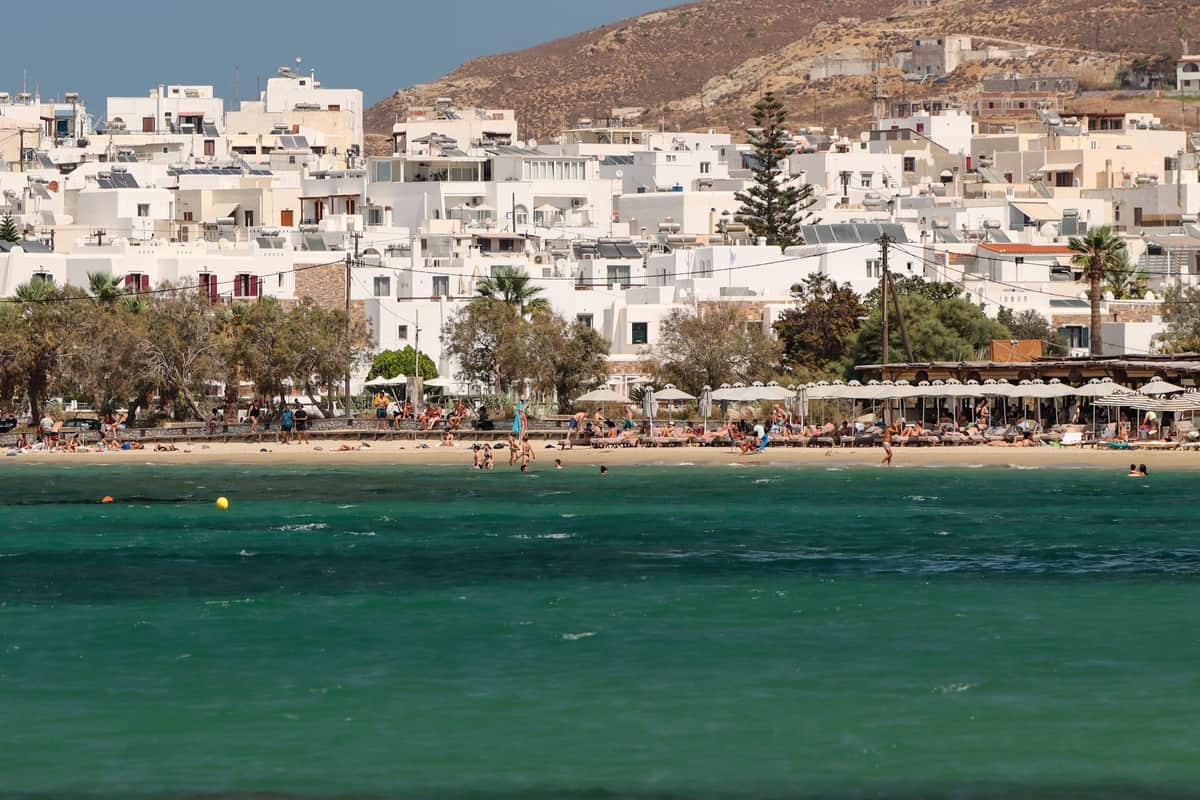
Naxos hotels stand along a west coast that one source calls a single long sandy beach. Eight named stretches line it, and more beaches lie to the north. On the east coast there are two small harbours. Each place gets just one clause here, and the fuller details sit on other pages.
One source names eight popular sandy stretches. The list pairs Agios Prokopios with Agia Anna, then adds Maragas, Plaka and Orkos. The last three names are Mikri Vigla, Kastraki and Alyko. Anyone sorting the Naxos hotels by area can treat these as a set of place names. Their sand and sea are left to other pages of this site.
Agios Prokopios, the first name on that list, is described in full on Agios Prokopios Naxos. Greek Wikipedia puts the settlement five kilometres south of Chora. English Wikipedia places Naxos Airport near it, three kilometres from Naxos City. The airport and the first beach name therefore share one stretch of coast. Neither fact says anything about rooms or views.
Going north, the same source adds Kalantos, Panormos, Psili Ammos, Lionas and Apollonas. The last of these takes its name from the village that lies above it. Four more beaches appear on that same list: Amitis, Kalados, Aliko and Pyrgaki. A visitor weighing the Naxos hotels can ask each property one thing: how long the walk to the sea takes.
Wikipedia calls Moutsouna a small village by the sea on the eastern coast. Its bay is quite open, and the port has limited facilities. It stands about thirty-nine kilometres from the capital and eleven kilometres from Apiranthos. Wikivoyage adds that the harbours of Lionas and Moutsouna stay small and quiet in summer. Read plainly, both places are calm ones.
Wikipedia says Moutsouna was the emery port until the early nineteen eighties. The emery came from the mountain above and reached the port by an aerial cableway. Emery is an abrasive rock. On any beach, watch for sea urchins, round, spiny sea animals three to ten centimetres across. Sort the Naxos hotels by place first, and then by shore.
What do families, couples, walkers and wind sports people find near the Naxos hotels?
Near the Naxos hotels, families find long beaches that one source links with families and water sports. Walkers find easy, marked footpaths up Mount Zas. Wind sports people find beaches where the wind favours windsurfing and kitesurfing. The sources tie no single place to couples as a separate group of visitors.
The Greek national tourism page lists long sandy beaches among its highlights and links them with families and water sports. It gives no detail on water depth or shade. A family choosing among the Naxos hotels can ask each property about shallow water, shade and food. The sources read for this page do not state them for any beach.
Wikivoyage calls the footpaths up Mount Zas easy and clearly marked. Other paths further away from Chora are not always simple to follow. Walkers can use the roads with care, though drivers there move quickly and cars are infrequent. In the villages, local people are said to give lifts readily, above all to those who speak a little Greek.
The Greek national tourism page also names walking on old paved roads, water sports and visits to traditional hamlets. Wikivoyage reports a growing cycling scene and says bicycles can be hired. Easier, flatter routes lead out of Chora towards Agia Anna and Plaka, and on to Mikri Vigla and Alyko. Riders pair a route with the Naxos hotels nearby.
Wikivoyage notes that the wind favours windsurfing and kitesurfing on a number of beaches. Windsurfing is a wind-driven water sport that mixes sailing with surfing. In the Aegean, the meltemi arrives in spells, dry and strong, and lasts until mid-September. A sea trip is a separate topic, treated on the page Naxos Yacht Tour with Snorkeling, not here.
Couples are the one kind the sources leave open. No source ties couples to a beach, a village or a type of lodging. A couple choosing among the Naxos hotels can use the facts given for the other three kinds. These are the shore, the walk and the wind. The rest is a question for the property itself.
Are the Naxos hotels open to guests with limited mobility?
Wikipedia and Wikivoyage give no list of ramps, lifts, accessible buses or beach wheelchairs. So the sources cannot state the access of one lodging. Accessible tourism is a wide idea. For the Naxos hotels, the answer comes from each property. The island’s tourism office adds the rest, and not this page alone.
Wikipedia defines accessible tourism as the work of opening tourist places and services to everyone. The definition names limits of body or mind, disability and age. Parents of children and elderly travellers belong to it. For the Naxos hotels, a lodging is only one link in a chain. The road, the bus and the beach are the other links.
A European network for accessible tourism sets out five needs. These are places without barriers, transport on land, sea and air, skilled staff, activities for all and plain information. A visitor can turn each need into a question. The Naxos hotels answer them house by house, never as one group. The list covers the whole trip, not the bed.
Wikipedia says a wheelchair helps when walking is hard or impossible. Causes include illness, injury, disability and old age. Wikivoyage notes that a number of areas of Chora are pedestrianised, so the town is easy to cross on foot. It says nothing about kerbs, slopes or lifts. The streets of the old town stay a question for the property.
After heavy rain, Wikivoyage says, the marble paths and streets turn as slippery as ice. Such storms are rare in the summer. Footing matters for walkers and wheels alike. Among the Naxos hotels, the page of Alkyoni Beach Hotel Naxos names one house on the Agios Georgios beach. Ask any property about its entrance, paths, steps and slopes.
No source for this page names a ramp, lift or accessible bus for the Naxos hotels. No beach wheelchair appears in them either. Before any plan, read what the island’s tourism office states on its current page. Wikivoyage adds that locals in rural areas nearly always offer a ride. A ride is no answer to a missing ramp here.
How safe are the Naxos hotels, the roads and the sea around them?
Wikivoyage calls Naxos a generally safe island, and the Naxos hotels sit on roads it describes as well kept. It names three main risks: hire scams, fast drivers and windy mountain roads. The sea adds the meltemi and sea urchins. Check each point on the current pages again before the day starts.
Wikivoyage states that Naxos is generally a safe island. This is a view of the whole island, not of one lodging. A visitor to the Naxos hotels still checks the road, the vehicle and the sea each single day. The source lists no crime figures at all, so this page gives no number and makes no promise of safety.
Wikivoyage says the roads are very well kept after large repair works in the past ten years. Mountain roads wind and have steep drops. On foot the same source asks for caution: cars are rare, yet drivers go fast. A walker on a village road therefore keeps a very close watch at every bend, every crossing and every verge.
Wikivoyage warns about hire scams, above all at agencies dealing only in motorbikes and quad bikes. The source urges a look at the vehicle first, and a read of the insurance terms. It adds that a quad bike is steadier and also safer than a scooter. Ask any lodging among the Naxos hotels which hire shops stand near it.
Wikipedia lists the meltemi as a summer wind of the Aegean that arrives dry and hard. It blows from the close of spring until mid-September. The article puts its top strength at force seven or eight. The Hellenic Coast Guard serves Greece as its national coast guard. The Naxos tour page sets the island’s roads and shores side by side.
Sea urchins have a round body covered in spines, and Wikipedia gives their size as three to ten centimetres across. A visitor who enters the sea from the Naxos hotels watches the water closely. Beaches change with wind and season, so check the municipality’s current page. Ask the property which beach is calm on the day of the visit.
How do you read a listing page for the Naxos hotels?
A listing page for the Naxos hotels names a kind of lodging. The kinds are hotel, apartment, studio, villa, guest house, and bed and breakfast. Each kind has its own habits. Read the kind first, then the place, then the facilities, and ask the property about anything the page leaves out.
Start with the labels first. Wikipedia’s three words, grading, rating and classification, all describe one shared task: sorting hotels by quality. A listing can use any of them. Greece appears in that article’s list of member countries with standards fixed in law. Check a class label on the current page of the ministry, never on the listing alone.
Wikipedia describes the hotel as paid lodging offered to guests on a short-term basis. That is the base meaning behind the Naxos hotels on any listing. Inside, a room can be a small space with a modest mattress, or a large suite with kitchen facilities. The site holds a page of Naxos recommended hotels, set beside this one.
Lodging, says Wikipedia, means the use of a short-term dwelling, by hiring the living space or through another arrangement. A listing page therefore describes a home for a short stay. Look for the kind of room, the number of nights the house takes, and the terms of stay. If a point is unclear, ask the property before any decision.
The word aparthotel points to a group of serviced apartments with a hotel-style reservation system. Wikipedia adds that contracts are not fixed. Guests can leave when they wish, within a minimum length of stay. When a listing among the Naxos hotels uses this word, ask for the minimum in nights. The company that runs the building sets it.
A private home changed for the sole use of visitors is one form of guest house, says Wikipedia. The owner can live in a separate area. A bed and breakfast is small, offers a night and breakfast, and has the hosts in the same house. Both words tell you who is nearby on a listing of the Naxos hotels.
What questions can a visitor ask a property of the Naxos hotels?
A visitor can ask a property of the Naxos hotels about its place, the nearest bus stop and the facilities. Any change since the old index is worth a question too. The sources say nothing on these points for today. The answers lie with the property alone. Keep each question short.
Ask about the place first. Wikivoyage advises fixing the location of a stay before anything else, as a long way adds expense. Ask how far a house among the Naxos hotels stands from the port. Ask the same about Naxos Airport and a bus stop. The airport lies three kilometres from Chora. Use that figure as a plain measure.
Wikivoyage counts ten bus lines on the island. Every village has a service, yet the source adds that three buses a day is possible. Ask which line serves a house among the Naxos hotels. Tickets come from a machine outside the bus offices or a village kiosk, and you need one before you board. The timetable changes by season.
Ask about the taxi. Wikipedia says a taxi is hired for a direct ride between two points, with no other passengers sharing it. Ask the property how one is arranged from the port or the airport. Ask whether a bus serves it too. A bus holds far more passengers than a car, but keeps to its lines.
A day frame helps the questions. Spend the morning in Chora on foot, where Wikivoyage says a number of areas are pedestrianised. A good question is the time of the walk back to the house. Another is the position of the closest island bus stop. This frame turns each of the Naxos hotels into a distance you can judge.
Plan the afternoon by bus or car and the evening back at the place. Wikivoyage calls the mountain roads windy, with steep drops. Check the wind: the meltemi, a dry north wind, lasts until mid-September. Compare the Naxos hotels by these answers. The island is rich in marble, and the Naxos Marble Carving Workshop post sits on this site.
Which questions do readers ask about the Naxos hotels?
Here are short answers on the Naxos hotels, and each one rests only on the sources of this page.
How near is the runway to the Naxos hotels?
One encyclopedia note says the airport stands by Agios Prokopios and lies three kilometres from Naxos City. A travel page also measures three kilometres from Chora and says the walk is possible. For the Naxos hotels close to the town, the runway is therefore near. The exact distance changes from one house to another, so ask the property directly.
The travel page lists a bus to town every half hour and a taxi drive of six or seven minutes. These are that page’s words and the timetable changes by season. Read the operator’s current page before relying on either. A tourism page lists flights from Athens at forty-five minutes. These are listed travel durations. No fare is stated here.
The ferry port is in Chora, which is the other way to reach the island. Sailing times shift from one season to the next. Look at the ferry line’s current page. The airport is small, and it lies close to the town. A short distance matters to the Naxos hotels near Chora, so ask each house about its own place.
Are the Naxos hotels found in the mountain villages of Naxos, and at what height?
No source of this page counts any of the Naxos hotels in the mountain villages. Heights are given here instead. Filoti, in central Naxos, stands four hundred metres above the sea on the lower slope of Mount Zas. It lies about eighteen kilometres from Naxos City. Its three settlements are Rachidi, Klefaros and Lioiri, on the slopes of two hills.
Apeiranthos is a mountain village on a foothill of Fanari. Its height runs from six hundred and fifty metres up to seven hundred metres. The capital lies twenty-eight kilometres off to the north-east. A Wikipedia article also puts it second to Filoti in size and lists four museums. It had seven hundred and twenty-two residents in two thousand and eleven.
Above Filoti stands Mount Zas, the loftiest summit in the Cyclades, at one thousand and one metres. Two main routes lead up, and the easiest way up starts by the Agia Marina chapel. A travel page calls the paths up Zas easy and clearly marked. It says wealthy Athenians have houses in Halki and Filoti. Those are private homes only.
What is the heat of the Naxos hotels in July and August?
A single room’s heat is given by no source. One travel page describes the island by region. The west side is sheltered and flat, and in summer the air there climbs as far as thirty degrees. Sea breezes ease the stuffy air along the coast itself. The page names no single month, so July and August are not set apart.
Inland, the page says, the hills and valleys keep the temperature lower. The mountains are high enough that a sky without cloud is rare. Summer storms are rare but heavy. Afterwards the marble in paths and streets turns slippery. Take care on wet stone. These lines describe whole regions, not single houses. Ask the property about its own exact place.
An encyclopedia article names the meltemi among the hard northerly winds of the Aegean. The wind blows from the end of spring toward the middle of September. By day it blows hardest, and after dark it eases, yet one spell can go on for days. The same article says this northerly flow takes the edge off the hot summer.
Does this page state any sum of money for the Naxos hotels?
No. This page states no sum of money for any of the Naxos hotels. A figure from an old index or a travel page ages fast, so every sum is left out here. A visitor reads the current page of the property. That page is the fair source for a sum today. Nothing else is truly reliable for a sum.
This page also gives no fare for the bus, the taxi or the ferry. The sources describe how the island works for a visitor, not what anyone pays. A travel page warns that a far place adds to the expense of a stay. So establish the place first, then ask the property itself what the stay includes, item by item.
The questions to ask are short. Where exactly is the house, and how far is the bus stop? Which equipment does the room list? What rule holds for the season of the stay? A Wikipedia article says tourist taxes raise money from visitors. Ask whether a charge of that kind applies.
The answer of the property replaces any old figure. A visitor who keeps a short list of questions gets clear answers faster.
Which landmarks of Chora lie close to the Naxos hotels of the town?
Chora has a short list of landmarks, each a mark on a map. Wikivoyage names the Portara, a marble gate of the sixth century BC on the islet of Palatia. Only the doorway of the temple of Apollo remains, since its blocks were too big to carry off. A listing for the Naxos hotels can state the walk.
The Kastro is the old walled quarter, on higher ground above the harbour. Wikivoyage says it was fortified against locals and pirates and holds quiet alleyways. It counts the quarter among the medieval towns that survive in Greece. A small museum at the site of Grotta stands over a Mycenaean town of the eleventh century BC.
The Archaeological Museum shows Bronze Age objects of the Cyclades, says Wikivoyage. The town also has a Roman Catholic cathedral of the thirteenth century and a Greek Orthodox cathedral with marble ornament. These fixed points let a reader judge any address. Among the Naxos hotels of Chora, the walk to each landmark differs, so ask the property.
What is the size of the island that holds the Naxos hotels?
Wikipedia states that Naxos covers four hundred and thirty square kilometres. The Cyclades article ranks Naxos first by size in the group, while another island has more residents. The group sits in the Aegean, off the south-eastern side of mainland Greece. A lodging on such a large island can sit far from the port.
Wikivoyage calls Naxos the centre of the ancient Cycladic culture. Wikipedia names the Bronze Age and the Archaic Period as times when the island was an important centre. Wikivoyage places ancient ruins and statues across the island, not only in the town. A reader who studies the Naxos hotels on a map meets old sites far from Chora.
Wikipedia gives Naxos the top rank for fertile land in its group and notes a good supply of water. The high peak traps clouds and so brings more rain. Wikivoyage says the ground around Chora is flat and brown. Ten kilometres inland, it adds, green valleys appear with olive and lemon groves. The view changes with the road.
What do the shops and the farm food of the island mean for the Naxos hotels?
Wikivoyage says every village has at least a small supermarket, so self-catering is easy. Chora, Halki and Glinado have larger ones. Only frozen fish and chicken come ready-packed, while red meat needs a butcher. A unit with a kitchen suits this plan, so ask a property of the Naxos hotels whether it lists one.
Bakeries stand in a number of villages, says Wikivoyage, and the page calls them worth a stop. A bakery can close at midday. The page names cheese and spinach pie, baklava, loukoumi and a sticky chocolate cake. For fresh eggs and chicken, it adds, a truck drives round the island and announces itself by loudspeaker.
Wikipedia calls agriculture an important part of the island economy, and Wikivoyage calls farming the main source of income. A visitor to the Naxos hotels meets its products. Wikipedia lists thyme honey, potatoes, a lemon spirit called Kitron and the cheese Arseniko Naxou. A museum of the olive press at Eggares tells the history of the olive tree.