Ancient Olympia tickets give entry to the sanctuary of Zeus on the Peloponnese, where the ancient Games began, and to its museum. Readers who plan more stops in the country can start from the main page of tours in Greece.
This page explains what a ticket is, what it includes, where to get it, when the site is open, what visitors see, who needs which ticket and what visitors ask.
What are ancient Olympia tickets?
Ancient Olympia tickets are the way into the Archaeological Site of Olympia, a sanctuary of Zeus on the Peloponnese. The ministry page says one ticket covers the site and three museums. It adds that no ticket is sold for one area alone.
The town of Olympia sits in Elis on the Peloponnese, nowhere near Mount Olympus in the north of Greece. Wikipedia describes the site beside the town as a major Panhellenic religious sanctuary of the ancient Greeks. Its sacred precinct, the Altis, belonged mainly to Zeus, with other gods worshipped beside him.
The ancient Olympic Games were athletic contests between the city-states of Greece, always held at Olympia for the god Zeus. Tradition dates them to the eighth century BC, and they came round every four years, a span called an Olympiad. Ancient Olympia tickets open the gate to the sanctuary where those contests once took place.
The ministry page lists its special ticket package in two forms, full and reduced. The museum page lists the same two forms of ticket. Both pages point to an electronic ticket, and the museum page also places a ticket office at the site. Beside that office sits a kiosk that sells souvenirs and books.
Sellers add more kinds of ancient Olympia tickets. One seller sends buyers an electronic voucher and says to keep it on a phone. Another sells a version with an audio guide in five languages as an upgrade. Its title reads Archaeological Site and Museums Tickets with Audio Guide.
A tourism listing says the Ephorate of Antiquities of Ilia, of the Ministry of Culture, looks after the site. The same listing says UNESCO has listed the site as World Heritage since nineteen eighty-nine. It adds that a protection network covers the site. The ministry page also lists rules for visitors, such as no removing of any object.
What do ancient Olympia tickets include?
Ancient Olympia tickets cover four areas: the ruins, the Archaeological Museum of Olympia and two more museums. The two extra museums deal with the Olympic Games and the excavations. The ministry page puts all four areas on one ticket valid for one day.
Three seller pages name the site, then the Archaeological Museum, then the Olympic Games museum. One of them describes it as one ticket for the site and both museums. The ministry page adds a fourth area, a museum about the excavations at Olympia and their history. Wikipedia also counts three museums at the site, matching the ministry list.
A tourism listing also calls it the integrated ticket valid for one day. One seller ties its ticket to the chosen date, with a time slot for the Archaeological Museum only. Another seller allows entry in the chosen time slot or fifteen minutes before or after it. The rules for ancient Olympia tickets depend on where they are bought.
Certain products add an audio tour to the entry. One seller lists an audio guide for the Olympic Games museum. Another seller lists an audio tour of that museum in all options. It adds an audio tour of the site if selected. Two tours on the first seller’s page add a multilingual VR audio guide or app.
Transport and a tour leader belong to tours. One seller names the coach, the driver and an escort in two tours. In both, entry to the site is an upgrade. A third tour on that page lists the entrance with the transfer and a licensed English-speaking tour leader. Ancient Olympia tickets on their own list entries and audio tours.
This page follows the class titled Ancient Olympia: Archaeological Site and Museum Entry Ticket. One seller page with that title lists the site, the museum and the Olympic Games museum. Ancient Olympia tickets of that class open the listed areas. The museum page names two cafeterias outside those areas, one at the museum and one in the Truce Grove.
Where can visitors get ancient Olympia tickets?
Visitors get ancient Olympia tickets at the site ticket office, the official online ticket office or an online seller. The ministry page and the site’s own web page both link buyers to an electronic ticket.
The ministry page for Olympia links to a place to buy an electronic ticket. The site’s own web page has a matching link, headed Buy your electronic ticket, on its Visit page. Its home page also links to an e-ticket portal. A line beside it offers tickets for more than 25 museums, monuments and archaeological sites in Greece.
The site’s own web page names a ticket office, so ancient Olympia tickets can also be bought in person. A kiosk for books and souvenirs sits beside the ticket office. The site’s cafeteria is in the Truce Grove, which lies to the north of the ticket office. The cafeteria and the shops keep the same hours as the site.
Online ticket sellers list entry to the site as well, each with its own rules. One seller says the ticket is an electronic voucher to keep on a phone. Another seller points buyers to the final voucher for meeting point details and instructions. Both seller pages name the Olympia archaeological site as the meeting point.
Wikipedia places Olympia in the western Peloponnese, in the Alfeios river valley, as a small Elis town. Pyrgos is the capital of Elis and lies west of Olympia, 16 kilometres away. On the west, the site ends at the Kladeos river. Visitors holding ancient Olympia tickets cross the bridge to the main gate, says Wikipedia.
Visitors with ancient Olympia tickets reach the site by road or rail. The site’s own web page puts Olympia 290 kilometres from Athens, a drive of about 3.5 hours. Buses run via Pyrgos. Trains run from Pyrgos to Olympia, says Wikipedia. The same web page names Katakolo, 34 kilometres away, as the nearest cruise port.
When can visitors use ancient Olympia tickets?
Ancient Olympia tickets follow the ministry page’s hours. From April to October the day starts at 8 in the morning and ends at 8 in the evening. From November to March the gates open at half past 8 and close at half past 3 in the afternoon.
Last admission for ancient Olympia tickets is 20 minutes before closing time, says the same ministry page. A tourism listing for the site credits the local Ephorate of Antiquities. Until 31 August it agrees with the ministry page, with a last entrance at half past 7 in the evening. One seller lists the same schedule.
From 1 September the listing cuts the day short in steps. Early September closes half an hour before the 8 in the evening closing, and late September at 7. Early October closes at half past 6, and the rest of October at 6. The ministry page keeps the 8 in the evening closing throughout, so the pages differ.
The site’s own web page says it opens 359 days a year. For Easter it lists Good Friday between noon and 5 in the afternoon. Holy Saturday opens at half past 8 in the morning, closing at half past 3. Easter Sunday is closed. The ministry page gives the same Holy Saturday hours.
Sellers add time slots to ancient Olympia tickets. One seller says slots apply only to the museum. Entry to the other areas stays open all day on the chosen date. That seller lets buyers arrive 15 minutes early or up to 60 minutes late. Another seller allows entry in the slot itself, or 15 minutes either side of it.
A visit with ancient Olympia tickets means extensive walking, says Wikipedia. One operator lists 1 hour and 55 minutes at the site and 1 hour at the museum. Nearby Pyrgos gets dry, hot summers and wet, mild winters, says Wikipedia. Wikivoyage calls the site open air, with hot sun and crowds in summer and no shelter from rain.
What do visitors see with ancient Olympia tickets?
Behind the gate stand two temples, one for Zeus and one for Hera. The stadium and the workshop of Pheidias lie within the site. Ancient Olympia tickets also open a museum that shows the Nike of Paionios and the infant Dionysus carried by Hermes.
Ancient Olympia tickets lead into the Altis, the sacred precinct. The official Greek tourism site calls the Temple of Zeus the largest temple in the Peloponnese. Wikipedia places its building in the fifth century BC, within the second quarter. Inside, seven columns stood in each of two rows, dividing the cella, the temple’s inner room, into three aisles.
No temple at Olympia is older than the Temple of Hera, says Wikipedia. It measures about 19 by 50 metres at platform level and has six columns by sixteen. Its capitals differ from column to column. Every two years the Olympic flame is kindled before its ruins. A mirror of parabolic shape focuses sunlight on the torch.
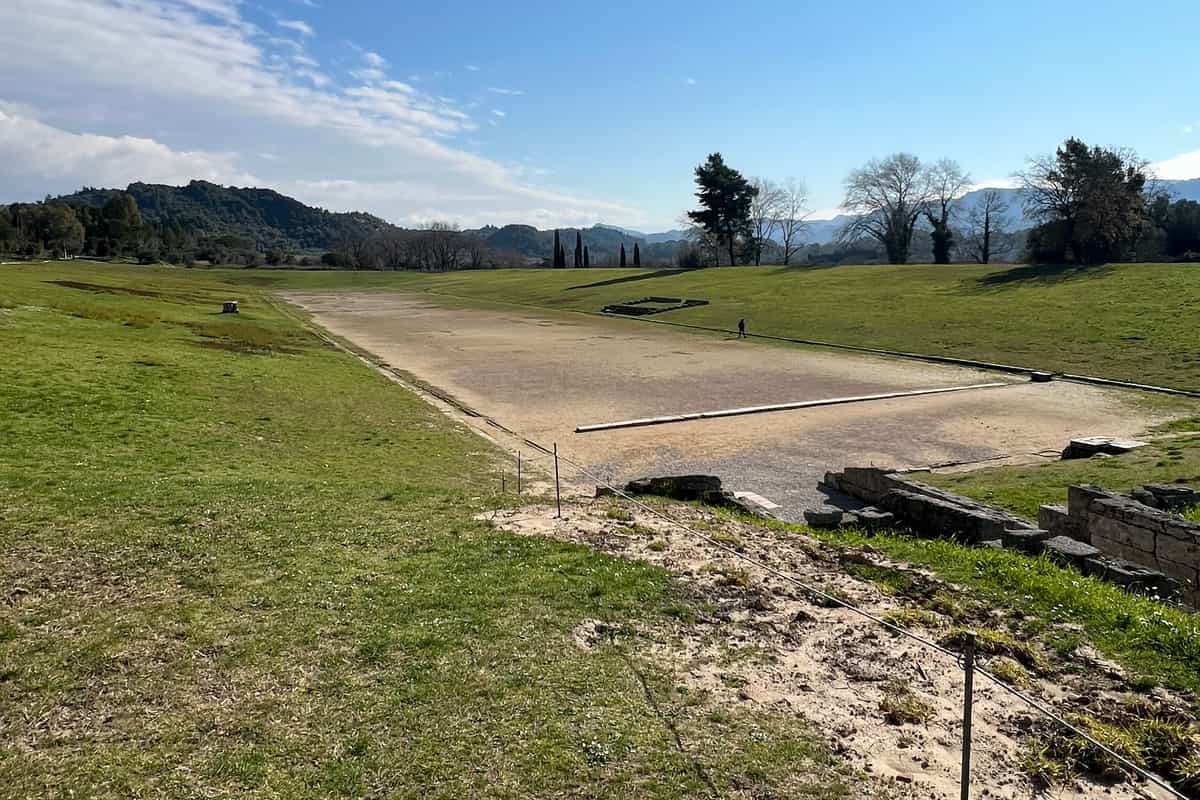
East of the Altis lies the stadium, 212.54 metres in length and 30 to 34 metres in width. The track was hard clay, with a white block marking the start. Athletes entered under the archway of a vaulted corridor. Ancient Olympia tickets also reach the treasuries that Greek cities built at the foot of Kronion Hill.
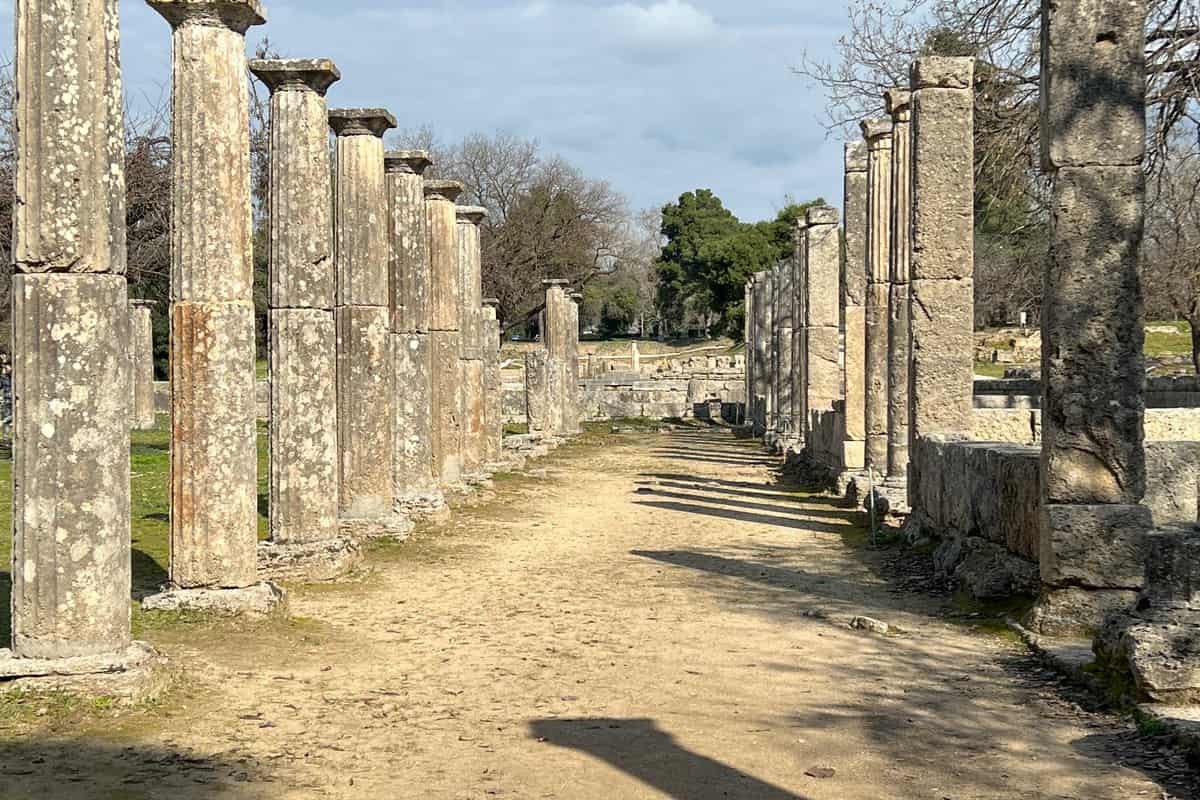
Beyond the sanctuary’s western side stand the Palaestra, the Gymnasium and the Leonidaion, plus the Workshop of Pheidias. Wikipedia calls the Leonidaion the site’s largest building, with 138 columns. Tools for working gold and ivory turned up in the workshop, which Wikipedia links to the statue of Zeus. The Philippeion, a round building 15 metres wide, honoured Philip II.
Ancient Olympia tickets lead to the museum, which has twelve exhibition rooms. It displays pediment sculpture from the Temple of Zeus. On the east pediment, Pelops and Oenomaus race their chariots. Paionios’s Nike once topped a six-metre pillar beside that temple. Diggers found the Hermes of Praxiteles, 2.10 metres tall, buried in rubble at the Temple of Hera.
Who needs ancient Olympia tickets?
Visitors need ancient Olympia tickets to enter the site and its museums. The museum’s own site lists days when entry needs no ticket. The ministry’s Olympia page names both a full ticket and a reduced one for the combined package.
Ancient Olympia tickets are not needed on those days. Two are 6 March, set in memory of Melina Mercouri, and 18 April, International Monuments Day. Others are International Museums Day, 28 October, a national holiday, and the last weekend of September. In winter, from November to March, two Sundays a month qualify, the first and the third.
The ministry’s Odysseus page for Olympia offers the combined package as a full ticket and as a reduced one. It sets no age or group beside the reduced ticket. The ministry’s page for another state site, the Olympieio in Athens, points to a separate page. That page covers reduced entry and entry without a ticket at state sites.
Covering all of the site calls for extensive walking, notes Wikipedia. Wikivoyage adds that no personal vehicles are permitted inside. Ancient Olympia tickets lead to paved paths and ramps for wheelchairs, says the museum’s own site. A ramp serves the museum entrance, and the museum lends a wheelchair after a telephone reservation. The ministry’s museum page lists parking and toilets.
For archaeological sites in general, the ministry page recommends shoes made for walking. Its rules ask visitors to dress and behave in a way that suits the site. Wikivoyage calls Olympia an open-air site and says to prepare for the hot sun in summer. It adds that visitors cannot shelter from rain and still see the ruins.
Holders of ancient Olympia tickets follow the ministry’s operating rules. They ban food and drink, smoking, litter and touching works of art. Visitors keep to marked routes and stay out of restricted areas. Pets stay out, but assistance dogs for visitors with disabilities are welcome. North of the ticket office, in the Truce Grove, stands the site’s cafeteria.
What else do visitors ask about ancient Olympia tickets?
What did the statue of Zeus look like, and do ancient Olympia tickets let visitors see it?
No visitor sees the statue today, because Wikipedia says it was destroyed during or before the sixth century AD. Its form is known only from ancient Greek descriptions and from approximate images on coins, gems and in art.
Phidias made a seated Zeus about 12.4 metres tall, with ivory plates and gold panels on a wooden frame. It filled half the width of its temple aisle, and Zeus sat on a throne ornamented with ebony and gold. Wikipedia counts the statue as one of seven ancient Wonders, and it stood in the Temple of Zeus.
Who was Pausanias, and why do writers and pages about Olympia quote his Description of Greece?
Pausanias was a Greek traveller and geographer of the second century AD who toured the mainland of Greece. His work Description of Greece describes ancient Greece from his own observations and sets out to cover all things Greek. Scholars once dismissed his writing as purely literary, but modern archaeological research has shown that his information is accurate.
He recounts that the Zeus statue was kept coated with olive oil against the marshiness of the Altis grove. Places he described, such as the Altis itself, lie inside the site that ancient Olympia tickets open to visitors.
What were the Heraean Games for girls, and did they happen where ancient Olympia tickets now lead?
The Heraea was an ancient festival in which unmarried young women ran a footrace in three age groups, says Wikipedia. Sixteen women organised the festival and were responsible for weaving a peplos for Hera and arranging choral dances. The only event was the stadion, a race one sixth shorter than the equivalent men’s race.
The prize was a wreath of olive leaves, plus a portion of the cow that was sacrificed to Hera. Wikipedia says the race was held at Olympia, and a tourism listing places it in the stadium there.
How do the modern Olympic Games link back to the place that ancient Olympia tickets open?
Pierre de Coubertin founded the International Olympic Committee in eighteen ninety-four, and the first modern Games followed in Athens. Wikipedia calls the Olympic flame a symbol of continuity between the ancient and the modern Olympic Games. The flame is lit at Olympia, and ancient Olympia tickets reach the ground where that lighting starts the torch relay.
The relay had no ancient precedent, says Wikipedia, and Carl Diem introduced it at the Berlin Games of nineteen thirty-six. The idea came from a sacred fire kept burning on the altar of Hestia’s sanctuary during the ancient Games.
Why did the ancient Games end, and who uncovered the ruins that ancient Olympia tickets now open?
The last recorded Games took place under the emperor Theodosius I, in the fourth century AD, says Wikipedia. It adds that flooding and earthquakes had already damaged the buildings, and that invasions had reached Olympia. Later, the earthquakes of the sixth century AD caused the Temple of Zeus to collapse, according to a tourism listing.
The same listing says the site’s treasures stayed buried until modern times and came to light from eighteen seventy-five. Those treasures came from excavations by the German Archaeological Institute, and ancient Olympia tickets now lead into the grounds.