Titania Hotel Athens is a hotel on Panepistimiou Avenue in central Athens, between Syntagma Square and Omonia Square. Tickets and tours beyond the hotel doors are collected on our tours in Greece page.
Below you find the hotel today, its star class, rooms and operator, the avenue and the neoclassical buildings around it, the history of the site, the way there from the airport, the metro and the tram, the rooms, the restaurants and the conference halls, and short answers to common questions.
What is the Titania Hotel Athens today?
The Titania Hotel Athens is a city hotel in central Athens. It works today under the name that the restored entry already gives. Its own pages describe a working hotel and say it continues to host travellers.
This page belongs to the part of the site called Athens accommodation, beside the pages of the other city hotels. It sets the restored text for the Titania Hotel Athens beside the hotel’s own pages and reports what each says. It sells nothing, quotes no tariff and arranges no stay. Questions about anything current go to the hotel.
The text restored on this site, the old entry, carries no date. Its heading reads “TITANIA HOTEL ATHENS GREECE A CLASS – Athens city center”. It sets the hotel on Panepistimiou Avenue, inside the historic and commercial core of Athens. Because the text is undated, every detail drawn from it is marked as coming from it alone.
The hotel’s own pages state that it is a member of a hotel group. The step dates from February of two thousand and twenty-four, as its story page says. The pages keep the same name for the hotel. They list sections for accommodation, for eating and drinking, for meetings and events, and for the location.
A business that offers lodging for payment and for short stays counts as a hotel, as Wikipedia defines the term. In that plain sense the Titania Hotel Athens is a hotel. Both texts give it the same name, and the restored text also uses a shorter form. Ask the hotel which company stands behind its listings today.
What star class did the Titania Hotel Athens hold?
Four stars is the class that the restored text gives the Titania Hotel Athens. It writes “CLASS A (4 star)” in its details. No class appears anywhere on the hotel’s pages. For the current category document, put the question to the hotel.
The old entry files the hotel among its A class hotels. Elsewhere on this site, that class is covered as 4 star hotels in Athens. Within the old entry’s own list, the hotel sits beside the other four star names. The text on this page adds no class of its own and awards no grade.
The old entry gives the class twice. Near its top it says “Rated: (4 star)”, and later it says “CLASS A (4 star)”. Both lines agree on four stars. The old entry names no body that awarded the stars and gives no year for them. So the four stars of the Titania Hotel Athens are an undated label.
The hotel’s own website carries no class. Its home page, hotel page and story page cover the location, the history and the group. None of them carries a star count or a class letter. Nothing on the website shows a change of class either, up or down, since the old entry was written.
Hotel ratings, as Wikipedia puts it, sort hotels by their quality. A class taken from an old entry is one such label, and this entry gives no date for it. Which category document does the Titania Hotel Athens hold today, and when was it last reviewed? Ask the hotel for both answers in writing, with the date of each.
What is the number of rooms at the Titania Hotel Athens after its renovation?
The Titania Hotel Athens lists 385 rooms and suites on its site today. The old entry of this site listed 375 rooms and 21 suites. The two sources count differently. The current total is the hotel’s to confirm.
Under its general information, the old entry lists one line: 375 rooms and 21 suites. It gives the rooms and the suites as two separate figures. The entry has no date, so no year is tied to either figure. Ask the hotel whether the 21 suites sit inside the 375 or beside them.
A single total of 385 rooms and suites appears on the rooms page of the Titania Hotel Athens. It describes the interiors as built for comfort and practical use. The page does not split the total between rooms and suites. Set against it, the two figures of the old entry cannot be matched line by line.
The old entry also speaks of a series of renovations at the hotel. Its words for the result are completely renovated rooms, fully air-conditioned. The entry names no year for that work and no number of rooms involved. Ask the hotel whether all of the rooms in the old figures went through it.
Four room types are called fully refurbished or fully renovated on the hotel’s site. They are Executive Room Acropolis View, Deluxe Room City View, Premier Room and Superior Room Atrium View. Their pages at the Titania Hotel Athens give no year for the work. Ask for the split of rooms and suites and the year of the last renovation.
Who runs the Titania Hotel Athens since two thousand and twenty-four?
A hotel group acquired the Titania Hotel Athens in February of two thousand and twenty-four, says its own story page. The same page says a family owns the group. This page names neither; the operating company is the hotel’s to confirm in writing.
The story page files the sale under a heading that reads New Era. Its hotel page repeats the month under a heading about the modern era. That page adds that the hotel has been part of the group since then. Neither page tells who manages the rooms, the kitchens or the front desk from day to day.
The story page adds a statement of intent about the future. The group plans to keep the history of the Titania Hotel Athens and improve its services. It ties the plan to the location, which it calls a meeting point and a reference in Athens. It gives no date and no list of projects.
Both the story page and the home page say that a family owns the group. Wikipedia counts a firm as a family business when multiple generations of one family shape or influence its decisions. The hotel’s pages use the word owned and not the term family business. Ask the hotel how the group is led and by whom.
The old entry names no owner or operator for the hotel. The account of that change comes from the hotel’s site. Ask the Titania Hotel Athens for the name of the company that operates it today. Request the answer in writing. Also ask whether that company is the owner of the hotel.
Where is the Titania Hotel Athens on Panepistimiou Avenue?
The old entry puts the Titania Hotel Athens on Panepistimiou Avenue, between Syntagma and Omonia squares. On its own website, the hotel anchors the building to the same two squares. Neither text gives a street number or a side of the road.
The old entry describes the position twice. Its short label calls the road a street and puts the hotel between the two squares. Its longer text calls the same road an avenue. The same text sets the hotel in Athens’ historical and commercial centre. Both lines sit in one undated text, which the hotel must confirm.
The home page of the hotel’s website calls the Titania Hotel Athens centrally positioned between the same two squares. It adds no distance to either square. The page says sights, shopping areas and business districts are reachable on foot or by a brief metro ride. It names no sight in that line and gives no minutes.
The hotel’s own location page words the position differently. It says the hotel is situated in Omonia Square and a short walk from the central districts. That is looser than the old entry, which puts the hotel between two squares and not in one. The hotel has to say which wording is exact.
A visitor who plans a route to the Titania Hotel Athens needs details that no source states. Which street number does the entrance carry? Does it open on the avenue itself or on a side street? Which side of the avenue is it on? Those are plain questions for the hotel, to be answered in writing.
Which neoclassical architecture stands in the area of the Titania Hotel Athens?
No source names a neoclassical building near the Titania Hotel Athens. The hotel’s own location page lists neoclassical architecture among the heritage that its central position gives access to. It names no building and no street.
The own location page for the Titania Hotel Athens lists neoclassical architecture as one of three items. The other two are Byzantine churches and local markets. The page does not say which building, church or market it means. No walking time is given, so the line is a category and not a route.
Wikipedia names Italy, France and Germany as the first homes of the neoclassical movement. It dates the move toward this style to the seventeen fifties. Its aim was a purer classical form in place of the excess of the late Baroque. Symmetry and simple geometry define it, rather than ornament. It is a style, not one building’s name.
Wikipedia adds a second wave, the Greek Revival, from about the start of the nineteenth century. It followed a growing understanding of Greek buildings that had survived. The Wikipedia article on Ernst Ziller calls him a German-born architect who became a Greek national. He designed royal and municipal buildings in Athens and Patras, mostly in the neoclassical style.
No source ties Ernst Ziller or the neoclassical style to the building of the Titania Hotel Athens. Wikipedia also notes that the term neoclassical is applied loosely to any building that borrows a little classical vocabulary. For that reason the designer’s name and any classical detail of the frontage are questions for the hotel.
What was on the site of the Titania Hotel Athens in nineteen eleven?
A patisserie called “The United Voustasias” stood on the site of the Titania Hotel Athens in nineteen eleven. The hotel’s own story page says the building opened that year as a pastry shop. It became a meeting place for intellectuals, artists and politicians.
The hotel’s own story page begins the tale of the building in nineteen eleven, long before it became a hotel. The hotel’s main page agrees on the year and on the name of the patisserie. Neither page tells who ran it, how large it was or what it sold, so those points stay open.
The story page names four groups who gathered there: intellectuals, artists and politicians, along with the Athenian aristocracy. It calls the place a popular meeting point and a social hub of the city. The page gives no names, only kinds of people. The Titania Hotel Athens website says no more about these first customers.
The story page ties the patisserie to its time. It says the atmosphere reflected a capital that was taking in modern European influences. The hotel’s main page words it differently, calling the patisserie a cultural hub for Athenian intellectuals. As the story page puts it, the hotel hosts travellers as the building once hosted the city’s thinkers.
Wikipedia describes a patisserie as a bakery that focuses on sweet baked goods and desserts. For the building, that means its first business sold sweets, not rooms. The hotel’s pages mention no fittings or photographs from that time. Ask the Titania Hotel Athens whether any part of that patisserie survives in the building today.
What did the Titania Hotel Athens building host as a cinema?
The Titania Hotel Athens building hosted the Titania Cinema, a film hall with two thousand seats. The hotel’s own story page says construction began in nineteen thirty-two. The cinema opened in nineteen thirty-three and ran until nineteen seventy.
The story page sets the scene in the early nineteen thirties. Cinema was gaining popularity across Athens, and competition among film businessmen grew much sharper. In that climate, it says, the old patisserie gave way to the Titania Cinema. The new hall rose on the ground where the Titania Hotel Athens stands today.
The cinema officially opened in nineteen thirty-three. The story page says it was equipped with the latest technology of its time. It does not list the equipment, the size of the screen or the first film shown. The hotel’s main page is just as silent on those points. Those details are questions for the hotel.
The main page of the Titania Hotel Athens website gives a second view of the same hall. It says the architecture and the cultural role of the cinema impressed visitors. The story page calls the cinema a giant among cinemas. Neither page names the architect, so ask the hotel who designed the building.
Wikipedia defines a movie theatre as a business with auditoriums where films are shown to the public. By that plain measure, the building worked as a cinema for nearly four decades, from nineteen thirty-three to nineteen seventy. Ask the Titania Hotel Athens whether any part of the cinema hall survives in the hotel today.
Planning help sits on the Athens Hotels page and the Athens Travel Tips page. Our Greece Hotels page and our Zinon Hotel Athens page add more detail. A different stay waits on the Achilleas Hotel Athens page.
When did the Titania Hotel Athens open as a hotel?
The hotel’s own story page dates the change from cinema to hotel to nineteen seventy-one. It says the Titania Hotel Athens was inaugurated in nineteen seventy-six. The two dates sit five years apart.
The story page opens its next chapter in nineteen seventy-one. In that chapter the old cinema site is turned into a modern hotel. The inauguration follows five years later, in nineteen seventy-six. The own pages do not say what filled the years in between. Ask the hotel what the conversion work involved and when it ended.
The story page links 385 rooms and suites to the inauguration of the Titania Hotel Athens in nineteen seventy-six. The hotel page of the same website repeats both the year and the figure. That page adds that the rooms and suites were offered to travellers visiting Athens. Neither page gives a day or a month for the inauguration.
From that moment, the story page says, the hotel welcomed guests from around the world. It also says the hotel kept the name and the legacy of the Titania Cinema. So the name of the hotel goes back to the cinema on the same site. The story page closes by comparing today’s travellers with the intellectuals the patisserie hosted.
The own pages leave a number of dates open. Ask the Titania Hotel Athens when the first hotel operator started work. No page names that operator or gives the day of its start. Ask also whether the hotel keeps papers from the inauguration of nineteen seventy-six. A dated record settles what a story page can only suggest.
How do guests reach the Titania Hotel Athens from the airport and park a car?
The hotel’s website gives the airport as approximately 35 minutes by car from the Titania Hotel Athens. Its services page lists transport hire to the airport. Its FAQ lists an underground car park with 170 spaces.
Guests of the Titania Hotel Athens who fly in land at Athens International Airport. The hotel’s pages call it Eleftherios Venizelos. Wikipedia gives the twenty-eighth of March, two thousand and one, as its first day. That start came before Athens hosted the Games in two thousand and four. Ask the hotel which time of day its 35 minutes describes.
The hotel’s own FAQ lists a shuttle for the airport and the port, in both directions. The FAQ says it runs on request, needs arranging in advance and is paid separately. Ask the hotel for the current transfer arrangement in writing. Transport between the airport and Athens is a wider topic, taken up under Athens airport transfers.
Private garage parking is among the facilities in the old entry. The hotel’s own FAQ says the Titania Hotel Athens has an underground car park with 170 spaces. Its services page adds that the underground parking runs around the clock. Ask the hotel for the current parking tariff and for the number of spaces open to guests.
The hotel’s own services page also lists car rental information at the reception. Ask the reception what that information covers. Hiring a car is a wider subject than the reception’s information; the general facts sit under car hire. Ask the Titania Hotel Athens whether the transport service, the shuttle and the car park still run as described.
Which metro and tram lines are close to the Titania Hotel Athens?
The Titania Hotel Athens states on its own website that the Panepistimio and Omonia metro stations lie only metres away. Wikipedia calls Omonia a transfer station linking Line 1 with Line 2. The website names no tram stop near the building.
On its home page, the hotel’s own website states that the two metro stations are only metres away. It gives neither a distance in figures nor a walking time. What is the exact walk from the entrance of the Titania Hotel Athens to each station entrance? That is a question for the hotel, answered in writing.
Omonia is an underground station, set below the square from which it takes its name. Wikipedia says only two stations let travellers change from Line 1 to Line 2, and this is one. Such a station is the point where the two lines meet. The hotel’s website therefore puts both of these lines close to its door.
The Panepistimio station belongs to the Athens Metro system. Wikipedia says it entered service in two thousand. The hotel’s website names it first of the two stations near the Titania Hotel Athens. Which exit of the station lies closest to the hotel’s entrance? No page names an exit, so the question goes to the hotel.
The tram is a separate network from the metro. Wikipedia says the company STASY has run it since June two thousand and eleven. It replaced the earlier tram company at that time. The hotel’s website names no tram stop near the building. Which stop is closest, and which lines call there? Both questions go to the hotel.
What is Athinas Street in the district of the Titania Hotel Athens?
Wikipedia calls Athinas Street a street in downtown Athens, and its name honours the goddess of wisdom, Athena. The old entry places the Titania Hotel Athens in the Athens city centre. The street therefore belongs to the same wider district.
According to Wikipedia, the street is nearly one kilometre long, and it runs in a line from south to north. The hotel’s pages carry no walking time between the building and the street. That distance is therefore a question for the Titania Hotel Athens, which can answer it in writing on request.
Wikipedia says a walkway of 80 metres has existed in its northern part since nineteen ninety-nine. The rest carries two lanes of traffic, with room for parked cars along the kerb. In the nineteen nineties, its northern section was under reconstruction. Pedestrian traffic lights were added, with full access to the metro station at that end.
Wikipedia says Metro Line 1 runs underneath the street for its whole length. That line is one of the two that meet at the transfer station described above. By the hotel’s own account, that station lies only metres from the Titania Hotel Athens. So the line below the street is also the line near the hotel.
The first paving of the road dates from the late nineteenth century, says Wikipedia. Buildings in a modern style were added in its northern part in the nineteen fifties. In June two thousand and eight, the mayor of Athens ordered the street pedestrianised. The aim was to make it one of the greenest streets in the city.
What rooms and suites does the Titania Hotel Athens list today?
Six room types for the Titania Hotel Athens have detailed pages on the hotel’s own website. They range from the Standard Room and the Superior Room Atrium View to the Junior Suite Acropolis View. Sizes go from 20 to 42 square metres.
The Standard Room opens the list at the Titania Hotel Athens. Its page gives up to 20 square metres, and an extra bed makes room for a third guest. The Superior Room Atrium View has 20 square metres and faces the atrium. Wikipedia traces the atrium to Roman houses, where it was an open court with rooms around it.
The Deluxe Room City View spans up to 22 square metres. It suits two guests, with a double bed or twin beds, and has a private veranda with city views. Wikipedia defines a veranda as a roofed porch, open to the air, on the outside of a building. The Premier Room is fully refurbished, with city or atrium views.
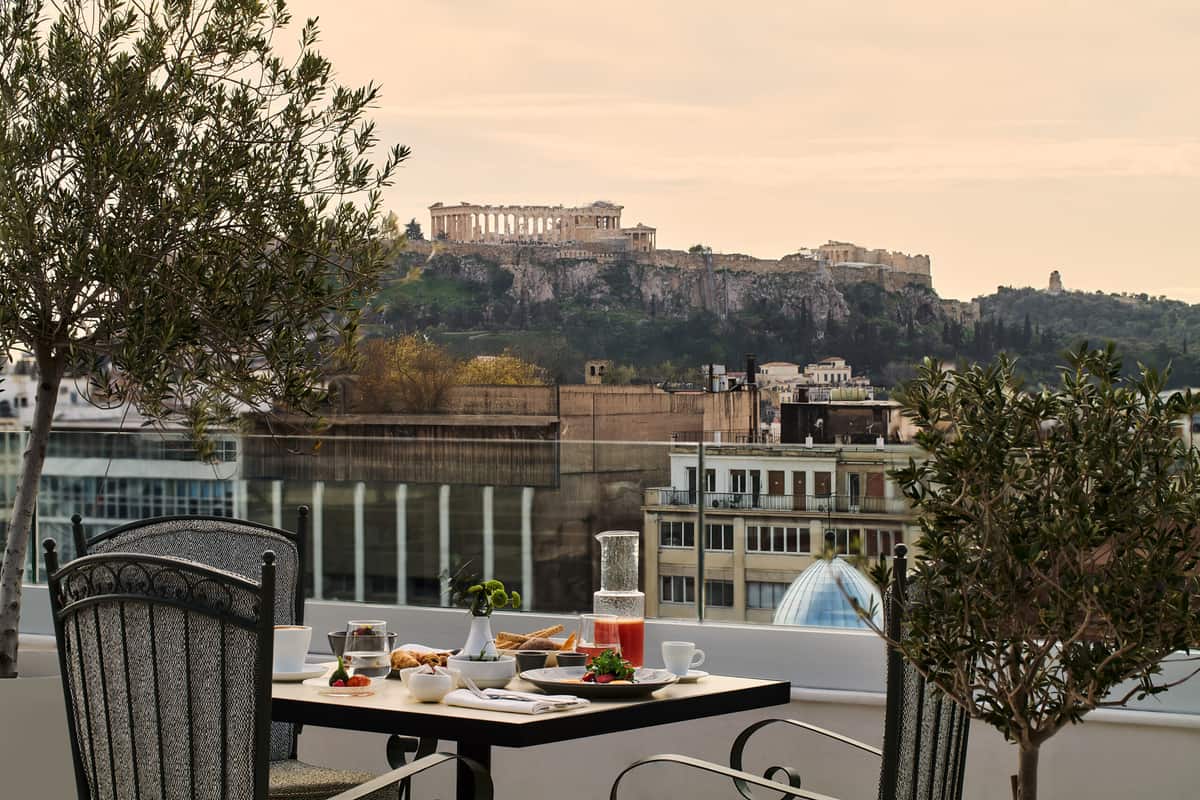
The Executive Room Acropolis View of the Titania Hotel Athens sits on the top floors. It measures up to 28 square metres and has a private balcony. Wikipedia notes that a balcony’s overhang cuts solar gain and so limits overheating indoors. The hotel’s own rooms page says a number of rooms overlook city landmarks, the Acropolis among them.
Four guests fit in the Junior Suite Acropolis View, which spans up to 42 square metres. The living area holds a sofa bed beside a master bedroom; a private balcony opens off it. The rooms page names family rooms and a further suite; the hotel can confirm what exists today. Pictures are in the Titania Hotel Athens photo gallery.
What in-room features and accessible rooms does the Titania Hotel Athens list?
Seven in-room items at the Titania Hotel Athens are named in the hotel’s own FAQ, from air-conditioning to a hairdryer. The Superior Room Atrium View is described as suitable for wheelchair users. Its services page also lists accessibility options, among them accommodation for wheelchair users.
Room facilities of the Titania Hotel Athens are listed in an undated text, the old entry here. They include satellite TV, in-house movies and a telephone with a data port and multilingual voice mail. It adds modems for fax and email, music, a mini bar, a hairdryer and a safe box. The hotel can say which remain.
The old entry presents individual climate control as a novelty, since a guest sets the room temperature independently. It also lists heat and sound isolated rooms. Wikipedia says air conditioning can regulate how humid the indoor air is. Wikipedia counts distance, barriers and absorption among the ways to limit noise in a room.
The hotel’s own rooms page names a minibar, where the FAQ writes a mini fridge. Wikipedia dates the first minibar to nineteen seventy-four, in a Hong Kong hotel. The Junior Suite Acropolis View has a marble bathroom with double wash basins, a separate shower and a Jacuzzi. Wikipedia says a hot tub is made for more than one bather.
The Superior Room Atrium View page asks guests to tell the hotel when arranging a stay. Wikipedia says a wheelchair serves people whose walking is limited by illness, injury or age. Wikipedia says lifts help make buildings accessible where ramps cannot be built. The floors a lift reaches and the accessible rooms are questions for the Titania Hotel Athens.
Which restaurants and bars does the Titania Hotel Athens list today?
The hotel’s own pages name three outlets at the Titania Hotel Athens. La Brasserie is by the lobby and the Olive Garden is on the eleventh floor. Vergina Restaurant on the mezzanine serves breakfast. The old entry names none of them.
La Brasserie is on the ground floor, beside the lobby, says the hotel’s own restaurants page. Its own page lists coffee, drinks, salads, sandwiches and desserts, and mentions soft wood accents. The services page calls it a café in the lobby area. Wikipedia’s entry on restaurants covers businesses that cook and serve meals and drinks to customers.
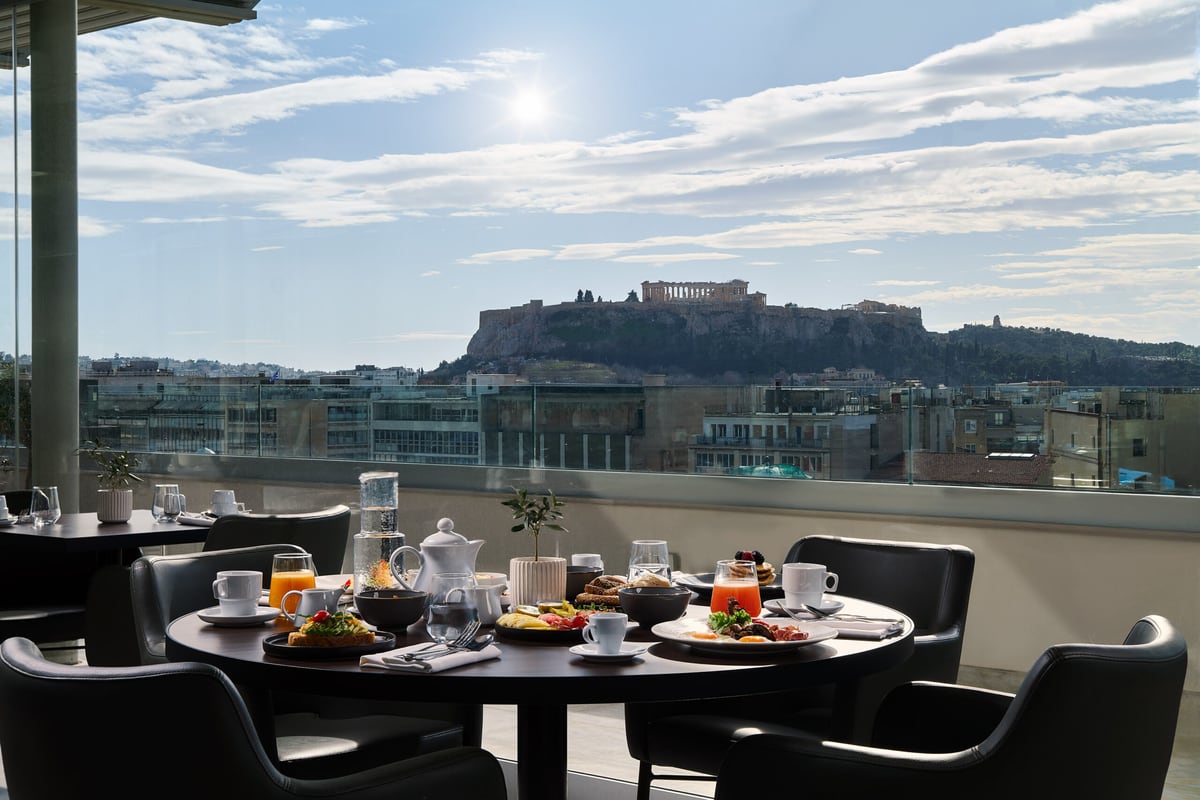
At the Titania Hotel Athens, the Olive Garden is the rooftop restaurant on the eleventh floor. The hotel’s restaurants page speaks of Mediterranean-inspired dishes. The Olive Garden’s own page says the kitchen serves contemporary Greek cuisine, made with fresh ingredients. Wikipedia describes Mediterranean cuisine as the foods and cooking methods of the lands around that sea.
The Olive Garden’s own page adds live piano music. Wikipedia defines a piano bar as an establishment that serves drinks, with a pianist at its centre. The own page names no such bar. It adds that the restaurant holds a special quality label for Greek cuisine. The services page lists lunch and dinner there, à la carte.
The old entry gave types, not names: a restaurant and a bar, a snack bar, a roof garden restaurant. Wikipedia’s entry on roof gardens deals with planting on top of a building. Its entry on bars centres on one trade, serving alcoholic drinks. Ask the Titania Hotel Athens which bar and snack bar still operate, and under which names.
Which conference halls and events spaces does the Titania Hotel Athens have?
The Titania Hotel Athens has nine conference halls and a top capacity of 800 attendees, its own page says. The own events pages add meeting rooms, catering, audiovisual systems and spaces for social events and celebrations.
The conferences page calls the nine halls fully equipped and says they can be arranged to suit each event. It gives 800 attendees as the top capacity. The undated old entry lists a single conference hall and gives no capacity. Ask whether 800 is the figure for one hall or for all nine.
The events page says each venue at the Titania Hotel Athens carries advanced audiovisual systems. The conferences page says audiovisual equipment can be arranged on request. The events page puts executive meetings and workshops in meeting rooms, large conferences in the halls. Wikipedia gives conference centre as the British term for a big building made to host conventions.
On-site catering on the conferences page runs from light refreshments to full meals. The events page names coffee breaks, buffet options and formal dining menus. In Wikipedia’s entry, a banquet is a formal meal shared by a crowd of guests. The events pages also list the rooftop Olive Garden among the venues for events.
The lifestyle events page lists parties, anniversary celebrations, baptisms and social gatherings, with menus crafted for each event. The events page adds a corporate meeting, a product launch, a gala dinner and a wedding. Ask the Titania Hotel Athens for the name and capacity of each hall. Ask also for the current layout of its event spaces.
What else do travellers ask about the Titania Hotel Athens?
Does the Titania Hotel Athens have a fitness room?
Yes. A fitness room sits on the second floor of the Titania Hotel Athens, as the FAQ page lists it. The same page says the room opens at eight in the morning and closes at eight in the evening.
The same FAQ names dumbbells and mats, a treadmill, an exercise bike, an elliptical machine and a full-body machine. In Wikipedia’s words, a health club is a place that holds exercise equipment for physical training. The hotel’s fitness room fits that plain definition.
The own services page adds a massage service on request. The old entry lists no gym and no massage. Ask the hotel whether the massage service still runs and how a guest arranges it.
Does the Titania Hotel Athens accept pets?
Yes. Pets weighing up to twelve kilograms are allowed, and the FAQ page calls the hotel pet-friendly. The services page repeats the weight limit in its list of facilities.
The FAQ asks guests to tell the Titania Hotel Athens in advance if a pet travels with them. It adds that additional charges or restrictions apply, and it states no amount.
Ask the hotel to send its pet rules in writing. Ask which room types take a pet and what the restrictions are. Ask how the weight limit applies to a second animal.
Can the Titania Hotel Athens provide a baby cot?
Yes. Baby cots and extra beds are supplied on request, when the hotel has them available, says the FAQ page. It asks guests to state these needs to the hotel in advance.
Ask the hotel what its total stock of baby cots is. Ask whether a cot fits in every room type. Ask how far ahead of arrival the request must reach the hotel.
Does the Titania Hotel Athens have a swimming pool?
Neither source mentions a pool on site. Per the website’s FAQ page, the Titania Hotel Athens has none. The old entry names no pool either, so the two texts agree.
The services page lists no pool among its facilities. The exercise space that the FAQ page names is the fitness room on the second floor. The old entry instead names a roof garden restaurant and garage parking.
Is there medical help at the Titania Hotel Athens?
Yes. The hotel’s own services page lists medical cover around the clock, with a doctor on call. The line stands in the same list of facilities and services as the fitness room and the massage service.
The same list puts a medical clinic six hundred and fifty metres away and a pharmacy twenty metres away. The hotel’s own page is the source of both distances.
The own FAQ asks guests to contact the reception for medical services or a doctor’s visit. A visit is paid separately, and the FAQ gives no amount. Ask the hotel for the names of the nearest clinic and pharmacy.