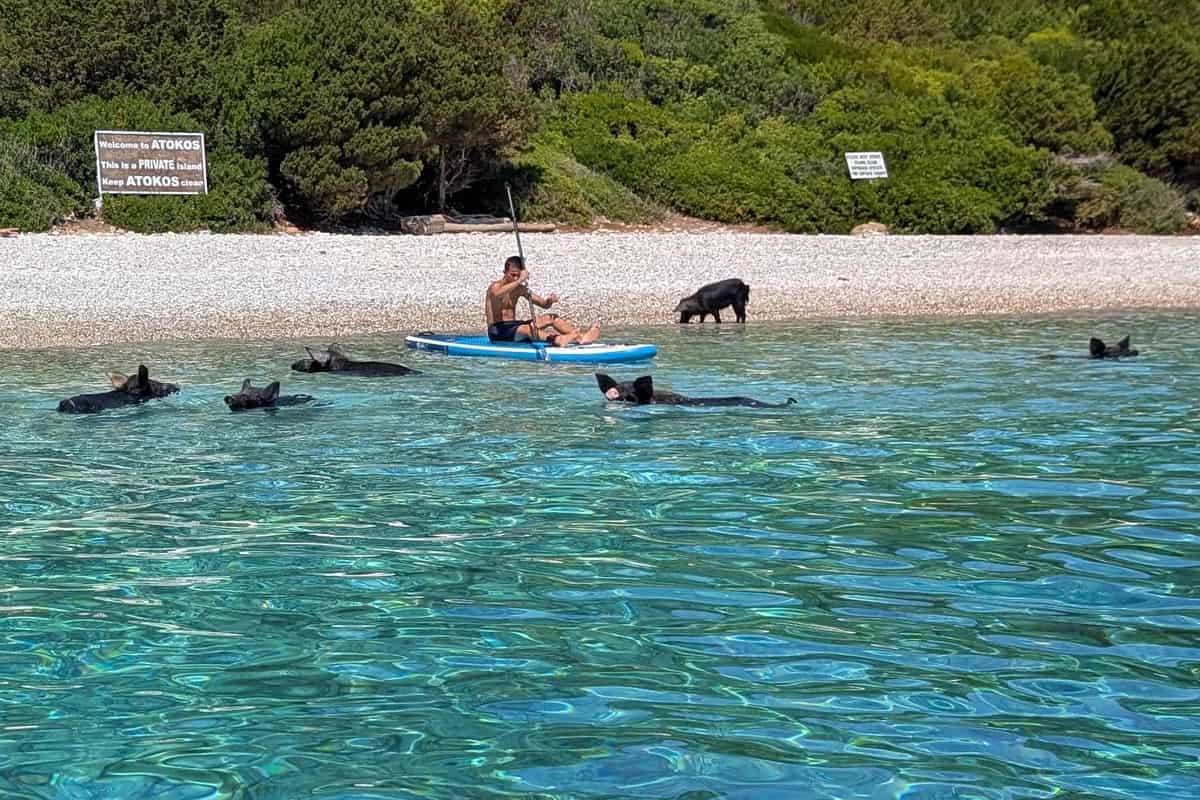
The Lefkada swimming pigs are the black pigs of Atokos, a small island in the Ionian Sea that visitors reach by boat from Lefkada. Anyone who wants more routes across the country can follow the tours in Greece page.
This page explains what the animals are, where they live, how visitors reach them, what a boat day includes, when to go, how to stay safe and what visitors ask.
What are the Lefkada swimming pigs?
The Lefkada swimming pigs are roaming black pigs, which sources also call wild boars, on the island of Atokos. They walk down to the shore, and visitors on boats sometimes see them paddle in the sea.
A travel blog describes the Lefkada swimming pigs as wild boars. They forage in the hills and come down to the pebbles from time to time. A news article writes of herds of black pigs roaming freely along the beach. Wikipedia says the boars roam the island’s beaches, and at times they go for a swim.
Sources do not agree on what to call the Lefkada swimming pigs. A newspaper travel writer met a big, hairy animal with tusks and wagered fifty-fifty that it was a wild boar. Wikipedia defines a feral pig as a farm pig that now lives in the wild.
Wikipedia also says wild boars can interbreed with farm pigs. It gives two plain differences. Farm pigs tend to have much more developed hindquarters than their wild boar ancestors. In wild boars the muscles sit on the head and shoulders. Adult male boars have canine teeth that protrude from the mouth.
The Lefkada swimming pigs became a trip because of photos and videos. A news article says the clips went viral on social media. Tourists from all over the world now come to see the animals up close. The same article says the island is now jokingly called “Piggy Island”.
The news article adds that the pigs seem used to people. They wander along the shore in search of food and appear unbothered by the tourists. The travel blog says the sight is not guaranteed on every trip. It calls the pig beach a bonus, not the whole point of the swim stop.
Where do the Lefkada swimming pigs live?
The Lefkada swimming pigs live on Atokos, a little uninhabited island of the Ionian Sea that lies off Acarnania’s coast. Sources place it near Lefkada or near Ithaca, and Wikipedia measures it 9 kilometres north-east of Ithaca.
Sources place the home of the Lefkada swimming pigs in different spots. A travel blog and a newspaper travel article put it near Lefkada. A news article puts it near Ithaca. The blog also says it sits between Lefkada, Ithaca and Kefalonia. Wikipedia gives a second distance: 8 kilometres south-west of Kastos, a Greek island east of Lefkada.
Atokos belongs to the Echinades, a group of islands off the coast of Acarnania. Wikipedia calls it one of the westernmost of them. It says a shipping magnate owns the island and the municipality of Ithaca administers it. The main channel for ships and ferries from Brindisi in Italy to Patras lies south-west of it.
No one lives on Atokos. The pigs share it with a flock of goats, and a shepherd visits the flock every fourth day, Wikipedia says. The blog adds that the island has no villages, no tavernas and not even a pier. Wikipedia and the blog both place it inside the European Natura network of protected areas.
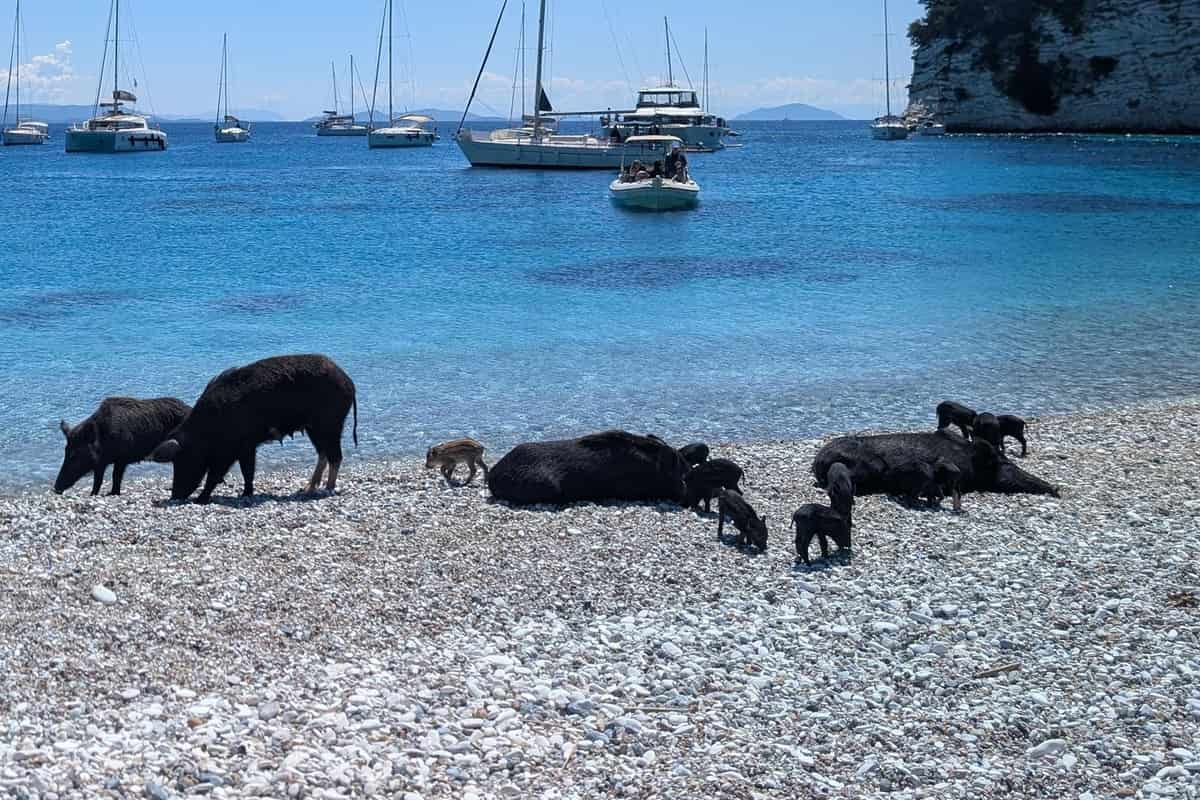
Boats that bring visitors to the Lefkada swimming pigs drop anchor in one of two coves, the blog says. One House Bay has smooth white pebbles and a single abandoned stone house at its edge. Wild Boar Beach is rougher, with steep cliffs behind it and shade from trees, and the animals regularly appear there.
Wikipedia names One House Bay on the east side and Cliff Bay on the south side as the two anchorages. A small chapel stands beside a short path from the beach at One House Bay. Wikipedia says visitors are allowed to land. The blog adds that local lore links the island to the travels of Odysseus, though no settlement survives.
How do visitors reach the Lefkada swimming pigs?
Visitors reach the Lefkada swimming pigs by boat only. No ferry or scheduled service calls at Atokos. Each trip starts on a private boat or a day cruise, and the main departure point is Nydri harbour.
Nydri lies on the east side of Lefkada, and Wikipedia calls it a popular tourist town. The Lefkada article on Wikipedia calls Nidri the island’s largest holiday resort. It adds that the sheltered setting looks out over Skorpios, Meganisi and the mainland.
Lefkada is not cut off from the mainland. Wikipedia says a causeway with a floating bridge links them. Wikivoyage adds that the bridge opens for passing yachts at the top of every hour.
Sources name six ways to reach the Lefkada swimming pigs. They are day cruises, private boat hire, small-group boats, sailing stops, rib boats and kayaks. The blog says a visitor already nearby can hire a rib boat or a kayak to cross in calm weather.
Wikipedia says a landing needs a private boat, and anchoring is safe in calm weather only. Wikivoyage says a sailboat or motor yacht can be rented on Lefkada with a skipper. One operator lists cruises from Nydri harbour and from Vasiliki harbour on Lefkada.
Trips to the Lefkada swimming pigs run from Lefkada and Kefalonia, says a news article. An organiser on Ithaca sails to the island each day. A second news site names Nydri, Ithaca and Sami on Kefalonia as departure points.
One operator lists Atokos as a beach stop after swimming from the boat. A newspaper writer who anchored off the island with friends also jumped in and swam onto the beach. In both accounts the last step to the Lefkada swimming pigs is a swim. Wikipedia adds that landing on the island is permitted.
What does a trip to the Lefkada swimming pigs include?
A trip to the Lefkada swimming pigs is a boat day with swim stops. One operator sets out at 9 in the morning. The day includes a cave swim, the pig beach, Meganisi, lunch and a cruise around Skorpios.
That day opens with a quick swim at a cave. Next comes Atokos, where the listing gives guests time on the pig beach. A swim at a beach on Meganisi follows, with a cocktail at a beach bar there.
The lunch stop is the village of Vathy on Meganisi, where guests explore and choose a meal. Lunch is not included. Wikipedia names Vathy as one of the ports of Meganisi. After lunch the boat cruises around Skorpios, and the day ends with one last swim before the return.
Both listed trips to the Lefkada swimming pigs circle Skorpios. Wikipedia describes Skorpios as a private island just east of Lefkada, part of the municipality of Meganisi. It covers 83.2 hectares and is heavily forested. The shipping owner Aristotle Onassis bought the island in nineteen sixty-three. Wikipedia counts over 200 tree varieties that he imported.
A second operator orders the stops differently on its Lefkada swimming pigs trip. It leaves Nydri harbour at 9 in the morning. The first stop is Kioni on Ithaca for an hour and a half. The second stop is Atokos. The third is the cave of Papanikolis on Meganisi, and the fourth is Lakka beach for a swim.
The last stop of that trip is Skorpios. The boat cruises around the island while a tour leader shares its history and stories. The listing gives the return to Nydri as about 5 in the afternoon.
The first operator offers its Lefkada swimming pigs cruise as a private charter. It also offers a small group with individual tickets, up to 11 people. It says the boats vary with the size of the group. The listing includes water, soft drinks and snacks. Cocktails and lunch at the stops are not included.
When can visitors see the Lefkada swimming pigs?
A news article ties the crowds of thousands of tourists to the summer season. The Lefkada swimming pigs are wild, and the blog stresses that they are not pets.
The news article says Atokos has grown into a major draw for thousands of tourists, particularly during the summer season. Demand for trips to see the Lefkada swimming pigs has risen sharply. Wikivoyage names August as the high season on Lefkada. It says charter flights to the airport near Preveza run from April through October.
A newspaper writer swam ashore on a hot day in late spring. The beach was empty of pigs and people. The writer guessed that the pigs were sheltering in the woods and walked in among the trees. Later one big male came out, followed by what looked like a female with two piglets.
The news article says the Lefkada swimming pigs take a brief dip in the sea when the temperature rises.
Wikipedia describes the climate of Lefkada as Mediterranean. Summers are hot and winters are cool. Its page on that climate describes dry summers with clear skies and high temperatures. Wikivoyage describes a strong, steady afternoon wind at Vasiliki on the south coast. It gives force 5 to 7 as the common strength in the late afternoon.
Wikipedia says safe mooring at Atokos is available only in calm weather. The prevailing winds blow from the north-west, and one anchorage gives boats cover. One operator warns that weather or unforeseen instructions from the competent authorities can alter the cruise itinerary. The blog adds that the Lefkada swimming pigs do not appear on every trip.
How do visitors stay safe around the Lefkada swimming pigs?
The blog calls the animals wild, not pets, says they bite and says to watch from a distance. The closest hospital is in Lefkada. Keeping that distance is the first rule around the Lefkada swimming pigs.
A newspaper writer met a big male that stopped about a metre away. The male looked at the group, then roared and lurched forward. The group ran into the sea and swam back to the boat. From the boat, the writer saw the Lefkada swimming pigs standing on the shore with unfriendly stares.
Wikipedia says the wild boar has a well developed sense of smell, acute hearing and comparatively weak eyesight. A frightened boar makes loud huffing sounds, and its back bristles stand up when it is agitated. Adult males have canine teeth that stick out of the mouth. The sharper lower ones show 10 to 12 centimetres.
Sources report the feeding of the Lefkada swimming pigs in different ways. One operator says guests have time to play with, feed and interact with the pigs. The news article says a number of travellers swim alongside the animals or feed them. In certain cases, it adds, organisers tempt the animals toward the boats with fruit.
The blog lists what to bring: swimwear, a towel, water, snacks, reef shoes and, for the phone, a dry bag. It adds reef-safe sunscreen and says the island has no facilities and no services. The newspaper writer wore wetsuit shoes as protection against burning-hot pebbles. The blog also says to keep an eye on conditions.
A visit to the Lefkada swimming pigs also means respecting the place, not only the animals. Wikipedia adds that the small chapel on the island has an open door.
What else do visitors ask about the Lefkada swimming pigs?
How long do wild boars live, and how do they group together?
One source calls the Lefkada swimming pigs wild boars, while another source describes herds of black pigs. Wikipedia gives wild boars a maximum lifespan of ten to fourteen years in the wild. Survival past four or five years is rare, and boars in captivity have lived for twenty years.
Wikipedia says boars are social animals that live in female-led family groups called sounders, led by an old matriarch. Young males leave at eight to fifteen months, and adult males tend to be solitary outside the breeding season.
Can wild boars swim, and what do they eat?
Wikipedia calls wild boars competent swimmers that are capable of covering long distances. It adds that the species occurs on islands of the Ionian and Aegean seas, sometimes swimming between islands. Swimming is therefore part of what wild boars do, which fits the stories of the Lefkada swimming pigs.
Wikipedia also calls the wild boar a highly versatile omnivore. All year it digs bulbs, tubers and roots out of the soil. In warm periods it eats earthworms, insects, fish, bird eggs, lizards, snakes, frogs and carrion.
What is Meganisi, where trips to the Lefkada swimming pigs also stop?
Wikipedia describes Meganisi as a Greek island and municipality lying close to Lefkada, on its east-southeast side. The Greek name means big island. Its villages are Katomeri, Vathy and Spartochori, and the two ports have a car ferry link to Lefkada.
Fishing boats mainly use the small harbour in Atheni Bay. Because it lacks a secondary school, pupils go to school in Nydri on Lefkada. Wikipedia adds that Wilhelm Dörpfeld and other researchers see Meganisi as Krocylea, an island in the kingdom of Odysseus.
Are the Lefkada swimming pigs the only swimming pigs in the world?
Wikipedia describes Pig Beach, on Big Major Cay in the Exuma district of the Bahamas. The cay has no human residents, and it takes its unofficial name from its colony of wild boars. Popular culture calls them the Bahamas’ swimming pigs, and the beach has become a tourist attraction.
Wikipedia adds that no single factual account of how the pigs reached the cay seems to exist. Tour operators run private and group trips there, just as boats do for the Lefkada swimming pigs.
What is the European Natura network that covers the island of the Lefkada swimming pigs?
Wikipedia calls the Natura network a set of protected nature sites spread across the European Union. It is built on the Birds Directive and the Habitats Directive and includes both land and marine areas. Wikipedia places Atokos, the home of the Lefkada swimming pigs, inside one of these areas.
Wikipedia notes that the network does not strictly limit how people use a site, and farms sit inside it. It says Skorpios is protected too, with no more than five percent of its area to be developed.