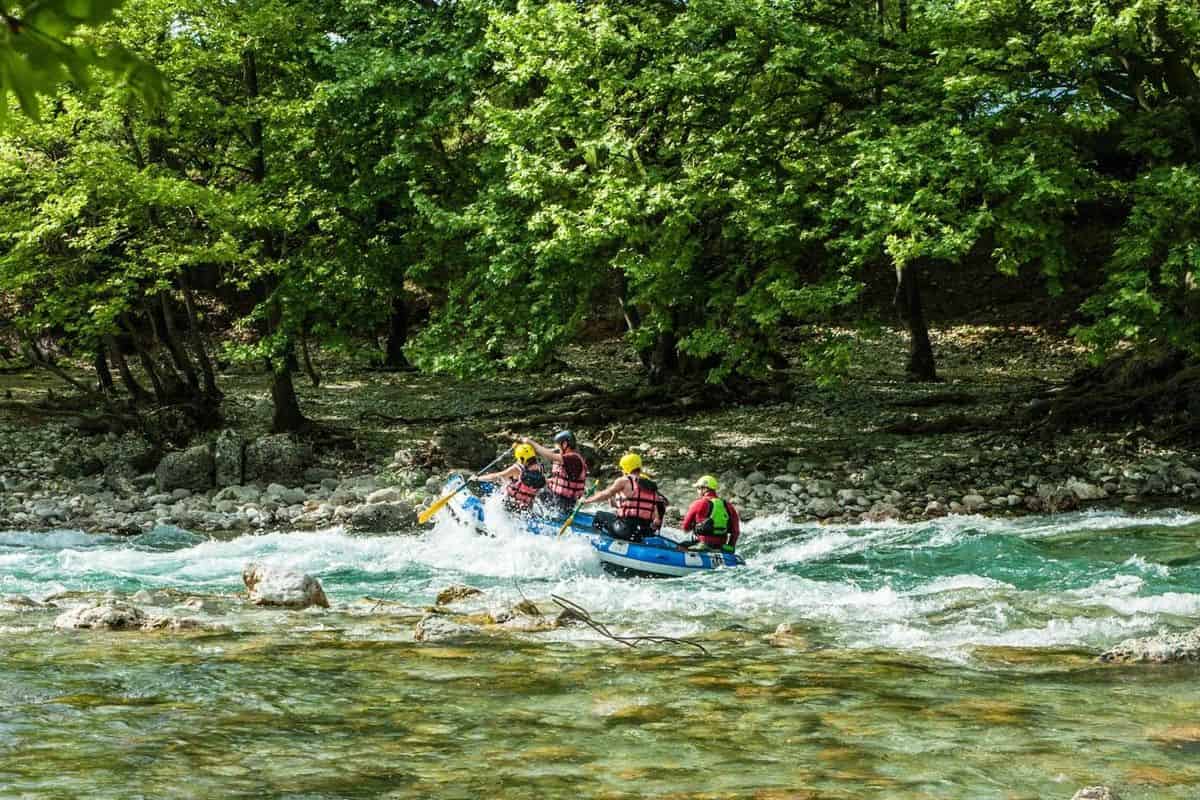
Voidomatis river rafting is a paddling trip down the Voidomatis river in the Zagori area of Epirus, in north-western Greece. Travellers who plan a longer stay on the mainland can find more routes through the tours in Greece hub.
Below, the page sets out what the trip includes, where it runs, the season, the order of the day, who it suits, how hard it is, what rafters wear and the questions that come up.
What is Voidomatis river rafting?
Voidomatis river rafting is a trip by inflatable raft down the Voidomatis river in Zagori, Epirus, in northwestern Greece. Operators describe it as an easy run for families and beginners. Each operator sets its own route, kit and package, so the details differ from page to page.
On a Voidomatis river rafting trip, a group sits in an inflatable raft and paddles downstream with an instructor. One operator calls its trip an easy-going rafting descent of the Voidomatis river. A family travel blog rates the route as easy and suitable for young children and total beginners. A tourism-board page calls the journey mostly serene.
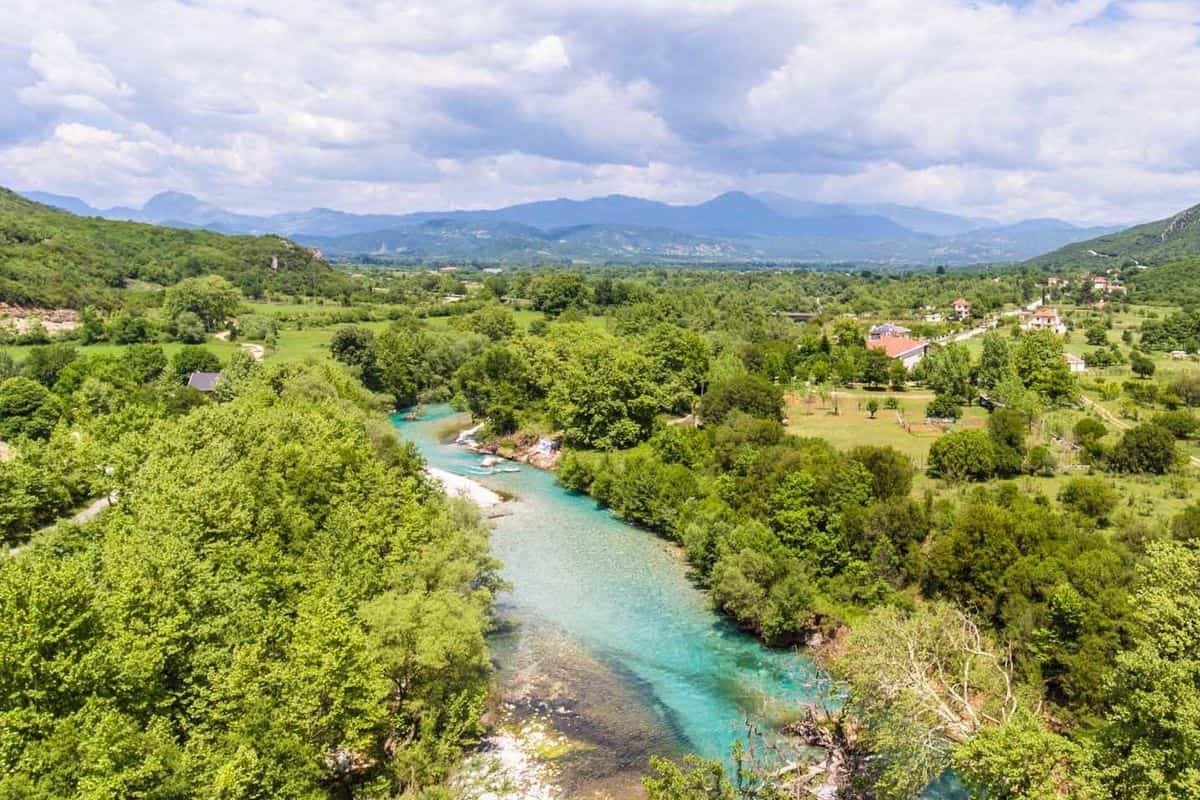
Wikipedia locates the Voidomatis within the regional unit of Ioannina, in the north-west of Greece. The Aoos receives the Voidomatis as a tributary, and the river is 15 kilometres long. Its main current begins at Vikos, a village, and the river finishes in the neighbourhood of Konitsa. The Aoos then crosses Albania and empties into the Adriatic Sea, Wikipedia says.
Clear water is one reason rafters choose Voidomatis river rafting. Wikipedia reads the river’s name as “the eye of the ox” and ties it to the clear blue eyes that oxen have. It also describes the river as one of Europe’s cleanest, because it faces no environmental issues. Since nineteen seventy-three the river has belonged to the Vikos-Aoos National Park.
Zagori sits among the Pindus mountains of Epirus, as both a region and a municipality. Wikipedia lists it as a UNESCO World Heritage Site, about 1,000 square kilometres in area. Epirus is a rugged, mountainous region of northwestern Greece, about 9,200 square kilometres in area. In the east, the Pindus Mountains separate Epirus from Macedonia and Thessaly.
Wikipedia says rafting uses an inflatable raft on a river or other body of water. It adds that certain sections of rivers are extreme, while other sections are not so extreme or difficult. Operators place Voidomatis river rafting at the easy end. One tour listed for the area carries the title “Epirus: Easy Rafting Experience on the Voidomatis River”.
What does Voidomatis river rafting include?
Operators who run Voidomatis river rafting list the raft and paddles, plus a wetsuit, shoes, a helmet and a lifejacket. Instructors lead the run, and a transfer links the base with the river. Photos and insurance appear on the lists too, and each operator sets its own package.
Kit comes first on a Voidomatis river rafting trip. One operator’s kit line reads neoprene suit and shoes, waterproof jacket, helmet, lifejacket. Another lists paddles, gloves and a windproof waterproof jacket, with a fleece in winter. The tourism-board page says the provider supplies all equipment, including wetsuit, booties, life jacket and helmet.
Instructors and transport come next. Three operators say their instructors are certified. One operator lists a welcome briefing and a safety briefing as part of the trip. Another lists transport in its own minibuses, and a third lists local transfers to the start and finish points. One operator says it sanitises its equipment after each use.
The lists for Voidomatis river rafting also name photos, insurance and exclusions. Four operator pages list photos or a recording of the trip. Three operators list liability insurance, one of them for all participants. One operator excludes personal accident insurance and anything its list does not name. One operator names Greek and English as the languages of the trip.
Group size differs too. One operator page says its rafts carry up to eight participants plus one instructor, with a minimum of two participants. A family travel blog about a summer trip says each raft suited six people and an instructor. The tourism-board page mentions an eight to ten person raft or a two person kayak.
Operators differ on where a Voidomatis river rafting day begins. One operator meets guests at its rafting base, which holds changing rooms, toilets and lockers. Another points to changing rooms and showers beside the finish, where snacks and cold water wait. A third collects guests at their accommodation, so they change there and skip the locker rooms.
Where does Voidomatis river rafting take place?
Voidomatis river rafting takes place on the Voidomatis, a river in the Zagori area of Epirus, in north-western Greece. Pages name the Aristi bridge as the start and the Kleidonia bridge as the finish, inside the Vikos-Aoos National Park.
A tourism page names the Aristi bridge as the starting point, midway between the villages of Aristi and Vikos. The run ends at the Kleidonia bridge. One operator lists the distance as 6.7 kilometres, while another operator lists seven kilometres. A family travel blog adds that a footpath joins the two bridges.
Meeting points for Voidomatis river rafting differ. A family travel blog describes meeting at an operator’s base in Kleidonia and riding a van to the Aristi bridge. Another operator keeps its base near Konitsa, within metres of the exit point. It wants every guest on site fifteen minutes ahead of time. A third operator picks guests up at their accommodation.
The tourism page calls Ioannina the closest city. It lists 51.7 kilometres, or one hour by car, to the Aristi bridge. Wikipedia describes Ioannina as the administrative centre of Epirus and its biggest city. It lies on the western bank of Lake Pamvotis at roughly 500 metres of altitude. Wikivoyage says buses to Zagori villages run without a regular schedule.
The tourism page names the villages closest to the start of Voidomatis river rafting. They are Aristi, Vikos and the two Papingo villages. The drive to the bridge takes seven minutes from Aristi and the same from Vikos. Megalo Papingo is thirteen minutes away, and Mikro Papingo twenty. Wikipedia counts forty-six villages in Zagori.
Papingo, says Wikipedia, is made of two villages, Megalo and Mikro, and both lie in the park. Kipoi, built on a rocky hill, sits where the Vikos Gorge ends in the south. A hiking trail enters the gorge from Monodendri.
Konitsa is a town close to the Albanian frontier, north of Ioannina. It sits on a slope of the Pindos range and looks over the spot where the Aoös and the Voidomatis come together.
Wikipedia says the park was founded in nineteen seventy-three and lies 30 kilometres north of Ioannina. Upstream, the Vikos Gorge runs along the south side of Tymphe, a mountain of the northern Pindus range. One operator says Voidomatis river rafting passes ancient oriental plane trees and silent monasteries.
When can visitors try Voidomatis river rafting?
Pages say Voidomatis river rafting runs all year. The tourism page rates spring and autumn as the top rafting seasons. It names summer as the season for swimming in the river. Trips depend on weather conditions, and the water is high until late spring.
One operator gives throughout the year as the active period of Voidomatis river rafting. Another says trips run daily. The family travel blog advises summer for children. Its instructor says only two or three companies stay active in winter. In summer he runs the river twice or even three times daily.
One operator offers two slots. The first trip gathers at 10 in the morning, while the second gathers at 2 in the afternoon. They finish at 1 and 5 in the afternoon. That operator gives about three hours in total for 6.7 kilometres, and another says over three hours. A third operator lists a two-hour route of seven kilometres.
The family travel blog puts the whole outing at between 2.5 and 3 hours. Roughly 1.5 hours of it is spent in the river. The tourism page sets the range for a Voidomatis river rafting trip at 2.5 to 4 hours. It ties the length to the water level, which it calls high until late spring.
Wikipedia gives an average water temperature of no more than 4 degrees Celsius. One operator states 4 degrees all year. The tourism page ties the refreshing chill, even in summer, to the river’s start in the snowcapped Pindos mountains. Wikivoyage says a swim in mid-summer lasts only seconds.
Wikipedia describes the climate of the Vikos-Aoos National Park as Mediterranean, changing to continental. Precipitation is high in winter, and summer brings a drought of two to three months. The yearly gap between the mean maximum and mean minimum temperature exceeds 40 degrees Celsius.
Wikivoyage calls the mountain climate unsteady, with rain and low temperatures. One operator of Voidomatis river rafting sets a cancellation deadline of twenty-four hours ahead of the activity.
How does Voidomatis river rafting work?
Operators describe the same order for Voidomatis river rafting. A briefing and kit come first, then a transfer, the run on the water and a snack at the finish. Each operator sets its own routine.
One operator lists five steps for Voidomatis river rafting. They are a welcome briefing, kit, a transfer to the river, a safety briefing and the run. A family travel blog tells the same story. Its author filled in forms, received kit, heard a briefing and boarded a small van with the other guests.
Wikipedia adds that rafting companies generally require customers to sign waiver forms. It also describes safety presentations at the start of rafting trips, which teach rafters about problems that can arise.
On a Voidomatis river rafting trip, the transfer differs by operator. One operator picks guests up at their hotel and returns them there. Another runs local transfers to the start and from the finish. Its base sits just metres from the exit point.
Wikipedia says paddles with one blade each push a raft along, while a person at the stern steers. Guests on commercial trips paddle themselves, as paddling is seen as more involving. On Voidomatis river rafting, one operator says a certified leader goes with each raft. The leader is trained in water safety and first aid and gives instructions throughout.
A tourism-board page calls Voidomatis river rafting mostly serene, with one small man-made waterfall just before the end. Two operators name the artificial dam there. The blog describes a slide near the end. Its leader asked the group for quick strokes. Then everyone sat down in the raft to get over the spot smoothly.
The blog describes a stop at the river bank about halfway, where the group drank from the springs. The leader asked who wanted to swim and took photos. The water was too cold for swimming, only for a dive in and out.
At the finish, the blog’s group changed clothes. One operator says its staff wait there with snacks, cold water and baklava. Photos reach guests in different ways. One operator emails the leader’s pictures once the day is over. A second operator records video and asks guests to bring a USB stick.
Who is Voidomatis river rafting for?
Voidomatis river rafting suits families with young children and first-time rafters, say operators and a travel blog. Two operators state that no earlier experience is needed. The blog rates the level of activity as easy.
The blog’s author went rafting with two young children. The other family on that raft had come from Corfu for the day. They brought a girl of seven and a half and an older boy. The blog calls the route suitable for young kids and total beginners.
The minimum age for Voidomatis river rafting differs by operator. One operator sets four years in the summer months. Another lists three years in summer and eight in winter. A third asks for five years and a legal guardian. A tourism-board page says children of four to six are accepted, depending on the difficulty.
Swimming rules for Voidomatis river rafting also differ. A tourism-board page says every participant needs to know how to swim. One operator says non-swimmers can join if they wear the safety gear provided and feel confident in the water. That operator requires every guest to wear the gear for the whole trip.
Wikipedia lists undisclosed medical conditions, such as heart problems, among the causes of injury in rafting. It advises discussing safety measures with a commercial operator before signing on for a trip. Wikipedia also links the higher classes of river to more rafting experience.
One operator invites guests to come with friends and loved ones. The blog’s author plans to return with friends and cousins. On the run, the author met walkers, because a path links the two bridges. For Voidomatis river rafting, two operators call the route gentle or easy going.
Wikipedia calls a kayak a low-to-the-water, canoe-like boat in which the paddler sits facing forward and uses a double-bladed paddle. A tourism-board page lists a two-person kayak next to a raft for eight to ten people.
How hard is Voidomatis river rafting?
Voidomatis river rafting is rated easy by the pages. One operator calls the run White Water class two and asks for no experience. Another operator rates it class one. Both say it suits beginners and families. The water is cold, and one stretch near the end is livelier.
Rafting classes follow the international scale of river difficulty. Wikipedia says the scale runs through six grades, class one to class six. Class one rapids are easy to navigate and need little manoeuvring. Class two adds rough water and rocks that can appear, and it asks for basic paddling skill. Class one and class two are the two lowest grades.
Voidomatis river rafting has one lively moment near the end. The tourism-board page calls the plunge down a small manmade waterfall the real adrenaline rush. It says the rest of the journey is serene. The family blog describes a slide over a barrier. The leader asked for quick paddling, then had everyone sit down inside the raft.
Cold is the other test. Wikipedia gives 4 degrees Celsius as the ceiling for the river’s mean water temperature. One operator reports a steady 4 degrees Celsius all year. The family blog says a guest found the water so cold that swimming meant diving in and getting out. The tourism-board page calls the water refreshing even in summer.
Two pieces of kit matter for Voidomatis river rafting. Wikipedia says the main job of a wetsuit is thermal insulation, and it names river rafting among its uses. Its article on flotation devices says a life jacket is a vest that holds the wearer up. The face stays clear of the water, and staying up takes no swimming.
Water level changes the run. Wikipedia’s kayaking article says water level can change the difficulty of rapids. The tourism-board page ties trip length to the difficulty chosen and the water level. It calls the level high until late spring. Voidomatis river rafting begins with a briefing at the base, says the family blog.
What do rafters wear and bring for Voidomatis river rafting?
For Voidomatis river rafting, the pages list personal items only, such as swimwear, a towel, spare clothes and sunscreen. The operators supply the technical kit, so nothing in the bag is gear for the river itself. Three pages ask for clothes to change into afterwards.
For Voidomatis river rafting, the family blog’s practical notes tell guests to take swimwear, dry clothes and a towel. One operator asks for comfortable clothes for after the activity, plus a swimsuit or a second pair of underwear. The tourism-board page lists dry clothes for changing back. All three pages plan for a change after the trip.
The tourism-board page closes its rafting and hiking notes with a longer list. It names a hat, sunscreen, sunglasses and a water bottle. It adds a top with long sleeves or UV protection. One operator asks for sunscreen in summer. Another operator records video and photos if the guest brings a USB stick of 8 GB or more.
Footwear shows how pages on Voidomatis river rafting differ. The family blog says rubber shoes were handed out at the base. The tourism-board page lists suitable footwear, such as sports shoes, but also says the operator supplies booties. Wikipedia advises discussing the required equipment with a commercial operator before a trip. Wikipedia says a snug fit helps a wetsuit work.
Valuables are another place where the pages differ. The family blog says the instructor strongly advised leaving everything in the car, so nothing is lost in the river. The tourism-board page lists a waterproof camera or phone case. One operator offers parking at its base. The same page adds that these trips rely on the weather.
After Voidomatis river rafting, the pages offer three ways to change. One operator’s base sits within metres of the exit point, with changing rooms and showers. Another operator lists changing rooms at its base in Kleidonia. A third operator drops guests back at their lodging, so they change in private and skip the locker rooms.
What else do visitors ask about Voidomatis river rafting?
What is the Vikos Gorge, and how is it linked with Voidomatis river rafting?
The Vikos Gorge is a canyon in north-western Greece, on the south side of Mount Tymphe, says Wikipedia. The gorge is about 32 kilometres long, and the height of its walls ranges from 120 to 1,350 metres depending on the spot. Wikipedia notes that Guinness ranks the gorge deepest in proportion to its width, although the claim is disputed.
Wikipedia says small streams run into the gorge, and the Voidomatis river then forms in its final stretch. Voidomatis river rafting takes place on that river, while a hiking trail from Monodendri leads north to its springs.
What are the arched stone bridges of Zagori, and when were they built?
Wikipedia says merchants who lived abroad paid for the arched stone bridges of Zagori, built in the eighteenth century. The stone bridges took over from wooden ones and linked the villages until modern roads came in the nineteen fifties.
The Vikos-Aoos National Park article lists sixteen of its stone bridges, plus seven churches, as protected historical monuments. Wikipedia names the Kontodimos, Milos and Petsonis bridges among the stone bridges that surround the village of Kipi. It also says that stone bridges span the Voidomatis, which is the river used for Voidomatis river rafting.
What are the Zagori villages near Voidomatis river rafting like, and what is Papingo?
Wikipedia says the 46 villages of Zagori centre on a square with a church, a plane tree and a fountain. Slate or cobblestone paths join the houses, and a local law says all buildings must use local, traditional materials.
The Papingo article describes a pair of villages, the greater Megalo Papingo and the lesser Mikro Papingo, under Mount Radovoli. Rock pools known as the Kolymbethres, or baptismal fonts, formed in limestone by the Rogovos stream on Mount Tymphe. The trek from Papingo to Drakolimni, a mountain lake that formed as glaciers retreated, takes about five hours on foot.
Who are the Sarakatsani, and how are they tied to the Zagori mountains?
Wikipedia calls the Sarakatsani an ethnic Greek group of traditional shepherds who once moved their flocks with the seasons. They spent the summer months in the mountains and returned to the lower plains for the winter months. The move up started in April, just before Saint George’s day, and the return began on Saint Demetrius’ day.
Wikipedia says they appeared in Zagori in the late eighteenth century as shepherds for the flocks of local families. Sarakatsani families also settled in Megalo Papingo, a village near Voidomatis river rafting trips, in the early twentieth century.
What ancient history lies beside Voidomatis river rafting, and what did archaeologists find?
Wikipedia says a British research team excavated Kleidi Cave, which sits just above the Voidomatis, in the nineteen eighties. Its finds, such as stone tools and animal remains, date to the Palaeolithic and are 12,000 to 20,000 years old.
One operator places its Voidomatis river rafting trip in the heart of the Vikos-Aoos National Park, a protected area. The earliest evidence of human presence in the park area, says Wikipedia, is between 10,000 and 17,000 years old. A small Molossian settlement with stone houses and two cemeteries stood between Monodendri and Vitsa in ancient times, Wikipedia says.