A Rhodes glass bottom submarine cruise takes you under the waterline of Rhodes Town harbour to watch the sea through large windows. More days out around the country are on our tours in Greece page.
This page covers what the trip is, its length and departure point, how the vessel works, the sea life, the sights above the waves, Mandraki harbour and the questions travellers ask.
What is a Rhodes glass bottom submarine cruise?
A Rhodes glass bottom submarine cruise is a boat trip in a vessel with an underwater viewing cabin. Large windows below the waterline let passengers watch the sea while they stay dry. Operators call the vessel a submarine or a glass bottom boat.
The island’s pages use two names. One operator’s page calls its vessel a submarine. Another operator’s page titles its trip both a submarine tour and a glass bottom boat. Both describe a cabin under the surface with windows onto the sea. On these pages a Rhodes glass bottom submarine cruise is one kind of trip with two names.
Wikipedia defines a glass bottom boat by its glass panels under the water level. It says the pane improves on a look down from above. The viewer does not look through disturbances on the water surface. The effect is like a diving mask, but passengers stay dry.
Wikipedia says a semi-submarine stays on the surface and cannot dive. Its cabin sits under the waterline, behind underwater windows. A true submarine faces high pressure from the water around it. A semi-submarine meets only the pressure that other surface vessels meet. Near the surface the pressure is low, so the windows can be large.
In one local listing, a Rhodes glass bottom submarine cruise leaves from Mandraki harbour. The listing gives guests a choice of route: the harbour and the medieval walls, or the beaches. It describes the view from the submarine cabin through huge windows.
The same listing also describes a safari tour with a glass bottom speed boat. It starts from Faliraki beach, not from Mandraki harbour. Wikipedia lists Faliraki as an outlying resort town east of Rhodes city. A Rhodes glass bottom submarine cruise from Mandraki and this speed boat tour are two different trips on that page.
How long is a Rhodes glass bottom submarine cruise and where does it leave from?
A Rhodes glass bottom submarine cruise lasts about 45 minutes, as two operators state it. It leaves from Mandraki harbour, which one operator places in central Rhodes Town. The other operator adds that the boat returns to the same place.
Two operators state the length. The first operator’s page says about 45 minutes and, in another line, 45 minutes from the port of Rhodes. The second operator’s page invites guests to a unique 45 minute trip. The figures match, so a Rhodes glass bottom submarine cruise fits into less than an hour.
Mandraki harbour is the departure point on both pages. The first operator’s page says Mandraki harbour is in central Rhodes Town. Wikipedia says the city has two marinas. One belongs to the municipality and sits in downtown Mandraki. The other is private and sits next to Akandia port.
The second operator says a Rhodes glass bottom submarine cruise departs every hour from Mandraki Harbour. One local listing says the same. Its first list starts at half past 10 in the morning. Its last entry reads half past 6 in the evening.
That page has a second list. It starts at half past 9 in the morning and ends at half past 10 at night. The two lists differ, so the page gives no single timetable. Night departures start at 8 in the evening. The listing gives the night trip 30 minutes.
The two operators state 45 minutes for a Rhodes glass bottom submarine cruise. The night trip is 15 minutes shorter. The second operator says its boat returns after 45 minutes to the same location. In plain words, the cruise is a round trip. Guests step off at the harbour where they stepped on.
How does a Rhodes glass bottom submarine cruise work?
A Rhodes glass bottom submarine cruise puts passengers in a room under the waterline, where big windows face the sea. Wikipedia says a semi-submarine floats on the surface and is unable to dive, so the boat never goes down.
Wikipedia compares the semi-submarine with the glass-bottom boat and says the semi-submarine sits deeper in the water. Its hull draft is greater, so more of the hull lies under the surface. The design looks like a small ship, with the passenger room low in the hull behind big underwater windows. Passengers walk up to the deck whenever they want.
A plain glass-bottom boat works in a similar way. Wikipedia says it has glass panels under the waterline, so passengers see the underwater world from inside. The view is better than looking down from the deck, because surface ripples disturb the picture. Wikipedia compares the effect to a diving mask, with the passengers staying dry.
Operators describe this layout for a Rhodes glass bottom submarine cruise. One operator lists a cabin with air conditioning below the surface. It also lists huge windows with a 360 degree panoramic view. The same operator lists a diver who feeds the fish while passengers watch and take photos of the underwater view.
Another operator says seven open doors lead into its underwater cabin. Passengers can explore the whole boat during the trip, it says. It adds that passengers can sit on top of the sundeck. They can also walk down the stairs to watch fish and starfish close to the windows.
Light and depth shape what a Rhodes glass bottom submarine cruise shows through its windows. Wikipedia says semi-submarines and glass-bottom boats run tourist trips in clear, calm water. Water clarity sets the depth of the seagrass Posidonia oceanica, which Wikipedia places between 1 and 35 metres. Seagrasses live in the photic zone, the layer of sea that light reaches.
What sea life can you see on a Rhodes glass bottom submarine cruise?
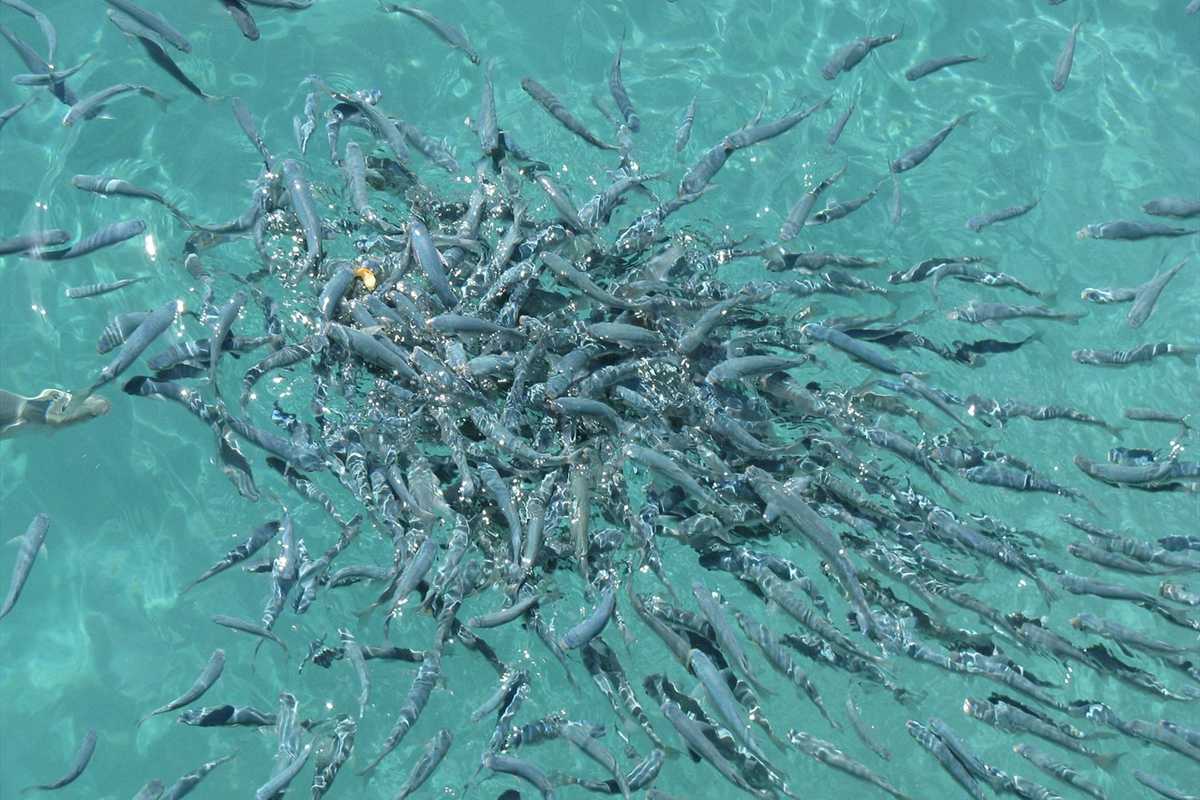
Operator pages list thousands of fish, starfish, jellyfish, octopus and marine plants for a Rhodes glass bottom submarine cruise. One operator calls the jellyfish and octopus occasional sights, so the list is a range, not a promise.
One listing says passengers see thousands of fish, as if inside a real aquarium. One operator says passengers watch colourful fish and starfish up close, and that the route includes shallow reefs. It also says passengers find fish that are local to Rhodes, which is the operator’s own claim.
Seabed plants matter to fish on a Rhodes glass bottom submarine cruise. The seagrass Posidonia oceanica, also named Neptune grass, is native only to the Mediterranean. Wikipedia says it forms large underwater meadows, a place for feeding, protection and nursery for juveniles. The Seagrass article says beds can harbor hundreds of species, fish included.
Wikipedia puts the Dodecanese, with Rhodes, Kos and Patmos, in the Aegean’s southeast corner. Wikipedia describes the Aegean as a long bay of the Mediterranean, set between the Balkans and Anatolia. Wikipedia lists seabream among Aegean catches. The damselfish, Chromis chromis, lives in small shoals in midwater above or near rocky reefs.
Operator lists for a Rhodes glass bottom submarine cruise name starfish and octopus. Wikipedia says sea urchins belong to the same phylum as starfish and crawl slowly on their tube feet. It says octopuses use camouflage to hunt and to avoid predators.
None of the operator pages for this trip names a seal or a turtle. Wikipedia says the Mediterranean monk seal survives in the Aegean Sea. No other pinniped species is believed to be rarer. Wikipedia calls Greece the top nesting site of the loggerhead turtle along the Mediterranean. Neither is a listed sight on a Rhodes glass bottom submarine cruise.
What do you pass above the water on a Rhodes glass bottom submarine cruise?
One operator names these sights on its Rhodes glass bottom submarine cruise. The list starts with the spot where the Colossus once stood, then Mandraki harbour and Elli Beach. The tourist harbour and the walls of the Old Town follow.
Another operator says its Rhodes glass bottom submarine cruise stops behind the three windmills. It calls them a reminder of Rhodes in the past. Its passengers can sit on the sundeck and admire the medieval walls. One listing adds that its harbour route runs around the harbour and the medieval walls. A second route follows the beaches.
Wikipedia describes the Colossus of Rhodes as a giant statue of Helios, the sun god. Chares of Lindos built it during the third century BC. It was one of seven wonders from antiquity. Wikipedia gives the height as about 70 cubits, or 33 metres. The statue is gone, but one operator names the spot where it stood.
An earthquake toppled the statue after 54 years. The Rhodians did not rebuild it, following the Oracle of Delphi, Wikipedia says. It calls the original location a matter of debate. In the floor of the Fortress of Saint Nicholas lies a ring of sandstone blocks with no known origin.
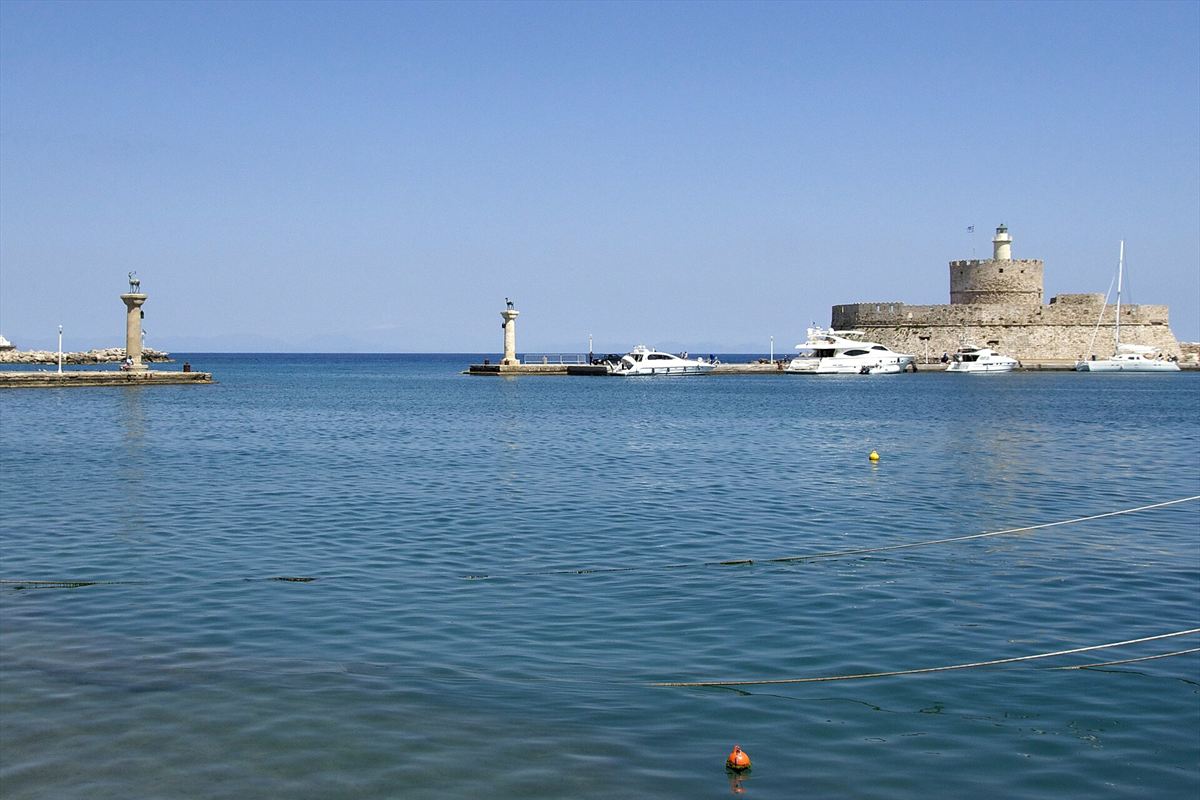
Wikipedia lists the Tower and Fort of Saint Nicholas at the tip of Mandraki’s natural mole. A Grand Master of the Knights built the tower in the fifteenth century. Later, a bastion built around it made the tower a fortress that guarded the sea. The Rhodes glass bottom submarine cruise of one operator starts at this harbour.
The walls of the Old Town end that operator’s list for a Rhodes glass bottom submarine cruise. In shape, they make a crescent that protects the medieval town. Wikipedia says the Knights Hospitaller began them in the early fourteenth century. The part that faces the harbour is a crenellated wall. UNESCO lists the medieval city as a World Heritage site.
Where is Mandraki harbour in Rhodes Town?
One operator starts its Rhodes glass bottom submarine cruise at Mandraki harbour, in the middle of Rhodes Town. Wikipedia puts Rhodes Town on the north-east tip of Rhodes, the biggest of the Dodecanese islands.
Rhodes Town is the main city of Rhodes and houses the municipality’s seat. Wikipedia gives it a population of about fifty-six thousand, and nearly ninety thousand with the surrounding area. The Aegean Sea touches the town on three sides: north, east and west. From Crete, the island lies to the northeast. From Athens, it lies to the southeast.
The Knights Hospitaller held Rhodes for about two centuries, and Wikipedia says Mandraki was their military harbour. The old military harbour is now where a Rhodes glass bottom submarine cruise starts, as the operators state. The Liberty Gate in the walls links the Kolona and Mandraki harbours.
Florestano Di Fausto, an Italian architect, planned the new quarter of Rhodes around Mandraki as a Garden City. Along the main sea promenade he built the Market, the Palace of the governor and a cathedral. The city keeps a municipal marina in the Mandraki area today.
Wikipedia reports a local belief that the Colossus stood at the port entrance of Mandraki, where two pillars rise today. Wikivoyage shows modern bronze deer statues in Mandraki harbour, a spot it links to the Colossus. One operator names the same spot as a sight.
Wikivoyage lists the Commercial Harbour, the yacht and ferry harbour Mandraki and Elli Beach on the New Town waterfront. So two sights from the list of a Rhodes glass bottom submarine cruise share one stretch of coast. Wikipedia describes the Aquarium of Rhodes as a research centre in an Art Deco building by Armando Bernabiti.
What else do travellers ask about a Rhodes glass bottom submarine cruise?
How does the Aquarium of Rhodes differ from a Rhodes glass bottom submarine cruise?
In Rhodes, Greece, one building works as an aquarium, a museum and a marine research centre. It dates from the nineteen thirties, when Italy ruled the island. The Hellenic Centre for Marine Research is in charge of it now.
The aquarium sits in the basement, in a corridor designed to look like an underwater cave. The tanks along each side hold approximately 80,000 litres of filtered seawater. On a Rhodes glass bottom submarine cruise the windows face the open sea, while here the animals live in tanks.
The exhibits cover sharks, lobsters, crabs, corals, sea urchins and octopuses. One freshwater tank is home to the Rhodes minnow, a threatened species that lives nowhere else. A grave at the port of Rhodes gave up the skeleton of a Mediterranean monk seal, 2,000 years old.
What does the Faliraki glass-bottom speedboat route visit?
One local listing describes a safari tour on a glass-bottom speedboat from Faliraki beach. It names five stops: Anthony Quinn Bay, the diver’s cave, Ladiko beach, the Diamond islands and the Seal’s cave. This route differs from the harbour trips of a Rhodes glass bottom submarine cruise.
The listing gives the Faliraki trips their own times. The first line starts at 10 in the morning and ends at 4 in the afternoon.
Do evening and night trips run from Mandraki harbour?
Yes, in one local listing. Three Mandraki lines list a Rhodes glass bottom submarine cruise: a day line, a longer line and a night line. The longer line runs from half past 9 in the morning to half past 10 at night.
The night line starts at 8 in the evening and carries its own note on running time. The other two operator pages read for this post list no night run. A Rhodes glass bottom submarine cruise after dark therefore rests on that one listing.
What climate and winds shape the sea around Rhodes?
Wikipedia gives the city of Rhodes a Mediterranean climate with hot summers. Its weather station at the port puts the average temperature of the year at 20.9 degrees Celsius. Wikipedia also says Rhodes Port has among the mildest winters in Europe.
In the Mediterranean zone that includes the Dodecanese, Wikipedia describes summers that are mainly sunny and dry. On the coast, it says, the cooler sea and the breeze from it soften heatwaves.
Meltemia, or etesian winds, blow from late spring until October. July and August record their highest frequency. Wikipedia adds that under these winds the Aegean stays cooler than mainland Greece or the Ionian Sea. It says nothing about boat trips, so this page gives no forecast for a Rhodes glass bottom submarine cruise.
What do travellers take aboard a Rhodes glass bottom submarine cruise?
The pages of the boat operators list no items to pack for a Rhodes glass bottom submarine cruise. One submarine operator invites guests to photograph the views under the surface. A phone or camera is therefore the one item tied to a source.
That operator also lists a bar on the vessel and states that drinks are not included. Another operator asks guests who need a transfer to write by e-mail at least one day before the activity.