
A Knossos Palace ticket with audio guide lets a visitor walk through the Minoan ruins near Heraklion at their own pace while a recorded voice names each stop. For more days out, the home page of tours in Greece lists tours on the other islands.
This page covers what the ticket gives, how the audio works, where the palace lies, its history, what visitors see, the Minotaur myth, Arthur Evans, the opening times and the questions travellers ask.
What is a Knossos Palace ticket with audio guide?
A Knossos Palace ticket with audio guide pairs entry to the site with a recorded tour on your own phone. One operator lists a time-slotted e-ticket, a downloadable audio tour and a site map in one listing.
One operator offers a self-paced audio tour built for Android and iOS smartphones, with offline content and an activation link. Another operator lists an admission ticket with an optional audio guide, so the audio is an add-on. A third operator sends the e-ticket in a messaging app or by email, with steps to download the audio.
The difference between a plain entry ticket and a Knossos Palace ticket with audio guide is the commentary. The Greek Ministry of Culture page on Knossos sends visitors to its official e-ticketing service for entry tickets. The audio versions add a recorded story that plays while you walk through the ruins.
The visit is self-paced. One operator says no live tour leader accompanies you and no meeting point is set. Another operator says visitors enter on a selected date and time, then wander at their leisure.
For a Knossos Palace ticket with audio guide, one operator lists a charged smartphone and headphones as mandatory items. The phone needs Android version 9.0 or newer, or iOS version 17.0 or newer. It also asks for room for 100 to 150 MB. The same operator lists the audio tour per device used, not per person.
How does the audio guide work at Knossos Palace?
A Knossos Palace ticket with audio guide works as a download. You open a link and load the tour on your phone before the visit. On site, you play it stop by stop while a map shows the route.
Everything starts with an email. One operator says it carries instructions to download the audio tour, plus an activation link. Another operator tells buyers to download its app and pick the audio tour named on the voucher. The first operator also says to download the ticket and the audio on Wi-Fi before the visit.
At the site, a Knossos Palace ticket with audio guide plays as a route of stops. One operator says an interactive map leads you step by step, and each stop carries a choice of stories. That tour holds maps, video, audio and text, and the operator recommends headphones.
One audio tour app for Knossos lists 25 spots and 50 minutes of audio, plus up to 45 podcasts. It adds adjustable voice speed, a button that jumps back 10 seconds, and podcasts that play by location. It also has an offline, illustrated map. It says access lasts 30 days after purchase.
Languages differ by operator for a Knossos Palace ticket with audio guide. One operator lists English, French or Italian, depending on the option chosen. One listing site gives five languages and names English, Italian and French. A third operator lists its virtual reality audio tour in ten languages, including Polish, Japanese and Portuguese.
Wikipedia explains the idea behind a Knossos Palace ticket with audio guide in general terms. An audio tour, or audio guide, is recorded spoken commentary that gives background on what a visitor sees. Phone apps can use GPS to start the matching audio near each location, and visitors can pause or skip stops.
Where is Knossos Palace?
Knossos Palace stands on Crete, in the southern part of Heraklion, around 5 km south of the city’s historic centre. A Knossos Palace ticket with audio guide opens the gate to this archaeological site and ancient urban centre.
No Greek island is larger than Crete, and only four Mediterranean islands are bigger: Sicily, Sardinia, Cyprus and Corsica. Heraklion, the island’s capital and largest city, sits on its north shore. Kephala hill, in the Kairatos river valley, carries the ruins, which fall inside the municipality of Heraklion.
The valley gave the settlement access to the north coast and to routes into the island’s interior. The ancient port of Heracleium, which gave Heraklion its name, served as the harbour for Knossos. It lay about 20 stadia, or approximately 3.7 kilometres, away. A Knossos Palace ticket with audio guide opens the hill that this harbour once served.
A Knossos Palace ticket with audio guide leads to a site 5 km from Heraklion, but sources differ on direction. Wikipedia says south of the historic centre, one operator says south of Heraklion, and another operator says southeast. The culture ministry of Greece gives the site name as Knosos, in the Prefecture of Iraklio.
The multi-storey palace complex covered approximately 20,000 square metres. UNESCO lists Knossos in a World Heritage Site called Minoan Palatial Centres. The group also holds Phaistos, Malia, Zakros, Zominthos and Kydonia. A Knossos Palace ticket with audio guide opens one of those six places.
What is the history of Knossos Palace?
Knossos was first settled around seven thousand BC and grew into the biggest centre of Minoan culture. The first palace dates to around nineteen hundred BC. A Knossos Palace ticket with audio guide opens a site lived in from Neolithic times into the first millennium AD.
The first community lived on Kephala hill, the later site of the palace. It was a small settlement of farmers and herders. Wikipedia reports a wide view that Knossos is Europe’s oldest city. Earlier structures were levelled or reorganised to form its platform. The palace appears to have served administration, storage, ritual and craft work.
That first palace fell around seventeen hundred BC, probably to an earthquake or a series of seismic events. The Minoans then rebuilt it, bigger and more elaborate than before. The ruins on a Knossos Palace ticket with audio guide largely belong to this second palace. It was at its height from about seventeen hundred to fourteen fifty BC.
Knossos kept strong links with the eastern Mediterranean, and pottery, frescoes and luxury objects suggest trade. Around sixteen hundred BC, the volcano on Thera, now Santorini, erupted and destroyed Akrotiri. Wikipedia says Knossos continued to prosper, and a Knossos Palace ticket with audio guide opens its ruins today. The exact date of the eruption is still debated.
From about fourteen fifty BC, Mycenaean Greeks used Knossos as an important administrative centre. Linear B tablets from the site write down an early form of Greek. They track land, labour, livestock, textiles and offerings. Michael Ventris deciphered Linear B in nineteen fifty-two. Linear A, the older Minoan script, has not been fully deciphered.
A fire destroyed the palace around thirteen fifty BC, and its final end is still debated. Under Rome the city was Colonia Iulia Nobilis Cnossus, and its Villa of Dionysos is known for mosaics. Heraklion later became the main city, and Knossos declined. A Knossos Palace ticket with audio guide opens a site with that long past.
What do you see on a Knossos Palace ticket with audio guide?
A Knossos Palace ticket with audio guide brings you to courts, the Throne Room, storage rooms and painted walls. Operators name these places, and the audio tour lets you take them at your own pace.
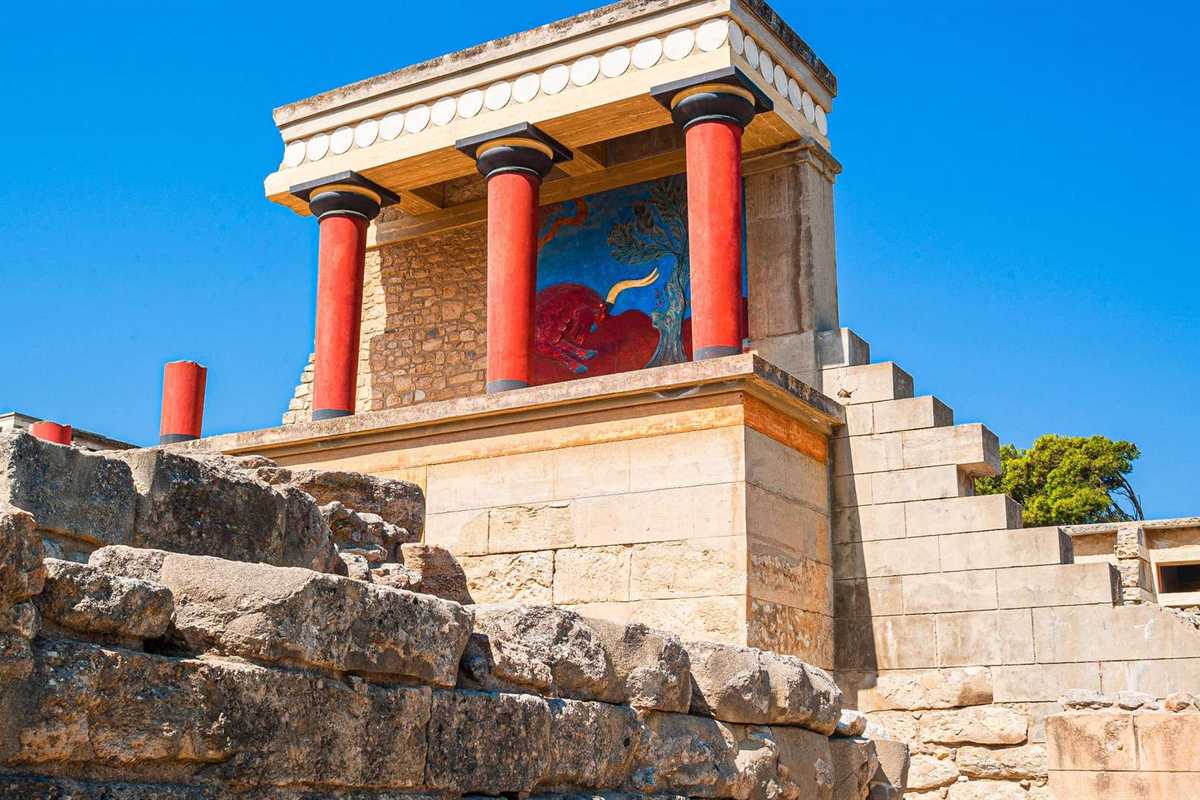
Wikipedia says the palace was built around a large rectangular Central Court. The West Court was a major approach. One operator names red-painted columns, and Wikipedia notes that Minoan columns can taper downward, unlike later Greek columns.
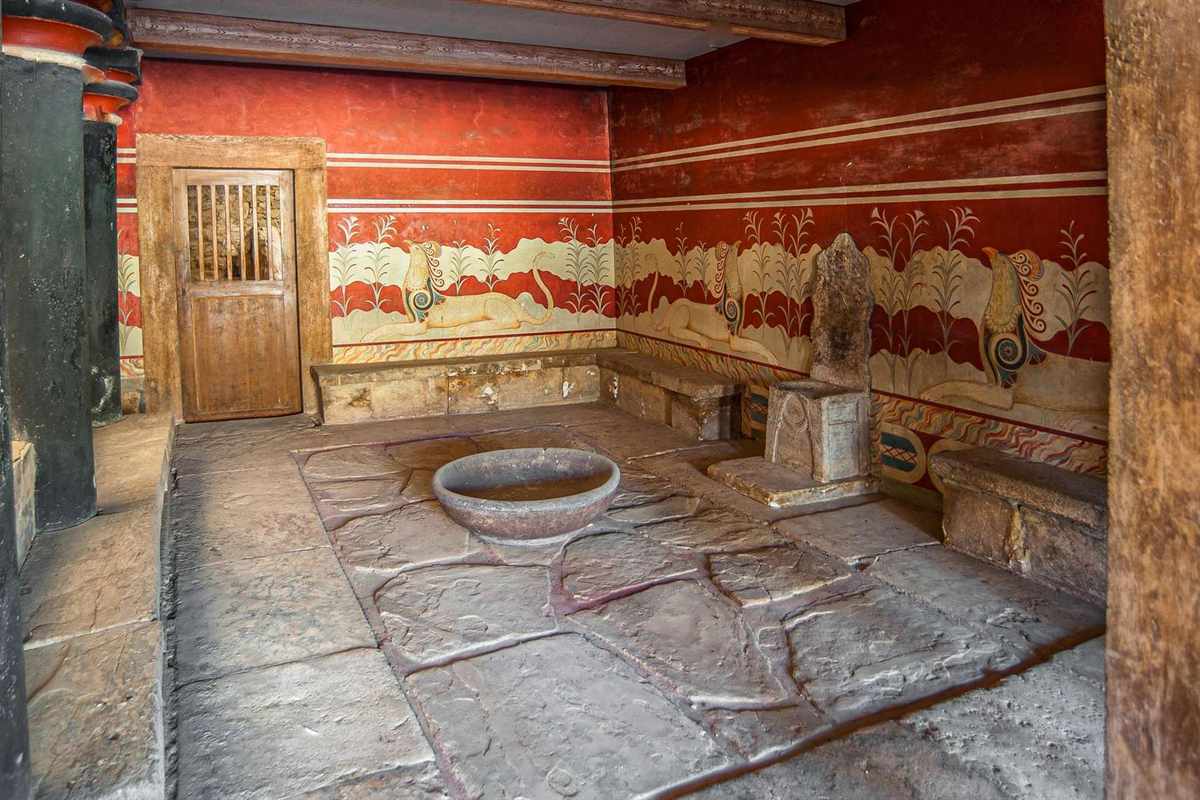
Wikipedia says the Throne Room holds a seat of gypsum set against one wall. Benches, a lustral basin and griffin paintings share the room. One operator calls the stone seat mysterious. Another says the throne of King Minos is still intact. A Knossos Palace ticket with audio guide suits a slow look, because the tour runs on your own phone.
The storage rooms are another sight. Wikipedia says the long magazines held large clay jars, called pithoi, for oil, grain and wine. One operator says the West Magazines tell of palace bureaucracy, early linear writing and Minoan trade. Another lists workrooms, living spaces and storerooms.
Frescoes need time, and a Knossos Palace ticket with audio guide leaves the time to you. One operator names the South Propylaeum, where cupbearers and procession frescoes show daily life and ceremony. It also names the Queen’s Megaron, with a blue dolphins fresco and a bathroom.
Wikipedia says Cretan frescoes normally survive as partial fragments. The palace shows a replica of the Prince of the Lilies. The mostly rebuilt original stands in the Heraklion Archaeological Museum. The museum holds the larger part of the Knossos finds. Treat it as a separate stop in Heraklion.
What is the Minotaur myth at Knossos Palace?
Greek myth sets the Minotaur story at Knossos, where King Minos had a Labyrinth built to hold a bull-headed monster. A Knossos Palace ticket with audio guide puts you on the ground that tradition ties to the tale.
Minos was a king of Crete. In the story, he asked the sea god Poseidon for a white bull and kept it instead of sacrificing it. As a punishment, his wife Pasiphaë fell in love with the bull. She bore the Minotaur, who had a man’s body and the head and tail of a bull.
Minotaur is a Greek word for “Bull of Minos”. Minos had the craftsman Daedalus build the Labyrinth to hold him. The myth places that maze near the palace at Knossos, the site a Knossos Palace ticket with audio guide opens.
In one telling, Athens sent fourteen young people, seven men and seven women, to the Labyrinth every nine years. This followed the death of Minos’s son Androgeus. The Athenian hero Theseus volunteered to face the Minotaur. Ariadne, a daughter of Minos, gave him a ball of thread. He killed the Minotaur and followed the thread back out.
Wikipedia says the courts, corridors and staircases of the palace probably contributed to the later Greek image of the Labyrinth. Its Minotaur article says the Labyrinth was never found. A Knossos Palace ticket with audio guide opens the ruins. One operator says there is no separate labyrinth to visit.
Wikipedia says a link between the word labyrinth and labrys, a double axe, is debated. The east wing had the Hall of the Double Axes. The Bull-Leaping Fresco from Knossos shows a figure vaulting over a bull, and scholars debate whether it records a ritual.
How did Arthur Evans shape Knossos Palace?
Arthur Evans, a British archaeologist, bought the palace land and began digging in nineteen hundred. He named the Minoan civilization and rebuilt parts of the palace with concrete. A Knossos Palace ticket with audio guide takes you through the site he shaped.
Wikipedia says Minos Kalokairinos, a Cretan merchant of Heraklion, led the first known digs in the late nineteenth century. He exposed part of the west wing and its storage rooms with large jars. Ottoman authorities stopped him after three weeks.
Almost three decades later, Evans heard of that find. With private funding, he bought the surrounding land, including the palace ground. Profits from his family’s paper mill helped pay for the digs and the rebuilding.
Evans made Minoan the accepted label for Crete’s Bronze Age civilization, drawing on the myth of King Minos. The Minoans never used it: their own name is unknown. A Knossos Palace ticket with audio guide admits you to the ground he opened.
Wikipedia says Evans used reinforced concrete, colour and architectural interpretation to rebuild parts of the palace. The work made the site easy to picture. Critics say it goes beyond what the evidence supports in places. One operator calls his method controversial yet says it helps visitors understand the site.
A visit with a Knossos Palace ticket with audio guide therefore mixes old ruins with rebuilt parts. In places only five percent of a rebuilt fresco section is original, Wikipedia says. Evans hired the Swiss artist Émile Gilliéron and his son to restore the frescoes. Specialists now view their work with healthy skepticism.
When can you use a Knossos Palace ticket with audio guide?
Operators list the palace as open all seven days, and the hours change through the year. The Ministry of Culture gives closing times between 8 in the evening and 5 in the afternoon. Use a Knossos Palace ticket with audio guide inside those hours.
The Odysseus page of the Ministry of Culture lists hours by date. Starting 1 April the site is open 8 in the morning to 8 in the evening. The closing time then steps earlier through September and October. Starting 1 November it opens at half past 8 and closes at 5 in the afternoon.
Operator pages give simpler hours, and they differ. One lists two daily ranges, ending at 8 in the evening and at 5 in the afternoon. Another opens at 8 in the morning and closes at 6 in the evening. Check your date before you pick a Knossos Palace ticket with audio guide.
The palace closes on selected public holidays. One operator names Easter Sunday, 25 March, 1 January, 25 December and 26 December. The Odysseus page lists Labour Day as closed.
One operator says the travel date and entry time slot cannot be changed. Another puts a visit at 1.5 to 2 hours. A third suggests arriving before 10 in the morning, to miss the midday sun and the tour buses. These notes matter when you set a time for a Knossos Palace ticket with audio guide.
Every visit, including one with a Knossos Palace ticket with audio guide, means walking on uneven ancient paths. One operator warns of slippery original stone near staircases. Operators list comfortable shoes, a hat, sunscreen and water. One operator lists the site as not wheelchair accessible. Another names an easier route to key areas.
What else do travellers ask about a Knossos Palace ticket with audio guide?
Is a Knossos Palace ticket with audio guide offered in other languages?
Yes, but the language depends on the option. One operator lists a virtual reality audio tour for the palace in ten languages. They are English, German, French, Italian, Spanish, Polish, Japanese, Russian, Chinese and Portuguese.
Another operator ties the language to the option picked and lists a shorter set of languages. One audio tour app added German, Italian and Spanish to its list. Because the lists differ, read the language line of each Knossos Palace ticket with audio guide option before choosing.
Can children and families use a Knossos Palace ticket with audio guide?
One operator says its audio tour is suitable for all ages. Another operator calls the palace family-friendly. A Knossos Palace ticket with audio guide has no live tour leader and no meeting point, as one operator states. A family can walk the site at its own pace.
The same operator notes a cafe near the entrance. It adds that light snacks are handy if the family plans to spend a long time exploring the ruins.
Do you need internet during a visit with a Knossos Palace ticket with audio guide?
Not for the audio itself, according to one operator. It lists offline content: text, audio narration and maps. It asks visitors to download the tickets and the audio tour on WiFi before the visit. It lists no WiFi or 4G on site.
Another operator says mobile reception can be patchy around the site and advises downloading everything in advance. Storage needs differ. The first operator lists 100 to 150 MB on the phone. One audio tour app lists 40 MB. Wikipedia says phone tour apps can work online or offline.
Does the Heraklion Archaeological Museum come with a Knossos Palace ticket with audio guide?
Not on its own. One operator sells a combo option that lists Knossos Palace and Heraklion Archaeological Museum tickets with audio tours together. Another operator lists a museum e-ticket with an audio tour on your phone as a separate item. Check the title of the option for the museum.
You find the museum in the middle of Heraklion town. Wikipedia says it keeps the bulk of what archaeologists uncovered across the Knossos site. So the museum and a Knossos Palace ticket with audio guide work as two stops that tell one story.
How far is Knossos Palace from Heraklion and how do visitors get there?
Wikipedia says the ruins lie 5 km to the south of Heraklion’s old centre. One operator says the drive takes about 15 minutes and that parking is available near the entrance. It gives a taxi ride as 10 to 15 minutes, depending on traffic.
The same operator says a city bus runs regularly from the centre of Heraklion to the palace entrance. It also says the walk is around 5 km and takes about an hour.