An Ayia Napa Famagusta ghost town tour takes a day trip from the Cyprus south-east coast to the fenced-off resort quarter of Famagusta and its walled old city. Other islands and cities are covered in our tours in Greece collection.
This page covers what the tour includes, its length and start, the documents you carry, the Deryneia crossing, Varosha past and present, the United Nations view, the buffer zone, the Venetian walls, the former cathedral, Othello Castle, Ayia Napa, Protaras and Cape Greco, and the questions travellers ask.
What does an Ayia Napa Famagusta ghost town tour include?
An Ayia Napa Famagusta ghost town tour takes you from a hotel in Ayia Napa or Protaras across the border. The day covers a walk through the abandoned resort quarter of Varosha. It also gives you time in the old walled town, with transport and a tour guide.
One operator lists its three-in-one tour with transport both ways to and from Ayia Napa or Protaras. The trip has a guided visit inside Varosha. It also visits the old town of Famagusta and its key historical landmarks. A Turkish Cypriot tour guide joins the local tour guide, so the story comes from both communities.
Another operator runs a small-group Ayia Napa Famagusta ghost town tour for up to 8 people. The group is collected at a hotel in Ayia Napa or Protaras and taken back there. It travels with a driver, and the tour guide speaks English.
Both operators build the day around two stops, Varosha and the old town. Each Ayia Napa Famagusta ghost town tour works this way. The tour guide explains the history during the drive as well as on foot. In Varosha, the tour guide also tells you where you can walk and take photos.
Check what is left out of your Ayia Napa Famagusta ghost town tour before you go. The three-in-one operator does not cover food, drinks or personal expenses. The small-group operator leaves out entry to archaeological sites, food and drinks. Bring a little cash for a coffee or a snack in the old town.
How long is an Ayia Napa Famagusta ghost town tour, and when does it leave?
In the small-group format, an Ayia Napa Famagusta ghost town tour takes around 4.5 hours. The three-in-one format lasts about 6 hours. Different operators sell them, so check which one you book first.
The small-group trip runs about 4.5 hours in total. That time counts the border crossing, the visit to Varosha and the time left for the old town. The day ends with a return crossing, and then you go back to your hotel.
The three-in-one operator sells a longer day of about 6 hours. Its three parts are Varosha, the old city of Famagusta and the dividing line. The same operator also lists a Varosha-only trip of about 4 hours.
The small-group Ayia Napa Famagusta ghost town tour picks you up at around a quarter to 8 in the morning. Pickup is from your hotel in Ayia Napa or Protaras. The exact time depends on your hotel, and the operator confirms it after you book. Be ready in the lobby with your document in hand.
On that small-group trip, you spend about an hour walking through Varosha. The remaining hours go to the drive, the border formalities and time of your own in the old town. The order of the day is simple. You collect your hotel pickup, cross the border, walk Varosha, explore Famagusta, and cross back.
A half-day trip of 4.5 hours leaves room to plan the rest of the day. Even so, an Ayia Napa Famagusta ghost town tour needs time for the crossing. Treat it as part of the schedule. When you compare operators, look at the total hours first, then at the pickup time.
Which documents do you need for an Ayia Napa Famagusta ghost town tour?
For an Ayia Napa Famagusta ghost town tour, bring an original passport. Citizens of the European Union can bring an original national identity card instead. At the crossing, a photocopy of a passport is not enough, and neither is a driving licence.
The day leaves the government-controlled part of Cyprus and enters the north of the island. One operator states that the crossing rules are strict. At the checkpoint, the group shows its original documents and completes the border formalities before the day moves on.
Another operator running an Ayia Napa Famagusta ghost town tour states a similar rule. To cross the checkpoint, every guest needs a valid passport or an identity card from an EU country. Both operators ask travellers to check the rule before they book.
Entry rules depend on nationality. One operator says that certain nationalities need extra permission or a visa. The other says that certain nationalities have restrictions. Both ask unsure travellers to get in touch before booking, so the operator can confirm the answer.
One listing marks the day as not suitable for two groups. The first group is travellers without a valid original passport or, for EU citizens, a national identity card. The second group is nationalities that cannot cross without special permission. Any Ayia Napa Famagusta ghost town tour depends on this rule.
Wikipedia adds background. The Republic of Cyprus once placed restrictions on foreigners who crossed the Green Line. An EU regulation abolished those restrictions for EU citizens. Operators of an Ayia Napa Famagusta ghost town tour still ask every guest for the original document.
The same operator says the tour guide handles the formalities with you and the driver. The responsibility for valid documents stays with you. Do not carry prohibited items, and follow every instruction at the checkpoint. Be ready in the hotel lobby at pickup with the document in your hand.
What is the Deryneia crossing?
The Deryneia crossing is the checkpoint on Cyprus’s east coast leading towards Famagusta. An Ayia Napa Famagusta ghost town tour leaves the government-controlled area through it. Wikipedia names it the Dherynia checkpoint.
Wikipedia calls Deryneia a large village in the east of Cyprus. It lies 2 km south of the city of Famagusta and about 12 km from Ayia Napa. The checkpoint takes its name from the village.
Since the Turkish invasion of Cyprus in nineteen seventy-four, around 75 percent of the village land lies in Northern Cyprus. The line of division therefore runs through the old farmland. An Ayia Napa Famagusta ghost town tour crosses at the edge of this divided countryside.
Before an Ayia Napa Famagusta ghost town tour begins, the village offers a view. Wikipedia says a clear view of Varosha opens up from the Cultural Centre roof. The craters left by shells fired during the invasion lie in the field opposite.
Wikipedia dates the opening of the checkpoint to 12 November, in the year twenty eighteen. The Lefka-Aplikli checkpoint opened on the same day. Together they brought the crossing points to nine along the island’s buffer zone, which the article calls 180 km long.
The crossing takes time. One operator notes that patience is part of the day, and its itinerary places the crossing straight after hotel pickup. Another operator calls the border post a designated checkpoint. It states that its Ayia Napa Famagusta ghost town tour follows all official crossing procedures.
What is Varosha, the ghost town of Famagusta?
Cyprus has its east-coast port city, Famagusta, and Varosha forms the southern edge of it. A fence has closed off that quarter since the summer of nineteen seventy-four. Every Ayia Napa Famagusta ghost town tour walks through a part of it.
In law, the city is territory of Cyprus, but Northern Cyprus currently controls it. Varosha covers 6.19 square kilometres. At the census held in twenty eleven, it had a population of 226. A visitor on an Ayia Napa Famagusta ghost town tour therefore enters a quarter with almost no residents.
Varosha takes its name from varoş, a Turkish word for suburb. The Greek name is Varosi, and in Turkish the quarter is also called Maras. The ground was once fields where animals grazed.
The quarter took shape under Ottoman rule. Early in that rule, Greek Cypriots had to leave the walled city. Their new homes lay outside the walls, on land that later became Varosha.
It grew into a prosperous farming town, set away from the marshes. Under British rule it became the administrative centre. Tourism grew in the last years of that rule. An Ayia Napa Famagusta ghost town tour shows the final chapter of that story.
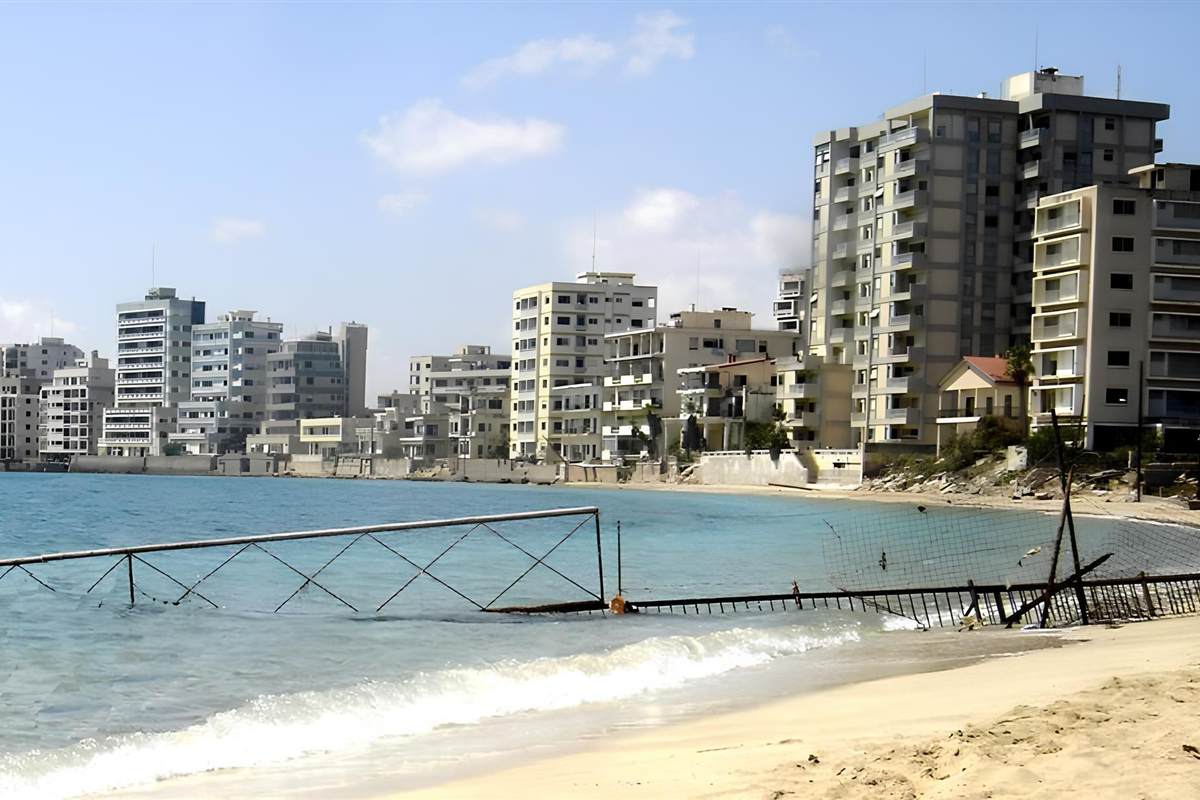
Without people or upkeep, the buildings decay. Metal corrodes and windows break, while the roots of wild plants work into walls and pavements. One operator lists vacant hotels, shop fronts and apartment buildings with greenery growing up through them. A news report once noted sea turtles nesting on the city’s beaches.
On an Ayia Napa Famagusta ghost town tour, the operator’s tour guide recounts the lives of the former residents.
What was Varosha like as a seaside resort?
By the early nineteen seventies, Famagusta drew more tourists than any other place in Cyprus. Varosha was its resort quarter. New high-rise buildings and hotels rose to serve the growing crowds. An Ayia Napa Famagusta ghost town tour now passes what is left of that boom.
Between nineteen seventy and nineteen seventy-four, Varosha was a very popular tourist destination worldwide. Brigitte Bardot and Raquel Welch holidayed there, as did Richard Burton and Elizabeth Taylor.
Glossa beach lay beside John F. Kennedy Avenue, a street that began near the port of Famagusta and crossed Varosha. Hotels lined it: the Argo, the Florida, the Grecian, the Asterias and the King George. The Argo was the favourite of Elizabeth Taylor.
Leonidas Street branched off the avenue. It was the place for shopping and leisure, with bars, restaurants, nightclubs and a car dealership. On an Ayia Napa Famagusta ghost town tour, you walk streets like these.
Of all the hotels in Cyprus, 31.5 percent stood in Famagusta. The city offered 45 percent of the island’s beds. Varosha was its main tourist and business quarter. That is why an Ayia Napa Famagusta ghost town tour centres on it.
The city had about 39,000 residents. In peak summer, between 90,000 and 100,000 people stayed there. Visitors came mainly from Britain, France, Germany and Scandinavia. An Ayia Napa Famagusta ghost town tour crosses ground once busy with holidaymakers.
In April of nineteen seventy, the four future members of ABBA came to Varosha for a promotional holiday. They performed informally for Swedish peacekeepers serving with the United Nations on Cyprus.
One operator calls the quarter a fashionable resort of the nineteen seventies, full of high-rise hotels, cafes and beaches. Its residents left, the area was fenced off, and nature and time slowly took over the buildings. Today an Ayia Napa Famagusta ghost town tour walks those silent streets.
What happened to Famagusta and Varosha during the Cyprus conflict?
Famagusta fell to Turkish forces in August of nineteen seventy-four, during the second phase of the Turkish invasion of Cyprus. The city’s Greek Cypriot people fled, and the army fenced off Varosha. An Ayia Napa Famagusta ghost town tour visits the place where this happened.
By nineteen sixty, Famagusta was a modern port city that reached far beyond Varosha and the old walls. The story behind the Ayia Napa Famagusta ghost town tour begins on the fifteenth of July in nineteen seventy-four. That day the Cypriot National Guard, led by its Greek officers, overthrew the government. Five days later, Turkish troops landed near Kyrenia.
Turkey said it was using its right under the Treaty of Guarantee. A ceasefire came on the twenty-second of July. By then Turkish forces held about three percent of the island. Peace talks in Geneva did not hold. On the fourteenth of August, a second phase began. It reached the city that an Ayia Napa Famagusta ghost town tour visits.
Famagusta was bombed by Turkish aircraft, and the army needed two days to occupy it. Dozens of civilians died, including tourists. The entire Greek Cypriot population had fled before the army arrived. Across the island, around 150,000 people were displaced from the north. Visitors on an Ayia Napa Famagusta ghost town tour walk through the result of those two days.
The army fenced Varosha immediately after capturing it. Other areas under Turkish control were not closed in this way. With nobody living there, the buildings began to decay. Metal corrodes, windows break, and plants grow in old window boxes and between paving stones. This slow decay is what an Ayia Napa Famagusta ghost town tour looks at today.
What do the United Nations say about Varosha?
The Security Council gave its position in Resolution 550, adopted in late spring of nineteen eighty-four. It names Varosha directly, which matters to everyone joining an Ayia Napa Famagusta ghost town tour. The vote was thirteen in favour, one against, and one abstention.
The resolution came after Northern Cyprus declared independence on the fifteenth of November in nineteen eighty-three. The Security Council rejected that declaration in Resolution 541. Resolution 550 then condemned the exchange of ambassadors between Turkey and Northern Cyprus. It also dealt with Varosha in one sentence.
The Council calls it inadmissible when anyone but the original inhabitants tries to settle in Varosha. The Council also wants United Nations administrators to take charge of the quarter. Anyone booking an Ayia Napa Famagusta ghost town tour can read this wording in the resolution.
In nineteen ninety-two, Resolution 789 urged that the area under the peacekeeping force include Varosha. That resolution asks for the peacekeepers to cover the quarter.
A United Nations settlement plan, the Annan Plan, offered the return of Varosha to its original residents. Greek Cypriot voters rejected it in a referendum. The quarter lies in the north. An Ayia Napa Famagusta ghost town tour therefore crosses a line that these United Nations texts describe.
The Council came back to the subject in a presidential statement dated the twenty-third of July. It used the same word, inadmissible, for settlement of the quarter by anyone but its inhabitants. Turkey rejected the statement, and the authorities of Northern Cyprus condemned it. The United Nations peacekeeping force later stated that it had not changed its view of Varosha.
Each Ayia Napa Famagusta ghost town tour therefore visits a place that the Security Council still follows. The texts above are the plain record of the United Nations position.
What are the buffer zone and the Green Line in Cyprus?
The buffer zone, also called the Green Line, is a strip patrolled by the United Nations. The line runs 180 kilometres across Cyprus, with Kato Pyrgos at its western end and Paralimni at its eastern end. An Ayia Napa Famagusta ghost town tour ends up north of it, because Famagusta lies in the north.
The idea dates from the end of December, nineteen sixty-three. Violence between the two communities had broken out that Christmas. Using a green pencil, a British general marked the agreed cease-fire line across a map. People started to call it the Green Line. Today an Ayia Napa Famagusta ghost town tour passes the zone at a border checkpoint.
The zone took its present shape in the summer of nineteen seventy-four. It marks the southernmost points the Turkish troops reached. In practice it became the southern border of Northern Cyprus. Crossings were very limited until the early two thousands, when the rules were relaxed. This easing lets an Ayia Napa Famagusta ghost town tour cross today.
Altogether the strip takes up 346 square kilometres of land. In places it is narrower than 20 metres, and in others it is wider than 7 kilometres. Nicosia, the capital, is divided by it. The Turkish army built a barrier on the northern side. The barrier includes minefields, watchtowers, anti-tank ditches, barbed-wire fencing and concrete wall segments.
About 10,000 residents work on farms and live in the zone, in villages such as Pyla, Deneia, Athienou and Troulloi. In Pyla, Greek Cypriots and Turkish Cypriots share one village. Untouched areas became a safe haven for plants and animals. So the zone that an Ayia Napa Famagusta ghost town tour crosses is not empty land.
How much of Varosha can visitors see on the tour?
Visitors on an Ayia Napa Famagusta ghost town tour see only a designated zone of Varosha, not the whole quarter. One operator’s walk through the empty hotels and silent streets of that zone takes about an hour. The area is monitored.
The part of Varosha that an Ayia Napa Famagusta ghost town tour visits opened in stages. In the autumn of two thousand twenty, parts of the quarter opened. The opened part runs from the Officers’ Club of the Turkish and Turkish Cypriot army to the Golden Sands Hotel.
Inside the visitor zone, the buildings stand empty. Furniture, power sockets and ceiling lamps are missing, and the doors have been broken in. One operator says plants grow through the hotels, shopfronts and apartment blocks. This is the sight an Ayia Napa Famagusta ghost town tour shows. The tour guide tells the story of the earlier residents.
In July of two thousand twenty-one, a second phase began, and the Bilal Aga Mosque reopened. The mosque dates to the early nineteenth century, and it closed in nineteen seventy-four. Later, a beach stretch opened for commercial use. It is 600 metres by 400 metres. The Oceania Building and the King George Hotel mark its two ends.
Not every traveller walks the streets. A listing of Famagusta excursions says the fenced-off area is visible from Constantia Beach and from the road beside it. A walking Ayia Napa Famagusta ghost town tour takes you inside the designated zone instead.
What is the old walled city of Famagusta?
The old walled city of Famagusta is the historic centre of the port. Fortifications enclose it on the east coast of Cyprus. On an Ayia Napa Famagusta ghost town tour, one operator gives it free time among ruined churches and mosques.
Ptolemy II Philadelphus founded the city about 274 BC, according to Wikipedia. An earthquake had damaged the nearby city of Salamis. The new city was first called Arsinoe. The third century gives us the name Ammochostos, Greek for hidden in sand. An Ayia Napa Famagusta ghost town tour reaches a place with that old a story.
Lusignan rule began at the end of the twelfth century. The natural harbour and the walls that protected the inner town raised its importance. After Acre fell, Christian refugees poured in, and the small village grew into one of the wealthiest cities in Christendom. An Ayia Napa Famagusta ghost town tour shows what that wealth left behind.
Genoa seized the port in the fourteenth century, and Venice took it in the fifteenth. By the middle of the fourteenth century, Famagusta was said to have the richest citizens in the world. Their churches, built in varying styles, earned it the name district of churches. An Ayia Napa Famagusta ghost town tour gives free time where churches still stand.
The last Venetian stronghold in Cyprus held out against the Ottomans for thirteen months. Then its garrison surrendered. Under Ottoman rule, Greek Cypriots were required to live beyond the walls, in a district that grew into Varosha. The walled city stayed dilapidated. The Ayia Napa Famagusta ghost town tour joins these two districts in one day.
What are the Venetian walls of Famagusta?
The Venetian walls of Famagusta are the fortifications that surround the old city. Mainly in the fifteenth and sixteenth centuries, the Venetians raised these fortifications, says Wikipedia. One Ayia Napa Famagusta ghost town tour operator puts their length at about 3 kilometres.
The walls form a rough rectangle, and Wikipedia dates sections to the early thirteenth century. A rock-hewn ditch runs along the landward side. The harbour lies on the seaward side. One operator describes bastions and a moat. Reading about the walls first makes an Ayia Napa Famagusta ghost town tour easier to follow.
There are fourteen bastions, named after Venetian families. The Martinengo Bastion came from the drawing board of Giovanni Girolamo Sammichele. He died in Famagusta in fifteen fifty-nine, while the fortifications were still under construction. It served as a prototype for other fortifications. Wikipedia sees a shift here from medieval defence toward bastioned design, like the one at Rhodes.
At first the walled city had only two gates. They were the Land Gate in the south-west corner and the Sea Gate beside the port. The original Sea Gate of thirteen ten is not used and is under restoration. The Arsenal Gate opened to land traffic in nineteen thirty-three. The North Gate followed in nineteen sixty-five.
Ottoman forces surrounded Famagusta on 15 September, and the city held out until August of the following year. The Ottomans repaired the damaged sections but made no major alterations. Wikipedia says the fortifications are still in relatively good condition. An Ayia Napa Famagusta ghost town tour with free time lets you walk beside them, as one operator lists.
What is the Saint Nicholas Cathedral, now the Lala Mustafa Pasha Mosque?
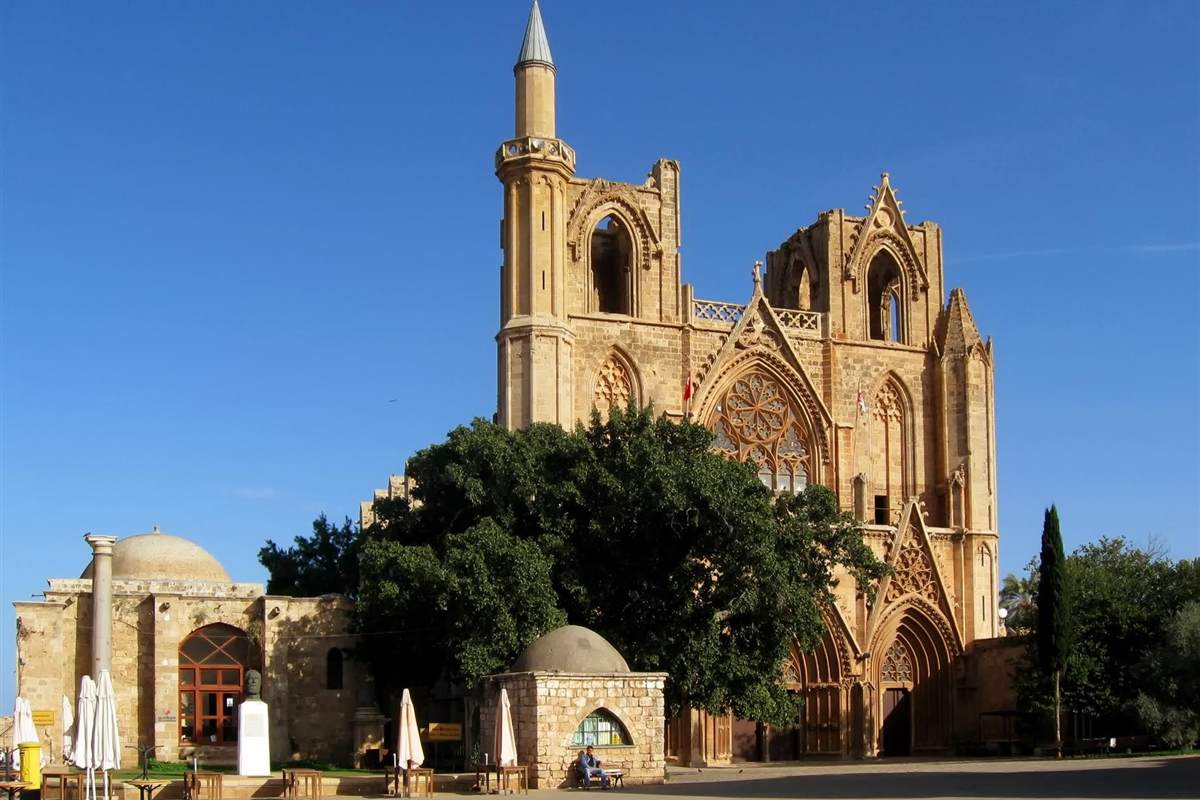
Among the medieval buildings of Famagusta, Cyprus, the Saint Nicholas Cathedral is the largest. It was consecrated as a Catholic cathedral in thirteen twenty-eight and became a mosque in fifteen seventy-one. One operator lists it among the sights for the free time on its Ayia Napa Famagusta ghost town tour.
Work began in twelve ninety-eight under the French Lusignan dynasty, the kings of Cyprus. The result is a Rayonnant Gothic church, a style that is rare outside France. People call it the Reims of Cyprus, because it looks so close to Reims Cathedral. An Ayia Napa Famagusta ghost town tour brings you to a church built under French kings.
The builders gave it three doors and twin towers over the aisles. A meeting chamber called the Loggia Bembo was added after fourteen eighty. It stands at the south-west corner, with slender marble pillars at the entrance.
In fifteen seventy-one the Ottoman Empire took Famagusta, and the church became a mosque. It is still a mosque today. Earthquakes and the Ottoman bombardments that year damaged the upper parts of the two towers, and nobody repaired them. An Ayia Napa Famagusta ghost town tour passes this change of faith in the old town.
The statues, crosses, coloured glass, frescos, paintings and altar were taken out or covered with plaster. So were nearly all the tombs. The Gothic frame itself survived, and a small number of tombs can still be identified in the north aisle. Travellers on an Ayia Napa Famagusta ghost town tour see this blend of two faiths in one building.
Since nineteen fifty-four the building has carried the name of Lala Mustafa Pasha. He was the Ottoman commander who led forces against the Venetians in Cyprus. One operator offers an Ayia Napa Famagusta ghost town tour. It describes the west front as looking like a French cathedral and a minaret at the same time.
What is Othello Castle in Famagusta?
Othello Castle is a fortress in Famagusta, in the eastern part of Cyprus. The Lusignans built it in the fourteenth century to protect the port, and the Venetians later changed it. A listing names the castle as a sight beside the old port, for an Ayia Napa Famagusta ghost town tour.
The Lusignans ruled the Kingdom of Cyprus. They made the castle the main entrance to Famagusta, and it also guarded the harbour. Deep ditches surrounded it, so an attack was nearly impossible. For that reason it was once called the impenetrable fortress.
After Cyprus passed to Venice, Venetian builders swapped the square towers for round ones, which suited newer artillery. Over the main entrance they engraved the Lion of Saint Mark. Near it sit the date fourteen ninety-two and the name of Captain Nicolo Foscari, who ran the work.
Today the castle holds four circular towers. Inside, a dormitory and a refectory date from the Lusignan period. The yard still holds cannonballs left by the Spaniards and the Ottomans, relics of its turbulent history. A traveller on an Ayia Napa Famagusta ghost town tour sees walls that kept attackers out.
In nineteen hundred the water was drained from the ditch to lower the risk of malaria. The castle was restored and reopened to the public in July two thousand fifteen. A listing for an Ayia Napa Famagusta ghost town tour calls it a recently restored fortress at the old port.
A stage note in the play Othello by Shakespeare gave the castle its modern name. Its action takes place in a harbour town on the island of Cyprus. On an Ayia Napa Famagusta ghost town tour, the castle is a plain link between the harbour and the play.
Where is Ayia Napa, and how far is Famagusta?
The southern shore of Cyprus ends at Ayia Napa, a resort in the east of the island. Famagusta is about 27 kilometres away. One listing gives the drive as around 35 minutes. That sets the distance for an Ayia Napa Famagusta ghost town tour.
An Ayia Napa Famagusta ghost town tour begins in a resort town near Cape Greco. Ayia Napa lies south of Famagusta, inside Famagusta District, in the section run by the Republic of Cyprus. The red soil of the wider region gave it the name Kokkinochoria, meaning Red Villages.
The region behind an Ayia Napa Famagusta ghost town tour is one of six districts in Cyprus. The whole district spans about 1,985 square kilometres. Only about 244 square kilometres of it are held by the Republic of Cyprus. A district administration works from Paralimni. The municipalities of Ayia Napa, Paralimni, Deryneia and Sotira sit in that held section.
A monastery from the Venetian period, in the town centre, gave the town its name. Ayia is Greek for “holy”. The second word describes a dell, which is a wooded valley. A traveller on an Ayia Napa Famagusta ghost town tour starts in a town named for that monastery. The building still stands and now houses a museum.
No resort in Cyprus is larger than Ayia Napa. Over 175 hotels and apartment complexes serve it. Of its 27 beaches, 14 have won the Blue Flag. Anyone who books an Ayia Napa Famagusta ghost town tour leaves from a resort of that size. The town also has two municipal marine museums.


What are Protaras and Cape Greco near Ayia Napa?
Protaras is a resort about 12 kilometres from Ayia Napa. Cape Greco is the headland that lies between the two towns. Both places are close to the start of an Ayia Napa Famagusta ghost town tour.
The Municipality of Paralimni governs Protaras, close to where an Ayia Napa Famagusta ghost town tour starts. Leukolla, a city-state of ancient times, stood here and had a harbour that was small but safe. In 306 BC Demetrius Poliorketes sheltered there, lying in wait for Ptolemy, one of Alexander the Great’s successors. Protaras also carries the nickname land of windmills.
Its reputation is calmer than its neighbour’s. The club scene is smaller, and the resort caters more to families and to Cypriot holidaymakers. Sandy beaches line the coast, and Fig Tree Bay is one of them. Divers know the resort for Green Bay, where underwater statues stand, and for Malama Bay, Decosta Bay and Cyclops Bay.
Cape Greco, a headland in the island’s southeast, closes Famagusta Bay at its southern end. The headland belongs to Ayia Napa Municipality, and the Republic of Cyprus has no land further east than this headland. People in ancient times called it Cape Pedalion. Strabo recorded that the hill above the cape belonged to Aphrodite as a holy place.
The cape is a National Forest Park under the Forestry Department of Cyprus. Sea caves line its limestone cliffs, and it is an Important Bird Area for birds on migration. From the middle of Protaras the cape takes ten minutes by car. One operator collects guests from hotels in both resorts for its Ayia Napa Famagusta ghost town tour.
What else do travellers ask about an Ayia Napa Famagusta ghost town tour?
What is Salamis, the ancient city near Famagusta?
Six kilometres north of modern Famagusta, where the river Pedieos meets the sea, stood Salamis. This ancient Greek city-state sat on the Cypriot east shore. By tradition its founder was Teucer, the son of Telamon. One operator keeps Salamis for a separate full-day tour, apart from its 4.5-hour Ayia Napa Famagusta ghost town tour.
Diggers found baths, a gymnasium, a stadium, a theatre and an amphitheatre in the northern, Roman-era part of the city. Up to 15,000 spectators fitted into the theatre. Arab invasions in the seventh century ended life at Salamis, and the people left for Arsinoë, which is Famagusta.
Where is Cyprus, the island of an Ayia Napa Famagusta ghost town tour?
Sicily and Sardinia are the only bigger islands in the Mediterranean. Cyprus lies in its eastern part. The island is 240 kilometres long and 100 kilometres across at its widest. Nicosia is the capital. Every stop on an Ayia Napa Famagusta ghost town tour lies on this one island.
What are Larnaca and Paralimni in Cyprus?
Larnaca is the southeastern port city of the island and gives its name to a district. Only Nicosia and Limassol are bigger cities. Larnaca International Airport is named after the city, yet the airport itself stands in a nearby village, Dromolaxia. A promenade of palm trees along the sea is named Finikoudes.
Paralimni is a town in the Famagusta District, and its name means “by the lake”. Staff for the tourist business of Ayia Napa and Protaras travel in daily from this town. Famagusta is just 10 kilometres north of Paralimni.
Is an Ayia Napa Famagusta ghost town tour suitable for children?
One operator says older children cope well on its Ayia Napa Famagusta ghost town tour. Expect plenty of walking and a wait through the border formalities. Every traveller needs a valid document of their own.
The same operator lists travellers with limited mobility as unsuitable, for the same reason: the amount of walking.
What do you pack and wear for an Ayia Napa Famagusta ghost town tour?
One operator asks guests on its Ayia Napa Famagusta ghost town tour to wear comfortable shoes, a hat and sunglasses. It also asks them to bring water. The tour has plenty of walking in the open air.
It notes that religious buildings call for modest clothing. In Varosha, the tour guide decides where you walk and take photos, because the area is monitored.