

Short, wild and hands-on, the Santorini volcano and hot springs boat tour leaves the old port of Fira for a black lava island, then adds a climb to the crater rim and a swim in warm, rust-coloured water. For another kind of day away from the caldera, look through our tours in Greece.
The sections below set out the contents of the tour, its length and departure times, the old port of Fira and the cable car, the boat and the crossing, Nea Kameni and the crater walk, the eruptions that built the island, the question of an active volcano, the Palea Kameni hot springs and the swim, the tours on the route, the volcanic rock, the town of Fira and the villages on the caldera rim, what to wear and bring, the months and departure times that suit the trip, black beaches and wineries, the size of the island and the questions travellers ask.
What does a Santorini volcano and hot springs boat tour include?
A Santorini volcano and hot springs boat tour combines two stops. You walk on the volcano island of Nea Kameni, then bathe at the Palea Kameni hot springs. The cruise begins in the old harbour below Fira.
Per the operator’s tour page, the tour guide speaks English and Greek. The vessel is a traditional wooden boat. At the old port, the tour guides wait for you, explain the plan, and show you aboard.
On Nea Kameni, a tour guide leads the walk to the ridge of the volcano. This guided walk takes an entrance ticket for the volcano.
The page makes the climb on to the top, where the active craters are, a choice. You choose, on the Santorini volcano and hot springs boat tour, between the ridge only and the craters too.
After the volcano, the boat sails to Palea Kameni for a bath. That makes two stops in all: the volcano island first, the hot springs second. The page calls the hot springs a popular place for thermal waters. The tour ends at the old port of Fira, and you pick your own way back up to Fira town.
Two items stay outside the boat ticket on the operator’s page. They are the cable car ticket for the old port and the volcano entrance ticket. The page rates the walking as moderate. Know these extras before you pick a Santorini volcano and hot springs boat tour. For questions, the operator keeps a travel agency down at the port.
How long is the Santorini volcano and hot springs boat tour, and when do the boats leave?
Departures for the Santorini volcano and hot springs boat tour run twice a day from the old port of Fira. Boats go at 11 in the morning and at 2:30 in the afternoon. Each trip stops at the volcano first and the hot springs second.
The operator’s page sets out the Santorini volcano and hot springs boat tour in five steps.
- The boat leaves the old port of Fira.
- The crossing to the volcano bay takes about 15 minutes.
- The boat docks at Nea Kameni for about 1 hour 30 minutes.
- The boat stops at Palea Kameni for the hot springs, about 30 minutes.
- The boat heads back to the old port of Fira.
A second line on the same page gives 20 minutes to reach the jetty of Nea Kameni. So plan for 15 to 20 minutes on the water before the walk begins. The volcano stop is three times as long as the hot springs stop. Add the two stops, and you get about two hours, before the boat rides are counted.
A travel blog by a tourism worker gives a rough total of three to four hours. That total is for a basic volcano trip. The blog adds that a sunset combination runs longer. That figure is loose, not an operator timetable. Check the schedule of your own Santorini volcano and hot springs boat tour.
Another operator lists its boat tours in lengths of three, six and nine hours. The operator of this route says the Santorini volcano and hot springs boat tour depends on favourable weather.
How do you reach the old port of Fira, by cable car or on foot?
The Santorini volcano and hot springs boat tour starts at the old port of Fira, below the town. No road reaches it. The cable car takes 3 minutes, and the other way is a walk down 587 steps. The cable car is the more common choice.
Before the Santorini volcano and hot springs boat tour sails, the operator’s tour guides meet you at the port. Gialos is the harbour at the bottom of a rocky cliff, just under Fira. It is tiny, with huge rocks above it and cave houses that seem to hang on the cliff. The tour guides give you the key information.
The line links the harbour with the centre of Fira. A gondola holds up to 6 passengers, and its capacity is 1,200 people an hour. Queues seldom form, apart from the times cruise ships arrive. For the Santorini volcano and hot springs boat tour, the cable car is the quick way down to the port.
The other way down is the Karavolades stairway, a paved path that climbs 200 metres over 588 steps. The tour operator counts 587 steps, so the two counts differ by one. The stairway is also called the Donkey Trail. Its path twists, and in places it is narrow, with only low walls. The stones can be slippery with donkey droppings.
After the Santorini volcano and hot springs boat tour, the boat brings you back to the old port. You then pick the cable car or the steps again to reach Fira town. Donkeys also carry riders up the trail, within weight limits. The trail takes far longer, but it is an option when the base station queue is long.
What boat do you sail on, and what is the crossing like?
One operator runs its Santorini volcano and hot springs boat tour on a traditional wooden boat. Its page gives 15 minutes by boat to the volcano bay and 20 minutes to the jetty of Nea Kameni.
On the Santorini volcano and hot springs boat tour, the boat makes the crossing in two legs. First it docks at the jetty of Nea Kameni. Next it moves on to Palea Kameni, which lies south-west of Nea Kameni. Both stand in the flooded basin, near its centre.
The Santorini volcano and hot springs boat tour sails on a flooded caldera. It is about 12 kilometres long and 7 wide. Steep walls, 300 metres tall, close it in on three sides. The deepest point lies 385 metres under the surface. The caldera is mostly submerged.
You are not alone on this water. Between Fira and Nea Kameni lies a small harbour where big cruise ships drop anchor. Every summer day, dozens of tourist boats stop at Nea Kameni. A travel wiki says ferries and excursion ships both reach Nea Kameni from Thira, the main island.
The operator’s page states that the Santorini volcano and hot springs boat tour runs subject to favourable weather conditions. A travel wiki calls the trip from the old port to Nea Kameni a 10 minute boat journey. Whichever figure you read, the sail is short.
What is Nea Kameni, and why can you walk on it?
Nea Kameni is a small, uninhabited island of volcanic rock in the middle of the flooded Santorini caldera. The Santorini volcano and hot springs boat tour lands you on it. Lava and ash from repeated eruptions piled up until the island became solid ground that carries a path.
Nea Kameni is not the main island of Santorini. A Santorini volcano and hot springs boat tour carries you across the water to reach it. The main island forms the outer ring of the group, and the two Kameni islands sit near the centre.
Nea Kameni is close to a circle, roughly 2 kilometres from side to side. It covers 3.4 square kilometres of ground. The municipality of Santorini counts it among its uninhabited islands.
Its name means “new burnt”, and its neighbour Palea Kameni means “old burnt”. Palea Kameni lies south-west of Nea Kameni. Nea Kameni formed in recent centuries and marks the centre of the island group. On one operator’s Santorini volcano and hot springs boat tour, the volcano is the first stop. The hot springs come next.
The island is nearly barren. When summer comes, red succulents spread over the thin soil like a carpet. Dozens of tourist boats call at the island daily in summer. A Santorini volcano and hot springs boat tour is one way to join them. The island is also a protected scientific site.
What is the walk to the crater like?
On a Santorini volcano and hot springs boat tour, the climb to the crater top follows a gravel path. The crater is 130 metres high, and a walk around the whole rim is possible from the top.
One operator describes its Santorini volcano and hot springs boat tour this way. The boat ties up at the Nea Kameni landing. A tour guide then walks the group to the ridge and explains the history and geology of the volcano. The page calls the climb optional and lists a moderate amount of walking.
Vents dot the island, and sulfur vents sit all around it. One vent still gives off sulfur and carries the local name Jorgo, or George. The name honours King George I of Greece. The king visited Santorini, and the vent was active the next day.
The volcano also has fumaroles. These are vents or cracks where steam or gas escapes, and you can feel them in certain spots. Black lava makes up the craters of both Kameni islands.
A travel blog says that on a Santorini volcano and hot springs boat tour, you walk on warm lava rocks. It adds that sulfur still rises from the ground, and you can smell it. The blog describes black lava stones, loose in places and uneven everywhere.
It notes yellow sulfur patches and warm spots, but no red lava and no smoke cloud. The blog says the tour guide stops along the path and shows where the ground is warm.
From the crater of Nea Kameni, you can see Santorini and the town of Fira across the water. Neither trees nor buildings stand on it. Nothing blocks the sun on your Santorini volcano and hot springs boat tour.
Which eruptions built Nea Kameni?
One eruption after another piled up lava and ash to make Nea Kameni. A Santorini volcano and hot springs boat tour lands there. Major eruptions came in the early eighteenth century, the later nineteenth, and then through the first half of the twentieth.
A Santorini volcano and hot springs boat tour visits two islands of different ages. Palea Kameni is the older one. Its eruptions came between the second century BC and the first century AD. The ancient writer Strabo described four days of flames over the water. An island then formed, 2.4 kilometres around.
No further activity is known on Palea Kameni until the early eighth century. Then a submarine explosive eruption produced pumice and lava. In the late sixteenth century, the growth of Nea Kameni brought reports of increased volcanic activity. In the early eighteenth century, an undersea volcano broke the surface and formed Nea Kameni’s current centre of activity.
Three more major eruptions followed. They came in the later nineteenth century, the late nineteen twenties and around the start of the nineteen forties. A final small eruption extruded a lava dome. Together, these eruptions grew Nea Kameni, the volcano stop of a Santorini volcano and hot springs boat tour.
The dark lava shields of both Kameni islands were piled up by minor and medium-sized eruptions after the Minoan eruption. Nine eruptions that reached above the sea surface are recorded since the early eighteenth century. Nea Kameni has grown substantially since, and a Santorini volcano and hot springs boat tour reaches it by sea.


Is the Santorini volcano still active, and who watches it?
Yes. Santorini is dormant but remains an active volcano. ISMOSAV, an institute that studies and monitors the Santorini volcano, watches Nea Kameni closely. A Santorini volcano and hot springs boat tour visits that island.
Within the South Aegean Volcanic Arc, Santorini ranks first for volcanic activity. Its last eruption ran from January into February, halfway through the twentieth century. Now only fumarolic activity takes place, mainly inside the recently active craters. On a Santorini volcano and hot springs boat tour, you walk on a dormant volcano, not an erupting one.
Steam and carbon dioxide still rise at the current active crater. GPS instruments measured fresh ground movement around the caldera in the early twenty-tens. In about fifteen months, a rush of molten rock added ten to twenty million cubic metres to the magma chamber. Scientists compare that surge with 20 years of normal activity.
Volcanologists are drawn to Santorini by its good observation conditions, sunny climate and high caldera walls. Santorini also sits on the list of sixteen Decade Volcanoes worldwide. That project aims to reduce the severity of natural disasters. Visitors on a Santorini volcano and hot springs boat tour stand on the same volcano that researchers study.
In the middle of the twenty-twenties, Santorini entered a new phase of volcanic unrest. Seismic activity rose significantly from mid-summer. The strongest volcano-tectonic sequence struck near the Anydros islet, about 30 kilometres north-east of Santorini, in late January. Check the latest news before you book a Santorini volcano and hot springs boat tour.
What are the Palea Kameni hot springs, and how did they form?
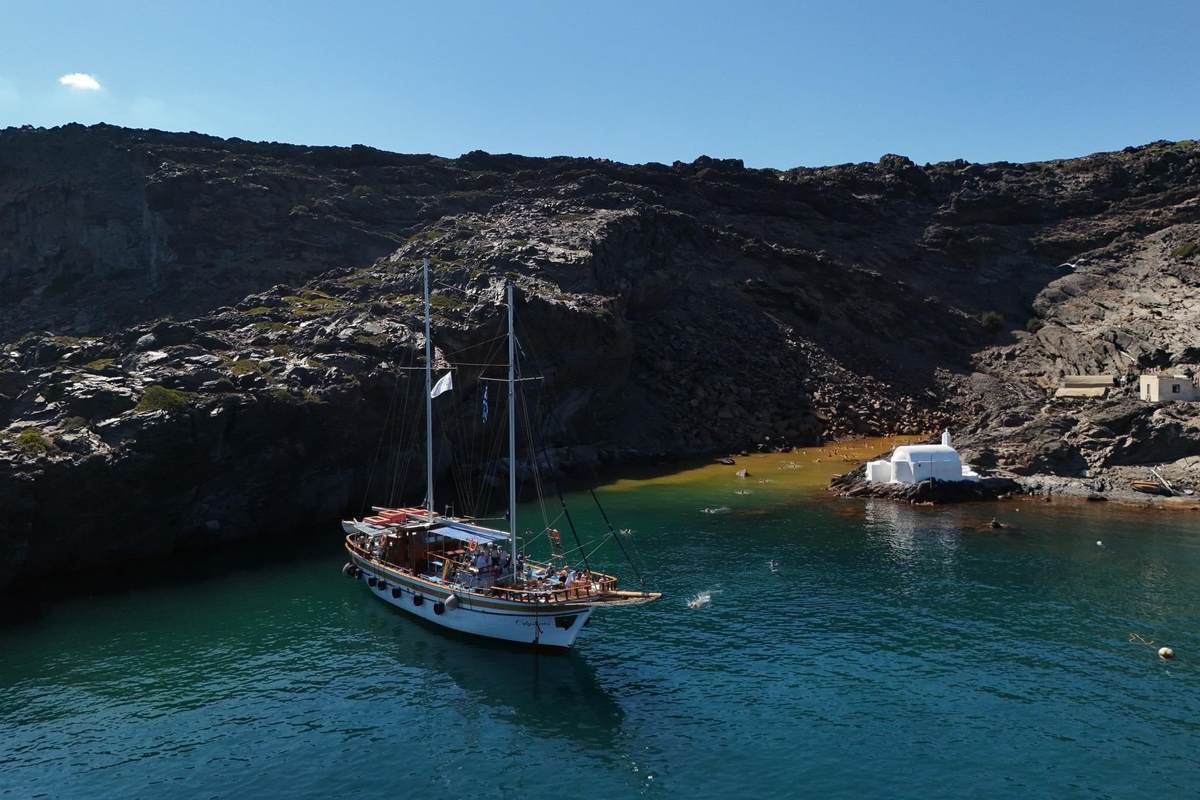
The Palea Kameni hot springs are patches of warm sea water beside a small volcanic island in the Santorini caldera. A Santorini volcano and hot springs boat tour brings you to swim there, in Agios Nikolaos bay.
The name Palea Kameni translates as Old Burnt Island. The island lies southwest of Nea Kameni, near the caldera’s centre. A Santorini volcano and hot springs boat tour visits both.
The island covers half a square kilometre and is private. It holds a small church and a goat herd. Wikivoyage calls it barren and names only two points of interest there, the church and the hot spring.
A string of smaller eruptions built the island, and the first of them happened under the sea. They left deposits of pumice and dacite lava. One operator says a series of volcanic eruptions formed the hot springs. They lie along the island’s western edge.
A travel blog explains the springs in plain words. Warm volcanic water meets the cold Aegean near the shore, and the mix makes the warm patch. The blog says it is not like a spa with a pool. So a Santorini volcano and hot springs boat tour gives you a swim in open sea.
One Santorini volcano and hot springs boat tour operator says the bay’s water changes temperature with the months. It tends to be warmer than the sea around it. Wikipedia lists thermal waters, warmer than the surrounding sea, among the features of the Santorini volcano. It also notes that the island lacks a good harbour.
How do you swim at the hot springs, and why is the water brown?
On a Santorini volcano and hot springs boat tour, you swim 30 metres from the boat to the warm water. The water looks brown because it carries iron, sulphur and other metals from the volcano.
One operator stops its boat 30 metres out from the shallows of Agios Nikolaos bay. You dive off the boat and swim in. The same operator calls very good swimming skills a must on its Santorini volcano and hot springs boat tour. A travel blog adds that certain boats have a ladder.
The swim comes after the stop on Nea Kameni. The blog calls it optional and notes that the water is deep. Guests who feel unsure in open water stay on the boat. The warm patch hugs the shore, and the sea beyond it is cooler. Expect lukewarm water, not a hot tub.
On a Santorini volcano and hot springs boat tour, the colour comes from minerals. The blog describes the water as reddish orange brown, from iron and sulphur. The operator says the water is full of sulphur, iron and other metals from the volcano.
These minerals leave marks. The sulphur water can stain a swimsuit, so the operator suggests a dark one. The blog says white swimsuits turn orange and silver jewellery turns dark. It advises leaving jewellery on the boat.
The blog also notes that the sulphur smell stays in long hair for a while. If you join a Santorini volcano and hot springs boat tour, tie your hair up before the swim.
Which tours run on the volcano and hot springs route?
One operator lists four boat tours on the caldera, and three name the volcano and the hot springs. For a Santorini volcano and hot springs boat tour, those three are the ones to compare. The fourth is an evening sail with dinner.
The first of the four is the Volcano & Hot Springs Tour. Its text lists the history of the volcano, a hike over the youngest formations and the craters. It adds views from the peak and a swim in the hot springs. Of the four, it is the one built around a Santorini volcano and hot springs boat tour.
The Caldera Half Day Tour tells the story of the volcano and visits the hot springs of Palea Kameni. It adds Thirasia Island. The Full Day Bus & Boat Tour lasts nine hours and names the same three places. It ends with the sunset over the village of Oia.
The Sailing Sunset Tour with Dinner is the evening option. Its text talks about views, food and entertainment. The trip finder on the same site sorts its tours into 3, 6 and 9 hours. Check the length before you pick a Santorini volcano and hot springs boat tour.
Another operator lists a Santorini volcano and hot springs boat tour with two stops. Its boat sails from the old harbour to the volcano on Nea Kameni. It then crosses to Palea Kameni for the hot springs and sails back. Compare each operator’s route alone, because the stops differ.
Our Greek Islands Cruises page and our Car Rental Greece page add more detail. Readers can also open the Cyclades Islands page or the Santorini Tours page.
What is the rock of the Santorini volcano made of?
On a Santorini volcano and hot springs boat tour you stand on dark lava rock. Repeated eruptions built the two central islands from dacite lava and ash. Dacite is a thick volcanic rock that is high in silica.
Palea Kameni has beds of pumice beside its dacite lava. A Santorini volcano and hot springs boat tour reaches it for the swim. Pumice forms when hot rock under pressure is thrown out of a volcano. It cools fast as the pressure drops, so the rock turns foamy. It is commonly pale, from white and cream to grey.
The smallest island of the group, Aspronisi, shows the pale side of the volcano. Its name means white island and points to the pumice above the water. Aspronisi lies on the outer rim of the group, while the dark Kameni islands sit in the centre. A Santorini volcano and hot springs boat tour sails to those central islands.
On Santorini, the old soil lies under 60 metres of white tephra. That layer shows where the ground stood before the great eruption that shaped the caldera. Tephra is the broken material an eruption produces. Ash is its finest part, with grains under 2 millimetres. The layer has three bands that mark different phases of the eruption.
Not every rock on the island is volcanic. Rock that did not come from the volcano shows at these places on Santorini:
- Mesa Vouno
- the Gavrillos ridge
- Pirgos and Monolithos
- the inner caldera wall between Cape Plaka and Athinios
The Kameni islands are different. They are made of lava rocks. That is the ground under your feet on a Santorini volcano and hot springs boat tour.
What is Fira, the town above the old port?
As the capital of Santorini, Fira sits along the caldera’s rim on the island’s west edge. The old port lies below the town, and the Santorini volcano and hot springs boat tour sails from it.
The municipality of Santorini has its seat in Fira. The latest census counts 1,516 people in the community. Fira takes its name from a second way of pronouncing Thira, which was the island’s name in antiquity. Fira and villages such as Imerovigli, Megalochori and Vothonas share one municipal unit, Thira.
The town offers sights of its own before or after the Santorini volcano and hot springs boat tour. The white Orthodox Cathedral of Ypapanti replaced an older church on the same spot. The Amorgos earthquake of the nineteen fifties destroyed that church. Beside the cathedral, at its southeast corner, is the Museum of Prehistoric Thera.
East of the cable car entrance, 30 metres away, is the Archaeological Museum of Thera. Plateia Theotokopoulou is the central square, with banks, pharmacies and a station for buses and taxis. Over a dozen restaurants in Fira stay open all year. That gives you a place to eat after the Santorini volcano and hot springs boat tour.
On the Santorini volcano and hot springs boat tour, you can look back at Fira from Nea Kameni. Looking out from Fira, you see the whole caldera, and Nea Kameni sits in the middle of it. Between Nea Kameni and Fira lies a small harbour where large cruise ships drop anchor. Roads reach the town mainly from the east.
Which villages sit on the caldera rim above the boat route?
Imerovigli and Oia are built along the caldera’s rim, to the north of Fira. The inner walls are steep and up to 300 metres high. Villages stand along the ridge above the Santorini volcano and hot springs boat tour.
Firostefani is quieter than the centre of Fira, and its blue-domed church is dedicated to St. Spirou. Imerovigli is crossed by narrow, paved paths and has 469 permanent inhabitants. Its churches all follow the Cycladic style of building. Both villages lie north of Fira, where the Santorini volcano and hot springs boat tour begins.
The Monastery of Saint Nikolaos sits beside the path that joins Imerovigli and Fira. Nearby, Skaros Rock holds the ruins of a Venetian castle. Marco Sanudo, who ruled all the Cyclades at the time, had it built in the early thirteenth century. The rim villages look out over the caldera, where the Santorini volcano and hot springs boat tour sails.
Oia is 11 km from Fira, on the north-western edge of Santorini. Along the caldera’s northern edge, it runs for nearly two kilometres, at heights between 70 and 100 metres. In Venetian times, the Argyri family held its seat in the ruined castle at the top. Steep steps lead down to Ammoudi, the old fishing harbour.
Buses from the station in Fira serve Oia. A day around the Santorini volcano and hot springs boat tour can include a visit to the village. A trail of 11 km runs along the crater rim from Fira to Oia. It starts north from Agiou Mina Street, which follows the rim through Fira.
What do you wear and bring for the crater walk and the hot springs?
For the Santorini volcano and hot springs boat tour, pack a dark swimsuit and a towel. Add closed shoes with a good grip, a hat and water. The path crosses lava rock in open sun, and the sulfur water can stain a swimsuit.
Start with your feet. The operator’s page for the Santorini volcano and hot springs boat tour lists a moderate amount of walking. The way up is a gravel path, and the ground is dark lava rock. A travel blog advises closed shoes with a good grip, since loose stones make flip-flops hard to use.
Next, think about the sun. Nea Kameni is nearly barren, and the same blog says the island has no trees and no shade. Wikivoyage reports an extreme UV index once late spring ends. A hat, sun cream and a water bottle belong in the bag for the climb. In spots, the blog adds, the ground feels warm through your shoes.
Keep the swim kit simple on the Santorini volcano and hot springs boat tour. The operator suggests a dark-coloured swimsuit, because the sulfur water can stain one. The blog says the water also turns silver jewelry dark, so leave rings and chains on the boat. The sulfur smell stays in hair for a while, so tie long hair up.
Which months and departure times suit the Santorini volcano and hot springs boat tour?
Choose April through June or September through October for the Santorini volcano and hot springs boat tour. Wikivoyage names those months the ideal times to visit the island. The operator sails daily: a morning boat at 11 and an afternoon boat at 2:30.
From April into late spring, Wikivoyage describes pleasant weather with little rain. It adds that wildflowers colour the otherwise barren islands in that season. The tourist season starts on 1 April, or around Greek Easter. Summer heat then scorches the flowers away, leaving dried grasses.
Expect heat on the Santorini volcano and hot springs boat tour in summer. Wikivoyage says temperatures soar after late spring, and trees are rare, so shade is hard to find. In summer, Nea Kameni sees dozens of tourist boats each day, says Wikipedia. It adds that red grassy succulents carpet the thin soil then.
Wikivoyage gives noon to 3 in the afternoon as the hottest hours of a summer day. On the Santorini volcano and hot springs boat tour, the boat at 11 keeps passengers ashore through noon. The boat at 2:30 reaches the volcano at about a quarter to 3. On either boat, wear the hat and carry water.
Cooler weather returns in September, Wikivoyage says, and rain becomes more common as the year closes. Late in October, businesses that open only for the season begin to shut. December to March is the off-season, with cooler weather, occasional rain and wind.
The operator ties the Santorini volcano and hot springs boat tour to favourable weather. It adds that the water temperature changes with the months but tends to run warmer than the sea nearby. Ask the operator about dates before you plan a winter trip.
Other trips include the Santorini Top Sights Day Trip and the Santorini Flying Dress Photoshoot. A second outing can be the Santorini Thirasia and Oia Sunset Cruise or the Santorini Day Trip from Crete. Day planners can read about the Santorini Cooking Class and the Santorini Horse Riding.
Which black beaches and wineries are worth a visit after the volcano tour?
Kamari and Baxedes have black sand beaches, and the Kamari strip runs on south into Perissa. Megalochori and Pyrgos offer winery tours. A Santorini volcano and hot springs boat tour finishes back in the harbour below Fira. These places are separate trips by land.
The caldera cliffs, where the Santorini volcano and hot springs boat tour sails, are steep rock, not beaches. Beaches lie on the outer coast of the semicircle instead. The sea has not yet worn the volcanic rock into fine sand. So the shores are pebbles of mixed sizes, mostly black, white or red. Bring proper shoes.
Kamari sits on the east coast. Perissa lies 13 kilometres south-east of Fira, near the rock of Messa Vouno. Both lie across the island from the western caldera that a Santorini volcano and hot springs boat tour crosses. One 3-kilometre beach links Perissa, Perivolos and Agios Georgios, with bars and restaurants along it.
On the north coast, Baxedes is the island’s main beach, a peaceful place with black sand. In Perissa, the church of Timiou Stafrou stands right next to the beach. It is among the biggest churches on the island and has blue domes. Saint Irene’s early Christian basilica lies in ruins in the same village.
Pyrgos climbs a hill about 7 kilometres from Fira, topped by a ruined Venetian castle. The Profeta Elias Monastery stands near it on the highest hill of the island and is rarely open to visitors. After a Santorini volcano and hot springs boat tour, walkers can take the Fira to Kamari trail past it.
Santorini wine holds an EU protected designation of origin. The vines grow in dry soil and a windy climate. Assyrtiko is grown as a shrub, not as a vine, and vineyards are visible across the island. Wine lovers can learn about the region at the Santorini Wine Museum in Vothonas.
Megalochori is a traditional village of old white Cycladic churches. You can tour local wineries there and in Pyrgos. Vothonas sits in a ravine and is the hub of local winemaking. The vines grow in volcanic soil. A winery tour and a Santorini volcano and hot springs boat tour show two sides of one volcanic island.
How big is Santorini, and where does it lie?
Santorini lies about 200 kilometres from the mainland, towards the south-east, and its area is about 73 square kilometres. Among the Cyclades, it is the island furthest south. A Santorini volcano and hot springs boat tour starts on this main island and sails into the caldera.
Of the islands that circle the caldera, the main one is the biggest. Ios and Anafi are its neighbours in the south of the Cyclades. Crete lies 120 kilometres south of the caldera where the Santorini volcano and hot springs boat tour runs.
The census counted 15,480 people on the main island. The municipality also includes Therasia, which has residents. Five more islands are uninhabited: Christiana, Anydros, Aspronisi and the two Kameni islands. In all, it has 90 square kilometres of land. Both islands on the Santorini volcano and hot springs boat tour belong to it.
Almost all hotels and tourist services stand on the main island, and nearly all visitors land and sleep there. A drive between the two ends, Exomytis and Oia, takes about an hour. The old port of Fira, where a Santorini volcano and hot springs boat tour begins, lies on the same island.
What else do travellers ask about a Santorini volcano and hot springs boat tour?
Why is Santorini also called Thera?
In antiquity the island was called Thera. The name honours Theras, the Spartan leader who colonised it. In the nineteenth century Thera returned as the formal name of both the island and its main city.
Santorini, the everyday name, is a short version of Saint Irene. Perissa village has an old church of that name. The geographer Muhammad al-Idrisi first mentioned the name in the middle of the twelfth century. So the island behind a Santorini volcano and hot springs boat tour answers to two names.
Which airport and ferry port bring you to a Santorini volcano and hot springs boat tour?
Before a Santorini volcano and hot springs boat tour, visitors either fly in or come over on a ferry. The airport has the code JTR, and civil and military aircraft both use it. It sits north of Kamari village, about 6 kilometres to the southeast of the main town centre.
The airport is very small, so bags are accepted only two hours before departure. The flight time from Athens is 30 to 45 minutes. After its redesign, the apron takes up to nine civilian airliners at one time.
Ferries from Piraeus dock at the port of Athinios. The fast catamarans cover the trip in about 4 to 5 hours, the standard ferryboats in about 7 to 9. A bus meets every ferry, and the trip to Fira takes 15 minutes. The road up from the port makes seven turns of 180 degrees.
Which time zone does Santorini use?
Santorini keeps UTC+2, known as Eastern European Time. In summer the clocks move to UTC+3. Set your watch to that offset before you board a Santorini volcano and hot springs boat tour.
Can you reach the volcano without a boat?
Not the island of Nea Kameni. It lies inside the flooded caldera. The island’s travel entry says ferries and excursion ships reach it from the main island.
A volcanic cone is still within walking reach. The same entry names Mavro Vouno and Kokkino Vouno, which you can climb on hiking trails from Finikia. That village has two volcanic cones in its backyard. These climbs need no boat, unlike a Santorini volcano and hot springs boat tour.
How strong was the Minoan eruption?
The Smithsonian Global Volcanism Program gives it a 7 on the Volcanic Explosivity Index. It stands among the biggest eruptions in recorded history. The blast came about 3,600 years ago and went on for weeks. It carved the caldera that you cross on a Santorini volcano and hot springs boat tour.