Greece tours and cruises start from one base in Athens: coach days across the mainland and boat days to the islands. Anyone who wants a wider view can start with tours in Greece.
This page covers the Athens tours, the Cape Sounion, Corinth and Saronic Islands trips, the Argolis, Delphi and Meteora tours, the multi-day classical tours, the cruises to the Greek islands and Turkey, how long these trips last, the seasons, the ferries, and where to stay.
What are Greece tours and cruises?
Greece tours and cruises are two ways to see the country from one base. Coach tours cross the mainland by land, and cruises sail the islands by sea. Both come as short day trips or as longer journeys that run over days.
Greece holds sites on the mainland and islands out at sea. Wikipedia describes the Aegean Sea as an arm of the Mediterranean between Europe and Asia. The Balkan peninsula borders it to the west, and Anatolia to the east. Island cruises sail across this water.
On land, a coach takes a group to ancient sites in one day or in a chain of days. Greece tours and cruises of this kind include classical tours in Greece. They join the old sites of the mainland into one route. The coach does the driving, so the traveller only steps out at each stop.
At sea, the ship carries the bed along. Wikipedia names the Dodecanese and the Cyclades as two island groups of the Aegean. To see what sails among them, read about Greek islands cruises. One cruise listing says ships dock at each port for six to twelve hours.
Picking one means weighing two kinds of day. A coach day goes deep into one site or one region. A cruise day moves on to a new island and gives a shorter look at each. Greece tours and cruises also fit together in one trip: days on land first, then days at sea.
Length varies. One tour operator’s site lists half-day tours from Athens next to packages of seven and nine days. Another operator’s site groups its pages as tours and day trips from the city of Athens. A short outing and a long journey leave from the same place.
How do Greece tours and cruises start from Athens?
Greece tours and cruises start from Athens, the capital of Greece and its largest city. Coach trips leave from the city. Ships sail from the port of Piraeus, about eight kilometres southwest of the centre, says Wikipedia.
Wikipedia counts over three point six million people in the urban area of Athens. UNESCO recognises two sites in the city: the Acropolis and the medieval monastery of Daphni. For a closer look at the city itself, read more about Athens before you pick a trip.
The country’s busiest air gate is named after Eleftherios Venizelos. Wikipedia lists it as the biggest airport for international flights in Greece. Its first day of service was 28 March, in the year two thousand and one. It stands about twenty kilometres east of central Athens. A traveller who joins Greece tours and cruises from abroad can land there.
The metro links the airport to the city. According to Wikipedia, the blue Line 3 gained its airport branch in two thousand and four, in summer. A railway station sits beside the terminal, and the suburban railway uses it too.
Syntagma is the heart of modern Athens. Wikipedia explains the name. King Otto was forced by an uprising to give Greece its first Constitution on 3 September, eighteen forty-three. Two metro lines cross under it, and the article ranks the station among the largest transport hubs of the country.
Plaka is the oldest quarter of the city. Wikipedia puts it under the Acropolis, on the slope that faces northeast. Syntagma lies at one end, Monastiraki at the other. Its lanes mix neoclassical houses with ancient remains. Together, Syntagma and Plaka form the central areas that Greece tours and cruises pass through.
Cruises by sea depart from Piraeus. Wikipedia names the Port of Piraeus as the main harbour serving Athens, set on the Saronic Gulf. It adds that no other harbour in Greece is bigger. A second article ranks Piraeus fifth among passenger ports in Europe. For Greece tours and cruises by sea, this is the gate.
Which Athens half-day tours belong to Greece tours and cruises?
Athens half-day tours on Greece tours and cruises centre on the Parthenon, the rock around it and the Acropolis Museum. One listing names a city tour of five hours that takes in the rock and the new museum.
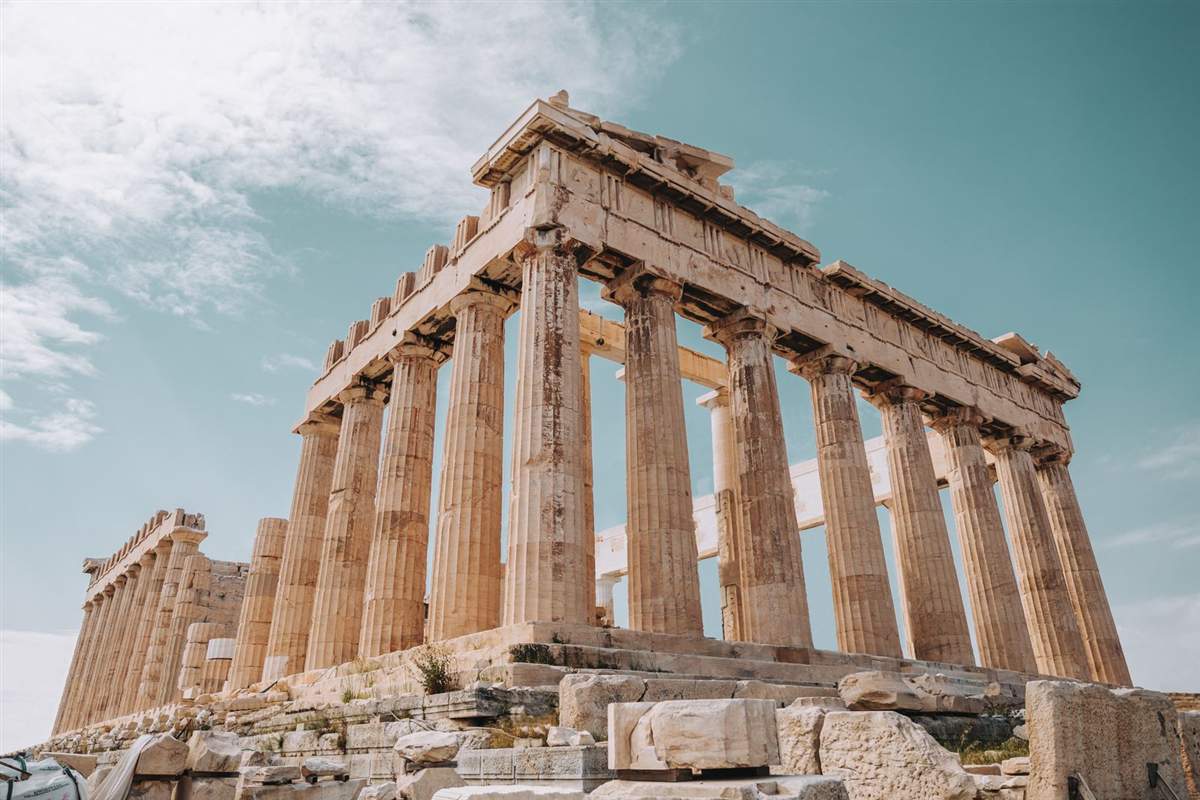
Wikipedia describes the Acropolis as a citadel standing on a rock over the city, 150 metres high. Pericles organised the building work of the fifth century B.C. that produced the ruins still standing on the hill. Among them are the Propylaea, the Erechtheion and the little temple of Athena Nike.
Athena, the goddess of the city, received the Parthenon as her temple. The first stones went down in 447 B.C. and the walls stood finished in 438 B.C. Sculptors kept carving until 432 B.C. Eight columns face each end, where a Doric temple normally shows six.
One listing for a five-hour city tour names the Parthenon, Athena Nike and the Erechtheion. Greece tours and cruises that start in Athens share these same ruins. Wikipedia adds that a Venetian shell struck the Parthenon in the late seventeenth century and wrecked much of the roof.
Wikipedia dates the museum opening to 20 June in the year two thousand nine. More than 4,250 objects fill its halls. Wikipedia places the building 280 metres from the Parthenon, close to the old road up the rock. The Athens sightseeing tour with the new Acropolis Museum carries it in the title.
The Parthenon hall repeats the column spacing of the old temple. Glass panels in the floor show diggings under the building. Greece tours and cruises in Athens therefore pair old stone with a modern museum. Another page here is plainly called the Athens city tour.
For the evening, Greece tours and cruises add the Athens by night tour, named for the city after dark. The title alone says that much, and nothing else is claimed here.
Which Greece tours and cruises reach Cape Sounion, Corinth and the Saronic Islands?
Greece tours and cruises reach Cape Sounion, Ancient Corinth with the Corinth Canal, and the Saronic Islands. The tour pages name an evening tour, a half-day tour and a one-day cruise for these three places.
Sounion is a headland at the far south of Attica, 69.5 kilometres from Athens by Wikipedia’s count. Builders put up its Poseidon temple between 444 and 440 B.C. Fifteen of the original 34 columns remain upright, and the whole ruin sits almost 60 metres over the water.
The Cape Sounion evening tour shares its name with this headland. Sea surrounds the ruin on three sides. Homer’s Odyssey is the earliest text to mention Sounion, Wikipedia says, and it tells how Menelaus came ashore there.
Digging the Corinth Canal ended in the year eighteen ninety-three. The cut links two seas, and ships pass without any locks. Wikipedia gives its length as 6.4 kilometres and its sea-level width as 24.6 metres. Its eastern mouth meets the Saronic Gulf. Wikipedia calls it mainly a tourist sight today. Greece tours and cruises list it beside Ancient Corinth in one half-day title.
The old city sat on the narrow isthmus between Athens and Sparta, Wikipedia says, with 90,000 people around 400 B.C. It dates the temple of Apollo to about 550 B.C. The Ancient Corinth and Corinth Canal half-day tour names both stops in its title.
The Saronic Islands form a group close to the mainland, and ferries from Piraeus link them with Athens. Aegina lies 27 kilometres away. Wikipedia names its Aphaia temple and its pistachio crop. For the crossing from Piraeus it lists forty minutes on a hydrofoil, or about an hour on the regular ferry.
Poros is two islands tied by a bridge, about 58 kilometres south of Piraeus. Hydra bans wheeled vehicles. Such short hops suit Greece tours and cruises that fill one day on the water. The one-day cruise to the Saronic Islands is named for the whole group.
Which Greece tours and cruises cover Argolis?
Greece tours and cruises cover Argolis by land, with Epidaurus, Mycenae and Nafplio as the stops. Wikipedia places Argolis in the eastern Peloponnese, with one coast on the Saronic Gulf and another on the Argolic Gulf.
Argolis is an administrative district of Greece, set on the Peloponnese peninsula. Wikipedia names oranges and olives as its main farm products. Our Argolis classical tour page carries the name of the region in its title.
Greece tours and cruises that stop at Epidaurus visit its ancient theatre. Wikipedia places it at the southeast end of a sanctuary for Asclepius, the healing god. The ancient writer Pausanias credits Polykleitos the Younger as architect. The work dates from about the end of the fourth century B.C.
Wikipedia gives seating for 14,000 spectators, and UNESCO lists the theatre with the sanctuary. The article also reports a long reputation for acoustics, a tale recounted by tour guides. Measurements on the spot moderate that claim. The Epidaurus Festival still stages ancient drama in the summer months.
Greece tours and cruises that add Mycenae reach a Bronze Age citadel. Wikipedia puts the site 120 kilometres from Athens, towards the south-west, on a hill rising 274 metres. The two-day tour to Argolis page shows a length of two days in its title.
Visitors to Mycenae enter through the Lion Gate, the main opening in the walls. Beyond it a stepped ramp climbed to the palace, beside Grave Circle A. The article describes that circle as a walled enclosure of shaft graves. Finds from the graves include the Mask of Agamemnon and engraved swords and daggers.
Nafplio is the capital of Argolis. Wikipedia calls it the first official seat of government of modern Greece. Venetian builders raised Palamidi castle on a hill above the old quarter. A second fortress, the Bourtzi, rises from the harbour. Greece tours and cruises that add Nafplio meet a harbour town with two fortifications.
Which Greece tours and cruises go to Delphi and Meteora?
Greece tours and cruises reach Delphi, the seat of the oracle of Apollo, and Meteora, the monasteries on rock pillars. Wikipedia locates Delphi in the middle of the mainland and Meteora in the north-west.
Wikipedia describes Delphi as a sacred precinct in ancient times, lying on the slope of Mount Parnassus that faces south-west. Ancient Greeks treated it as the centre of their world, and a stone named the Omphalos marked that point. The Delphi classical tour page names the site in its title.
The oracle spoke through the Pythia, priestess of Apollo’s temple. Wikipedia says people consulted her until Emperor Theodosius I destroyed that temple, late in the fourth century A.D. Greece tours and cruises that stop here walk through the precinct. Today it is an archaeological site and UNESCO lists it.
The Delphi Archaeological Museum shows finds from the sanctuary in fourteen rooms on two levels. Wikipedia names the Sphinx of Naxos, the Charioteer of Delphi and reliefs from the Siphnian Treasury among the displays. The two-day tour to Delphi page shows two days in its title.
Meteora is a group of rock pillars in the region of Thessaly. Twenty-four monasteries rose on its giant pillars, Wikipedia reports, from the late fourteenth century onward. Six remain, and four are occupied. Greece tours and cruises can pair it with Delphi, as the two-day tour to Delphi and Meteora page title shows.
Monks first reached the monasteries by long ladders and hauling nets. Staircases and pathways now lead up, and Wikipedia dates the carved rock steps to the nineteen-twenties. The three-day tour to Delphi and Meteora page adds a third day in its title.
Kalabaka, spelled Kalambaka on other maps, is the town near the monasteries. The article traces the town name to Turkish, where it means powerful fortress. The name Meteora means lofty. For Greece tours and cruises that add Meteora, Kalabaka is the town beside the rock pillars.
Which multi-day Greece tours and cruises cross the mainland?
Multi-day Greece tours and cruises on land run three, four, five or seven days, as the tour pages name them. The longest page names the Peloponnese, Central Greece and Macedonia, so one trip crosses the country from south to north.
The three-day classical tour of Greece names Epidaurus, Mycenae, Olympia and Delphi on its page. Olympia needs a little history. Wikipedia describes it as a small town in Elis, on the Peloponnese, beside a major sanctuary of ancient Greece.
Greece tours and cruises that stop at Olympia reach the home of the ancient Olympic Games. Wikipedia says the games honoured Zeus and were held every four years, from the eighth century B.C. to the fourth century A.D. The sacred precinct was called the Altis.
Among Greece tours and cruises on land, the four-day classical tour of Greece adds Nafplio and Meteora to that list. Its page names Epidaurus, Mycenae, Nafplio, Olympia, Delphi and Meteora. Wikipedia says the Peloponnese joins the central mainland at the Isthmus of Corinth, where the Corinth Canal was cut.
The five-day tour of Central Greece and Macedonia turns north. Its page names Delphi, Meteora, Dion, Vergina, Pella, Naoussa, Edessa, Kastoria and Thessaloniki. Wikipedia says Cassander founded Thessaloniki around 315 B.C. and named it after his wife Thessalonike, half-sister of Alexander the Great.
The seven-day tour of the Peloponnese, Central Greece and Macedonia joins both halves of the country. Wikipedia says King Archelaus moved the Macedonian capital to Pella at the start of the fourth century B.C.
Greece tours and cruises in Macedonia also meet Vergina. Wikipedia calls it the site of ancient Aigai, the first capital of Macedon. Philip II was killed in its theatre, and his son Alexander the Great was proclaimed king there. UNESCO lists the site as a World Heritage Site.
Philippi lies further east than those stops, near modern Kavala. Wikipedia says Philip II renamed the city after he conquered it in 356 B.C. UNESCO lists its ruins for their Roman architecture and their place in early Christianity.
Which Greece tours and cruises sail the Greek islands and Turkey?
Greece tours and cruises at sea run three, four or seven days, as the cruise pages name them. The cruise pages name Mykonos, Rhodes, Patmos, Santorini and Crete in Greece. They also name Kusadasi in Turkey, the resort town that gives access to ancient Ephesus.
Start with the page on cruises in Greece, which gathers the cruise pages. Wikipedia places the Aegean Sea between the Balkans and Anatolia. It counts Crete and Rhodes among the Aegean islands.
The three-day Greek Islands and Turkey cruise names Mykonos, Rhodes, Patmos and Kusadasi with Ephesus. Mykonos, says Wikipedia, is a Cyclades island of 85.5 square kilometres. Its nickname is the Island of the Winds.
Greece tours and cruises that call at Mykonos have Delos close by, only 2 kilometres away. Wikipedia names Delos the birthplace of Apollo and Artemis in Greek myth. UNESCO lists it for an archaeological site that conveys the image of a great cosmopolitan Mediterranean port.
The alternative three-day Greek Islands and Turkey cruise names Mykonos, Patmos, Heraklion, Santorini and Kusadasi. Patmos is one of the northernmost islands of the Dodecanese, says Wikipedia. Its monastery of Saint John the Theologian and the Cave of the Apocalypse are World Heritage Sites.
The four-day Aegean cruise names Mykonos, Rhodes, Patmos, Santorini, Crete and Kusadasi. Wikipedia calls Rhodes the largest island of the Dodecanese. The Knights of Saint John ruled it, and its medieval Old Town is a World Heritage Site.
Among Greece tours and cruises at sea, the seven-day cruise to Greece and Turkey is the longest. It names Santorini, Mykonos, Rhodes, Patmos, Crete, Istanbul and Kusadasi. On Crete, Knossos lies about 5 kilometres south of Heraklion. Wikipedia calls it the largest centre of the Minoan civilisation.
Greece tours and cruises to Turkey end at Ephesus. Wikipedia describes an ancient Greek city on the coast of Ionia. Its ruins include the Library of Celsus and a theatre that seated 24,000 people. The ruins are reached from Kusadasi, and UNESCO lists them.
How long do Greece tours and cruises last?
Greece tours and cruises here run from half a day to seven days, going by the tour page titles. The short end is a half-day tour near Athens. The long end is a seven-day tour or cruise.
The tour page names show the ladder. The Ancient Corinth and Corinth Canal tour is a half-day tour. The cruise to the Saronic Islands is a one-day cruise. Argolis and Delphi each have a two-day tour, and Delphi with Meteora comes as a two-day or a three-day tour.
Among Greece tours and cruises on land, the longer coach tours are named for three, four, five and seven days. Two classical tours are named for three days and for four days. A five-day tour covers Central Greece and Macedonia, and the seven-day tour adds the Peloponnese.
At sea, the cruise page titles name three, four and seven days. One cruise listing says a standard Greece ocean cruise covers four to six islands in seven or eight days. The same listing gives six to twelve hours at each port.
Wikipedia explains what changes with a cruise. The article says a cruise ship sails a round trip and stops at ports, where passengers join shore excursions. It adds that the ship is run much like a floating hotel. On Greece tours and cruises, a night at sea is a night aboard that hotel.
Short tours show the pace of a coach day. One Athens listing gives five hours for a city tour that covers the Acropolis and its new museum. Another titles a Delphi day trip with three named stops: the oracle, the museum and Arachova. A third lists a Meteora day trip by bus.
Cruises were once much longer. Wikipedia describes an early cruise that left Naples in the eighteen-thirties and sailed for just over three months. Its ports of call included Corfu, Patras, Delphi and Athens. Modern Greece tours and cruises fit ports and shore visits into seven days or fewer on this site.
When do Greece tours and cruises run through the year?
Greece tours and cruises follow the Mediterranean climate. In the Aegean region, Wikipedia gives hotter and drier summers with milder and wetter winters. One cruise line points to April through October for a visit to the Greek islands.
In summer, says Wikipedia, skies are sunny and dry, and rain comes only as showers or storms. Daytime air is hot, while nights feel pleasantly warm. It records 48.0 °C at Tatoi and Elefsina as the highest temperature ever measured in Greece.
Wikipedia calls winters wet and says snow melts quickly on slopes that face south. On the water, the sea itself matters. Its surface water reads 19 to 24 °C in summer, according to the Aegean Sea article. Winter water ranges between 8 °C (north) and 13 °C (far south).
The meltemi is the Aegean wind from the north, and it is dry and strong. Wikipedia dates it from around the midpoint of late spring until mid-September. Afternoons bring the peak, and nights can calm it, yet it can last whole days.
The article warns that it arrives under clear skies with no notice. Winds of force 7 to 8 are listed. In such gales the greater number of ferries between islands cannot sail.
The climate article stretches the wind from late spring to October and ranks July and August as its peak. It also records very windy summer days, especially around the Cyclades. Greece tours and cruises that sail in July or August meet the wind at its peak.
The cruise line gives low 70s to mid 80s Fahrenheit for April to October. One listing gives the peak cruise season as late spring to September, at 24 to 29 °C. It calls July and August the warmest, with the largest crowds at Santorini and Mykonos.
The same listing names late spring with June, and September with October, as calmer months. It says major ports see fewer visitors then. For Greece tours and cruises, these are the shoulder seasons that sit either side of high summer.
How do Greece tours and cruises connect to the islands?
Greece tours and cruises link to the islands through the harbours of Attica, above all Piraeus. Its Wikipedia page says ferries from the harbour serve Crete, plus the Dodecanese and the Cyclades. Boats also leave for the Saronic islands and the northern Aegean.
Piraeus looks onto the Saronic Gulf and is the largest port of the country. The article puts the city 8 kilometres south-west of Athens centre. The Athens article ranks it second in Europe for passengers. For Greece tours and cruises, the sea part of a trip starts here.
Rafina works as a back-up gate. Wikipedia names it the second port of the capital, with ferries to southern Euboea and to islands of the Cyclades. It sits on the Aegean coast, 25 kilometres out from the centre.
A cruise ship is a different thing from a ferry. Wikipedia defines it as a big passenger vessel built mainly for holidays. An ocean liner moves people between places. A cruise ship returns to where it began, so guests step off at each port and board again.
Piraeus has a cruise harbour of its own for Greece tours and cruises that sail. The port article counts eleven berths and gives the cruise terminals the letters A, B and C. A third of the ships that call, it adds, also begin their voyage there. One terminal has room for 120 tour buses.
The Saronic Gulf is the sea nearest to Athens. Poros has no airport, Wikipedia notes, so travellers reach it from Athens by ferry or hydrofoil. Wikipedia places it in the Aegean between Attica and Argolis, holding Aegina, Salamis and Poros. Aegina takes forty minutes by hydrofoil from Piraeus and about an hour by ordinary ferry.
Hydra is 69 kilometres out, and the fast boats call at Poros first.
Island hopping joins such links into one chain. Wikivoyage notes that ferries serve every island, while routes and frequencies change with the time of year. Anyone adding an island stay to Greece tours and cruises therefore checks the sailings for the chosen dates first.
Where do travellers stay between Greece tours and cruises?
Between Greece tours and cruises, travellers base themselves in Athens, in Plaka, near Syntagma Square, around Monastiraki or in Piraeus. Wikipedia describes Plaka as the oldest quarter in Athens and Syntagma as the middle square of the capital.
Plaka climbs the slope below the Acropolis, with Syntagma on one side and Monastiraki on the other. According to Wikipedia, homes have stood there since the Neolithic age. The article gives the quarter a nickname, the Neighborhood of the Gods.
Across the road from Syntagma Square stands the Old Royal Palace, now the seat of the Greek Parliament. The metro station below joins lines 2 and 3. With trams and buses added, Wikipedia ranks it as a leading transport hub of the nation. Greece tours and cruises that need a central base start well from here.
Monastiraki is one of five metro stations where lines cross. The Athens Metro article names the others as Attiki, Omonia, Piraeus and Syntagma. Line 1 goes from Monastiraki down to Piraeus, and the Piraeus station stands beside the port.
Piraeus itself suits a night before a sailing on Greece tours and cruises. Wikipedia says Terminal A takes visitors in around the clock and is a walk from the middle of Piraeus. Free shuttle buses inside the port carry passengers to the other terminals.
The airport is the other fixed point. Wikipedia sets it 20 kilometres east of the city centre, or 30 by road. A station by the terminal takes trains of Athens Metro line 3 and of the Proastiakos suburban service. The Piraeus article adds an express bus, the X96, that runs day and night to the port.
Regional buses also join the airport to Rafina and Lavrio. For a bed near the centre, look at the hotels in Athens and pick the area from the points above.
What else do travellers ask about Greece tours and cruises?
Where does the name of the Aegean Sea come from?
Wikipedia says ancient writers gave different reasons. One story names Aegeus, the father of Theseus, who leapt into the sea in grief. Another points to a goat-shaped rock called Aex. A third ties the name to the Greek word for goats, because waves or islands looked like a herd.
Greece tours and cruises that sail the Aegean cross a sea that the Romans called Mare Aegaeum. The Turkish name for it, Adalar Denizi, means Sea of Islands.
Where does the Temple of Olympian Zeus stand?
Wikipedia describes a ruined temple in Athens, five hundred metres to the southeast of the Acropolis. Tyrants who ruled the city started the work around 520 B.C. The work halted when Hippias was driven out in 510 B.C. Hadrian completed the temple a long time later, in the second century of our era.
It had 104 columns, each 17.25 metres tall. Fifteen are upright today. The sixteenth lies on the ground after a storm brought it down in eighteen fifty-two. Travellers on Greece tours and cruises who stay near Syntagma Square find it close. Wikipedia puts the temple about 700 metres south of the square.
What is Lycabettus?
Mount Lycabettus is a limestone hill in central Athens, 277 metres high, says Wikipedia. Its summit is the highest spot in the middle of the capital, and pine trees cover its base. Travellers on Greece tours and cruises can ride a funicular railway up it from Kolonaki.
The nineteenth-century Chapel of Saint George, an open-air theatre and a restaurant stand at the two peaks. One story links the name to wolves, because lycos is the Greek word for wolf. Another traces it to a word from before the Mycenaean age.
What did builders try before the Corinth Canal opened?
Periander, the tyrant of Corinth, first dreamed of a canal, Wikipedia says. He chose the Diolkos instead, a stone trackway that carried ships across the isthmus. Remains of it still lie next to the canal.
The Roman emperor Nero dug the first basket of soil with a pickaxe in 67 A.D. The work stopped soon after he died. Real digging restarted in eighteen eighty-one and ended twelve years later. Greece tours and cruises that reach the canal see a cut that follows the course of Nero’s trench.
What do travellers eat on Greece tours and cruises?
Wikipedia names three pillars of Greek cooking: wheat, olive oil and wine. The oil is the oldest key ingredient, and people eat the olives themselves too. Along the coast and across the islands, fish dishes are a regular choice.
Street food includes souvlaki, gyros, pitas and roasted corn. A Greek breakfast, says the article, can hold Greek coffee, bread, honey, yogurt, bougatsa and tiropita. Eating out is a habit, and a taverna or an estiatorio serves home cooking.