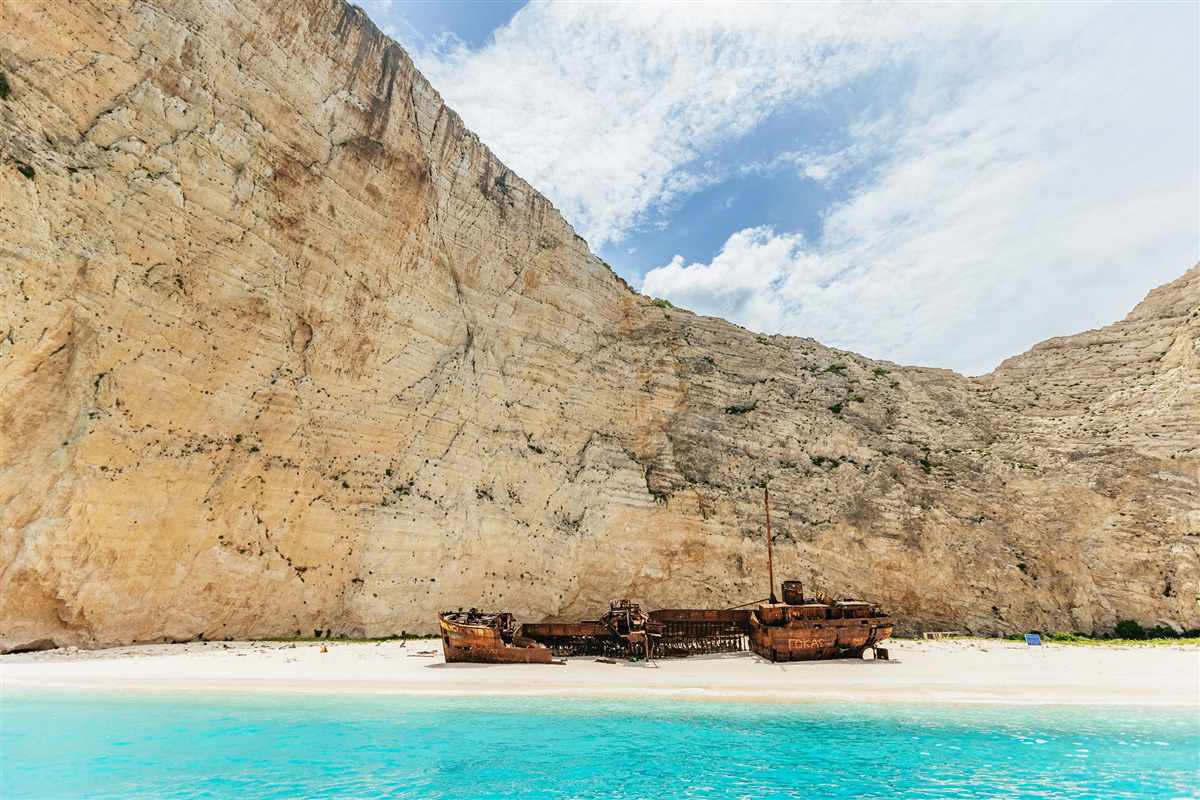
A Zakynthos shipwreck beach and blue caves tour sets out by boat to Navagio, the cove with the rusted wreck on the north-west coast, and on to the sea caves at Cape Skinari. The home page lists a wider range of tours in Greece.
This page covers what the tour includes, how the boat day runs, Navagio as a place, how the wreck is seen from the cliff and from the sea, the Blue Caves, the island of Zakynthos and the questions travellers ask.
What does a Zakynthos shipwreck beach and blue caves tour include?
A Zakynthos shipwreck beach and blue caves tour takes you by boat along the western coast of the island. It visits the shipwreck cove and the Blue Caves, with swim stops on the way, as the operators describe it.
A Zakynthos shipwreck beach and blue caves tour is built around two sights. The first is the cove with the wreck, also called Navagio. One operator names it Shipwreck Bay and adds the old name Smugglers Cove. The second is the Blue Caves, a group of caves cut into the sea cliffs.
The boats on a Zakynthos shipwreck beach and blue caves tour vary between operators. One operator runs glass-bottom boats, and its four boats hold from 22 up to 60 people each. Another operator uses a small glass-bottom speedboat and says the low capacity brings comfort. A third operator sails two speedboats with 25 seats each.
A Zakynthos shipwreck beach and blue caves tour can also begin on land. The operator with the coach collects guests from the resorts in a 48-seat coach and drives up the east coast. The tour guides speak English and tell stories about the history and mythology of the island.
Swimming is part of the day on a Zakynthos shipwreck beach and blue caves tour. One operator names three swim stops and a photo stop at the cove. Another says its boats stop for swims at small secluded beaches before the wreck. The operator with the coach lets guests swim inside the Blue Caves.
How does the boat trip to Navagio and the Blue Caves run?
On one operator’s Zakynthos shipwreck beach and blue caves tour, the speedboat leaves Agios Nikolaos harbour. The ride to the shipwreck cove takes about 30 minutes, and then comes the Blue Caves. The whole day takes 6 to 7 hours.
That operator starts early in the morning with the pick-ups and the coach ride. The first stop is the harbour of Agios Nikolaos, where guests can have a coffee or breakfast before they board. The cove comes first on the water. After the photos, the boat goes to a nearby beach for a swim. The Blue Caves follow.
Back at the harbour, the day goes on with lunch at a seaside taverna, which the operator lists as optional. The last stop is Xigia Bay, a small sandy bay. The operator calls it a natural sea spa, with sulphur in the water. This land and sea Zakynthos shipwreck beach and blue caves tour then ends.
Other operators run a shorter Zakynthos shipwreck beach and blue caves tour from a harbour. One departs from Porto Vromi Maries every hour and reaches the cove in 15 to 20 minutes. Its hours are 9 in the morning until 5 in the afternoon, daily from late spring to October. Its trips can change with the weather.
Another operator starts its boats at 9 in the morning and sends one every 15 minutes. The boats run until 6 in the evening. Its Zakynthos shipwreck beach and blue caves tour lasts 2.5 hours and includes stops in the caves. A trip to the Blue Caves alone takes 40 minutes, and the boat goes inside the caves.
One more operator offers a half-day cruise of 3 hours from Agios Nikolaos port. It runs from late spring to October. This Zakynthos shipwreck beach and blue caves tour sails south around Cape Skinari. It stops at the Blue Caves and the shipwreck cove. An optional 30-minute stop at Xigia Beach comes with the door-to-door transfer.
What is Navagio, the shipwreck beach of Zakynthos?
A Zakynthos shipwreck beach and blue caves tour calls at Navagio Beach, also named Shipwreck Beach. The cove is open to the sea, on the Zakynthos coast in Greece. A wrecked ship lies buried in its limestone gravel.
The cove carries more than one name. Navagio Beach is the Greek name, Shipwreck Beach is the English one, and it is sometimes called Smugglers Cove. Travellers on a Zakynthos shipwreck beach and blue caves tour come to see where that ship came ashore.
The wreck seen on a Zakynthos shipwreck beach and blue caves tour is the coaster MV Panagiotis. It ran aground on the fifth of October in nineteen eighty, during stormy weather and bad visibility. Rumours said it carried contraband, but official sources never confirmed this. The captain faced no conviction for smuggling then.
Papers and photos that came out later support the smuggler story. They suggest the ship sailed from Turkey with contraband cigarettes bound for Italy. The crew left it in the cove to escape the pursuing Navy. The wreck gives the beach its nickname.
The cove also appears in a Korean drama, Descendants of the Sun. That led to a surge of interest among Chinese and Korean tourists.
A cliff above the beach collapsed in twenty eighteen. The authorities briefly closed the beach and banned swimming and anchoring. It then reopened, with anchoring allowed under limits, out of concern about further landslides.
Rules for a Zakynthos shipwreck beach and blue caves tour changed with each landslide.
A second landslide came in September twenty twenty-two, after a quake rated 5.4 shook the sea between Kefalonia and Zakynthos. Experts from the national earthquake protection body advised banning access. Boats can approach, but swimming is not allowed near it. A Zakynthos shipwreck beach and blue caves tour by boat meets that rule from the water.
How do you see the shipwreck beach from the cliff and from the sea?
You see the shipwreck beach from viewpoints on the cliffs above it, or from a boat down on the sea. One operator says only boats reach the beach. A Zakynthos shipwreck beach and blue caves tour gives the sea-level view.
The viewpoints sit on the cliffs above the beach. A boat shows the cliffs and coastline from sea level. One operator calls that a perspective the viewpoints cannot give. A Zakynthos shipwreck beach and blue caves tour adds this second angle to cliff photos.
One operator says the municipality of Zakynthos has banned landing on the beach since twenty twenty-two. It links the ban to the earlier landslide and the large number of daily visitors. Its boat still sails into the bay and stops a short distance away, so passengers take photos.
Another operator says swimming in the bay is not allowed. Visitors enjoy the views and take photos from the boat or the cliff viewpoints. It adds that the beach offers no facilities and no lifeguards. Parents need to supervise children during the swim stops of a Zakynthos shipwreck beach and blue caves tour.
That operator also explains the colour of the water. White limestone cliffs, a deep seabed and reflected sunlight create the shades of turquoise and blue. The boat gives the closest look at that colour, with the cliffs rising above you.
The same operator says morning brings calmer sea and softer light. Midday shows off the vibrant blue of the water. For a Zakynthos shipwreck beach and blue caves tour, the right time depends on the aim: photos, swimming or atmosphere.
A third operator says its boat reaches the bay before the crowds. Passengers see the white sandy beach from the water. When you compare each Zakynthos shipwreck beach and blue caves tour, ask about the arrival time at the bay.
What are the Blue Caves of Zakynthos?
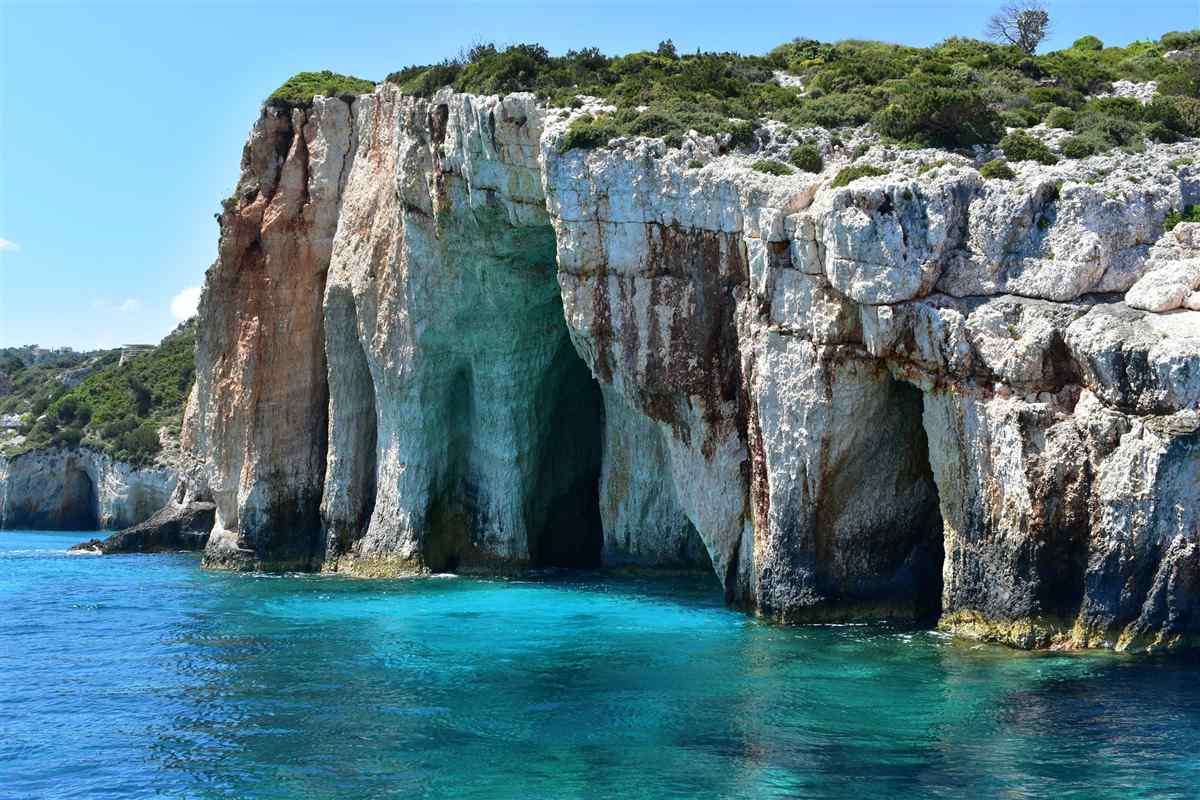
The Blue Caves are sea caves in the rock walls near Cape Skinari, at the northwest end of Zakynthos. Only small boats can enter them, so a Zakynthos shipwreck beach and blue caves tour reaches them by sea.
On the western coast, from Keri up to Skinari, the cliffs form arches and other rock formations. The caves are part of that rugged line. Wikipedia counts them among the landmarks of Zakynthos. A Zakynthos shipwreck beach and blue caves tour shows this wall of stone from the water.
The boat decides what you see. One operator describes a small glass-bottom speedboat that sails south around Cape Skinari. It passes steep terrain and small bays along the western coast. Another operator, with glass-bottom boats too, says its boat goes inside the caves. On a Zakynthos shipwreck beach and blue caves tour, the captain steers into these narrow spaces.
The light is the reason people come. One operator says the sun reflects blue light on the water and on the cave walls. Another describes translucent blue water, sea arches and rock formations, seen from a speedboat built to enter the caves. A Zakynthos shipwreck beach and blue caves tour of this kind brings you close to the rock.
Swimming inside the caves is part of the stop for one operator. It speaks of an optical effect. The water makes your skin look bright blue, and the operator calls it the Smurf effect. The colour fades once you leave the water. A Zakynthos shipwreck beach and blue caves tour with a swim in the caves lets you test this.


Where is Zakynthos, and what is the island like?
Zakynthos, also named Zante, belongs to Greece. This island floats in the Ionian Sea, close to the Peloponnese coast. Only two Ionian islands are bigger. It is the setting of the Zakynthos shipwreck beach and blue caves tour.
The Peloponnese mainland is about 20 kilometres to the east. Kefalonia, the next island, sits 15 kilometres north. Among the main Ionian islands, Zakynthos lies furthest south.
Its length is about 40 kilometres and its width about 20 kilometres. The land measures 405.55 square kilometres, ringed by 123 kilometres of shore. A little over 40,000 people live here. Navagio and the Blue Caves both lie in the northwest. That is the region of a Zakynthos shipwreck beach and blue caves tour.
On a map, the outline is an arrowhead, with Cape Skinari as the point facing northwest. A mountain plateau fills the western half. Steep cliffs line the southwest coast. Navagio lies on the northwest shore behind tall cliffs, and only boats can get there. A Zakynthos shipwreck beach and blue caves tour works along this edge.
The east is flat, fertile and crowded, with long sandy beaches. Laganas is the biggest resort. Above the main town, Bochali hill has a small Venetian castle. The cliffs of a Zakynthos shipwreck beach and blue caves tour are far from this side, in the west.
Summers bring heat and little rain, and winters are cooler and wet. That winter rain keeps the vegetation thick. Farmers grow olives, grapes, citrus fruit and the Zante currant. This small, sweet grape has no seeds and comes from the island. The highest point is Vrachionas, at 758 metres.
In Greek myth, Zacynthus, a son of the Arcadian chief Dardanus, gave the island its name. The Venetians once called it “Fiore di Levante”, Flower of the East. Anyone on a Zakynthos shipwreck beach and blue caves tour visits an island with a long story behind its name.
What else do travellers ask about a Zakynthos shipwreck beach and blue caves tour?
Does a Zakynthos shipwreck beach and blue caves tour have anything to do with the sea turtles?
Sea turtles nest inside the Zakynthos national marine park, found in Laganas Bay on the southern shore. The park covers 135 square kilometres. It opened at the close of the nineteen nineties. No park in the Mediterranean had been made for sea turtles before it.
The turtle is the loggerhead, Caretta caretta. A grown adult has a shell about 90 centimetres long and weighs around 135 kilograms. Females leave the water after dark to lay eggs on the park’s beaches between late spring and August. No turtle sighting is promised on a Zakynthos shipwreck beach and blue caves tour.
What is Zakynthos town?
Zakynthos town is the island’s capital, found in the easternmost part of Zakynthos. Greeks also call it Chora, meaning “the Town”, and Zante is a second form of its name. Its municipal unit counted 16,996 residents at the last census.
Wikipedia adds that visitors travel into the town from every corner of the island. Boat trips, food and nightlife draw them. A Zakynthos shipwreck beach and blue caves tour is one more reason to know where the capital sits.
How do travellers arrive for a Zakynthos shipwreck beach and blue caves tour?
Regular and charter flights land at Zakynthos International Airport. The poet Dionysios Solomos gives the airport its name. The terminal stands 4.3 kilometres from Zakynthos town. Laganas, Tsilivi and Kalamaki are close neighbours. The airport opened in the nineteen seventies.
Nesting turtles shape its timetable. Take-offs and landings are barred from 10 at night until 5 in the morning, except in extenuating circumstances. Aircraft approach over Laganas Bay and Kalamaki beach, which lies inside the marine park.
Where are the Ionian Islands and the Ionian Sea?
Greece’s western shore faces the Ionian Sea, a long arm of the Mediterranean. Five big islands lead the Ionian group: Ithaca, Lefkada, Kefalonia, Corfu and Zakynthos itself. Every boat on a Zakynthos shipwreck beach and blue caves tour sails on this sea.
Of the thirteen Greek regions, the Ionian Islands region covers the smallest area. Five regional units divide it, and Zakynthos is one. The Calypso Deep, 5,109 metres down, is the deepest spot in the Mediterranean and sits in the Ionian Sea. The origin of the name Ionian is unknown.
Which items does an operator list for a Zakynthos shipwreck beach and blue caves tour?
On its Zakynthos shipwreck beach and blue caves tour, one operator reports stony beaches. It asks guests to wear suitable footwear. It also lets guests carry a packed lunch, because lunch is not included. Footwear and a packed lunch are the two items that operator names.