
A Vergina and Pella day trip from Thessaloniki visits two ancient capitals of Macedonia in one day: the royal tombs at Vergina and the city of Pella. To see more of the country, visit our tours in Greece page.
This page covers what the trip includes, the length of the road, Vergina and its Great Tumulus, the royal tombs and their museum, the palace and theatre of Aigai, Pella with its mosaics and museum, the people of Pella and the questions travellers ask.
What does a Vergina and Pella day trip from Thessaloniki include?
A Vergina and Pella day trip from Thessaloniki joins two sites of ancient Macedonia in one day. Two operators list the Pella site and museum and the royal tombs museum at Vergina. They add transport from the city and English-speaking staff.
One operator starts at the Venizelos statue, at Aristotelous Square and Egnatia Street. Departure is at 8 in the morning, and guests are asked to arrive 10 minutes early. On this Vergina and Pella day trip from Thessaloniki, Pella comes first, then Vergina.
That operator lists round-trip transport. Its team member on the trip is an archaeologist who speaks English. It adds basic travel insurance during the transport and help with issuing the tickets. In its list, a Vergina and Pella day trip from Thessaloniki leaves the museum tickets and the lunch out.
A second operator pairs its Vergina and Pella day trip from Thessaloniki with a one-day sightseeing bus pass. Its meeting point and start hour match the first operator’s. It lists a coach and an English-speaking tour guide, and Pella is its first stop as well.
One licensed tour guide lists the two sites in the opposite order. The tour visits the royal tombs of Vergina first. It then drives to Pella for the site and the museum before returning to Thessaloniki. The same listing also names a Vergina-only tour with hotel pick-up in an air-conditioned vehicle.
A transfer company lists a private Vergina and Pella day trip from Thessaloniki with Edessa added as a third stop. The car option is for up to four passengers, the minivan option for five to eight. Pick-up is at the hotel, at a time set on request. The driver stops for photos, and a tour guide can be added.
How long is the road from Thessaloniki to Vergina and Pella?
One operator lists the whole Vergina and Pella day trip from Thessaloniki at about 8 hours and 30 minutes. Its drive legs are 45 minutes to Pella, one hour on to Vergina and one hour back to the city.
The same operator itemises the day. A Vergina and Pella day trip from Thessaloniki spends 90 minutes at the Pella site and museum. Then it spends two hours at the Vergina museums and one hour at lunch.
The legs it lists, drives included, add up to 7 hours and 15 minutes. About an hour and a quarter of its total is not itemised. The operator does not say what fills it.
A Thessaloniki travel portal gives the distance to Vergina as 73 km, about 68 minutes by car. It puts Pella 40 km from the city and calls it a morning stop on the way. For the royal tombs museum it allows 1.5 to 2 hours.
Wikipedia gives other figures. It gives the city of Veria as 73 km from Thessaloniki, in a west-southwest direction. Vergina belongs to the municipality of Veroia. The portal’s route runs about 14 km on from Veria. The distance for a Vergina and Pella day trip from Thessaloniki therefore depends on the source.
Wikipedia also helps with Pella. It says Giannitsa lies 48 km from Thessaloniki, and the ruins of Pella are about 7 km from that town. Its Pella article adds that the Roman Via Egnatia crossed Pella, on the route between Dyrrachium and Thessalonica.
On the map, the trip crosses two regional units. Wikipedia places the Pella museum in the Pella regional unit. That unit borders the Thessaloniki unit to the east and Imathia to the south. Wikipedia places Vergina in Imathia, so a trip that starts at Pella visits the Pella unit first and Imathia second.
A transfer company lists a private round trip to Vergina, Pella and Edessa at 270 km. It gives the day as 8 hours at the top of its page. Its option list says 10 hours, with 6 hours of travel and 4 hours of waiting.
What is Vergina, the site of ancient Aigai?
Vergina lies in Imathia, in Central Macedonia, and belongs to the municipality of Veroia. Wikipedia says ancient Aigai, the first Macedonian capital, stood at Vergina. Operators list the town on the Vergina and Pella day trip from Thessaloniki for its royal tombs.
The Vergina and Pella day trip from Thessaloniki reaches the Haliacmon valley, where Wikipedia places Aigai. The city lay below the Pierian Mountains and looked out over the central Macedonian plain. It stood between the modern towns of Vergina and Palatitsia. UNESCO says the rivers Haliakmon and Askordos and the Pierian Mountains define the site.
The name Aigai means goat town, Wikipedia says, from an Ancient Greek word for goat. Perdiccas I, the story goes, was told to establish his city where goats with white horns rest at dawn. The Pythia at Delphi gave that instruction, Diodorus Siculus says. Wikipedia calls this story the official founding myth of the fifth century B.C.
Aigai became the capital in the first half of the fifth century B.C. Once Pella took over as capital, Aigai still served as the kingdom’s sacred city. The traditional cult centres, the palace and the tombs stayed there. So the Vergina and Pella day trip from Thessaloniki covers the old capital and the one that followed.
Aigai never became a large city, and the bulk of its people lived in the villages around it. In the second century B.C. the Romans overthrew the kingdom, and both capitals were burned. A landslide in the first century A.D. destroyed what had been rebuilt. Only a small settlement named Palatitsia, meaning palace, remained.
Léon Heuzey, a French archaeologist, began digging at Vergina in eighteen sixty-one. The modern town of Vergina is young: Wikipedia says it was founded in nineteen twenty-two. UNESCO says the royal tombs found in nineteen seventy-seven and seventy-eight made a worldwide sensation. The Vergina and Pella day trip from Thessaloniki goes to the place of that find.
What is the Great Tumulus of Vergina?
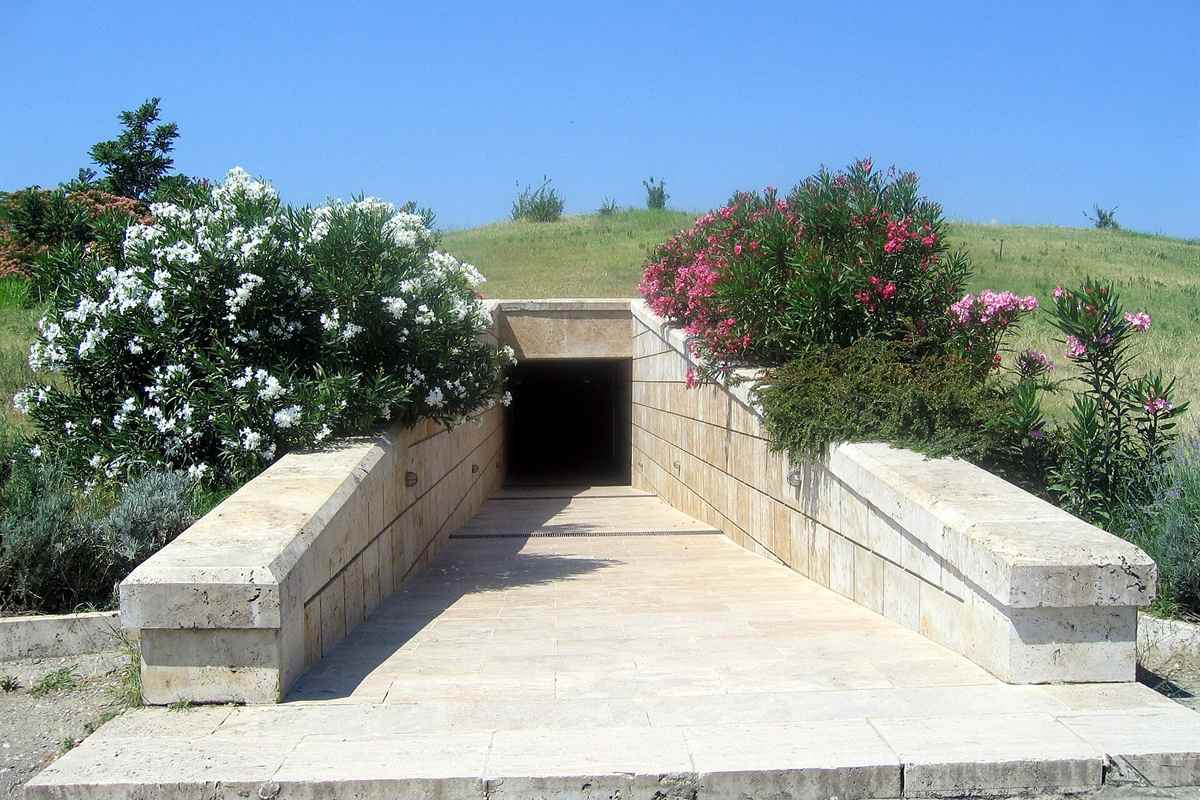
The Great Tumulus is the mound at Vergina that hid the royal tombs of Aigai. Wikivoyage says it has a diameter of over 100 metres and was once 12 metres high. A museum now stands in its place, and operators list it on the Vergina and Pella day trip from Thessaloniki.
Wikipedia says the Great Tumulus was built at the start of the third century B.C. It names Antigonos Gonatas as the builder. The mound was meant to guard the royal tombs against more pillaging. Raiders called Galati had plundered and destroyed the cemetery.
Archaeologist Manolis Andronikos became convinced that one hill, the Great Tumulus, hid the tombs of Macedonian kings. In nineteen seventy-seven he led a six-week dig there. He found four buried tombs, and two had never been disturbed. One operator lists the Royal Tombs of Aigai as a stop on the Vergina and Pella day trip from Thessaloniki.
The original mound is gone. UNESCO says digging into an earthen structure destroys it, so the Great Tumulus was simulated in a cover structure. This shelter is shaped like a tumulus and protects the royal tombs. Wikivoyage adds that reconstructions inside show what the complex once looked like.
Wikipedia says the museum was inaugurated in nineteen ninety-three. It was built over the tombs and leaves them where they were found. It shows the tumulus as it looked before the dig. The Vergina and Pella day trip from Thessaloniki visits this museum. UNESCO calls it a particularly original example of burial monuments sheltered in a modern underground museum.
Wikipedia says the cemetery of the tumuli extends for over 3 kilometres. It holds over 500 grave-mounds, and the earliest go back to the eleventh century B.C. The Vergina and Pella day trip from Thessaloniki stops at the royal cluster, one part of that burial ground.
Who lies in the royal tombs of Vergina?
The Vergina and Pella day trip from Thessaloniki leads to the royal tombs of Aigai. Wikipedia gives Tomb II to King Philip II, who fathered Alexander the Great. It gives Tomb III to Alexander IV, whose father was Alexander the Great. A newer study puts Philip II in Tomb I.
For this Vergina and Pella day trip from Thessaloniki, the name to know is Manolis Andronikos, who led the dig. He named Tomb II as the grave of Philip II. Wikipedia notes that one greave, a piece of leg armour, fitted a leg with a misaligned tibia. Philip II was recorded as having broken his tibia.
Wikipedia says the right eye in the skull was damaged when an object penetrated it. History records the object as an arrow. A study by two scientists later claimed that Philip II lies in Tomb I. They cited his age, a knee that had stiffened, and a hole that matches a piercing wound.
The Greek Ministry of Culture replied that this claim was baseless. It said the stiff knee came from a different body, put into Tomb I after looting. Wikipedia adds that newer research finds the king in Tomb II with Meda, his Thracian wife. So the Vergina and Pella day trip from Thessaloniki meets more than one answer.
Antonios Bartsiokas, one of the authors of that first study, later led a second study of the skeletons. Wikipedia says it names Philip II for Tomb I. For Tomb II it names Philip III, who shared a father with Alexander the Great. It also finds a woman and a baby in Tomb I.
Tomb II, says Wikipedia, has two rooms and a Doric entrance. Above the entrance is a 5.6-metre painting of a hunting scene, thought to picture Philip and Alexander. Tomb I has one wall painting, of Persephone being carried off by the god of the underworld. Your Vergina and Pella day trip from Thessaloniki leads to a museum holding four tombs.
What is inside the Museum of the Royal Tombs of Aigai?
One operator lists the Museum of the Royal Tombs of Aigai for its Vergina and Pella day trip from Thessaloniki. Wikipedia says the museum holds the burial cluster of Philip II. Its finds include a golden larnax, a gold wreath, a diadem, armour and weapons.
This Vergina and Pella day trip from Thessaloniki reaches a museum centred on the royal tombs built at Aigai. Wikipedia says its exhibits sit in four connected areas. They are the Palace, the Temenid royal burial cluster, the cluster of Philip II, and a gateway entrance. One travel portal says the museum is climate-controlled to protect the finds.
Wikipedia lists the finds from the tomb of Philip II. The golden larnax, a small coffin, has the sixteen-rayed sun on its lid and holds the king’s bones. Other finds are a gold burial wreath, a diadem with a Heracles knot, and vessels from the funeral feast.
Along the Vergina and Pella day trip from Thessaloniki, one travel portal calls Tomb II the museum’s centrepiece. Wikipedia gives the golden larnax as 24-carat gold with a weight of 11 kilograms. It stood in a marble chest in the main room of Tomb II. The golden wreath has 313 oak leaves and 68 acorns.
The sun on the lid is the Vergina Sun. It is a rayed solar symbol that first appears in ancient Greek art during the fifth century B.C. The larnax lies in a royal tomb of Philip II or Philip III, says Wikipedia. An eight-point sun is the museum’s logo.
On that Vergina and Pella day trip from Thessaloniki, the operator lists royal armour and the Star of Vergina. Another operator adds Philip II’s golden funeral wreath and ceremonial armour. Wikipedia says Tomb III held cremated bones in a silver jar, called a hydria, topped by a golden oak wreath.
What is the Palace of Aigai and its theatre?
The Palace of Aigai was the royal palace of ancient Aigai, built in the time of Philip II. The theatre beside it is where he was killed. The Vergina and Pella day trip from Thessaloniki pairs this first Macedonian capital with Pella, the later one.
Wikipedia calls the palace the biggest building of classical Greece. With the Parthenon, it ranks among the buildings of greatest significance from that age. It stood on a plateau, close beneath the acropolis. It had two stories, with a third possible. A big open courtyard lay at its centre, with Doric colonnades along its sides.
Floors were laid with mosaic, and walls were plastered and painted. Fine relief tiles added to the decoration, and marble stucco of high quality covered the stonework. Conserved mosaic covers more than 5,000 square feet, with scenes such as the ravishing of Europa and motifs from nature.
Nearly thirty large columns around the main peristyle have been reconstructed, and they tower to twenty-five feet in places. A wide gallery on the north side had a view of the theatre’s stage and the whole Macedonian plain. The Vergina and Pella day trip from Thessaloniki reaches Vergina. One website puts the palace on the hill above the village.
Excavations have dated the palace to the time of Philip II, although he also had a palace at Pella. The Vergina and Pella day trip from Thessaloniki therefore links the two places where he kept a palace. Wikipedia notes a suggestion that Pytheos of Priene designed it. That architect is known for the Mausoleum at Halicarnassus.
The theatre belongs to the late fourth century B.C. and was tied closely to the palace. Pausanias of Orestis killed Philip II in the theatre as the king attended his daughter Cleopatra’s wedding. Alexander the Great, his son, was proclaimed king on the spot. The Vergina and Pella day trip from Thessaloniki stops at Vergina, close to that theatre.
Why is Aigai a World Heritage Site?
The listing came in nineteen ninety-six, when UNESCO added Aigai to its World Heritage List. Wikipedia gives the reason as its monumental significance in Western civilization and exceptional architecture. The Vergina and Pella day trip from Thessaloniki goes to Vergina, the town where ancient Aigai stood.
As Wikipedia quotes it, the listing text calls Aigai “an exceptional testimony to a significant development in European civilization”. That development is the change from the city-state of classical Greece to imperial rule in the Hellenistic and Roman periods. The article on Aigai calls the city’s urban fabric a pivotal moment of transition between those two worlds.
Wikipedia lists Aigai under two cultural criteria, the first and the third. The first asks a site to represent a masterpiece of human creative genius. The third asks for a unique or at least exceptional testimony to a cultural tradition or civilization, living or disappeared. The Vergina and Pella day trip from Thessaloniki calls at that listed site.
Behind the label stands a UNESCO treaty, adopted in November nineteen seventy-two. A host country nominates a site, and the World Heritage Committee decides. A site has to satisfy at least one of ten criteria. Listing brings recognition around the world and legal protection. Anyone on the Vergina and Pella day trip from Thessaloniki visits a protected place.
The Vergina and Pella day trip from Thessaloniki heads for a town beside ruins that survived a landslide. The palace burned in one hundred sixty-eight B.C. In the first century A.D. a landslide covered the ruins under three to four metres of soil. The palace reopened to the public in January two thousand twenty-four, after a sixteen-year restoration.
One operator calls the Royal Tombs Museum a World Heritage Site in its Vergina and Pella day trip from Thessaloniki. Wikipedia says the area today has an archaeological site and two museums. The ancient town stayed small, and its people lived across the countryside villages nearby.
What is Pella, the ancient capital of Macedonia?
Pella was the capital where the Macedonian kings ruled, from the early fourth century B.C. to the Roman conquest in the second century B.C. A Vergina and Pella day trip from Thessaloniki visits its ruins, one kilometre outside the modern town of Pella.
Wikipedia names Archelaus I as the builder of Pella, in the opening years of the fourth century B.C. A second view credits Amyntas III. He made it the commercial capital, beside the older palace-city of Aigai. Aigai kept its role as the place where kings and their families were buried.
One operator puts Pella before Vergina on its Vergina and Pella day trip from Thessaloniki. The route therefore runs against the order of history, because Pella replaced Aigai as the capital. Wikipedia adds that Pella soon grew into the biggest and wealthiest city of Macedonia.
In antiquity Pella was a strategic port in Lower Macedonia. An inlet open to boats led to the Thermaic Gulf. Wikipedia says the harbour and the gulf have silted up since. A Vergina and Pella day trip from Thessaloniki therefore reaches a site that now lies inland.
The city that a Vergina and Pella day trip from Thessaloniki visits was planned on a grid. Wikipedia describes eight rows of rectangular blocks, each about 45 metres wide. The middle avenue, up to 15 metres wide, leads to the central agora. Livy, quoted there, saw the citadel standing in a marsh like an island.
North of the city, a hill 70 metres high carried the palace, which covered 75,000 square metres. Wikipedia says its size shows a place of government, not only a royal home. Parts of the palace have been restored, and it has opened to the public.
After the Roman sack, Wikipedia says nearby Thessalonica overshadowed Pella and became the provincial capital under Rome. In about the first century B.C. an earthquake destroyed Pella, and shops with the remains of their goods have been found. The ruins that a Vergina and Pella day trip from Thessaloniki visits belong to that city.
What are the mosaics of Pella?
The mosaics of Pella are floor pictures made of small pebbles, laid in the rich houses of the ancient city. They show hunts, gods and myths. A Vergina and Pella day trip from Thessaloniki reaches the museum that shows them.
Wikipedia notes that Tiryns in Mycenaean Greece already had pebble mosaics. Those of Olynthus date from the fifth century B.C. and use small white and black pebbles. The Pella floors, from the fourth century B.C., use a wider range of colours and tones. They also show an early use of terracotta and lead wire to sharpen contours.
Wikipedia places the Stag Hunt mosaic in a rich home of Pella, named after the Abduction of Helen. The Archaeological Museum of Pella keeps it now. One operator lists that museum on its Vergina and Pella day trip from Thessaloniki. Another operator names the “Amazonomachy” floor among the museum’s mosaics.
The Stag Hunt carries the words “Gnosis epoesen”, which mean “Gnosis created”. Wikipedia calls this the first known signature of a mosaicist. It is not known whether Gnosis set the pebbles or painted the picture that the floor copies. The stones come from beaches and riverbanks and sit in cement.
The scene shows a stag torn by a hound. Wikipedia offers a reading, not a proof. The hunter on the right is Alexander the Great, judged by the date and the upswept hair. The hunter on the left holds a double-headed axe, which points to the general Hephaestion.
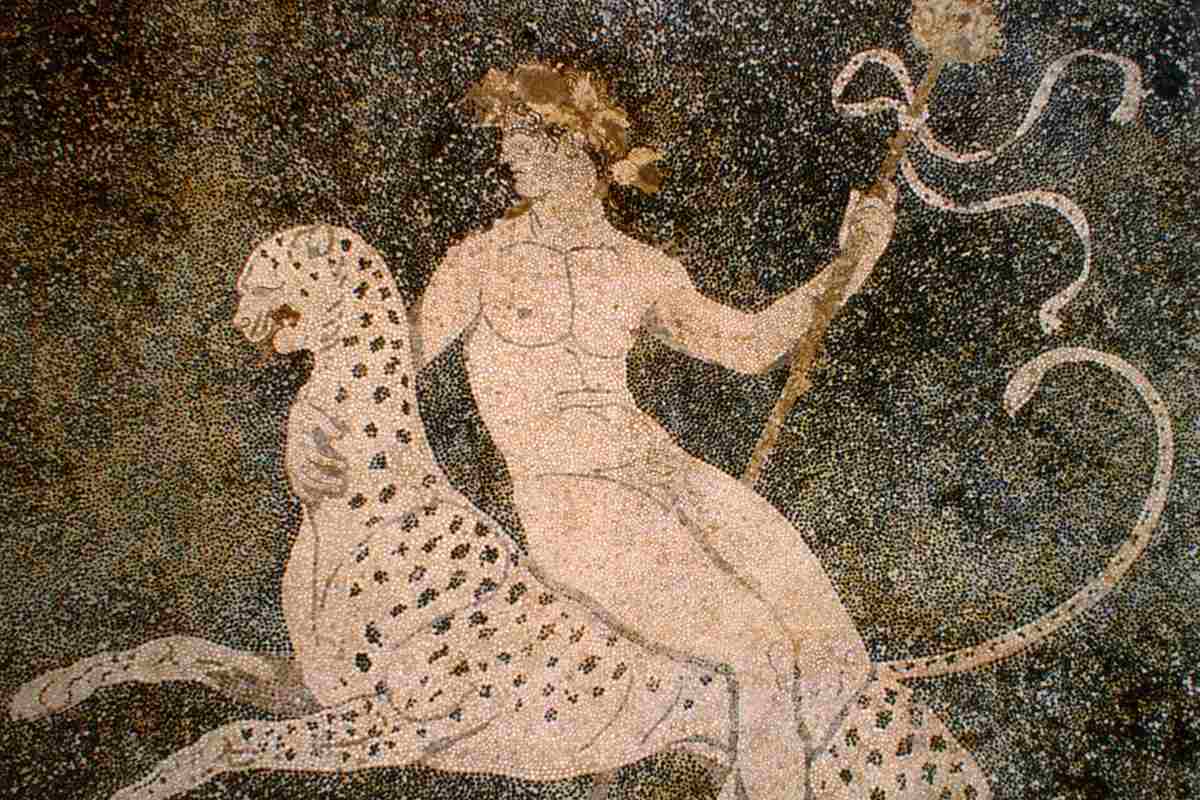
One travel blog about a Vergina and Pella day trip from Thessaloniki copies the museum’s wall texts. They describe a lion hunt floor, with a hunter on each side of the lion, set in a mountain landscape. Another text describes the Dionysus floor from the largest house in Pella, where the god sits on a panther.
What does the Archaeological Museum of Pella hold?
The Archaeological Museum of Pella holds five groups: daily life, public life, sanctuary mosaics, graves and a palace gallery. One operator lists Pella’s site and museum on its own Vergina and Pella day trip from Thessaloniki.
Wikipedia says the museum rises where the ancient city once stood, close to the palace ruins. Kostas Skroumpellos was the architect, and the building was finished in the year two thousand nine. Its rectangular atrium refers to the central courtyard of the ancient houses in Pella.
Any Vergina and Pella day trip from Thessaloniki that enters the museum meets an information section. It holds a short video about Pella, a model of the site, maps, drawings, photographs and texts. At the entrance stand a head taken to portray Alexander and a statuette showing Pan, the god.
Daily life is the subject of the first group. The same operator lists mosaics and relics of daily life on its own Vergina and Pella day trip from Thessaloniki. Floor mosaics from the Houses of Dionysus are key exhibits. The Abduction of Helen mosaic comes from the House of the Wall Plasters.
Restored furniture, models and cloths show how people lived. The second group covers public life. Its finds come from the Agora and relate to the city’s administration: coins, inscriptions and sculpture. The third group shows mosaics from the Thesmophorion and the shrines of Aphrodite, Darron and the Mother of Gods.
The fourth group comes from the cemeteries. Its graves run from the Bronze Age into the Hellenistic period. They tell about the Doric Greek language of the residents and about funeral customs. The exhibition ends with the palace gallery, which tells of the life and personality of Alexander the Great.
One visitor’s own Vergina and Pella day trip from Thessaloniki included a bronze Poseidon in the museum. The same account lists statuettes of household protector gods.
Who was born and taught at Pella?
Philip II was born at Pella in 382 B.C., and his son Alexander the Great in 356 B.C. Aristotle taught Alexander at Mieza, a royal estate near the city. Any Vergina and Pella day trip from Thessaloniki takes in the city where both kings were born.
Wikipedia gives Pella as the birthplace of Philip II. Each Vergina and Pella day trip from Thessaloniki reaches ruins 1 km outside modern Pella. The article adds that Philip made walled Pella a city of great international importance.
His son Alexander was born there in 356 B.C. His mother was Olympias, daughter of King Neoptolemus I of Epirus. When Alexander was thirteen, Philip invited Aristotle as his tutor. Wikipedia dates the invitation to 343 or 342 B.C. That invitation brought Aristotle to the capital that any Vergina and Pella day trip from Thessaloniki now reaches.
Aristotle taught Alexander at the private school of Mieza, in the gardens of the Nymphs, a royal estate near Pella. Philip provided the Temple of the Nymphs at Mieza as the classroom. Wikipedia places the ancient town of Mieza at modern Lefkadia, near Naousa.
Mieza was like a boarding school for Alexander and the sons of Macedonian nobles. Wikipedia names Ptolemy, Hephaestion and Cassander among them. Aristotle taught medicine, philosophy, morals, religion, logic and art. The lessons ended when Alexander was sixteen.
Pella also hosted artists. King Archelaus, who made Pella his capital, invited the painter Zeuxis to adorn his palace. Wikipedia says he also hosted the poet Timotheus of Miletus and the playwright Euripides, who finished his days there. Another article calls that the traditional story and notes a doubt among modern scholars.
Two more names tie to Pella. The poet Aratus died there around 240 B.C. Cicero stayed in the city in 58 B.C., although the provincial seat had already moved to Thessalonica. Both knew the city that every Vergina and Pella day trip from Thessaloniki reaches today.
What else do travellers ask about a Vergina and Pella day trip from Thessaloniki?
Which city is Veria?
The Vergina and Pella day trip from Thessaloniki reaches Vergina in the Veria area. Wikipedia places the site 12 km south-east of the Veria city centre. It calls Veria the capital of Imathia and a commercial centre of Central Macedonia.
Veria is an old city. Wikipedia says Thucydides first mentioned it in the fifth century B.C. It calls Veria an important possession of Philip II of Macedon. The Apostle Paul preached there. The Anastasis Church holds frescoes from the fourteenth century. Its museums include an archaeological museum and a Byzantine museum.
What are the Vermio Mountains west of Veria?
The Vermio Mountains form a range in northern Greece, says Wikipedia. They lie between the regional units of Imathia and Kozani, and Veria sits at their base. In Hellenistic times the range marked a boundary inside the Macedonian state.
Aigai and Pella, which anchor the Vergina and Pella day trip from Thessaloniki, were both capitals of Macedon. Wikipedia gives the highest peak, Chamitis, as 2,065 metres, west of Naousa. Seli and Tria Pente Pigadia are among the ski resorts on the range.
What is the Haliacmon river?
The Haliacmon is the longest river of Greece, at 297 km. Wikipedia says it flows entirely on Greek soil and enters the central Macedonian plains south-east of Veria. Its name joins the Ancient Greek words for salt or sea and for anvil. Wikipedia also says the Haliacmon-Axios delta produces about ninety percent of Greece’s mussels.
One old link to the Vergina and Pella day trip from Thessaloniki runs through Pella. In the time of Herodotus, says Wikipedia, the Loudias apparently joined the Haliacmon. The Loudias was the outflow of the lake of Pella. Its course has since changed, and it now flows straight into the Aegean Sea.
Where is Naousa in relation to the Vergina and Pella day trip from Thessaloniki?
Naousa is a city in Imathia on the eastern foothills of the Vermio range. Wikipedia places it 22 km north of Veria and 90 km west of Thessaloniki.
The Naousa area is known for red wine from the xinomavro grape. Wikipedia says this variety earned a European PDO label, meaning protected designation of origin. The city also stages a carnival. A waterfall on the Arapitsa river lies inside the city, and a 25 m high Clock Tower is its hallmark.
Which items do travellers pack for this Vergina and Pella day trip from Thessaloniki?
Comfortable shoes head one operator’s list for its Vergina and Pella day trip from Thessaloniki. The list names sunglasses, sunscreen and a hat for summer. A third item stresses punctuality at all meeting times.
Weather is the other half of packing. Wikipedia describes Veria, the city near Vergina, as having hot, dry summers from April to October. It calls the winter, which runs from mid-October to March, wet and cool, with temperatures above or well above freezing.