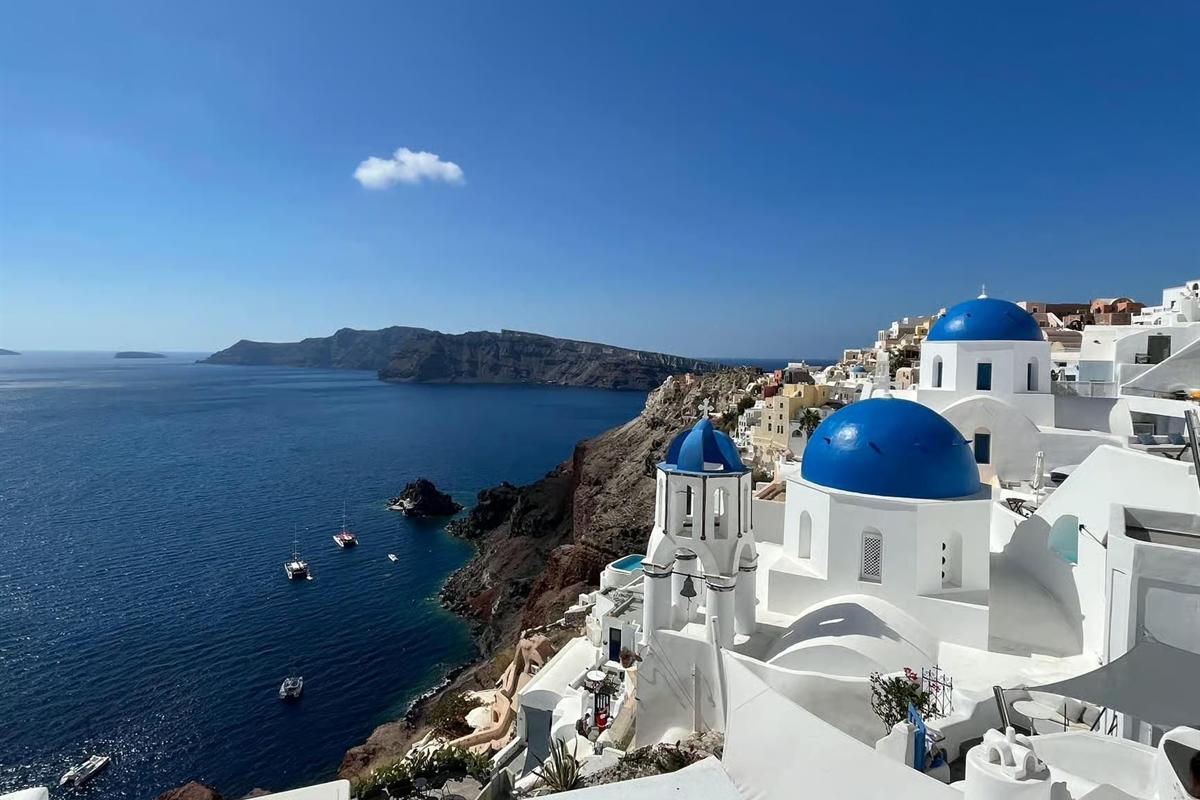
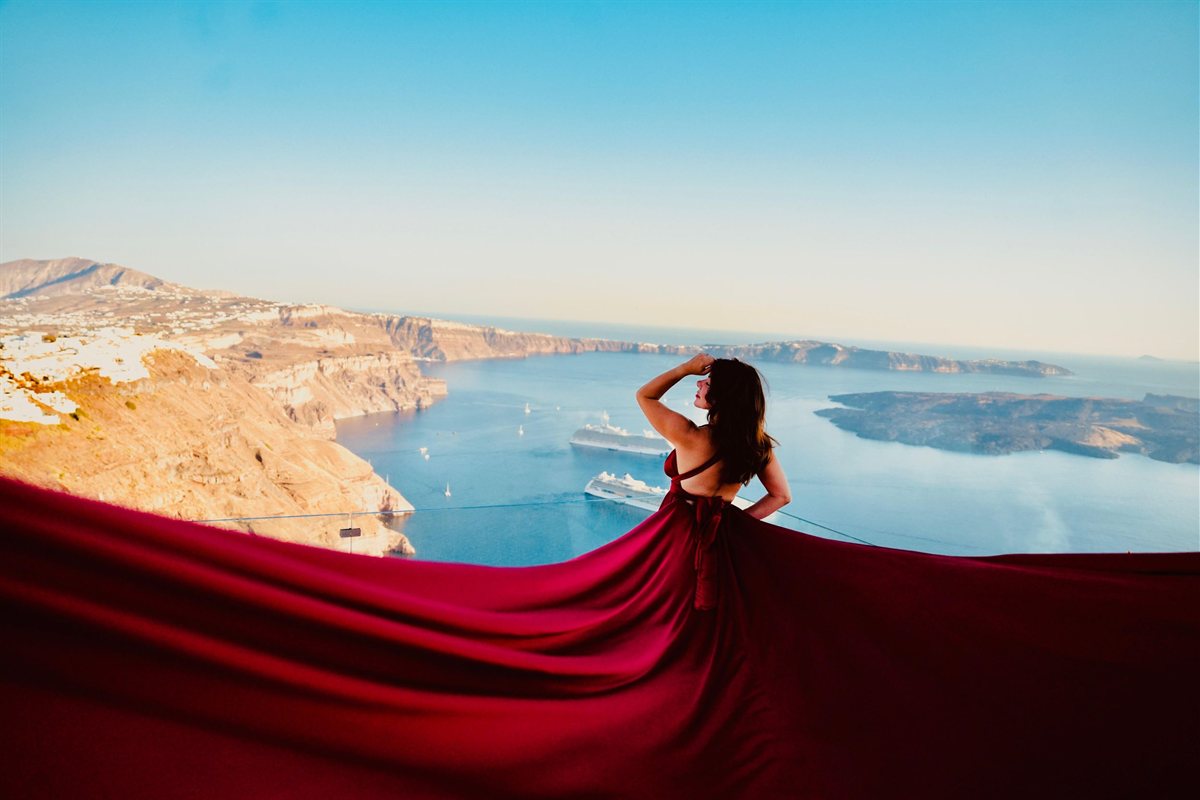
A Santorini flying dress photoshoot sends a long dress billowing into the wind above the caldera while a photographer catches every shape of the fabric. Trips to other regions are listed under tours in Greece.
This page covers what a session includes and how long it runs, how the dress is thrown, the dress choices, the photographer’s guidance, poses, hair, hands and chin, how the photos reach you, Santorini and its caldera, Oia, Finikia, Imerovigli and Skaros Rock, Firostefani and Fira, Pyrgos Kallistis, Megalochori and Emporio, Profitis Ilias, the windmills and chapels, the Akrotiri lighthouse, the Red Beach, Kamari and Perissa, Cycladic architecture, the wind, the light and the questions travellers ask.
What does a Santorini flying dress photoshoot include?
A Santorini flying dress photoshoot gives you a catalog dress, retouched photos and creative guidance on the day. One photographer sells packages that hold from 3 up to 25 retouched photos.
One photographer lists six packages for Santorini. The smallest holds one flying dress from the catalog in any style. It also holds 3 high-end retouched photos and creative guidance from the Santorini photographer. The next package keeps the same dress and guidance, and it doubles the photos to 6.
The third package changes the picture. A Santorini flying dress photoshoot at this level adds hairstyling and full make-up. It lists 10 retouched photos. It also lists a slow-motion clip, edited short, made for Instagram as a reel. A personal assistant is listed too, and this helper makes the dress fly.
The largest package carries two flying dresses from the catalog and 25 retouched photos. It keeps the hair, make-up and assistant, and its Instagram reel is an edited video with music. It also lists transport to and from the shooting location in a luxury minivan.
Only the largest package states a ride. The other five do not list one. Check this point with the photographer before you book. It decides how you reach the first location.
A third site says its services cover photography, filming, cosmetics and wardrobe. It adds that its experts help you choose the location. A Santorini flying dress photoshoot, in this view, is a full plan and not only a camera and a dress.
Another photographer says its team talks with clients in five languages: Russian, Ukrainian, Greek, German and English. The listing says this covers the whole process, from booking to the final delivery of the photos.
How long does a Santorini flying dress photoshoot take?
In one list, a Santorini flying dress photoshoot lasts 30 minutes for each girl in the group package. The 1-hour package leaves the dress out. The other packages state no length.
The group package counts time for each person. Every girl in a dress gets a 30-minute shoot. She also gets one flying dress from the catalog in any style and 3 high-end retouched photos. The listing gives no single time for the whole group.
The 1-hour package is the longest shoot on that list. The listing marks the dress as not included, and it gives no count of retouched photos. The package still holds creative guidance from the Santorini photographer, so the hour is a full session with direction.
The packages with 3, 6, 10 and 25 retouched photos name no shoot length. Their listings count the result in photos and in extras such as make-up, the assistant and the reel. The time of a Santorini flying dress photoshoot in those packages is a question for the photographer. Ask for the answer in writing.
Another photographer’s page says slots are limited each day. At a set time, your team and dress wait for the Santorini flying dress photoshoot to begin. The date matters as much as the length, so fix the day early.
The first photographer runs the same style of shoot in Santorini, Dubai, Athens and Mykonos. Its package lists repeat for each place, so read the Santorini list when you compare lengths. Ask how long the team stays at each location.
How does a Santorini flying dress photoshoot work?
A Santorini flying dress photoshoot works as a timed toss. A long dress is thrown into the air, and the camera fires at the same moment. One photographer’s packages add a personal assistant who helps make the dress fly, so you can think about your pose.
A Santorini flying dress photoshoot is team work. You wear the dress, an assistant helps it fly, and the photographer watches for the right moment. One photographer calls the result a delicate toss, wind in your hair, and a split second of timing.
Photography has a simple rule for this kind of picture: a very short shutter speed freezes a fast-moving subject. A thrown dress is fast-moving fabric, so the camera needs that split second to hold its shape. Each Santorini flying dress photoshoot is built around those frozen moments.
You can join in, too. One photographer advises you to play with the outfit. Twirl it, toss it up with one hand, or let the Santorini wind catch the skirt. Then the wind does part of the work. The same photographer adds that the dress carries much of the effort for you.
Changing clothes needs a plan. According to one operator, its fitting room on the island gives you privacy for switching dresses where tourists gather. A second operator writes that each flying dress has its own character and movement, shaped by light, wind and place. That makes a Santorini flying dress photoshoot feel different with each dress you pick.
What flying dresses can you choose for a Santorini photoshoot?
One operator keeps over 130 dresses for a Santorini flying dress photoshoot, from classic white to bold, vibrant colours. Its named styles: yellow off-shoulder, blue halter top, rose halter top and an iconic red dress.
The names tell you the cut. Wikipedia calls a halterneck a strap running from the front of the garment around the back of the neck. It adds that this design is also used to make a backless dress. An off-the-shoulder neckline, by the same source, sits below the shoulders and collarbone.
One photographer’s packages list one flying dress from the catalogue, in any style. The largest package lists two dresses. A group package gives one dress to each girl, and the one-hour option leaves the dress out. So the dress you get depends on the package you choose for your Santorini flying dress photoshoot.
The same photographer says the ideal dress flatters you and works in harmony with the natural landscape. Use that as your test when you look through the whole catalogue before you book.
Another operator lists over 300 tailored gowns and says the collection is chosen for particular places and ideas. Its listings show one-size dresses, with European sizes 32 to 44 for one style and 32 to 40 for another. It also shows a fuchsia satin dress and a yellow satin dress, both called transformer dresses.
The same page says a satin weave gives a glossy, smooth material. Wikipedia also notes that satin-weave fabrics are more flexible, with better draping, than plain weaves. Fabric matters when a dress has to rise and fall in the air. Ask the photographer which dress suits your Santorini flying dress photoshoot and the weather of the day.
What does the photographer do during a Santorini flying dress photoshoot?
The photographer gives creative guidance during a Santorini flying dress photoshoot. One photographer lists it in every Santorini package. That photographer’s blog says the advice covers the dress toss, the poses and the angles.
Another operator sums up the job in three parts. Its photographers direct the stances, choose the views and catch the moments in any light. For you, that means no guessing where to stand or which way to face. The same operator adds that its experts help pick the sites and shape the full visual plan.
One photographer’s packages with hair and make-up also list a personal assistant to help make the dress fly. The assistant works with the dress. The creative guidance appears as its own line on the same list. A Santorini flying dress photoshoot therefore has two roles, one for the dress and one for the picture.
Guidance only helps if you understand it. Another photographer’s team states that it communicates in English, German, Greek, Ukrainian and Russian, from booking to final delivery. Check which language your Santorini flying dress photoshoot runs in before you choose a date or confirm the booking.
The blog calls this a very specific kind of photoshoot, so the photographer’s insider tips matter even more. They cover how to toss the dress and which poses and angles flatter you.
Arrive with a vision for the day if you like. The photographer has done the job for a long time and knows the tricks of the trade. Listening is a smart way to get good photographs from your Santorini flying dress photoshoot.
Which poses work well for a flying dress?
Simple poses suit your Santorini flying dress photoshoot. One photographer advises skipping poses you have not rehearsed. Play up the dress, which does much of the work.
Models in magazines make hard poses look easy, but they have had years of practice. The same photographer advises against comparing yourself with them. Listen to your body, know your limits and stay comfortable while the camera runs.
Unless you have rehearsed a pose in a mirror at home, leave it out. Keep it simple, and the picture will look good. A Santorini flying dress photoshoot rewards easy moves.
The blog names three easy moves that put the dress to work for you:
- Twirl in the dress.
- Toss the dress lightly into the air with one hand.
- Leave the breeze to lift the skirt on its own.
That photographer also suggests looking at fashion magazines and models to see how they treat clothes as a playful prop. The idea is to work in harmony with the dress, not against it. Once you play up what the dress does well, it carries much of the picture.
Your mood counts as part of the pose. That photographer says you are there to feel good and have a great time. Your Santorini flying dress photoshoot offers a chance to try something new and feel like a model for the day.
Stop comparing yourself with other flying dress images you have seen. Confidence and being yourself, the photographer says, leave nothing in the way of strong images. The photographer calls a Santorini flying dress photoshoot a uniquely fun mix of fashion and scenery.
How do you place your hair, hands and chin in a flying dress?
Keep your chin tilted slightly up, give your hands a job, and tie your hair back before the wind arrives. One photographer advises these three habits for a Santorini flying dress photoshoot. Your face, arms and hair sit right beside the dress.
Start with the chin and neck of your pose in a Santorini flying dress photoshoot. One photographer advises keeping your head facing up. Models are busy shaping their bodies, so it is easy to forget everything above the shoulders. Poses that look down can create the illusion of a short neck, and that advice avoids them.
To lengthen the neck, push it slightly forward and tilt the chin upward. The same photographer adds a warning: do not overdo it, because a stretched pose turns unnatural. A small lift is enough. Awareness of the area above your shoulders brings the whole look together.
Now the arms and hands. Even experienced models feel unsure about their hands, so you are not alone. Lifeless arms at your sides take the shape out of a photograph.
The advice is to pop an elbow and rest one hand on your hip. Hands can also lie on the waist or the leg, or touch your hair or neck. Keep your fingers and wrist relaxed, so they look elegant. Hands are the second tip of your Santorini flying dress photoshoot.
Hair is the third job. Hair meets the open air in a Santorini flying dress photoshoot, and wind changes it fast. On a windy day, hair can tousle and tangle, and then it distracts from the picture. An up-do keeps it easy to manage. If you prefer to wear it down, bring a clip or hairspray to hold it back.
One photographer’s package also lists hairstyling and full make-up among its contents.
All three habits come from one idea: keep things natural. A relaxed neck, a hand on the hip and tidy hair let the dress do the moving. A Santorini flying dress photoshoot rewards a simple look, so let the wind add the drama.
What happens after the shoot, and how do you get your photos?
After a Santorini flying dress photoshoot, the photographer delivers your pictures twice. First come all the images without editing, then the edited photos. In one photographer’s package, the full set arrives in 14 days and the edited photos in 25 days.
The wait is not the same for every Santorini flying dress photoshoot package. The same photographer lists a faster option. In it, all images arrive in 7 days and the edited photos in 15 days. Delivery time is written into each package, so read that line before you choose.
The first set is a full gallery of the shoot with no editing. The listing names screen resolution for the standard packages, and two packages name web resolution instead. The second set holds the photos that the listing calls high-end retouched photos.
Photos can be lost, and the listing deals with that. Packages with a one-year photo backup name it as cover in case of loss. Not every package carries this line, so look for it in the list of contents.
Once the shoot ends, you no longer have to pose or plan. The work moves to the photographer, and all that remains is waiting for the two deliveries. Check the delivery days again before booking your Santorini flying dress photoshoot.
Where is Santorini, and why do photographers like it?
In the Aegean Sea, Santorini sits at the far south of the Cyclades. Mainland Greece lies roughly 200 km to its northwest. A Santorini flying dress photoshoot there has tall cliffs, white villages and open sea around the frame.
Seen on a map, the island belongs to a ring of land around a flooded volcanic basin. Santorini itself is the biggest piece. Therasia and Aspronisi complete the outer edge of the ring, and the Kameni islands rise inside it. The main island measures about 73 square kilometres, and Therasia adds 9.3.
The island carries two names. Thira, or Thera, is the official one. Santorini is the everyday name, and it comes from Saint Irene, honoured by an old church at Perissa village. Ancient writers also called the island Kallisti, a Greek name that praises its looks.
Whichever name a photographer uses, a Santorini flying dress photoshoot happens in the same place. Crete sits about 120 km to the south, so the island stands well out in open water. Sea shows up on every side of the picture, whichever village you pick.
Reference sources give plain reasons why cameras follow visitors here. Whitewashed villages hang on the high caldera walls, and the sky is sunny. Summers are dry, and yearly rain adds up to only 270 mm.
One reference adds that couples from Asia travel to Santorini for pre-wedding photos with the landscape behind them. They want the same backdrop as a Santorini flying dress photoshoot.
What is the Santorini caldera as a photo backdrop?
A caldera is a basin left by a collapsed volcano, and the Santorini caldera is mostly under water. Its basin is roughly 12 km by 7 km, and 300 m cliffs wall it in on three sides. For a Santorini flying dress photoshoot, cliff and sea are the backdrop.
Picture the caldera as a bowl of sea water, 385 m deep at the lowest point. Close to its middle sit two small islets of volcanic rock, called Nea Kameni and Palea Kameni. Dark lava rock forms both of them. The land area of Nea Kameni is 3.4 square kilometres, and nobody lives there.
This bowl is the shape behind every Santorini flying dress photoshoot that looks out over the water. On the inside, the coast falls away in a sheer drop of over 300 m at the tallest spot. Layers of hardened lava lie stacked in the rock face.
The towns line the rim of that drop. In a Santorini flying dress photoshoot picture, the villages seem to hang above the sea. Behind the towns, the land tilts down and outward toward the far shore.
On the outside, the beaches are smooth and shallow. Their sand or pebbles are made of solidified lava. A Santorini flying dress photoshoot can therefore use two kinds of scene. One is a steep inner edge crowned with villages. The other is a gentle beach on the outer side.
One reference says whitewashed villages along the high walls make the caldera a highlight of Aegean tourism. The International Union of Geological Sciences also lists it among 100 geological heritage sites worldwide. So the caldera is a recognised landmark. It is more than a pleasant view for a Santorini flying dress photoshoot.
Why is Oia a photo location?
Oia is a photo location because white walls and blue domes line the caldera edge and face the sunset. A Santorini flying dress photoshoot here sets the moving fabric against cliffs, rooftops and open sea.
Oia crowns the north western end of Santorini, part of the Cyclades. Close to two kilometres of the village follow the top edge of the northern caldera wall. Its rooftops stand between 70 and 100 metres high. Houses and restaurants fill niches cut into the slope, and narrow passages join them to a central square.
White churches with blue domes stand between the Cycladic houses and the cave houses carved into the rock. One photographer’s page names Oia as a place where its team works. Together, these give a Santorini flying dress photoshoot walls, passages and a caldera view within a short walk.
Sunset watching is a daily event here. As the evening sun sinks, the village fills with people watching from the Sunset Serenade point. In those last seconds, the setting sun paints the white houses and the caldera in every colour. A reference page adds that the village gets longer sunlight hours than Fira.
Narrow paths congest quickly in the tourist season, the same page states. One photographer states that no area of the island can be closed for a shoot, so onlookers can stand nearby. This holds above all in a crowded place. Plan your Santorini flying dress photoshoot in Oia with that crowd in mind.
Two landmarks help a Santorini flying dress photoshoot here. An old windmill appears on postcards, and a travel wiki says no other structure on the island is photographed more. Fort Londsa, a ruined castle, crowns the upper village, and its lookout reaches a full circle of horizon.
What is Finikia, the quiet village near Oia?
Finikia is a small village directly east of Oia, on the north end of Santorini. One photographer lists it, spelled Finika, as a western caldera sunset place within its Santorini flying dress photoshoot locations.
A reference page places Phinikia, also written Finikia, immediately to the east of Oia. The photographer’s page calls Finika just outside Oia. It names Imerovigli beside it as another sunset spot. Both lie on the western caldera coast, the stretch that page recommends for a Santorini flying dress photoshoot at sunset.
The sources do not call Finikia empty, so a Santorini flying dress photoshoot there carries no promise of silence. The same photographer notes that quieter pictures come from stepping out of the popular coastal villages. A travel wiki calls Oia overrun by tourists for its sunsets, which is why a village next door draws interest.
Finikia is also a walking base. A travel wiki says a hiking trail leads from the village to two volcanic cones, Mavro Vouno and Kokkino Vouno. It also lists a route of 5 kilometres from Finikia to Cape Koloumpos. The route passes through the village, then vineyards, caves and a Minoan cistern.
The wiki adds that windmills stand east of Finikia, and that two stand in Oia itself. One photographer allows more than one location in a Santorini flying dress photoshoot. It warns that transfers on the island are slow, so certain pairs of places do not fit one shoot.
What are Imerovigli and Skaros Rock for photographs?
Imerovigli sits on the edge of the Santorini caldera, north of Fira, and Skaros Rock juts out beside it. A Santorini flying dress photoshoot in this area puts the caldera edge and old ruins behind the dress.
Narrow paved paths cross Imerovigli, and the houses stand right on the caldera rim. A travel wiki describes the place as a coastal town looking over the caldera. One photographer’s location page lists Imerovigli for sunset, along with the western caldera coast. That makes Imerovigli a place to plan a Santorini flying dress photoshoot around the evening sun.
Every church in the village follows Cycladic building style. A Santorini flying dress photoshoot here meets that look at each turn. Ai-Stratis is in the village centre. Between Imerovigli and Fira, the footpath passes the Monastery of Saint Nikolaos. Only 469 people live in Imerovigli all year.
Skaros Rock is a big promontory of rock. The caldera next door gave it shape through volcanic activity, then erosion and earthquakes carved it further. A travel wiki describes a rock that rises high over the water with the ruins of a fort. That makes it a rugged backdrop for a Santorini flying dress photoshoot.
Builders first fortified the rock in the early thirteenth century, and that fortress was called La Roka. When Venice ruled Santorini in the fourteenth century, the settlement had over 200 homes. An eruption in the seventeenth century shook the town, and part of it fell into the sea. By the early nineteenth century, only weathered ruins stood there.
Now walkers and photographers visit the ruins, and the access runs through Imerovigli. Below the cliffs, the Chapel of Panagia Theoskepasti is still in use. The old stones, the cliff and the open caldera make a rough, wide setting for a Santorini flying dress photoshoot.
What are Firostefani and Fira for photographs?
Fira, the capital of Santorini today, has whitewashed houses along the caldera edge. Firostefani is the calmer village next to it on the north side. Fira gives a Santorini flying dress photoshoot a wide view of the caldera.
The caldera cliff at Fira is 400 metres high. A Santorini flying dress photoshoot here has a tall wall of rock below it. Looking out, you take in the full 18 kilometres of the caldera, between Cape Akrotiri and Cape Agios Nikolaos. Nea Kameni lies in the middle of the water, and Thirassia is next to it.
Cruise ships drop anchor in the small harbour that lies between Fira and Nea Kameni. Visitors coming up from the port take the zigzag footpath, a donkey or the steep cable car. The bus and taxi station is on the central square, Plateia Theotokopoulou.
Among the churches of Fira are the Three Bells and the Cathedral of Ypapanti. According to a travel wiki, the Three Bells counts among the island’s top photographed places. A Santorini flying dress photoshoot in town can use a church like this as a landmark.
North of Fira, the town blends into Firostefani. The same travel wiki finds a little more charm there than in the commercial town centre. A photo on that wiki shows the blue dome of a church for Saint Spyridon in the village. Buses to Oia call at Firostefani and Imerovigli on the way.
A marked trail runs along the caldera rim from Fira up to Oia, and the walk takes about 2.5 hours. The travel wiki warns that the path comes close to unprotected cliffs with sharp drops into the caldera. Remember the drop when you choose a rim spot. Stay well back from the edge during a Santorini flying dress photoshoot.
What is Pyrgos Kallistis as a photo location?
Pyrgos Kallistis is a hill village on Santorini, around 7 km from the capital Fira, laid out like an amphitheatre. A Santorini flying dress photoshoot finds old stone lanes and castle ruins there.
In Greek the name means “Beauty Tower”, and people shorten it to Pyrgos. Thira is the municipality that holds the village. A census counted 1,078 residents, so the place is small.
Rings of houses climb the slope. Castle ruins crown the summit. Venetians built it, and the locals call it Kasteli. For a long period the island was governed from here. A travel wiki says Pyrgos Castle is the island’s newest castle and the one in the soundest condition.
The hill opens views in nearly every direction, so the background changes whenever the photographer turns. A Santorini flying dress photoshoot can use that freedom.
An encyclopedia sums up Pyrgos as a textbook case of medieval building: tight, twisting streets, fortified walls and concealed passages. It adds that tourism has spoiled this village less than other places on the island. In a Santorini flying dress photoshoot picture, the lanes press the dress between walls. The summit frees it against the sky.
Five fortified settlements stood on Santorini, each called a kastelli. The same encyclopedia describes them as large, permanent settlements with a church of Saint Theodosia at the entrance.
Pyrgos was one of them, together with Agios Nikolaos at Oia, Akrotiri, Emborio and Skaros. The ruined fortress above Oia was a link in the Venetian defences that also held Pyrgos. A church dedicated to the Presentation of the Theotokos stands among the houses. Such old walls give a Santorini flying dress photoshoot a setting with real age.
What are Megalochori and Emporio for photographs?
Megalochori is a village of old white Cycladic churches and wineries. Emporio is Thira’s second largest town, and a Venetian castle stands on its hill. Both give a Santorini flying dress photoshoot a village setting.
Twelve local subdivisions share the municipality of Thera with Fira. Megalochori is one, and Pyrgos Kallistis and Emporio are two others. A travel wiki also lists a rock formation near Megalochori, the Heart of Santorini, as a popular stop for photographers. The white churches are what a Santorini flying dress photoshoot can frame inside the village itself.
Emporio sits 12 km from Fira. Its community takes in Perissa and two further villages, and counts 3,704 permanent residents. Inside the town you find the old Goulas Castle and churches, among them Saint Nicholas Marmaritis.
A Goulas is a rectangular tower of multiple storeys. Four of them stood on the island. Each rose above the rest of its kastelli and served as an observatory and a refuge. A tall stone tower like this gives a Santorini flying dress photoshoot a strong vertical line beside the moving fabric.
A travel wiki describes narrow cobblestone streets in a castle quarter from the fifteenth century. It also records far fewer souvenir shops here than in Fira or Oia. In a photograph, that keeps the frame calm: stone, whitewash and the dress, with little clutter behind it. This is the quiet side of a Santorini flying dress photoshoot.
The same wiki mentions a tiny square temple near Emporio, dedicated to Agios Nikolaos Marmaritis. It measures only 4 m along each side, and services still take place inside. Beside a building so small, the full length of a long skirt reads clearly.
How does Profitis Ilias work as a photo backdrop?
The summit of Santorini is Profitis Ilias. One photographer’s FAQ calls it a sunset place with crowds that are not overwhelming. Ask about it for your Santorini flying dress photoshoot.
A travel wiki puts the Profitis Ilias monastery on the island’s top hill, close to Pyrgos. The monastery is rarely open to guests, so do not count on a Santorini flying dress photoshoot inside it. The view from the top still makes the climb worth it, the wiki says. The hiking trail from Fira to Kamari passes the hill.
The same FAQ answers where to stand at sunset. It points to the western caldera coast and lists Imerovigli and the village of Finikia first. Further down that coast comes Profitis Ilias. At sunset, a Santorini flying dress photoshoot therefore has a third option beyond the two busy villages.
Crowds shape any Santorini flying dress photoshoot. A photographer cannot block off a spot, so other visitors can be nearby. Onlookers can therefore stand nearby, above all in a busy area. It also says the session has a set time slot and moving around Santorini takes a while. Two places far apart do not always pair well.
Rock tells a story here too. An encyclopedia says Santorini sits on a small non-volcanic base of metamorphosed limestone and schist. That base shows at Mikros Profititis Ilias, Mesa Vouno, the Gavrillos ridge, Pyrgos and Monolithos. Late in Ottoman times, it adds, the monastery ranked among the leading monastic centres of the Cyclades.
What are the windmills and chapels of Santorini?
Windmills and domed churches are two Cycladic landmarks that work as photo backdrops. On Santorini, says a travel wiki, no structure is photographed more than the windmill of Oia. Cycladic detail comes from mills and chapels in a Santorini flying dress photoshoot.
A windmill turns the push of the wind on its sails into milling power for grain. The travel wiki calls the windmills as iconic as the white walls and blue roofs. It counts two in Oia, with others east of Finikia and in the south near Emporio. A Santorini flying dress photoshoot has more than one mill to choose from.
An encyclopedia says an old windmill is a building people recognise at once in Oia. It appears on postcards. The same page adds that the village paths are narrow and get congested during the tourist season. Such a landmark makes a Santorini flying dress photoshoot a shared space, because onlookers can stand close by.
Oia offers a Santorini flying dress photoshoot white-washed, blue-domed churches among Cycladic houses and cave houses. The encyclopedia lists restored churches there, among them the Panagia church. It says a number of them were built in memory of sailors. The travel wiki notes that only a handful of churches in Oia really have blue roofs.
Imerovigli has churches too, built in the Cycladic manner. Ai-Stratis is the church at the heart of the village. Meanwhile the Monastery of Saint Nikolaos stands along the way to Fira. The wiki says Santorini holds a nearly endless number of churches, along with monasteries. A small white chapel gives a clean, simple frame.
The encyclopedia lists the Chapel of Panagia Theoskepasti, a monastery under Skaros Rock that people still use.
What is the Akrotiri lighthouse as a photo location?
The Akrotiri lighthouse marks the far western point of Santorini, beyond Akrotiri village. A Santorini flying dress photoshoot here has a working lighthouse, open ground and the island edge behind the dress.
A French company built the lighthouse in the late nineteenth century. Within the country, it counts as an old light. The war years switched it off. The Greek Navy relit it in the nineteen forties.
A travel wiki says the Greek Navy still runs the light today. It also calls the cape a popular place to watch the sunset and far less crowded with tourists. A quieter point suits a Santorini flying dress photoshoot. The frame stays cleaner, with fewer strangers behind the dress.
The lighthouse sits close to Akrotiri village. The village stands 15 kilometres south of Fira, built up a hillside that looks over the caldera cliffs. At the top of that hill, a Venetian castle named Goulas left its remains.
Houses in the village gather around the Castle of Akrotiri. This fortress from the thirteenth century now lies in ruins. This corner of the island gives two kinds of backdrop. One is the lighthouse on the cape. The other is the old stones in the village.
The caldera cliffs seen from that hill are sheer. At the highest point, the inner coast drops more than 300 metres. A photographer on the hill gets the long view of that wall. A Santorini flying dress photoshoot in the village can use it as a distant frame.
The same area holds the Minoan site of Akrotiri, about 2 kilometres southeast of the village. It dates to the Bronze Age and ranks high among Aegean sites. Here it is only a landmark near the spot for a Santorini flying dress photoshoot.
What is the Red Beach?
Red Beach lies on Santorini, south of Akrotiri village. Its volcanic sand takes the red colour from oxidised iron. A Santorini flying dress photoshoot here sets a moving dress against red cliffs and red sand.
The sand is a mix of black and red rock, ground fine, from the nearby caldera. A travel wiki adds that the name also comes from iron-rich rock in the cliff face. That cliff towers above the water. For a photographer, it is a tall wall of strong colour behind the dress.
You reach Red Beach from Akrotiri. The same travel wiki describes the beach as quite crowded. It also says distant yachts are visible from the sand, and that the view looks romantic at sunset. Plan the frame around other visitors, because a Santorini flying dress photoshoot cannot close a beach.
Take care with the cliffs here. Red Beach is prone to landslides. For more than ten years, slides have kept visitors out of parts of the beach.
A travel wiki advises visitors not to linger under cliffs on Santorini, as they are prone to rockslides. So the working space is the open part of the sand, away from the foot of the cliff. Check which parts are open before you choose a spot for a Santorini flying dress photoshoot.
Each beach takes its sand colour from the rock layer that lies open there. The island’s outer beaches are smooth and shallow, and Red Beach is a lava beach. Its red tone gives a Santorini flying dress photoshoot a different palette from the villages along the caldera edge.
What are Kamari and Perissa, the black sand beaches?
Kamari and Perissa are two beach villages on the south-east side of Santorini, joined by one long dark shore. A Santorini flying dress photoshoot here has dark sand, open water and a mountain behind the dress.
Fira, the island’s capital, is 8 km away from Kamari. Its first people came from Episkopi Gonias, a nearby village almost flattened by an earthquake in the nineteen fifties. Kamari takes its name from the little arch beside the sea, the last part of an old customs house.
No other beach on Santorini is longer. One encyclopedia entry describes black pebbles; a travel wiki calls it a black sand beach. Both agree on the dark colour. The result is a long, open shore for a Santorini flying dress photoshoot.
From Monolithos, the beach reaches the foot of Mesa Vouno. This mountain rises about 400 metres and is the second highest peak on the island. The shore therefore ends against a mountain wall.
Perissa is a village 13 km south-east of Fira, close to the Messa Vouno rock. The travel wiki says the dark beach of Kamari carries on south into Perissa. A Santorini flying dress photoshoot can follow the dark strip from one village to the other.
The same wiki describes the Perissa and Perivolos beach as one continuous strip, 3 km long, ending at Agios Georgios. Along the way, colour and grain size vary. A Santorini flying dress photoshoot therefore meets slightly different ground in each spot.
Perissa also has old layers. Ruins of a church to Saint Irene, built in early Christian times, stand here. The island’s present name grew out of that saint’s name. The ruins of Ancient Thera sit on Gavrilos Hill, between the two beaches. A Santorini flying dress photoshoot can set old stones next to the dark sand.
What does Cycladic architecture look like in photographs?
Santorini follows the Cycladic style: low, cubical houses made of local stone and covered in whitewash or limewash. This plain shape gives a Santorini flying dress photoshoot a flat wall behind the moving fabric.
The island entry says the old building style matches the other Cyclades. Builders coloured the limewash with volcanic ashes. Newer house fronts lean towards those ash colours rather than plain white. So not every wall in a photograph is white.
The island has its own type of cave house, called hypóskapha. Builders cut extra rooms sideways or downwards, straight into the pumice behind a house. Air trapped in the pumice insulates them against heat and cold. A Santorini flying dress photoshoot near such rooms shows how people built here.
The entry on Oia describes cliff houses set into niches carved in the caldera slope. Whitewashed houses in Fira line a caldera cliff 400 metres high. Both towns therefore put white walls right beside a steep drop.
Domes are the second mark of the style. The Oia entry notes white and blue domed houses. Their walls get a coat of white lime water, which lets rainwater run off and be collected. A round dome beside a long dress gives a Santorini flying dress photoshoot two soft shapes.
The travel wiki says square houses with white painted fronts remain the rule across the island. Blue roofs, it adds, are rarer than people think. A Santorini flying dress photoshoot against a plain white wall is therefore a safe frame.
Why does the wind matter for a flying dress?
Wind is what makes the dress fly. In a Santorini flying dress photoshoot it lifts the long skirt away from the body. One photographer says to let the Santorini wind take the skirt naturally. Another operator names wind next to light and location.
Every dress on offer is built to move. One operator’s listing says its dresses are crafted to flow in the wind. Another operator gives each flying dress its own character and movement. That is where a Santorini flying dress photoshoot begins.
Air is not the only lift. One photographer names three moves for a Santorini flying dress photoshoot: twirling, a light toss, and wind on the skirt. The same tips call the Santorini wind quintessential.
Travellers in the Aegean know the etesian, or meltemi, as a summer north wind. Wikipedia calls it strong and dry. Its dates start in the second half of spring and stop around mid-September. The Santorini caldera is in the southern Aegean, north of Crete.
Afternoons bring the strongest gusts, and nights frequently bring calm. A spell can run for days with no break. No warning comes first, and the sky stays clear while the wind climbs. On the Beaufort scale it can reach 7 or 8.
A Santorini flying dress photoshoot held in the summer months meets the etesians in season. Settled, sunny weather goes with them, and the north flow cools the strong summer heat. Down in the southern Aegean the direction swings to northwest.
Etos is the Greek word for year, and the winds take their name from it. It points to how they rise and fall through the year.


When is the light right for a Santorini flying dress photoshoot?
Low sun gives the right light for a Santorini flying dress photoshoot. Photographers call this the golden hour. It is the stretch just after sunrise or just before sunset. Daylight then looks redder and gentler than the glare of a high sun.
Wikipedia also calls it the magic hour. The golden hour has no set length, and the season and latitude change it. A low sun sends its light through a thicker layer of atmosphere. That softens the direct beam and stretches the shadows.
At midday the sun overhead throws hard highlights and deep shadows. Wikipedia says this harsh light is a particular problem for portraits. Low sun cuts the contrast, so shadows stay lighter and bright areas are less prone to overexposure. A Santorini flying dress photoshoot is portrait work, so the difference counts.
The blue hour is the window just before the golden hour at dawn, or just after it at dusk. The sun is far below the horizon, the leftover light is indirect and mostly blue, and no sharp shadows form.
The island supplies the backdrop. Wikipedia describes high caldera walls draped in whitewashed villages. It says the sunny climate adds to the draw of the caldera for visitors to the Aegean. It also gives the island dry summers.
For sunset, one photographer’s page on a Santorini flying dress photoshoot points to the western caldera coast. It names Finikia, just outside Oia, and Imerovigli. It adds Profitis Ilias, the point on the island that stands highest, where the crowds are not overwhelming.
What else do travellers ask about a Santorini flying dress photoshoot?
Can a Santorini flying dress photoshoot use more than one location?
Yes. One photographer states that a shoot can take place in more than one location. The island has slow transfers, though, and the session runs on a fixed schedule.
So not every pair of locations works in one Santorini flying dress photoshoot. The drive between two spots takes time away from the camera work. Choose places that sit close to each other, and the booked minutes go to photographs instead of the road.
Will other people be around during the shoot?
Yes, onlookers can be there. One photographer says it cannot shut off any part of the island during a session. The place is never yours alone, and the photographer cannot send other visitors away.
The risk is higher in a crowded area. Think of a busy viewpoint at sunset, where every visitor stands at the same railing. Nobody can clear it for your dress. A Santorini flying dress photoshoot in such a spot happens in front of the crowd.
Where are the quieter spots for a Santorini flying dress photoshoot?
One photographer names two kinds of quieter place. The first is a beach in the evening, when the shore is less crowded. The second is a rural area, where the landscape is vast and open.
The same answer adds that less crowded places appear once you step out of the popular coastal villages. These spots suit secluded photographs. A Santorini flying dress photoshoot there has open space around the dress, and fewer people stand in the frame. Ask the photographer which beach or rural area fits your day.
Which dress is supplied, and what do you bring along?
You wear the flying dress, and the packages of one photographer list a dress from its catalogue. One package, a one-hour shoot, states that the dress is not included. Read each package list before you book, because the contents differ from one package to the next.
Another photographer runs a fitting room in Santorini. It gives privacy for changing in public tourist areas. For your hair, one photographer advises an up-do. If you wear it down, bring a clip, hairspray or another tool that keeps it in check. The photographers list no item to wear underneath, so ask the photographer directly before the day.
Can a couple or a group book a Santorini flying dress photoshoot?
Yes. One photographer offers a Santorini flying dress photoshoot for couples, solo travellers, maternity and special occasions. A third photographer lists options for individuals, pairs, families and groups.
The list of one more photographer holds group packages. In the group package, each girl gets a 30-minute shoot and one flying dress from the catalogue. The package states three retouched photos. The packages have their own contents, so read the list of the one you choose.